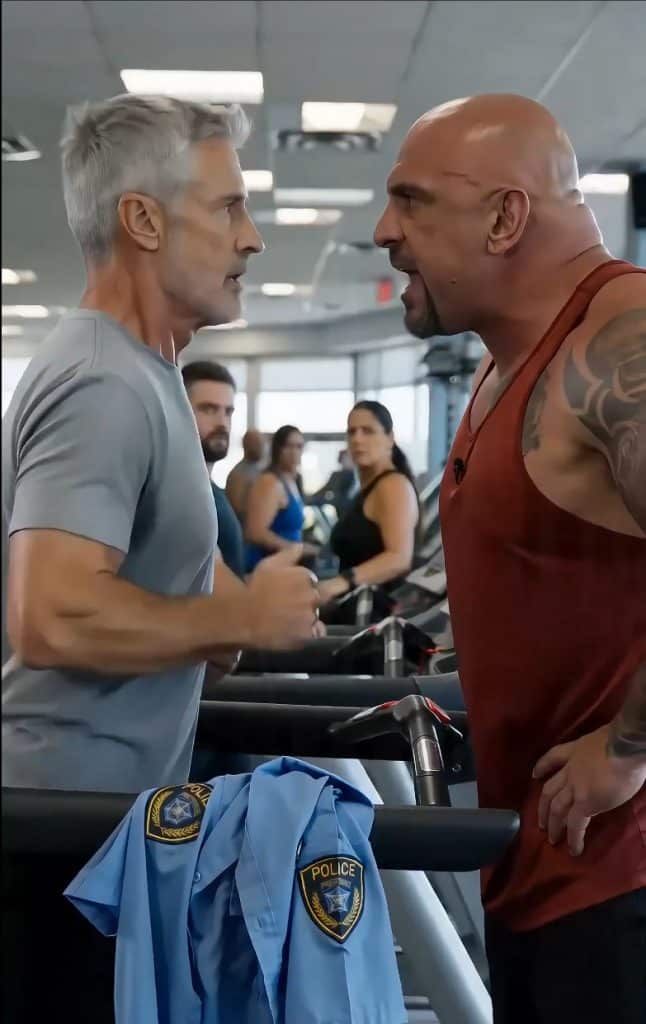
Act I
The treadmill belt kept moving after the old man hit the floor.
That was the part everyone remembered.
Not the insult. Not the red tank top. Not the way the bald, tattooed bodybuilder leaned over the machine like he owned the whole gym.
It was the sound of the belt still running.
A flat, cruel hum beneath the shocked silence.
Lieutenant Robert Hayes lay on his side on the black rubber floor, one arm braced under him, his gray T-shirt twisted at the shoulder. His short steel-gray hair was damp with sweat. His breathing came sharp through his teeth, but he did not cry out.
Above him, the blue police uniform shirt hanging from the treadmill handle swayed gently from the vibration.
The man who had tripped him stood beside the machine, chest heaving.
His name was Mason Keller, though everyone at Iron House Gym knew him as the man who never waited, never wiped down equipment, and never apologized.
Five minutes earlier, Robert had been running at a steady pace.
Not fast.
Steady.
That was all he wanted from his body now. Steady breath. Steady knees. Steady heartbeat. He had come straight from duty, changed into a gray T-shirt and black joggers, and draped his uniform shirt over the handle while he ran.
Then Mason walked up.
“Move, old man,” he said loudly. “Finish your workout. This is my spot.”
Robert did not look at him at first.
The treadmill thudded beneath his shoes. Weights clanked somewhere near the benches. A young woman on the next treadmill slowed just enough to glance over.
Mason stepped closer.
“This is my spot,” he repeated.
Robert turned his head slightly.
“No.”
One word.
Calm.
Firm.
It was not loud enough to challenge anyone, but it was strong enough to deny him.
Mason’s face changed.
He looked around as if expecting the room to laugh with him, but the gym had begun to notice. A man sitting at a cable machine lowered the handle in his grip. Two college students near the dumbbells stopped mid-conversation.
Robert kept running.
His stride was controlled. His hands were loose. His eyes returned to the front wall as if Mason had become nothing more than bad weather.
That made Mason angrier.
He moved toward the side of the treadmill, pretending at first to pace, then watching Robert’s legs. His shoes squeaked once on the rubber floor.
Robert’s right foot landed.
Then his left.
Then Mason struck.
His foot shot into Robert’s lower leg at the exact moment the treadmill belt carried his stride forward.
Robert’s rhythm broke instantly.
His hand slapped against the rail. His knee buckled. The belt pulled him sideways before he could recover, and his body rolled off the machine onto the floor with a heavy thud.
Gasps burst from every corner of the gym.
Mason stood over him, breathing hard, eyes cold.
For one long second, he looked satisfied.
Then someone whispered, “That’s a police shirt.”
Mason’s gaze lifted to the blue uniform hanging from the treadmill handle.
The badge patch caught the overhead lights.
And for the first time, his confidence cracked.
But the shirt was only the smallest thing Robert Hayes had brought into that gym.
Act II
Robert Hayes had spent thirty-four years teaching angry men that size was not the same as power.
He had learned it in alleys, kitchens, parking lots, school hallways, and quiet living rooms where people spoke in trembling voices after the danger had already left. He was not the kind of officer who chased glory. He was the kind who remembered names.
Victims. Witnesses. Kids sitting on curbs after bad nights.
People who needed someone steady.
That was why the fall hurt more than his ribs.
Not because Mason had knocked him down.
Robert had been knocked down before.
It hurt because the whole room saw an older man attacked for refusing to be bullied, and for a few seconds, nobody knew what to do.
That was how bullies survived.
They counted on the pause.
Robert had seen Mason Keller’s type a hundred times. A man built like a wall, walking through public places as if patience was weakness and kindness was permission. He did not need to win every fight. He only needed everyone to believe he might start one.
Iron House Gym had been living under that belief for months.
Mason dropped weights beside people’s feet. He shoved younger members away from benches. He mocked older men who moved slowly and women who lifted seriously. When staff asked him to follow rules, he laughed.
The manager kept giving him warnings.
Then private warnings.
Then no warnings at all.
Because Mason was not just a member.
His uncle, Victor Keller, owned the building. His father sat on the city council. His family name was printed on donation plaques around town, always polished, always respectable.
Robert knew that too.
He had not come to Iron House by accident.
Three weeks earlier, a nineteen-year-old trainer named Jamie Lin had walked into the precinct with a shaking voice and a phone full of recordings. She said Mason had cornered her in the storage hallway after she refused to clear equipment for him.
He had not hurt her badly enough for people to take pictures and gasp.
That was part of the cruelty.
He shoved. He threatened. He grabbed wrists. He leaned close and told people who they should know better than to upset.
Jamie filed a complaint with the gym.
The next day, her shifts were cut.
When she pushed harder, the manager told her Mason was “a difficult personality” but also “important to the business.”
Robert had listened without interrupting.
Then Jamie said something that stayed with him.
“He only does it when he thinks the person can’t fight back.”
Robert had looked at the bruised place on her wrist and felt an old anger settle behind his ribs.
Not hot.
Not reckless.
Useful.
So he asked questions.
Quietly.
He learned Mason had been involved in three “accidents” at the gym. One older man slipped near the squat racks after Mason bumped him. A college student dropped a bar after Mason slapped the rack beside him. A woman canceled her membership after Mason followed her to her car, laughing when she told him to back off.
Nothing had stuck.
No witnesses wanted the trouble. The cameras had “malfunctioned.” The manager claimed reports were incomplete.
Robert had been close to retirement once.
Then his wife died, and the job became the only routine that did not feel empty. Later, when his own knee gave out during a foot chase, doctors told him to slow down. He hated that phrase.
Slow down.
Everyone said it like the world was done needing him.
But Robert still had one habit age had not stolen.
He knew how to wait.
He joined Iron House Gym under his own name. No disguise. No drama. Just an older police officer rehabbing a knee on a treadmill, watching how people behaved when they believed he was harmless.
Mason noticed him on the third day.
By the fifth, the insults began.
By the seventh, Robert understood the pattern.
Mason did not simply want the treadmill.
He wanted the surrender.
And Robert had spent his whole life refusing to hand that over.
So when Mason leaned in and said, “Move, old man,” Robert answered with the same word he had used in courtrooms, crime scenes, and homes where fear had taken up too much space.
“No.”
He knew Mason might escalate.
He did not know the man would be foolish enough to do it in front of the entire gym.
And he did not know Jamie Lin was watching from the front desk with the security camera system already recording.
Act III
Robert pushed himself onto one elbow.
His leg burned where Mason’s shoe had struck it. His shoulder ached from the fall. Somewhere behind him, the treadmill still ran until a gym member finally hit the emergency stop.
The sudden silence made everything feel worse.
Mason looked around.
“What?” he snapped. “He tripped.”
Nobody answered.
Robert lifted his eyes.
He did not look afraid. That unsettled Mason more than shouting would have.
“You okay?” a young man asked, stepping forward.
Robert nodded once. “Stay back.”
Mason smirked. “Listen to him. Still giving orders from the floor.”
A few people shifted uncomfortably, but nobody laughed.
Jamie appeared near the end of the treadmill row, pale but steady, her phone in one hand and the desk radio in the other. She looked from Robert to Mason, then to the blue uniform shirt swaying on the handle.
“You kicked him,” she said.
Mason turned toward her. “You saw nothing.”
“I saw enough.”
His face darkened.
Robert noticed the change immediately.
There it was.
The real man beneath the gym swagger. Not just rude. Not just arrogant. Dangerous when contradicted by someone he considered beneath him.
Robert forced himself to sit up.
“Mason,” he said.
The room went still at the sound of his voice.
Not loud.
Commanding.
Mason looked down at him. “What?”
Robert’s breathing was controlled now. His eyes were sharp.
“You should stop talking.”
Mason’s jaw tightened. “Or what?”
Robert reached slowly toward the pocket of his joggers and pulled out his phone. The screen was cracked from the fall, but still lit.
On it was an active call.
Precinct Dispatch.
Mason stared at it.
Robert had placed the call before the fall, the moment Mason stepped too close to the moving treadmill.
The entire exchange had been recorded.
“Unit already en route,” Robert said.
Mason’s mouth opened, but no sound came out.
Then the gym’s glass doors opened.
Two uniformed officers entered first. Behind them came Sergeant Alana Price, a woman with a calm face and the kind of eyes that missed very little. She scanned the room once, saw Robert on the floor, saw Mason standing over him, and saw Jamie holding the desk radio.
Her expression hardened.
“Mason Keller?” she asked.
Mason recovered just enough to laugh. “You people can’t be serious.”
Sergeant Price stepped closer. “Did you strike Lieutenant Hayes’s leg while he was running?”
“No. He lost balance.”
Jamie moved to the front desk computer and turned the monitor toward the officers.
Security footage filled the screen.
There was Robert running. Mason beside him. Mason watching his legs. Mason’s foot cutting into the moving path at exactly the wrong moment.
The video left no room for imagination.
A murmur moved through the gym.
Mason pointed at Jamie. “That footage is private property.”
“No,” said a voice from behind the officers. “It belongs to the gym.”
The manager, Phil Arden, had emerged from the office, sweating through his polo shirt. He looked as if he wanted to vanish into the rubber floor.
Sergeant Price turned to him. “Then preserve it.”
Phil swallowed. “Of course.”
Jamie’s laugh was short and bitter. “Now you care about preserving footage?”
The room shifted again.
Robert saw it happen.
One truth had opened the door.
Others were waiting behind it.
A woman near the weight racks stepped forward. “He shoved me last month.”
The college student beside the dumbbells said, “He made my friend leave after threatening him.”
Another voice: “The camera by the squat racks didn’t break. Phil turned it off.”
Phil went white.
Mason looked at the crowd as if they had betrayed him.
But they had not betrayed him.
They had simply stopped obeying the fear that protected him.
Robert slowly rose to one knee. Pain flashed across his face, but he steadied himself.
Mason saw him getting up and sneered.
“Look at that,” he said. “The old man can stand.”
Robert looked at him for a long moment.
Then he reached for the blue police shirt hanging from the treadmill handle and pulled it into his hands.
When he turned it around, everyone saw the stitched name above the pocket.
HAYES.
But beneath it was not only a patrol patch.
There was a second badge clipped to the inside seam.
Internal Affairs.
Mason stopped smiling.
And Phil Arden stepped backward like the floor had disappeared beneath him.
Act IV
The gym had gone from a workout floor to a witness room.
Nobody touched the machines now. Nobody lifted weights. Nobody pretended not to listen.
Robert put on the blue shirt slowly, though every movement cost him. He buttoned only the middle two buttons, enough for the uniform to settle over his gray T-shirt and make the meaning plain.
Mason’s attack had not knocked down an old man who wandered into the wrong gym.
It had assaulted an officer during an active investigation.
But Robert did not need to say that yet.
Sergeant Price did it for him.
“Mason Keller, turn around.”
Mason raised both hands, not surrendering, only performing outrage. “You don’t know who my family is.”
“I do,” Price said. “That’s one of the reasons we’re here.”
The line landed hard.
Phil lowered his head.
Robert’s gaze moved to the manager. “You were warned.”
Phil’s mouth trembled. “I tried to handle it internally.”
Jamie’s eyes filled with tears. “You cut my hours.”
“I was under pressure.”
“From who?” Sergeant Price asked.
Phil looked at Mason.
Mason looked murderous.
Robert stepped forward slightly. “Careful, Mason. The cameras are working today.”
That was when everyone understood.
This had never been only about one bully wanting one treadmill.
For months, complaints had been erased because Mason Keller was connected to people who preferred problems to disappear quietly. Phil had not protected members. He had protected access, rent, favors, and his own job.
Jamie had refused to disappear.
Robert had believed her.
And Mason, arrogant enough to think fear was permanent, had walked straight into the open.
The officers moved in.
Mason jerked his arm back when one of them reached for him.
“Don’t touch me.”
Sergeant Price’s voice dropped. “Do not make this worse.”
For one second, the old version of the room tried to return.
The pause.
The fear.
The question of whether a powerful man would become more dangerous if challenged.
Then Robert took one step.
Not fast. Not dramatic. Just enough to stand beside Jamie.
Mason looked from the older officer to the young trainer and saw something he did not know how to fight.
People standing together.
“Fine,” Mason spat, turning around.
The cuffs clicked.
The sound was small, but the gym heard it like thunder.
As officers led him toward the door, Mason twisted his head toward Robert.
“You set me up.”
Robert’s expression did not change.
“No,” he said. “I gave you a choice. You chose.”
Mason looked away first.
But the real collapse came after he was gone.
Sergeant Price began taking statements. One by one, people spoke. Some hesitated at first, then steadied when they saw others doing the same. Jamie stood near the desk with her arms folded, listening as the room that had ignored her finally admitted what it had seen.
Phil sat on a bench with his hands clasped, answering questions quietly.
He admitted the complaints had been softened.
He admitted camera footage had been “lost.”
He admitted Victor Keller, Mason’s uncle and the building owner, had threatened to raise the gym’s rent if Mason was banned.
Robert listened without satisfaction.
Justice, when it finally arrived late, did not feel clean. It felt like seeing the size of the wound.
A paramedic checked his leg and shoulder near the treadmills. He waved off the stretcher, but not the ice pack.
Jamie approached him carefully.
“You knew he would do something,” she said.
“I knew he might.”
“You let him hurt you.”
Robert looked at the treadmill, then at the people giving statements across the gym.
“I let him reveal himself.”
Jamie shook her head. “That’s a dangerous way to make a point.”
Robert smiled faintly. “You sound like my doctor.”
For the first time that day, Jamie laughed.
But her face grew serious again.
“Thank you for believing me.”
Robert’s smile faded.
“That was the easy part,” he said. “The hard part was you coming in anyway.”
Jamie looked down, blinking quickly.
Outside, through the gym’s glass windows, Mason was placed into the back of a patrol car in full view of everyone inside.
For months, people had watched him walk in like he owned the room.
Now they watched him leave without power.
But Robert knew arrests were only beginnings.
The deeper question was who had taught Mason that consequences were for other people.
And that answer was waiting inside a locked office upstairs.
Act V
By the next morning, Iron House Gym had become the most talked-about place in the city.
The video spread fast.
Not just the fall. Not just Mason’s dirty kick. What caught people’s attention was the blue police shirt swinging above the treadmill while the older officer lay on the floor, and the stunned look on Mason’s face when Robert stood back up.
Some people called Robert a hero.
He hated that.
Heroes, in his experience, were usually ordinary people caught on the worst day of their lives. Jamie was closer to a hero than he was. So were the gym members who finally stepped forward, even if they had been late.
Late truth was still truth.
The investigation moved quickly after that.
Victor Keller’s name appeared in emails between Phil and the building office. Rent threats. Pressure to ignore complaints. A message referring to Mason as “family” and troublesome members as “replaceable.”
That word did more damage than Victor expected.
Replaceable.
Members canceled. Then came back only after the city took temporary control of the facility’s safety certification. Phil resigned. The gym ownership group suspended Victor’s lease negotiations after the emails became part of the public record.
Mason’s family tried to soften the story.
They said it was a misunderstanding.
Then a heated moment.
Then a private matter.
But there is nothing private about knocking a man off a moving treadmill in front of witnesses.
And there is nothing misunderstood about a foot aimed at someone’s leg.
Robert testified at the hearing two weeks later with a brace beneath his black slacks and no drama in his voice. He described the treadmill speed, Mason’s position, the impact, and the fall. He did not exaggerate the pain. He did not insult Mason.
That made his words harder to dismiss.
Jamie testified after him.
Her voice shook at first, but then strengthened. She spoke about the storage hallway. The cut shifts. The warnings that became jokes, and the jokes that became threats. When Mason’s attorney asked why she had not quit if the gym was so unsafe, Jamie looked directly at him.
“Because I needed the job,” she said. “And because he was the one who should have had to leave.”
The room went silent.
Robert sat behind her, hands folded, eyes lowered.
He had heard thousands of statements in his career, but that sentence stayed with him.
Because it was the truth so many people were forced to carry.
Why didn’t you leave?
Why didn’t you speak sooner?
Why didn’t you fight back?
As if the burden belonged to the person cornered, not the person doing the cornering.
Mason pleaded guilty before trial.
Not out of remorse. Out of math.
Too many witnesses. Too much footage. Too many buried complaints pulled into the light.
Phil cooperated with investigators. Victor Keller lost his contract with the city after a review uncovered pressure tactics tied to several properties. Iron House Gym closed for three weeks and reopened under new management with a wall of posted rules near the entrance.
No intimidation.
No harassment.
No retaliation.
Report unsafe behavior immediately.
Robert visited once after it reopened.
Not in uniform.
Gray T-shirt. Black joggers. Knee brace under one pant leg. Same calm eyes. Same steady step.
The treadmill row had been rearranged. Mirrors were replaced. Cameras were visible but not intrusive. Jamie now worked as assistant manager.
When she saw Robert walk in, she smiled.
“You sure about this?” she asked, nodding toward the treadmills.
Robert looked at the machine where he had fallen.
For a moment, the gym sounds faded.
He heard the belt hum again. Mason’s voice. The slap of his hand against the rail. The shocked gasp of strangers who did not yet know whether they would stay silent.
Then he heard something else.
Jamie’s voice.
I saw enough.
Robert stepped onto the treadmill.
“Start slow,” he said.
Jamie pressed the button.
The belt began to move beneath his feet.
At first, he walked.
The motion felt strange. His leg remembered the fall before his mind told it not to. His hand hovered near the rail, and he hated that Mason had left even that small ghost behind.
But then he breathed.
One step.
Then another.
Then another.
Across the gym, people worked out. A young man wiped down a bench without being asked. A woman corrected her lifting form in the mirror. Two older men laughed softly near the bikes.
Ordinary sounds returned.
Healthy ones.
Robert increased the speed.
Not much.
Enough.
Jamie watched from the desk, pretending not to.
Robert ran for eight minutes.
Then ten.
Then twelve.
When he finally stopped, his shirt was damp and his knee ached, but he was standing. That mattered more than anyone else could understand.
He stepped off the treadmill and reached for the blue police shirt folded over his gym bag.
For years, that shirt had meant duty. Authority. The weight of other people’s worst moments.
Now, for a moment, it meant something simpler.
A reminder that age did not erase courage.
Pain did not cancel dignity.
And one bully’s foot could knock a man down, but it could not decide whether he stayed there.
Before leaving, Robert looked at the posted rules by the door.
Below them, someone had taped a handwritten note.
The gym is for everyone.
No one had signed it.
No one needed to.
Robert walked outside into the clean afternoon air. His leg hurt. His shoulder hurt. Retirement was still waiting somewhere down the road, patient and unavoidable.
But not today.
Behind him, inside Iron House Gym, the treadmills kept moving.
This time, nobody owned them through fear.