Act I
The black SUV waited at the curb like a mouth.
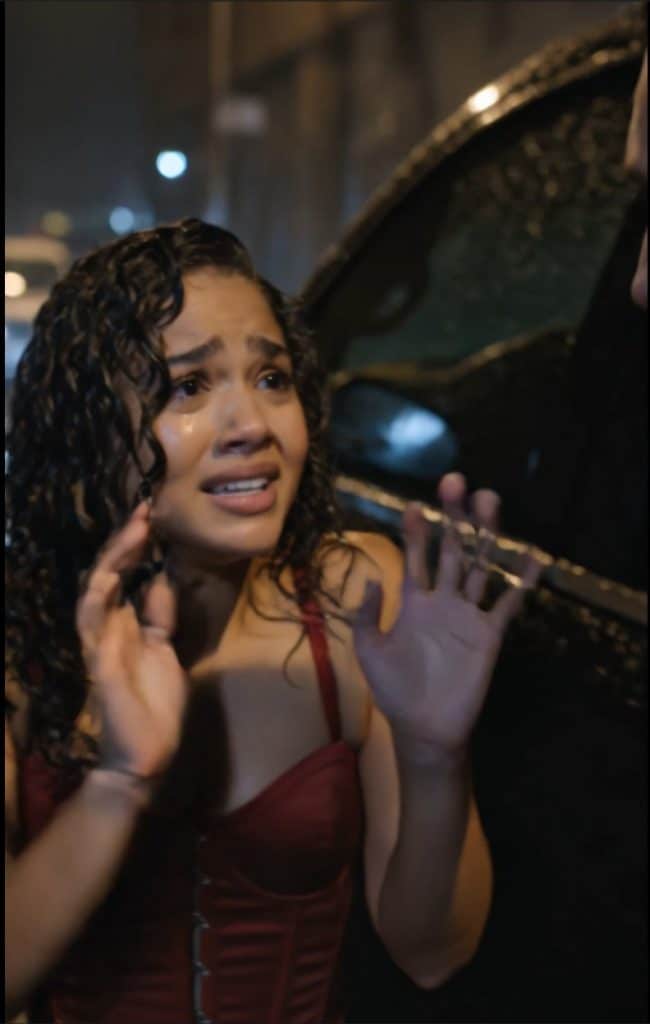
Rain slid down its dark windows. Yellow streetlights broke across its wet panels in long, distorted lines. The city hummed somewhere far away, but this street felt cut off from it, trapped between old brick warehouses and shuttered loading bays.
“Get in the car,” the man in the blue tank top said. “Let’s take a ride.”
He pointed toward the SUV as if the decision had already been made.
The young woman stood between him and another man in a gray hoodie, her curly brown hair damp from the rain, her red satin top darkened at the edges where water had soaked through. Her hands hovered near her chest, trembling but not reaching for either of them.
“No,” she said.
It was barely louder than a breath.
But it was still a refusal.
The man in the tank top smiled like she had told a joke. Tattoos flexed across his arms as he shifted closer, using his body to block the street behind him.
His name was Travis Cole.
The man in the gray hoodie laughed beside him. Rough stubble. Cold eyes. Tattoos crawling along his neck and hands. He watched her the way men watch locked doors they already believe they can open.
“Get in,” Travis snapped. “Right now.”
The woman took half a step back.
Her heel scraped against wet pavement.
Behind her, the SUV reflected her frightened face in its black side panel, making it look as if another version of her was already trapped inside.
The man in the hoodie moved.
Slowly at first.
Then with purpose.
One hand lowered as if he meant to grab her arm.
“No, please,” she sobbed, looking past him toward the empty street. “Somebody help me.”
The plea vanished into rain.
For one terrible second, nothing answered.
Then the streetlight above the SUV flickered.
Once.
Twice.
Every camera mounted along the warehouse wall turned toward them at the same time.
A red recording light blinked alive above the loading dock.
Travis froze.
The woman saw it.
So did the man in the hoodie.
Then a voice came from a speaker hidden somewhere in the shadows.
“Step away from her.”
Travis looked up, his face draining of color.
Because the voice was not a stranger’s.
It belonged to the woman he thought he had already silenced.
Act II
Her name was Mara Lane, and for six months she had been dead on paper.
That was the first thing people got wrong about her.
They thought she disappeared because she was careless. Because she trusted the wrong man. Because she walked alone at night. Because every ugly story about women becomes easier for the world when it can attach blame to the victim before learning her name.
But Mara had not disappeared.
She had escaped.
Travis Cole had once run security for a private nightclub district near the river. At least, that was the clean version. The real work happened after closing, when people stumbled out disoriented, when phones went missing, when black SUVs pulled up with tinted windows and no license plates visible to the nearest cameras.
Women reported being followed.
Men who tried to intervene were beaten or threatened.
Complaints vanished.
Footage glitched.
Witnesses changed their statements.
Travis had a talent for making fear look like confusion.
Mara was a singer at one of the clubs. Not famous. Not rich. Just good enough that people stopped talking when she stepped up to the microphone. She had a voice that could make a bad room feel honest for three minutes.
That made her useful.
It also made her visible.
One night, Mara saw a girl crying in the back hallway while Travis blocked the exit. Mara pulled the fire alarm, dragged the girl outside, and called the police from a stranger’s phone.
The girl survived.
The report did not.
Two days later, Mara was warned to stop asking questions.
A week later, her apartment was broken into.
Then her younger brother, Noah, was attacked outside his trade school by men who told him his sister needed to learn what silence cost.
That was when Mara stopped being only afraid.
She became careful.
She began recording everything. Names. Cars. Times. Faces. She copied files from the club office when the manager left her alone near the computer. She photographed payment ledgers and sent them to a detective named Elise Ward, the only officer who had ever called her back twice.
Then Travis found out.
Mara ran before he reached her.
For six months, she lived under protection while detectives built a case big enough to survive the people who kept burying the smaller ones. She cut her hair, changed apartments, stopped singing, stopped calling friends, stopped walking anywhere without checking reflections in windows.
But the case needed one final thing.
Travis had never been caught giving a direct order.
He always stood near the danger, not inside it. Always used men like the one in the gray hoodie. Always smiled after the worst part was already done.
So Mara made a choice.
She agreed to come back.
Not alone.
Never alone.
The red top, the heels, the dark street, the black SUV at the curb—Travis thought he had chosen the scene.
He had not.
Mara had walked into his trap carrying one of her own.
And now the cameras were awake.
Act III
The man in the gray hoodie stopped three feet from Mara.
His hand hung in the air, not touching her yet, but close enough for the camera to understand intention.
The speaker crackled again.
“Hands visible. Both of you.”
Travis turned toward the warehouse windows, eyes scanning the dark glass.
“Who’s there?”
Mara wiped rain from her cheek with the back of her hand.
“You know who.”
His head snapped toward her.
For the first time, he really looked.
Not at the red top.
Not at the fear.
At her face.
Recognition came slowly, then all at once.
“Mara?”
The man in the hoodie glanced at him.
“What?”
Travis’s jaw tightened.
“She’s supposed to be gone.”
Mara’s voice shook, but it held.
“You tried.”
The street changed around them.
A warehouse door rolled upward halfway behind the SUV. White light spilled across the wet pavement. Two unmarked cars turned in from the far end of the block without sirens, blocking the street silently. Then another vehicle appeared behind Travis.
Not dramatic.
Not loud.
Final.
Detective Elise Ward stepped into the rain wearing a black coat, badge visible at her belt, one hand near her radio.
“Travis Cole,” she called. “Move away from Mara Lane.”
The man in the hoodie swore.
Travis lifted his hands slowly, but his smile came back in pieces.
“You’re kidding. This is entrapment.”
Elise kept walking.
“No. This is a public street, a recorded threat, an attempted forced transport, and six months of warrants catching up.”
Mara’s knees trembled.
She hated that they did.
She wanted to look fearless. She wanted to stand like the women in movies who turn terror into a perfect sentence. But her body remembered too much. The hallway. The broken lock. Her brother’s bruised face. The nights she slept with a chair under the doorknob.
Fear did not mean she was weak.
It meant she had come anyway.
The man in the gray hoodie stepped back toward the SUV.
The passenger door opened from inside.
A third man, unseen until then, tried to climb out.
Detective Ward raised her voice.
“Police! Don’t move!”
The third man froze.
From the warehouse roof, floodlights snapped on.
The SUV’s black windows turned silver under the glare.
The hidden became visible.
Mara saw two cameras mounted inside the SUV. One fake plate cover. Zip ties on the floor mat. A second phone taped beneath the console.
Evidence.
So much evidence that Travis stopped smiling again.
He turned toward Mara, and hatred flashed across his face.
“You think this ends well for you?”
Mara flinched.
Then a new voice came from behind Detective Ward.
“Don’t talk to my sister.”
Noah stepped out of the warehouse doorway.
He was thinner than Mara remembered from before the attack, but he was standing. One arm still carried a faint stiffness when he moved, yet his eyes were clear and furious.
Mara broke at the sight of him.
“Noah,” she whispered.
Travis looked between them.
And for the first time that night, he understood the woman pleading for help had not been abandoned on the street.
She had brought witnesses.
Act IV
Everything happened quickly after that.
The man in the gray hoodie bolted.
He slipped on the wet pavement before reaching the alley, giving the nearest officer enough time to tackle him against the side of the SUV. The third man inside the vehicle was pulled out with his hands raised. Travis stayed still, but only because three officers had their weapons trained low and steady, and he was smart enough to understand when performance ended.
Mara stood near the curb, shaking so hard her teeth almost clicked.
Noah reached her first.
He did not grab her. He remembered what she hated now. Sudden hands. Corners. Men moving too fast.
He stopped in front of her and lifted both palms.
“Can I?”
She nodded.
Then he hugged her, and all the strength she had borrowed from anger collapsed into him.
“I’m sorry,” he whispered.
Mara pressed her face against his shoulder.
“For what?”
“For not being able to stop them.”
She pulled back and looked at him through tears.
“You were never supposed to.”
Detective Ward approached gently.
“Mara, we need to get you inside.”
Mara looked toward Travis.
He was being cuffed beside the SUV. Rain ran down his face. Without his laughter, without the men around him moving on command, he looked smaller. Still dangerous. Still cruel. But no longer untouchable.
He met her eyes.
“You’ll disappear again,” he said.
Detective Ward stepped between them.
“No,” Mara said.
Elise turned slightly, surprised.
Mara took one step forward, enough for Travis to hear her clearly.
“I disappeared because I had to survive. Not because you won.”
Travis’s mouth tightened.
The cameras caught every word.
The case unfolded from the SUV outward.
The hidden phone contained messages linking Travis to club managers, private drivers, and paid informants who warned him when complaints were filed. The fake plate cover matched traffic camera gaps from five previous incidents. The men in custody began turning on each other before sunrise.
Fear makes loyalty expensive.
By morning, three more arrests followed.
By the end of the week, the nightclub district that had once protected Travis with noise and money was full of inspectors, subpoenas, and locked doors. Owners who claimed ignorance suddenly remembered names. Bartenders who had been too scared to speak began giving statements. Women who had been dismissed as confused were called back, this time by detectives who listened.
Mara gave her formal statement in a room with no windows and a blanket over her shoulders.
She spoke for two hours.
She did not describe everything. She did not owe anyone every detail of her fear.
She gave them what was needed.
Names.
Dates.
Patterns.
The sound of Travis’s voice saying get in the car.
The way the street felt when the second man moved toward her.
The moment she said no and thought the word might be the last thing she ever owned.
At the end, Detective Ward turned off the recorder.
“You did enough,” she said.
Mara looked at the black screen of the device.
“No,” she said quietly. “I did what they forced us to become brave enough to do.”
Act V
The city tried to turn Mara into a headline.
She refused.
Reporters wanted the red top, the black SUV, the rain, the trap. They wanted the terrified woman on the street who became bait and survived. They wanted a clean story with a clean ending and a villain led away under streetlights.
Mara knew better.
There was no clean version of having to prove danger by standing near it again.
So she did not give them spectacle.
She gave testimony.
In court, Travis looked different in a suit. Men like him often do. The tattoos were covered. The jaw was shaved clean. The voice was lower. His lawyer used words like misunderstanding, exaggerated, consensual, reputation, context.
Mara sat behind the prosecutor and listened without looking away.
Then the videos played.
The black SUV under rain.
The command.
Get in.
Mara’s refusal.
No.
The second man closing in.
Somebody help me.
Then the streetlights.
The cameras.
The warehouse door.
Travis’s face when he recognized her.
She’s supposed to be gone.
No lawyer could soften that sentence.
Other women testified. Some behind screens. Some in open court. Some crying. Some furious. Some barely audible. Every voice added weight to the one before it until the room could no longer pretend any of them had been alone.
Noah testified too.
He described the attack outside his school, not with drama, but with a steadiness that made Mara cry harder than if he had broken down.
“My sister tried to protect someone,” he said. “They hurt me to control her. It didn’t work.”
Travis was convicted on multiple charges tied to coercion, assault, unlawful restraint, obstruction, and conspiracy. Others followed. The club managers lost licenses. The private security firm dissolved under investigation. The city installed new reporting requirements for nightlife venues, including independent camera storage and emergency staff training that bypassed owners.
Policies did not heal anyone.
But they closed doors predators had used for years.
Mara returned to singing six months later.
Not at the old district.
Never there.
She sang at a small benefit held in a community theater with bad acoustics and good people. The first row was full of women who understood why her hands shook before the music began. Noah sat near the aisle. Detective Ward stood at the back, off duty, arms folded, pretending she was not emotional.
Mara stepped to the microphone.
For a moment, the stage lights felt like streetlights.
Her breath caught.
Then someone in the front row whispered, “Take your time.”
So she did.
When she finally sang, her voice was not the same as before.
It had rough edges now.
Places where fear had left marks.
But it was hers.
That was enough.
Afterward, Noah found her outside behind the theater, where rain had begun to fall lightly on the pavement. Not heavy like that night. Just enough to make the city shine.
“You okay?” he asked.
Mara looked at the reflections in the street.
A black car passed, and her body stiffened before her mind could stop it.
Noah saw.
He did not pretend not to.
“Still?” he asked.
“Sometimes,” she said.
He nodded.
They stood together in the rain.
“I hate that you had to go back,” he said.
“So do I.”
“But you came back from going back.”
Mara looked at him.
That was the first time anyone had said it that way.
She smiled, small and tired.
“I did.”
The street where it happened was changed a year later.
The warehouses were converted into legal studios and storage spaces. More lights went up. Emergency call boxes were installed. The city painted a crosswalk at the corner and added a camera with a visible red recording light above the loading dock.
Mara visited once with Detective Ward.
She stood at the curb where the SUV had waited and listened to distant traffic.
No dramatic music.
No men laughing.
No command.
Just the city, imperfect and alive.
Elise stood beside her.
“Do you regret it?”
Mara watched rain gather in a crack in the pavement.
“I regret that it was necessary.”
“That’s fair.”
Mara looked up at the streetlight.
It flickered once in the damp air.
This time, she did not flinch.
She thought about the woman she had been that night, trembling between two men and a black SUV, saying no with a voice barely strong enough to leave her mouth.
That woman had not been weak.
She had been surrounded.
There was a difference.
Mara touched the small recording pendant now hanging beneath her jacket, a gift from Noah with a note that said, Not because you have to prove anything. Because you deserve backup.
Then she walked away from the curb.
Not fast.
Not running.
Just walking.
The rain followed softly behind her, washing the street clean enough for the lights to reflect in it.
And somewhere in the city, a woman said no and knew the word could be heard.