Act I
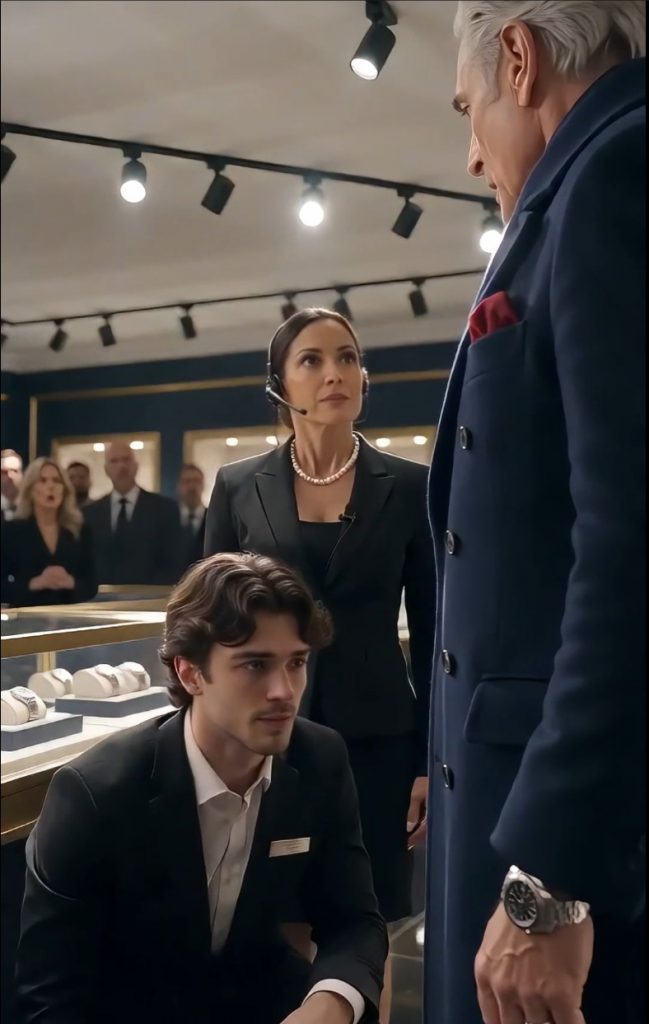
The name badge hit the black floor before anyone said a word.
It slipped from the young cashier’s jacket, clattered once beneath the glass counter, and spun under the spotlights until the engraved letters faced upward.
Laurent.
Then the young man stumbled into the display case.
A rare watch trembled beneath the glass. The security guard by the brass-trimmed door took one step forward, then stopped. Wealthy shoppers froze between cases of polished steel, gold, and sapphire crystal, their reflections stretched across the boutique’s black floor like shadows too ashamed to move.
Mr. Laurent steadied himself with one hand on the edge of the counter.
A faint red mark showed near his lip. His dark wavy hair had fallen across his forehead. His simple black cashier suit looked suddenly smaller under all that luxury light.
The man who had slapped him stood tall in a navy cashmere coat.
Silver hair. Red pocket square. Oversized luxury watch flashing on his wrist like a warning.
“You polish watches,” he said, voice sharp with contempt. “You don’t question men who buy them.”
The insult landed in the boutique like a second strike.
Mr. Laurent did not answer.
That restraint seemed to offend the customer more than defiance would have.
His name was Charles Whitaker, and he had spent forty years teaching rooms to open around his money. Hotels knew him. Private clubs knew him. Jewelers poured champagne before asking which piece he wanted to see.
He had entered Maison Laurent that afternoon expecting the same obedience.
Instead, a cashier had told him no.
Not loudly.
Not rudely.
Simply no.
He could not handle it.
“I asked to hold the Heritage Moonphase,” Whitaker snapped. “Do you understand who I am?”
Mr. Laurent looked at the fallen badge.
“Yes,” he said quietly. “A client who was told the watch requires authorized handling.”
A few people inhaled.
Whitaker’s face hardened.
Then the private office door opened.
A woman in a tailored black suit rushed into the showroom, pearl necklace shining at her throat, headset still on. The Boutique Director stopped when she saw the young cashier by the counter, the fallen badge on the floor, and Whitaker standing above him.
Her horror was immediate.
She moved straight past the customer.
“Mr. Laurent,” she said, voice formal and shaken, “your family’s new flagship store is ready for inspection.”
The room went silent.
The camera of every eye seemed to drop to the badge.
Laurent.
Then rise to the glowing logo on the wall.
MAISON LAURENT.
Whitaker’s mouth opened.
“Laurent?” he whispered.
Act II
Julian Laurent had spent most of his life avoiding the family name.
Not because he was ashamed of it.
Because everyone else worshiped it too quickly.
The Laurent watch house began in Geneva with his great-grandfather, Étienne Laurent, a watchmaker who believed timepieces should be touched only by hands that respected the hours inside them. He was not the richest craftsman in Switzerland. Not the loudest. But he made movements so precise that collectors began speaking his name with the careful reverence usually reserved for old paintings and rare wine.
By the third generation, Maison Laurent had boutiques in Paris, London, New York, Tokyo, and Los Angeles.
By Julian’s generation, the family name had become both inheritance and cage.
People bowed before learning him.
They laughed at jokes he had not made funny. They called his opinions brilliant before he finished them. They treated him as if being born near excellence meant he had earned it.
Julian hated that.
His father, Matthias Laurent, did not.
Matthias believed legacy was protected by distance. Family entered through private doors. Family did not stand behind counters. Family did not handle impatient clients, inventory errors, cracked display glass, or the daily humiliations service workers learned to swallow with a smile.
Julian disagreed.
He had grown up watching the quiet people who made the brand survive.
The polishers with aching hands.
The technicians who could hear a faulty movement before a machine caught it.
The sales associates who remembered anniversaries, widowhoods, divorces, and fathers buying watches for sons they did not know how to speak to.
The security guards who stood for ten-hour shifts while clients treated them as furniture.
At twenty-eight, Julian had been named heir to the American expansion.
The board wanted him introduced at a grand opening in a black tuxedo, surrounded by champagne and reporters.
Julian made another choice.
For six weeks, he worked inside the new American flagship boutique as a cashier named Laurent. No announcement. No family escort. No executive badge. Just a small metal name tag, a simple suit, and instructions from the Boutique Director, Evelyn Hart, to treat him like staff unless safety required otherwise.
Evelyn disliked the arrangement.
“Your father will blame me if this goes badly,” she had warned.
Julian smiled.
“Then make sure it goes honestly.”
He wanted to know how the store behaved when power looked ordinary.
At first, he saw beauty.
A young associate staying late to repair a client’s damaged bracelet free of charge because it had belonged to the client’s father. A security guard quietly walking an elderly shopper to her car. A technician refusing to rush a cleaning because “the watch waited fifty years to get here; it can wait one more hour.”
Then he saw the other side.
Clients snapping fingers.
Managers softening rules for wealth.
Security instructed to watch plainly dressed visitors more closely.
Sales staff whispering that certain VIPs were “impossible but profitable.”
Charles Whitaker was the worst of them.
And Julian had been waiting for him.
Act III
The Heritage Moonphase was not the most expensive watch in the boutique.
It was rarer than that.
Only twelve existed. Each movement had been assembled by hand using a restored design from Étienne Laurent’s private notebooks. The dial carried a deep blue moonphase enamel that changed slightly under different light, like night sky seen through old glass.
The piece in the boutique was not for sale that day.
It was being inspected before transfer to the new flagship vault.
Charles Whitaker did not care.
He saw it beneath the spotlight and tapped the glass.
“I’ll try that one.”
Julian looked up from the counter.
“That piece requires a private viewing appointment.”
Whitaker smiled without warmth.
“I don’t make appointments for clerks.”
“The protocol protects the watch.”
“I own seven Laurent pieces.”
“Then you understand why this one must be handled properly.”
That was the first mistake, at least in Whitaker’s mind.
A cashier had corrected him.
A young one.
Whitaker leaned closer.
“Do you know what I spent with this brand last year?”
Julian did.
Every VIP file had crossed his desk before the inspection began. Whitaker had spent lavishly. He had also screamed at a female associate in Dallas, threatened to ruin a manager in Chicago, and forced a junior salesman in Miami to apologize on his knees after a delivery delay caused by customs.
The brand had kept him.
Because the numbers were good.
Julian wanted to know how much humiliation the company had priced into those numbers.
So he held the line.
“Spending history does not override handling protocol.”
Whitaker’s expression shifted.
Behind him, wealthy clients pretended to browse while listening closely.
The boutique grew quieter.
Whitaker’s voice dropped.
“You people are all the same. You put on a little suit, stand behind a little counter, and forget your place.”
Julian glanced at the watch under the glass.
“My place is to protect what was entrusted to me.”
Whitaker laughed.
Then he reached over the counter toward the display latch.
Julian caught his wrist before it touched the lock.
Not roughly.
Firmly.
“No, sir.”
That was when Whitaker slapped him.
The display case rattled.
The badge fell.
And the old family name landed on the floor where everyone could finally see it.
Act IV
Evelyn Hart bent to pick up the badge.
She did it carefully, as if it were more delicate than the watches under glass.
When she straightened, her face was calm, but the anger beneath it had sharpened every line.
“Mr. Whitaker,” she said, “step away from him.”
Whitaker blinked.
The room had turned on him, but he was still trying to find the old order of things.
“Evelyn,” he said, forcing a laugh. “There has been a misunderstanding.”
Julian accepted the badge from her hand.
His fingers closed around the small metal plate.
“A misunderstanding?” Evelyn repeated.
“I thought he was staff.”
Julian finally looked at him fully.
“I was staff.”
Whitaker’s mouth tightened.
“I mean—”
“You mean you thought staff were safe to hit.”
No one breathed.
A security guard moved closer to Whitaker now, no longer waiting for permission from his wealth.
Evelyn turned toward the nearest associate.
“Preserve all security footage. Front floor, counter angle, audio if available. Lock the Heritage case and contact legal.”
The associate nodded quickly.
“Yes, ma’am.”
Whitaker’s confidence began to break.
“Legal? For a slap?”
Julian’s eyes stayed steady.
“For assault. For attempted unauthorized handling of a protected piece. And for repeated conduct violations across Laurent boutiques.”
Whitaker stared.
“You can’t be serious. I’m one of your best clients.”
Julian looked around the boutique.
Glass cases.
Spotlights.
Security.
Silent clients.
Sales staff who had endured men like Whitaker because someone above them had always decided the revenue mattered more than the damage.
“No,” Julian said. “You are one of our most expensive mistakes.”
The words struck harder than shouting.
Evelyn held herself perfectly still, but her eyes flickered with relief.
Whitaker’s face reddened.
“My collection alone is worth more than most of your employees will make in a lifetime.”
Julian stepped closer, badge now back in his hand.
“My great-grandfather built this house at a wooden bench with failing eyesight and hands that shook in winter. Every watch in your collection exists because someone with less money than you had more discipline.”
A soft murmur moved through the boutique.
Julian continued.
“You do not own the hands that made them. You do not own the people who sell them. And you do not buy the right to degrade anyone under this logo.”
Whitaker looked to the other clients for rescue.
He found only judgment.
One older woman near the brass display whispered, “He slapped him.”
A younger man added, “We all saw it.”
Security stepped beside Whitaker.
Evelyn’s voice remained professional.
“Mr. Whitaker, you are banned from Maison Laurent properties pending review. You will leave now.”
Whitaker’s lips trembled.
“Laurent?” he said again, smaller this time.
Julian did not answer.
The glowing name on the wall had already done that.
Act V
Charles Whitaker left the boutique without his watch, his champagne, or his dignity.
He walked past the glass cases under the gaze of clients who had once envied him. His oversized watch flashed under the lights with every stiff movement of his wrist, but now it looked less like taste and more like evidence.
Outside, luxury cars moved through the shopping district.
Inside, no one spoke until the brass doors closed behind him.
Then one of the youngest sales associates began crying.
Not loudly.
Just enough that the room remembered there were people behind the uniforms.
Julian turned toward her.
“What’s your name?”
“Mia,” she whispered, embarrassed.
“I know,” he said gently. “I’m asking because I should have asked before today how often clients make you feel this way.”
Her face crumpled.
Evelyn lowered her eyes.
That answer was enough.
The inspection of the new flagship store did not happen as planned.
Instead, Julian closed the boutique for two hours.
Not for damage control.
For truth.
He gathered the sales team, security guards, watchmakers, client advisors, cleaners, and back-office staff in the private salon where VIP customers usually drank champagne. For once, the people who kept the boutique alive sat on the velvet chairs while the untouched bottles remained unopened.
Julian stood at the front in the same black cashier suit.
The small metal badge was pinned back onto his jacket, slightly scratched from the fall.
“I came here to inspect a store,” he said. “I found a culture.”
No one moved.
“Some of it is worthy of the Laurent name. Some of it is not.”
Evelyn’s jaw tightened, but she did not look away.
Julian respected her for that.
He continued.
“A client who mistreats staff is not a VIP. He is a liability. A sale made through humiliation is not success. It is rot with a receipt.”
Several employees looked at one another.
Hope, Julian knew, could be painful when people had been disappointed too often.
So he did not stop at words.
By the end of the week, Maison Laurent changed its global client conduct policy. Any client who physically intimidated or degraded staff could be refused service and reported, regardless of spending history. VIP accounts were reviewed. Complaints previously labeled “personality issues” were reopened. Staff were given authority to pause viewings without manager approval when a client became abusive.
Several high-spending clients objected.
Julian’s father objected more elegantly.
“Luxury clients expect accommodation,” Matthias Laurent said over a private call.
Julian looked at the scratched name badge on his desk.
“Then we will accommodate respect.”
“You risk losing collectors.”
“No,” Julian said. “We risk becoming collected by them.”
The silence that followed told him his father had heard more than he wanted to admit.
The Heritage Moonphase was moved to the flagship vault the next morning.
Julian inspected it personally.
No damage.
Not a scratch.
But he found himself staring at it longer than usual.
The moonphase disc moved almost invisibly beneath the enamel sky, measuring time in changes too slow for impatient men to notice. His great-grandfather had written once that a watchmaker’s duty was not to command time, but to respect it.
Julian thought about that often after the incident.
The time staff spent swallowing insults.
The time managers spent excusing wealthy cruelty.
The time it took one fallen badge to reveal what should never have been hidden.
Three months later, the American flagship opened.
No red carpet.
No celebrity unveiling.
Julian insisted the first event be held for employees and their families.
The brass doors opened to watchmakers’ children, security guards’ spouses, retired polishers, cleaners, assistants, and sales associates who had never been invited to stand in the spotlight of the luxury they maintained.
Mia brought her mother.
The security guard brought his teenage son, who spent twenty minutes staring at an open movement under a magnifying lens.
Evelyn gave the welcome speech.
Her voice broke only once.
“Luxury,” she said, “is not the silence of people being mistreated. It is the care taken by people who deserve to be treated well.”
Julian stood in the back, not onstage.
He preferred it that way.
Near the main wall, the Laurent logo glowed softly above the central case. Beneath it, framed in a small shadow box, was the scratched name badge from the day of the slap.
Not as a relic of shame.
As a warning.
A plaque below it read:
A name does not create dignity. It only reveals who forgot it was already there.
Clients noticed.
Some loved it.
Some called it uncomfortable.
Julian considered both reactions useful.
Weeks later, an older man entered the boutique wearing an ordinary jacket and nervous eyes. He stood near the entrance too long, unsure whether he belonged among the glass and brass.
Mia approached him.
“Good afternoon,” she said warmly. “Would you like to look at something, or would you prefer a moment?”
The man smiled with relief.
“A moment, please. My wife loved watches. I don’t know much about them.”
“Then we’ll start there,” Mia said.
Julian watched from the private office doorway.
Evelyn stood beside him.
“That,” she said quietly, “is the store you wanted.”
He nodded.
“That is the store my great-grandfather deserved.”
The story of Charles Whitaker spread through luxury circles, of course.
People told it with relish.
The VIP slapped a cashier.
The cashier was Laurent.
The director revealed the family connection.
The customer stammered, Laurent?
It was satisfying because arrogance panicked under expensive lighting.
But Julian never liked that version much.
It made the name too important.
The slap had been wrong before anyone saw the badge.
The insult had been ugly before the logo on the wall became evidence.
The young man behind the counter had deserved respect before anyone knew his bloodline.
Years later, when Julian trained new boutique directors, he always ended with the same lesson.
He would place the scratched badge on the table between them.
Then he would say, “The most dangerous customer is not the one who knows the price of everything. It is the one who believes price can replace character.”
After that, he would close the case and look each director in the eye.
“Protect the watches,” he said. “But protect the people first. The watches only measure time. The people give it meaning.”