Act I
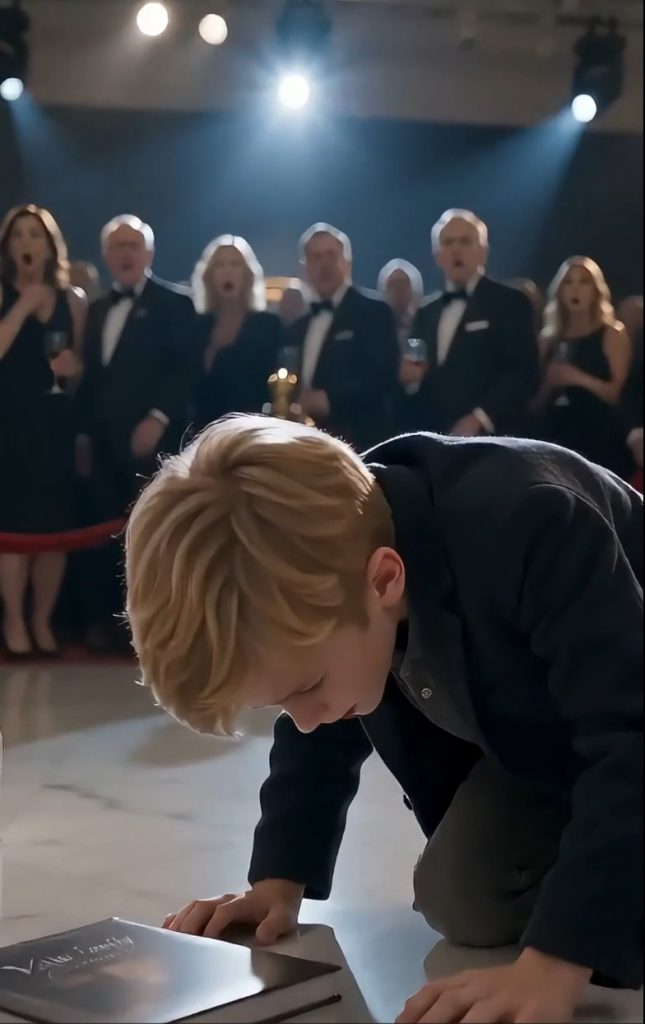
The art catalogue struck the marble before the boy did.
It slid across the museum floor, glossy pages fluttering open beneath the spotlights, stopping beside the velvet rope that guarded a priceless painting. The cover showed a woman in black standing before a wall of canvases, her name printed in silver beneath the title.
The Vale Family Collection.
Then Oliver Vale fell.
He landed hard on one hand, his simple dark blazer twisting at the shoulder, sneakers scraping against the marble. A faint mark appeared near his lip. His blue eyes watered from the shock, but he did not cry out.
Around him, the auction hall froze.
Black-tie guests stood among priceless paintings and marble columns. Security guards looked toward the sound. Museum donors stopped mid-whisper. The soft classical music seemed suddenly too delicate for the violence that had just cut through it.
The man who had slapped him stood above him with a silver-handled cane.
Malcolm Price, one of the most feared collectors in the American art world, adjusted his thin glasses and looked down at the boy as if he had touched a sacred object with dirty hands.
“Art belongs to families with names,” Malcolm said. “Not kids with empty pockets.”
The words echoed under the museum ceiling.
Oliver stayed low, one hand pressed against the floor near the fallen catalogue. His fingers trembled, but he reached for it anyway.
Malcolm moved his cane slightly, blocking the boy’s hand.
“You don’t even understand what you’re looking at,” he said. “This is not a playground.”
A woman nearby covered her mouth. A young auction assistant looked horrified. Several wealthy guests glanced toward security, then away, as if waiting for someone else to decide whether a man with Malcolm Price’s reputation could be stopped.
Then footsteps crossed the marble fast.
The museum curator, Helena Morris, rushed between Malcolm and the boy, her black evening suit sharp under the lights, museum badge flashing at her lapel. Security moved behind her, suddenly alert.
She did not ask Malcolm what happened.
She looked at Oliver first.
Her face changed with horror.
“Young Mr. Vale,” she said, voice trembling with controlled respect, “your mother’s collection is ready for the private wing.”
The crowd went still.
The camera of attention shifted from Malcolm to the painting label beside them.
DONATED BY THE VALE FAMILY.
Malcolm’s face drained of color.
“Vale?” he whispered.
Oliver slowly lifted his eyes.
Act II
Oliver Vale had grown up in museums after closing time.
Not because he was spoiled.
Because his mother trusted silence.
Clara Vale believed paintings spoke differently when crowds were gone. She would bring Oliver through quiet galleries after donors left and guards softened their voices. She never rushed him. Never told him what to admire. Never corrected him for staring too long at small details others ignored.
“What do you see?” she would ask.
When he was six, he answered, “A sad sky.”
Clara smiled.
“Good. Never let anyone convince you the right answer matters more than the honest one.”
Clara Vale was not born into art royalty.
She built her collection from obsession, patience, and a stubborn refusal to buy only what powerful people praised. She collected forgotten women painters, immigrant artists, Black modernists, Indigenous sculptors, and works dismissed by critics who later pretended they had always understood.
By the time the art world caught up, the Vale Collection had become legendary.
Private museums begged for loans. Auction houses courted her. Collectors wanted access. Critics called her visionary. Clara hated that word.
“Visionary usually means someone ignored you until your taste became expensive,” she told Oliver once.
Oliver loved her laugh when she said things like that.
Then she got sick.
At first, she still visited galleries, wrapped in elegant scarves, moving slowly but refusing pity. Then she stayed home more. Then paintings began arriving at the Vale house because she could no longer go to them.
Oliver would sit beside her bed with catalogues spread across the blanket.
She taught him provenance, restoration marks, brushwork, and the strange politics of museum walls. But mostly, she taught him that art was memory people tried to make visible.
Before she died, Clara made one final decision.
The heart of her collection would not be sold into private vaults.
It would be donated to the Harrington Museum, where students, families, and ordinary visitors could see it without needing an invitation from someone rich enough to own silence.
Oliver was eleven when the museum announced the gift.
The auction that night was not a sale of the main collection. It was a benefit event, designed to raise money for the new Vale Wing, restore several companion works, and fund free museum access for children from public schools.
Oliver had asked to attend quietly.
No speech.
No special entrance.
No velvet chair beside the stage.
He wanted to see the paintings the way his mother had taught him to see them. Not as property. Not as status. As pieces of a life being handed to the public.
Helena Morris understood.
She had been Clara’s closest museum partner for fifteen years. Refined, disciplined, and almost impossible to impress, Helena had once cried in a storage room after Clara decided to donate a painting she had protected for decades.
“This belongs where young people can find it,” Clara had said.
Oliver remembered that.
So on the night of the auction, he wore a simple blazer, sneakers, and carried the catalogue under one arm. He looked like someone’s child wandering through an adult event.
That was exactly what Malcolm Price saw.
Malcolm had wanted the Vale Collection for years.
He had offered Clara absurd amounts of money for a single painting. She refused. He offered to build a private gallery named after both families. She refused again. He hinted that museums mishandled great works and that children did not appreciate legacy.
Clara’s reply became famous in private circles.
“Legacy that hides behind locked doors is only vanity with insurance.”
Malcolm never forgave her.
When he saw Oliver standing near one of the collection’s most beloved paintings, catalogue clutched in both hands, he did not see Clara’s son.
He saw a child in sneakers standing too close to something he believed should have been his.
That was all it took.
Act III
The painting was small compared with the others.
That was why Oliver loved it.
It showed a woman standing at a kitchen sink in early morning light, one hand resting on the counter, face turned slightly away from the viewer. There was no drama in it. No grand landscape. No myth. Just exhaustion, tenderness, and sunlight touching a chipped mug.
Clara used to say it was the bravest painting in the collection.
“Why?” Oliver asked once.
“Because it tells the truth without shouting.”
At the auction, Oliver stood before it for a long time.
Behind him, guests discussed prices, tax benefits, museum influence, and which works would become most famous after the wing opened. He tried not to listen. He focused on the woman in the painting instead.
Then Malcolm’s cane tapped beside him.
“You’re blocking the label,” the collector said.
Oliver stepped aside immediately.
“Sorry, sir.”
Malcolm looked down at him.
His eyes narrowed.
“Where are your parents?”
Oliver’s throat tightened.
“My mother loved this piece.”
“That is not what I asked.”
Oliver looked at the painting again.
“She did.”
Malcolm’s expression hardened.
He mistook grief for insolence.
“This evening is for patrons and serious collectors,” he said. “Not children playing expert.”
Oliver held the catalogue closer.
“I’m not playing.”
A few guests turned.
Malcolm hated being contradicted, especially softly. Soft contradiction gave him nothing to crush without looking cruel.
So he became cruel anyway.
He reached for the catalogue.
Oliver pulled it back.
“Please don’t.”
The slap came fast.
It knocked Oliver sideways and sent the catalogue sliding across the marble. The sound of his fall moved through the auction hall before anyone’s conscience did.
Malcolm stood over him.
“Art belongs to families with names,” he said. “Not kids with empty pockets.”
Oliver stared at the floor.
The marble reflected the spotlights in broken shapes. He could see the catalogue open nearby, its pages bent, his mother’s portrait visible on the cover.
For one second, he felt smaller than he had felt in months.
Smaller than illness had made him.
Smaller than condolence letters.
Smaller than walking through rooms where adults spoke around him in careful voices, as if being a child meant grief could not understand English.
Then he heard his mother’s voice.
Never confuse volume with truth.
Oliver reached for the catalogue again.
That was when Helena arrived.
She crossed the floor with an expression no one in the museum had ever seen on her face. Not panic. Not anger exactly. Something colder.
Protection.
She stepped between Malcolm and Oliver, then lowered herself beside the boy.
“Oliver,” she said quietly. “Are you hurt?”
The crowd heard the name.
Some understood at once.
Most did not.
Malcolm’s face tightened.
“You know this child?”
Helena stood slowly.
Her voice carried.
“This is Oliver Vale.”
The room changed.
The air seemed to leave it.
Helena pointed gently toward the painting label.
“His mother donated the collection you came here to celebrate.”
Act IV
Malcolm Price tried to laugh.
It was a terrible sound.
“Vale,” he said. “No. Clara Vale had no—”
“A son,” Helena finished. “She did. And you just struck him.”
The words landed like a dropped frame shattering.
Oliver stood slowly, catalogue held against his chest. He did not wipe his face. He did not hide the faint mark near his lip. His quietness forced the adults to look at what had happened without decoration.
Malcolm’s hand tightened around the silver handle of his cane.
“I had no idea who he was.”
Helena’s eyes hardened.
“That is not a defense.”
“It is an explanation.”
“No,” she said. “It is the confession.”
The auction hall went silent again.
A security guard moved closer. An auction staff member whispered into a radio. Reporters at the back of the room began typing quickly, though the museum’s press team was already trying to control the damage.
Malcolm looked around, searching for allies among the collectors who had once praised his taste and envied his access.
No one stepped forward.
He turned back to Oliver, trying to soften his face into something almost human.
“Young man,” he said, “I apologize. I mistook you for—”
Oliver looked at him.
“For someone you could hit?”
The sentence was not loud.
It did not need to be.
A woman near the velvet rope lowered her gaze. A donor cleared his throat and stopped. The room seemed to understand, all at once, that the boy had named the real issue more precisely than any adult had dared.
Malcolm flushed.
“That is not fair.”
Helena’s voice became formal.
“Mr. Price, your bidding credentials are suspended effective immediately. You will leave the museum pending review.”
His eyes widened.
“You cannot remove me from an auction.”
“This is not only an auction,” Helena said. “It is a museum event honoring the Vale Collection. Clara Vale’s trust agreement gives the museum authority to exclude any patron whose conduct violates the dignity clause attached to the donation.”
Malcolm stared at her.
“The what?”
Helena opened the catalogue to the dedication page.
Clara’s handwriting had been reproduced there in silver ink.
Art is not made safer by wealth. It is made alive by access.
Helena turned the page toward him.
“Mrs. Vale was very clear.”
Malcolm’s face changed.
He had spent years trying to buy what Clara had protected. Now even after her death, her words stood between him and the walls he wanted to own.
Security approached.
Malcolm’s panic sharpened into anger.
“You are choosing a child over one of the museum’s most significant patrons.”
Helena did not blink.
“No,” she said. “We are choosing the purpose of the museum over a man who forgot it.”
The guests heard that.
So did Oliver.
For the first time that night, he looked up fully.
Helena turned to him.
“Your mother’s collection is ready for the private wing preview, but only when you are.”
Oliver looked toward the painting of the woman at the sink.
Then at the catalogue in his hands.
Then at Malcolm, who now seemed much older than before.
“I’m ready,” he said.
Malcolm whispered again, almost breathless.
“Vale?”
Oliver did not answer.
He walked past him toward the wing his mother had given away so others could enter.
Act V
Malcolm Price left through the side entrance under museum security.
Not because Helena wanted spectacle.
Because Clara Vale’s trust had anticipated men like him.
The dignity clause had seemed strange to lawyers at first. Too emotional. Too broad. Too personal. Clara insisted on it anyway. No donor, buyer, collector, board member, or guest could use wealth, status, or institutional influence to harass, degrade, or exclude children, students, staff, artists, or visitors in connection with the collection.
At the time, one attorney asked if she truly believed such a clause would be necessary.
Clara smiled sadly.
“If you think art rooms are immune to cruelty, you haven’t spent enough time in art rooms.”
After Malcolm was removed, the auction did not continue immediately.
Helena paused the event.
The orchestra remained silent. The guests stood awkwardly among masterpieces, suddenly unsure how to behave in a room where beauty had failed to make them kind.
Oliver sat in a small conservation office with an ice pack wrapped in a linen napkin. He held the damaged catalogue on his lap.
Helena sat across from him.
“I’m sorry,” she said.
Oliver looked at the cover.
“My mom said people would get strange around the collection.”
“She was right about many things.”
“She didn’t say they’d hit me.”
Helena’s face tightened.
“No. She hoped they wouldn’t.”
Oliver touched the corner of the catalogue where the page had bent.
“Would she be mad?”
“At Mr. Price?”
“At me.”
Helena leaned forward.
“Oliver.”
He looked up.
“Your mother would be furious that anyone made you wonder that.”
His eyes filled then.
Not because of the slap.
Because someone had said his mother as if she were still close enough to defend him.
Helena gave him time.
Outside, the museum waited.
Eventually, Oliver stood.
“I want to see the wing.”
Helena nodded.
The private wing was not grand in the way Malcolm would have wanted. It did not scream wealth. It opened quietly, with warm lighting and wide spaces designed for school groups to sit on the floor. The labels were written clearly, not as puzzles for insiders. Beside each painting, Clara had included a note about why she loved it.
Not why it was valuable.
Why it mattered.
Oliver stopped before the painting of the woman at the sink.
The label read:
Donated by the Vale Family in memory of Clara Vale, who believed ordinary lives deserved extraordinary walls.
Oliver read it twice.
Then he smiled through tears.
The auction resumed later that night, but it was different.
The bidding became less hungry. Guests spoke more softly. Several donors redirected their pledges toward the museum’s free access program. One collector, visibly shaken, funded transportation for public school visits for five years.
The story spread quietly at first.
Then loudly.
Malcolm Price issued a statement about confusion, regret, and heightened emotions. The museum did not respond directly. It simply announced his suspension from all future events involving the Vale Collection.
Other institutions noticed.
So did former assistants, young curators, and smaller collectors who had endured his intimidation for years.
Art magazines wrote about the incident without needing every detail. They had seen men like Malcolm before. Men who loved beauty but not humility. Men who spoke of legacy while treating living people like obstacles to ownership.
Oliver returned to the museum three months later for the public opening of the Vale Wing.
This time, there were children everywhere.
School buses lined the curb. Teachers handed out name tags. Kids in sneakers and backpacks wandered beneath paintings that had once hung in private rooms behind locked doors.
Oliver stood near the entrance in the same dark blazer.
Helena joined him.
“Nervous?” she asked.
“A little.”
“Good. Your mother always said nervous meant you cared.”
A little girl stopped in front of the kitchen-sink painting.
She tilted her head.
“She looks tired,” the girl said.
Oliver smiled.
“She is.”
“Why is it in a museum?”
He thought about that.
Then he answered the way his mother would have wanted.
“Because tired people are part of history too.”
The girl nodded seriously and kept looking.
That moment stayed with him longer than the auction.
Longer than Malcolm’s cane.
Longer than the slap.
Because this was what his mother had meant.
Not prices shouted under chandeliers.
Not collectors fighting over names.
Not men in tuxedos deciding who deserved to stand near beauty.
A child seeing a tired woman in a painting and understanding something true.
Years later, Oliver would still remember the marble floor and the catalogue sliding away from his hand. He would remember the room waiting to see whether he mattered. He would remember Helena saying his name like a shield.
But he would also remember the wing full of children.
And he would understand that his mother had won long before Malcolm knew he had lost.
Art did belong to families with names.
But not the way Malcolm meant.
It belonged to families who remembered. Families who gave. Families who opened doors instead of guarding walls.
And because Clara Vale had loved art more than ownership, her son learned that night that the most priceless thing in the museum was not a painting under a spotlight.
It was the right of every child to stand before one without being told they were too poor to see.