Act I
The leather folder hit the courthouse floor with a sharp crack.
Papers slid across the polished stone, scattering beneath the dark wooden courtroom doors and stopping near the brass plaque that read Courtroom One. Reporters turned. Attorneys froze mid-conversation. A court officer near the security desk lifted his head.
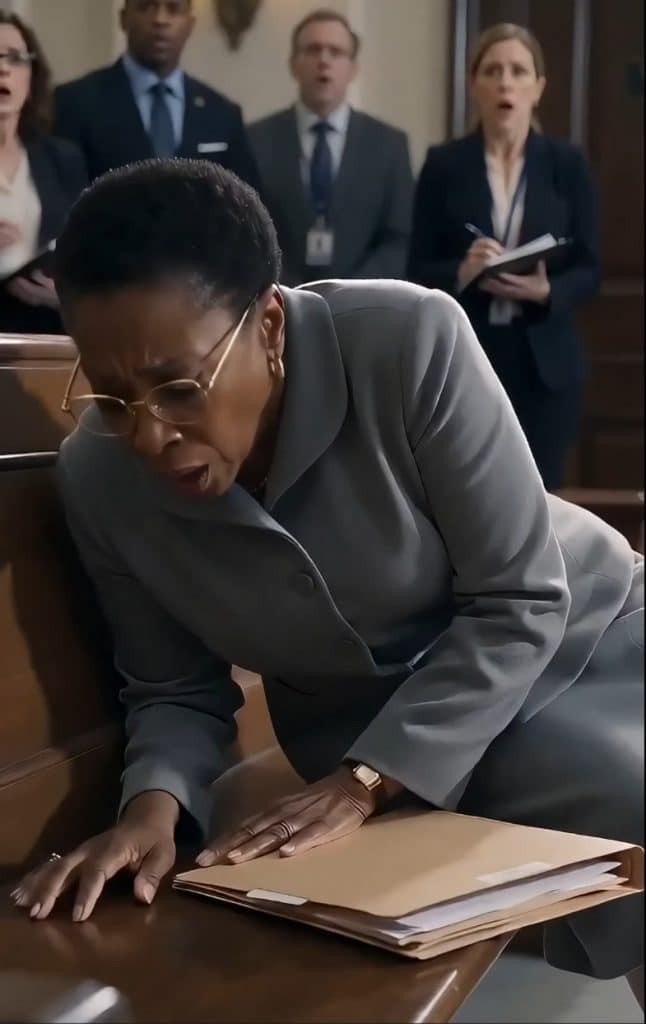
Then the woman fell against the wooden bench.
Her gold-rimmed glasses shifted crookedly across her face. One hand scraped lightly against the floor as she caught herself, and her modest gray coat twisted at the shoulder. For one stunned second, the hallway held its breath.
The man who had slapped her stood above her in a dark three-piece suit.
Calvin Pierce.
The famous trial lawyer.
The man reporters chased down courthouse steps. The man clients paid fortunes to intimidate witnesses, crush settlements, and turn courtrooms into stages built around his voice.
He looked down at the woman on the floor and smiled.
Not kindly.
Not nervously.
With the practiced arrogance of a man who had mistaken fear for respect for twenty years.
“This courtroom is for people with power,” he said. “Not women begging for justice.”
The insult moved through the courthouse hallway like a stain.
The woman stayed low for a moment, breathing carefully.
Her name was Marion Monroe.
She did not answer.
That seemed to make Pierce angrier. He stepped closer, polished shoes stopping inches from one of the scattered documents.
“Pick up your papers and move,” he said. “The adults have a case to argue.”
Reporters stared but did not speak. Younger attorneys looked toward senior partners, waiting for someone else to be brave first. Security officers stiffened, uncertain whether the great Calvin Pierce had truly crossed the line in front of everyone.
Then the courtroom doors opened.
A court officer in a dark uniform stepped into the hall, badge shining, posture suddenly formal. His eyes found the woman near the bench. His face changed at once.
He moved toward her with disciplined urgency.
Pierce turned, irritated.
“Officer, remove this woman from—”
The officer ignored him.
He stopped beside Marion Monroe, lowered his head with unmistakable respect, and lifted his voice so it filled the hallway.
“All rise,” he announced. “Chief Justice Monroe is entering.”
The reporters stopped breathing.
The lawyers went pale.
Pierce’s smile disappeared.
Marion Monroe slowly straightened her glasses, gathered her leather folder, and rose with absolute calm.
Pierce stared at her as if the courthouse itself had shifted beneath his feet.
“Monroe?” he whispered.
Act II
Chief Justice Marion Monroe had never liked entering through private doors.
The court staff preferred it. Security preferred it. Her clerks preferred anything that kept her away from reporters, lobbyists, angry litigants, and lawyers who believed proximity to a judge could be turned into advantage.
But Marion had spent too many years on the other side of courthouse doors to forget what they felt like.
Before the robe, before the appellate bench, before the appointment that made newspapers call her historic, Marion Monroe was a public defender with cheap heels, too many files, and a car that coughed every morning before starting.
She knew courthouse hallways.
She knew the smell of coffee, fear, paper, and polished stone. She knew mothers clutching custody documents, tenants holding eviction notices, defendants pretending not to shake, families praying that justice would recognize them before procedure swallowed them whole.
She also knew men like Calvin Pierce.
Pierce had built his legend in civil litigation. Corporate defense. Political scandal cases. Celebrity clients. He loved cameras, loved pressure, loved the moment an opponent realized he would make the process itself feel like punishment.
He had appeared before Marion twice when she was still on the appellate court.
The first time, he interrupted a junior attorney nine times.
The second, he referred to a woman plaintiff as “emotionally ambitious,” a phrase so polished and cruel Marion still remembered the taste it left in the room.
She had warned him then.
“Counsel,” she said from the bench, “advocacy is not permission to demean.”
He smiled.
“My apologies, Your Honor.”
But his eyes had not apologized.
Now he was arguing the biggest case of his career: a corruption appeal involving a private prison contractor, missing records, and families who had spent years demanding answers. Reporters lined the hall because everyone knew the ruling could reshape state accountability law.
Pierce represented the contractor.
Chief Justice Monroe would preside.
No one expected her to arrive in a robe yet. She had come early, wearing her gray coat, carrying confidential notes and draft questions in a leather folder. Her chambers were upstairs, but an elevator issue forced her through the public corridor.
Her clerk offered to walk with her.
Marion declined.
“I know the way,” she said.
That was true.
She knew the way too well.
As she entered the hallway, she noticed the crowd before they noticed her. Reporters checking phones. Attorneys murmuring near the courtroom doors. Paralegals guarding document boxes like treasure. Security watching everything with professional fatigue.
Pierce stood near the VIP courtroom entrance, holding court before the actual court began.
He was telling a story.
People laughed because powerful men often train rooms to laugh before the joke arrives.
Marion moved past quietly.
Then one of her documents slipped slightly from the folder.
She paused to adjust it.
That was when Pierce saw her.
Not the Chief Justice.
Not the woman whose portrait would one day hang in the courthouse.
A Black woman in a modest gray coat, standing too close to doors he believed belonged to him.
His expression hardened.
“Excuse me,” he said. “That entrance is restricted.”
Marion looked at him over her glasses.
“I’m aware.”
Pierce’s smile thinned.
“Then you should also be aware that loitering here is not appropriate.”
“I’m not loitering.”
“No?” His eyes dropped to the folder. “Then what are you doing?”
Marion studied him.
She could have ended it there.
She could have said her title and watched the hallway correct itself. But something in Pierce’s tone was too familiar, too revealing. He did not think he was speaking to a judge. He thought he was speaking to someone powerless.
So Marion answered simply.
“I’m entering the courtroom.”
Pierce stepped closer.
“No, you’re not.”
The hallway quieted.
And the test began.
Act III
Marion had seen intimidation dressed in many costumes.
Sometimes it wore police uniforms. Sometimes designer suits. Sometimes smiles. Sometimes legal language so clean it hid the bruise of what it meant.
Calvin Pierce wore a red tie and certainty.
“You need to step back,” he said.
Marion’s face remained calm.
“I suggest you do the same.”
A few reporters looked up fully now.
Pierce noticed the audience and mistook it for a stage.
His voice grew louder.
“This is a high-profile proceeding. People can’t just wander into restricted areas with papers and a grievance.”
Marion closed the folder more tightly.
“These are court documents.”
Pierce laughed.
“Of course they are.”
A young lawyer nearby shifted uncomfortably.
One of the reporters lifted a phone but did not start recording yet. Everyone seemed to feel the danger of the moment without knowing what kind of danger it was.
Pierce reached toward the folder.
Marion pulled it back.
“Do not touch my documents.”
That calm instruction struck him like defiance.
His face changed.
“You people come into courthouses thinking volume equals justice,” he said. “You think if you stand near important doors, someone important will listen.”
Marion’s eyes sharpened.
“Counselor, you should choose your next action carefully.”
He heard the warning.
He did not understand it.
The slap came fast.
It turned her face slightly and sent the folder from her hand. Papers slid across the floor. Her shoulder struck the bench. Her glasses shifted, but did not fall.
The hallway gasped.
Pierce stood over her, breathing hard.
“This courtroom is for people with power,” he said. “Not women begging for justice.”
The words revealed more than he intended.
Marion stayed down only long enough to feel her hand, check her breath, and look at the scattered papers. Some had landed face down. One had slid near Pierce’s shoe.
He did not know those pages contained questions she had written for his argument.
He did not know he had struck the one person in the building who could end his performance with a single order.
But Marion knew something more important.
She knew the hallway had seen him.
The reporters. The lawyers. The officers. The young clerks who had spent their first months in court learning which men everyone avoided correcting.
For once, Calvin Pierce had done in public what power usually did in corners.
Then the courtroom doors opened.
Officer Daniels stepped out.
He was a veteran court officer who had served under four chief judges and had once told Marion that courtrooms depended less on marble than on the people willing to protect the meaning of the room.
He saw her on the floor.
His jaw tightened.
He did not ask Pierce what happened.
He knew enough.
Officer Daniels crossed the hallway and stood beside her.
“All rise,” he announced. “Chief Justice Monroe is entering.”
The words hit the hall like a gavel.
Marion picked up one page.
Then another.
She straightened her glasses.
And rose.
Act IV
Calvin Pierce’s face lost all its practiced shape.
The famous smile disappeared first. Then the courtroom confidence. Then the theatrical impatience. What remained was fear, plain and ugly, flickering beneath disbelief.
“Chief Justice,” he said, voice hoarse. “I didn’t realize—”
Marion turned to him.
The hallway waited.
“You didn’t realize what, Mr. Pierce?”
His mouth opened.
No safe answer came.
That was the trap truth sets for arrogance. It makes every excuse confess.
Pierce swallowed.
“I didn’t realize it was you.”
Marion looked at the documents still scattered across the floor.
“No,” she said. “You did not.”
Officer Daniels picked up the leather folder and handed it to her with both hands.
“Your Honor.”
The title traveled through the crowd.
Reporters started typing. Attorneys exchanged stunned looks. A senior partner near the wall closed his eyes, already imagining the disciplinary complaint.
Pierce stepped closer, panic sharpening.
“Your Honor, please. This was a misunderstanding.”
Marion lifted one hand.
He stopped.
She did not raise her voice.
She did not need to.
“A misunderstanding is missing a filing deadline because the docket number was entered incorrectly,” she said. “A misunderstanding is walking into the wrong courtroom. What happened here was witnessed.”
Pierce’s eyes darted toward the reporters.
That, more than anything, revealed him.
Marion noticed.
“So now you understand the public nature of the act,” she said. “Interesting that it did not concern you when you believed the humiliation belonged only to me.”
A murmur moved through the hallway.
Pierce’s red tie seemed suddenly too bright.
“I apologize,” he said quickly. “Sincerely.”
Marion studied him.
“Do you?”
“Yes.”
“Then apologize without referring to my title.”
He froze.
The instruction struck deeper than punishment.
It forced him to face the woman he had harmed before power made her visible.
Pierce turned toward her, but his eyes kept flicking toward the cameras.
“I apologize, ma’am.”
Marion’s expression did not change.
“For what?”
His jaw tightened.
“For striking you.”
“And?”
“For speaking disrespectfully.”
“And?”
He looked trapped.
Marion waited.
Officer Daniels stood beside her, silent and immovable.
Pierce’s voice lowered.
“For assuming you didn’t belong here.”
The hallway went still.
Marion nodded once.
Not in forgiveness.
In acknowledgment.
Then she turned to Officer Daniels.
“Secure the hallway footage. Identify witnesses. Notify the judicial conduct administrator and the bar disciplinary office. Mr. Pierce is not to enter my courtroom today.”
Pierce’s eyes widened.
“Your Honor, my case—”
“Will proceed without you.”
He took a step back.
“My client has a right to counsel.”
“And your client’s co-counsel is present. You have a duty to conduct yourself in accordance with the standards of this court. You failed before reaching the threshold.”
The words landed like a sentence.
Pierce looked toward the courtroom doors, then at the reporters, then at the lawyers who had once orbited him like lesser planets.
No one moved to save him.
Marion gathered the last page from the floor herself.
A young associate bent to help, hands shaking.
“I’m sorry, Your Honor,” the young woman whispered. “I should have said something.”
Marion looked at her.
“Yes,” she said gently. “You should have.”
The associate’s eyes filled.
That mattered.
Not because Marion wanted shame for its own sake, but because silence needed to hurt before it changed.
Pierce whispered one final time.
“Monroe?”
Marion looked at him.
“Chief Justice Monroe,” Officer Daniels corrected.
Then the doors opened wider.
And Marion walked into the courtroom.
Act V
The courtroom rose before she reached the bench.
Not because of ceremony alone.
Because everyone knew.
The news had already moved through the building in whispers, texts, alerts, and urgent messages from hallway to courtroom. By the time Chief Justice Monroe entered, the room held a different kind of silence.
Not respectful.
Reckoning.
Marion wore her robe now.
Black fabric over the gray coat. Authority over the bruise of disrespect. The robe did not make her powerful. It only made visible what had been true in the hallway.
She sat at the center of the bench.
For a moment, she looked down at the courtroom.
At the attorneys preparing to argue. At the families waiting for answers. At the reporters ready to turn pain into headlines. At the empty chair where Calvin Pierce had expected to perform.
Then she spoke.
“Before we begin, the court will address a matter of conduct.”
No one moved.
“An officer of this court engaged in behavior outside this room that violated not only professional standards, but the basic dignity this institution exists to protect.”
She paused.
“The courthouse is not a theater for intimidation. It is not a private club for those who believe power excuses contempt. It is a public institution, and every person who enters its halls is entitled to safety and respect before anyone knows their name, title, or influence.”
Her voice stayed calm.
That made it impossible to dismiss as anger.
The proceedings continued.
Without Pierce.
His co-counsel argued stiffly, visibly shaken, but competently enough. The case did not collapse into spectacle. Marion would not allow that. Justice, she believed, deserved more discipline than revenge.
But outside the courtroom, consequences began.
The hallway footage was preserved. Witness statements were taken. Reporters confirmed what they had seen. By evening, Calvin Pierce’s firm announced he was taking leave. By the following week, the state bar opened an investigation.
His apology came through a publicist.
Marion did not read it.
She had no interest in sentences polished by crisis managers.
What mattered was the report from the courthouse safety committee one month later. It documented a culture of intimidation in high-profile cases. Junior lawyers afraid to report misconduct. Staff pressured to accommodate famous attorneys. Security uncertain whether prestige changed enforcement.
Marion read every page.
Then she ordered change.
No attorney, regardless of reputation, would receive special hallway access without clearance. Court officers received updated authority to intervene in harassment or physical misconduct immediately. Young lawyers and staff could report intimidation confidentially. Judges would receive misconduct alerts before proceedings began.
The courthouse did not transform overnight.
No institution does.
But the myth that certain lawyers were too powerful to correct cracked wide open.
Six months later, Marion returned to the same hallway before another major case.
The brass plaques had been polished. The wooden doors still looked imposing. Reporters still gathered with phones and notebooks. Lawyers still murmured in clusters, rehearsing arguments and reputations.
But something had changed.
Near the bench where she had fallen, a young woman stood holding a stack of files too large for her arms. A senior attorney brushed past her roughly, then stopped.
He turned back.
“Excuse me,” he said.
The young woman blinked, surprised.
Marion saw it from a distance.
Small change.
Real change.
Officer Daniels stood near the courtroom doors. He nodded when he saw her.
“Good morning, Chief Justice.”
“Good morning, Officer.”
He opened the doors.
This time, no one questioned whether she belonged.
But Marion thought of all the people who still entered courthouses without robes, without titles, without anyone ready to announce them.
That was who she carried with her.
The mothers begging for custody.
The tenants holding eviction notices.
The defendants with public defenders and trembling hands.
The women men like Pierce dismissed until power stood behind them.
She stepped through the doorway and paused just long enough to look back at the hallway.
She did not remember the slap as humiliation anymore.
She remembered it as evidence.
Evidence that dignity must not depend on recognition.
Evidence that silence protects the wrong person.
Evidence that the law loses its soul whenever power is allowed to decide who deserves respect.
Then Chief Justice Monroe entered the courtroom.
And everyone rose.