Act I
The tool case burst open before the cameras stopped rolling.
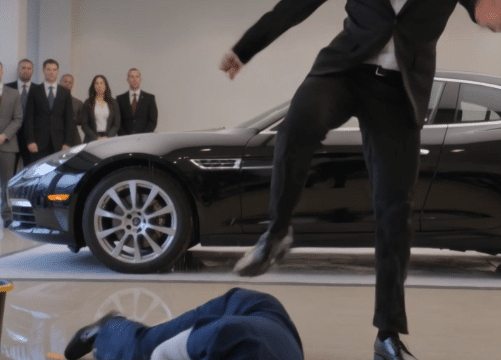
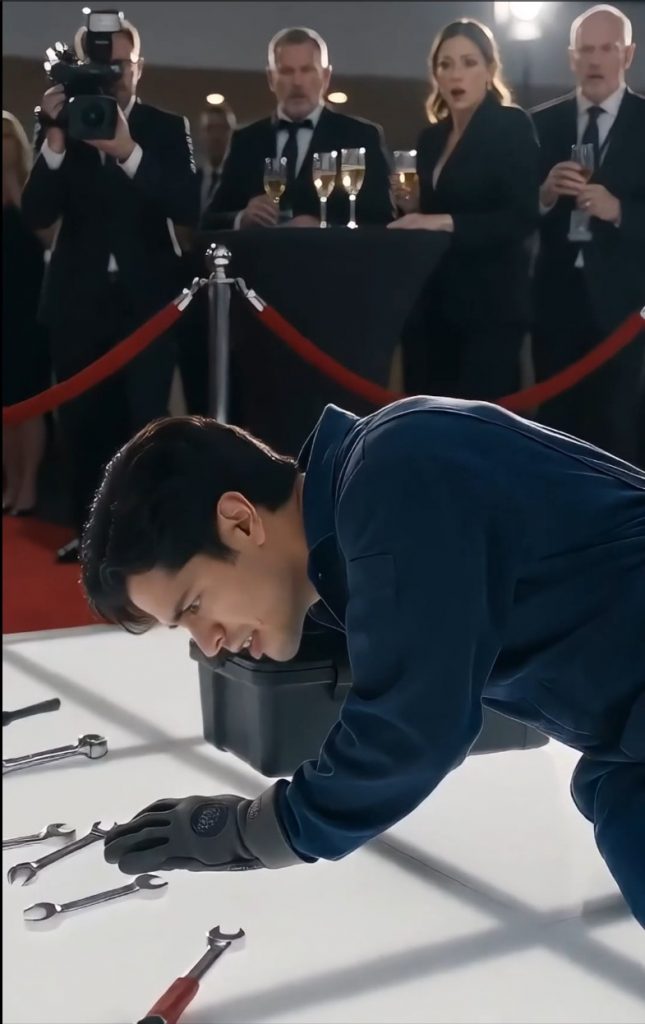
Metal wrenches skidded across the glowing launch floor, scattering beneath the red carpet lights and stopping near the covered concept car. Daniel Rivera fell beside them in his navy mechanic jumpsuit, one glove twisted at the wrist, one hand pressed against the floor to steady himself.
A small mark showed near his lip.
The room gasped.
Press cameras swung away from the champagne tables. Investors froze with glasses halfway lifted. Executives in dark suits stood beneath futuristic blue-white lighting, staring at the man on the floor as if the entire launch had suddenly cracked open.
Above them, the LED stage pulsed with the company slogan.
THE FUTURE ARRIVES TONIGHT.
The man who had punched Daniel stood over him in a sharp black suit and designer shoes, his open-collar shirt crisp beneath the stage lights. His face still held a media-ready smile, but now it looked ugly, stretched thin over rage.
His name was Adrian Cole, Marketing Director of Voltera Motors.
He had spent six months designing this moment.
The press angles. The lighting. The music. The champagne. The exact second the silver cover would be pulled from the car.
And then Daniel Rivera, in a mechanic jumpsuit, had stepped near the concept car and touched the charging port panel.
Adrian lost control.
“You fix engines,” he snapped, loud enough for every microphone nearby to catch. “You don’t touch the future.”
Daniel stayed low beside the spilled tools.
He did not shout back.
That silence made the room colder.
A journalist near the barricade whispered, “Who is he?”
Before anyone could answer, a woman stepped onto the LED stage.
Black tailored suit. Sleek bob haircut. Microphone headset. Eyes locked not on the cameras, not on Adrian, but on Daniel.
Eleanor Voss, CEO of Voltera Motors, crossed the launch floor with a fury so controlled it made people step aside before she reached them.
She stopped beside Daniel.
Then she turned to the crowd.
“This car exists because of him,” she said. “He designed the entire power system.”
The LED screen behind the covered vehicle flickered.
The marketing slogan vanished.
In its place appeared an engineering blueprint.
At the bottom, glowing larger than any logo, was a signature.
Daniel Rivera.
Adrian’s face drained.
“He…” His voice cracked. “He designed it?”
Act II
Daniel Rivera had grown up behind a repair shop in East Los Angeles where the air always smelled like oil, hot pavement, and his father’s coffee.
Rivera Auto Electric was not beautiful. The sign flickered. The waiting room had two plastic chairs and a vending machine that ate quarters. But people came from three neighborhoods over because Daniel’s father, Mateo, could listen to a broken car for ten seconds and tell you whether the problem was expensive or simple.
He never lied either way.
Daniel learned wiring before he learned algebra properly. He learned battery packs from wrecked hybrids, motor controllers from salvage yards, and patience from watching his father explain repairs to people who were afraid of the bill.
His mother, Lucia, kept the books and kept everyone fed. She used to tell Daniel that machines had no class. A luxury car and a delivery van both stopped moving when the connection failed.
Daniel remembered that.
At seventeen, he built a working electric kart from discarded parts. At twenty-two, he won a university engineering prize for a modular power distribution system. At twenty-seven, Voltera Motors hired him quietly into its advanced powertrain division after three larger companies dismissed him as “brilliant but not polished.”
Voltera was supposed to be different.
Its founder promised cleaner transportation, American manufacturing, and cars built by engineers rather than celebrity executives. Daniel believed in that version of the company. He worked nights. Slept under his desk during testing weeks. Ate cold pizza beside thermal simulation reports. Missed birthdays, weddings, and one painful Christmas when his father asked him if the car was worth becoming a ghost.
Daniel said yes.
Not because he loved the company.
Because the system worked.
He had designed a power architecture that solved the concept car’s biggest problem: heat loss during high-speed charging. Before his breakthrough, the car was beautiful and unreliable. After his redesign, it could charge faster, run longer, and survive stress tests the old prototype could not finish.
The engineers called it the Rivera Loop.
Marketing hated that name.
Adrian Cole hated it most.
To Adrian, the launch was not about the people who built the car. It was about the story he wanted to sell. A clean stage. Clean suits. Clean future. Nothing oily. Nothing complicated. No mechanics near the cameras. No engineers who stumbled over speeches. No one who reminded investors that the future was assembled by tired people with tools.
Daniel did not care about stage credit.
But he did care about the car.
Ten minutes before the reveal, he saw the charging port panel sitting slightly misaligned.
A tiny fault.
A dangerous one.
If the cover came off and the system diagnostics ran live, the panel could trigger a visible warning on the dashboard feed. Not catastrophic, but humiliating. Worse, it meant someone had rushed the final exterior reset without checking the power interface.
Daniel grabbed his tool case and walked toward the car.
Adrian saw only a mechanic stepping into his perfect shot.
And perfection, for Adrian, mattered more than truth.
Act III
Adrian Cole had not built the car.
But he had built the myth around it.
He joined Voltera from a luxury fashion brand, bringing with him a talent for turning engineering into desire. He could make investors lean forward. He could make journalists feel invited into the future. He could describe battery cooling like poetry, even if he could not identify the component on a bench.
The board loved him.
The press loved him.
He loved himself enough for everyone.
When Daniel’s power system saved the program, Adrian saw an opportunity. Not to elevate Daniel, but to absorb him.
He renamed the Rivera Loop as the V-Core System. He removed Daniel’s name from early presentation drafts. He told the communications team that “individual engineer stories distract from brand unity.” He moved Daniel off the launch speaking list and placed him backstage as technical support.
Eleanor Voss noticed.
She noticed everything eventually.
But Adrian was clever. He buried the change under production stress, legal reviews, investor schedules, and press deadlines. By the time Eleanor asked why Daniel was not on the stage program, Adrian smiled.
“Daniel prefers the lab,” he said. “He’s not a spotlight person.”
That part was almost true.
Almost truth is often the sharpest lie.
Daniel did prefer the lab. He hated attention. But he had never asked to be erased.
On launch night, he arrived in a mechanic jumpsuit because he had been underneath the concept car ninety minutes earlier correcting a thermal sensor issue. He did not change because the car mattered more than the cameras.
Then he noticed the charging port.
He crouched beside the panel with a small driver in hand.
Adrian crossed the stage fast.
“What do you think you’re doing?”
Daniel did not look up.
“Fixing the port alignment.”
“The car is covered.”
“The system is live.”
“You are not supposed to be visible.”
Daniel paused.
Then he looked at him.
“That is not a technical concern.”
A few press photographers turned.
Adrian’s smile twitched.
“You people never understand presentation.”
Daniel stood slowly.
“You mean engineers?”
“I mean mechanics.”
Daniel glanced at the tool case.
“I am both.”
That sentence should have ended the argument.
Instead, it lit the fuse.
Adrian stepped closer, voice dropping low enough to sound private but sharp enough to wound.
“This is not your father’s garage.”
Daniel’s eyes changed.
Still calm.
But colder.
“No,” he said. “In my father’s garage, people respected the person fixing the machine.”
The punch came then.
Fast.
Public.
And disastrous.
Act IV
Eleanor Voss knelt beside Daniel only long enough to ask one question.
“Can you stand?”
Daniel nodded.
She offered her hand.
He took it.
The cameras caught that too.
Adrian stood nearby, trying to understand how a launch he had choreographed down to the second had become a trial with spotlights.
“Eleanor,” he said, forcing a laugh, “this is being misunderstood.”
The CEO did not look at him.
She looked at the tools scattered across the floor.
Then at the concept car.
Then at Daniel.
“Is the panel safe?”
Daniel wiped one glove against his jumpsuit.
“It needs a ninety-second adjustment.”
Even after being punched, that was his first concern.
Not the cameras.
Not revenge.
The car.
Eleanor turned toward the press.
“Then everyone will wait ninety seconds.”
The room shifted.
No one knew whether to applaud, record, or stop breathing.
Daniel picked up the driver from the floor. One of the younger engineers rushed forward to gather the scattered tools, and this time no one told him to stay hidden. Daniel moved to the car, lifted the edge of the cover just enough to access the panel, and made the adjustment with hands that were steady despite the mark near his mouth.
The LED screen still displayed his blueprint signature.
Adrian stared at it like an accusation.
A reporter near the front raised her hand.
“Ms. Voss, can you clarify Mr. Rivera’s role?”
Eleanor faced the cameras.
“Daniel Rivera led the architecture of the power system that makes this vehicle possible. The charging efficiency, thermal distribution, and high-output safety loop are based on his design.”
The reporter looked toward Adrian.
“Why wasn’t he on the launch program?”
Silence.
Adrian opened his mouth.
Eleanor answered first.
“That is a question I will be asking internally.”
The words were clean.
Corporate.
Deadly.
Daniel finished the adjustment and stepped back.
“All set.”
Eleanor nodded.
“Thank you.”
Then she turned to security.
“Mr. Cole is to leave the stage area immediately.”
Adrian’s face tightened.
“You can’t do this in front of the press.”
Eleanor’s eyes flashed.
“You did this in front of the press.”
He lowered his voice.
“I protected the brand.”
“No,” she said. “You struck the man who built the thing you were trying to sell.”
The launch floor went silent again.
This time, the silence belonged to him.
Act V
The car was unveiled twelve minutes late.
No one remembered the delay as a failure.
The silver cover lifted beneath blue-white light, revealing a low, sculpted electric vehicle that seemed to glow from within. Cameras flashed. The LED stage displayed performance metrics, charging times, thermal maps, and, at Eleanor’s instruction, the engineering team’s names.
At the top was Daniel Rivera.
Not hidden in small print.
Not buried under brand language.
Centered.
For a moment, Daniel stood offstage near the tool case, uncomfortable with the attention. Then the youngest engineer on his team began clapping. Another joined. Then another.
Soon the whole engineering section was applauding.
The press turned their cameras toward him.
Daniel looked as if he wanted to disappear.
Eleanor leaned closer.
“You can survive applause,” she said.
“I prefer diagnostics.”
“I know.”
But she still guided him onto the stage.
Not as a mascot.
Not as a redemption prop.
As the engineer whose work had earned the floor beneath him.
Adrian Cole was gone by then, escorted through a side corridor with his designer shoes clicking too loudly against the concrete. By midnight, he was suspended. By morning, terminated. The legal process around the assault moved separately, and Eleanor made certain no press release softened what happened into “an altercation.”
But she also knew firing one man did not repair the culture that had allowed him near power.
So Voltera changed.
Launch credits became mandatory for engineering leads. Technical staff could halt public events for safety issues without marketing approval. No employee could be removed from a stage, photograph, or presentation because their appearance did not match an executive’s image of the future. Complaints about classism, racism, and workplace humiliation went to an independent review board.
Some executives called it overcorrection.
Eleanor called it overdue.
The biggest change came from Daniel.
He refused the title they offered him at first.
Vice President of Advanced Systems sounded too far from the workbench. Too far from the people still crawling under prototypes at midnight while the company spoke in clean slogans above them.
So he made a condition.
The advanced systems lab would be renamed the Rivera Workshop, not after him alone, but after his father’s garage. Every new engineer would spend their first month rotating through fabrication, testing, service diagnostics, and manufacturing support. Nobody designing the future would be allowed to look down on the hands that assembled it.
Eleanor agreed.
Daniel’s father visited the workshop six weeks later.
Mateo Rivera walked through Voltera’s glass headquarters in his best shirt, hands tucked awkwardly at his sides, staring at the machines his son had helped create. Daniel showed him the prototype charging unit, the test benches, the thermal rigs, the wall of signed blueprints.
At the center was the original drawing of the Rivera Loop.
Mateo stared at it for a long time.
“You named it that?”
Daniel looked embarrassed.
“The team did.”
His father nodded slowly.
Then he touched the frame.
“Good team.”
Daniel swallowed.
“Yes.”
Later that day, Eleanor invited Mateo to see the finished vehicle.
He stood beside the car, looking at the smooth lines, the hidden system, the charging port Daniel had adjusted moments before the launch nearly collapsed.
“So this is the future?” Mateo asked.
Daniel smiled faintly.
“Part of it.”
Mateo shook his head.
“No. The car is just the car.”
Daniel looked at him.
His father pointed toward the engineers walking across the floor, some in suits, some in jumpsuits, some with grease on their sleeves.
“That is the future. When they stop being ashamed of work.”
The sentence stayed with Daniel.
Months later, Voltera released the production model.
The campaign changed too.
Gone were Adrian’s empty slogans about owning tomorrow.
The new campaign opened with tools on a bench, hands connecting a battery module, engineers testing systems, factory workers inspecting final panels, and Daniel Rivera standing beside the car in the same navy jumpsuit.
Not polished into someone else.
Not hidden.
The tagline was simple.
Built by the hands that know it.
Investors worried it was not glamorous enough.
Customers loved it.
More importantly, employees believed it.
The black tool case from the launch was repaired and placed in the Rivera Workshop. A few tools were still scratched from scattering across the floor. Daniel refused to replace them.
A small plaque sat beside it.
Image without respect breaks before the machine does.
New hires always asked about it.
Daniel told them the truth, but not the sensational version.
People liked the sensational version.
The marketing director punched a mechanic.
The mechanic designed the car.
The CEO revealed his name.
He… designed it?
It was satisfying because arrogance panicked in public.
But Daniel cared more about the quieter truth.
The punch had been wrong before anyone saw the blueprint.
The insult had been ugly before the CEO stepped onstage.
The mechanic on the floor had deserved respect before the screen displayed his signature.
One evening, long after the factory lights dimmed, Daniel stood alone beside the concept car. The launch model had been preserved with the original port panel, the same one he had fixed in ninety seconds while cameras watched.
He placed one hand lightly on the metal.
He did not think about Adrian often.
Men like that took enough space when they were present. He refused to give them more after they were gone.
He thought instead about his father’s garage.
About the flickering sign.
About the vending machine that stole quarters.
About customers who came in frightened and left relieved because someone had told them the truth.
That, he realized, was what every machine deserved.
Truth.
Not image.
Not ego.
Not a stage so clean it erased the people who made it possible.
The future was not built under perfect lights by perfect men in perfect suits.
It was built by tired hands, corrected mistakes, late nights, quiet brilliance, and people humble enough to listen when a machine told them something was wrong.
Daniel closed the tool case and looked toward the sleeping factory floor.
The car behind him shone like tomorrow.
But the tools beside it told the better story.
Because the future had never belonged to the loudest person onstage.
It belonged to the ones who knew how to build it.