Act I
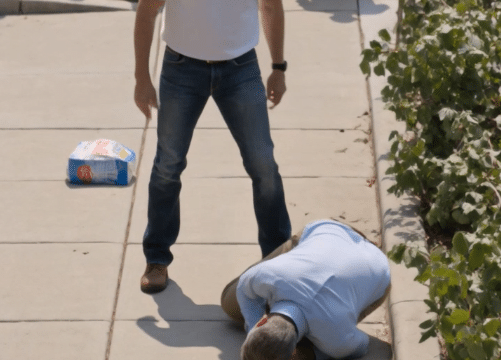
The kick came before anyone had time to understand how quickly a simple warning had turned into violence.
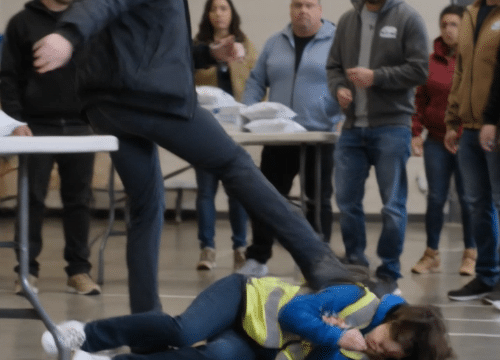
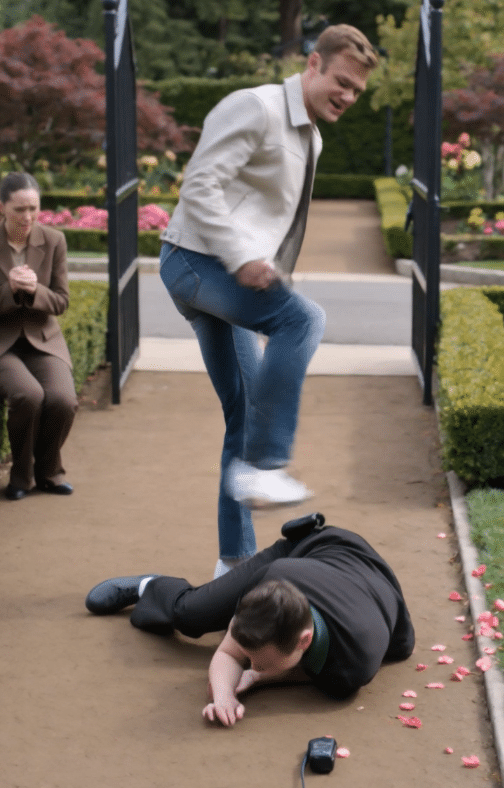
One second, the young garden staff member was standing beside a crushed flower bed, pointing toward the narrow walking path and the sign that clearly read Stay on Path. The next, a 24-year-old man in an expensive white jacket drove his foot into her chest and sent her crashing onto the dirt.
Her small radio flew from her belt.
Petals scattered across the path.
Her elbow struck the base of the sign, leaving behind only a thin, light trace of blood, but the pain on her face said enough. She curled slightly where she had fallen, breathing hard, trying to understand how a request meant to protect a garden had become a public humiliation.
Around her, phones lowered.
Visitors froze.
Several people covered their mouths, but nobody moved toward her.
She had not asked for much. She had not raised her voice. She had not threatened anyone.
She had simply been doing her job.
The young photo group had stepped into the flower bed to get closer to the blooms. Their shoes had already crushed several rows of petals, flattening flowers that had taken weeks to cultivate.
She had approached carefully, hoping a polite reminder would be enough.
Instead, the group’s leader had taken the correction personally.
Now he stood over her as though the entire garden belonged to him.
The woman forced herself to speak through the pain.
“Please stay on the path…”
The answer came with contempt.
“Trash. We came for pictures.”
Then he stepped closer.
Two more forceful kicks landed while she remained down beside the flowers. She recoiled instinctively, curling inward and trying to protect herself as the surrounding visitors gasped louder.
The cruelty was almost harder to comprehend than the violence itself.
He wasn’t trying to move her away.
He was punishing her for embarrassing him.
And then he said the words that revealed exactly how entitled he felt.
“Flowers matter more than customers?”
Nobody answered.
Nobody needed to.
Because somewhere beyond the garden gate, an engine had just begun to roar.
And the person stepping out of that vehicle was about to change who had power.
Act II
For the staff member, the flower garden was never simply a place where people came to take pictures.
She was thirty-one years old and had spent enough seasons working there to know that every flower bed represented months of planning, maintenance, watering, pruning, and careful protection from thousands of visiting feet.
The garden attracted photographers, families, wedding parties, tourists, and people looking for the perfect social-media picture.
Most visitors followed the paths.
Some needed reminders.
A few became irritated.
But the staff had learned to handle irritation with patience.
The woman wore the same green polo she had worn through countless busy weekends, a thin brown jacket against the morning wind, black jeans, boots, and a staff name tag. Her radio hung at her side because she was responsible not only for the flowers but also for keeping the public areas safe and orderly.
She had approached the group because the damage was visible.
Several crushed petals lay beneath their shoes.
One flower stem had been bent nearly flat.
The answer could have been simple.
Step back.
Take the photographs from the path.
Move on.
Instead, the group’s leader had interpreted the request as an insult.
He was twenty-four, dressed in a spotless white jacket and new sneakers, holding his phone as though it were a passport granting him access to anything he wanted.
The others in his group had followed his lead.
That was what made the scene so uncomfortable.
He wasn’t alone.
He had an audience.
And he seemed determined to make sure the staff member understood who he believed mattered more.
The woman had spent years learning the difference between an angry visitor and a dangerous one.
By the time she realized which kind he was dealing with, she was already on the ground.
Her radio lay a short distance away.
The flowers she had tried to protect were scattered around her.
The Stay on Path sign stood crookedly above the scene, almost absurdly close to the person who had been attacked for enforcing it.
The witnesses watched in stunned silence.
Some had their phones raised.
Others had pulled theirs down.
Nobody wanted to become the next target.
And the bully seemed to mistake their fear for agreement.
That mistake was about to cost him everything.
Because the garden had cameras.
It had event staff.
It had security.
And, more importantly, it had an owner who had no intention of allowing one visitor to decide what happened on his property.
But he wasn’t coming to save the flowers.
He was coming because someone had crossed a line.
And he was already at the gate.
Act III
The sound of tires against pavement cut through the garden.
A brown SUV braked hard near the entrance.
For a moment, everyone looked toward it.
The doors opened.
The garden owner stepped out wearing a dark green long coat, white shirt, and leather boots. Behind him came the event manager and two security guards, moving with the kind of urgency that instantly silenced the crowd.
No one spoke.
The owner looked across the garden.
First, he saw the visitors.
Then the crushed flower bed.
Then the scattered radio.
Finally, he saw the staff member on the ground.
His expression changed.
The young man in the white jacket was still standing where he had been, but the confidence that had filled his posture moments earlier suddenly looked less certain.
The owner didn’t rush toward him.
He went to the injured employee first.
The security guards immediately positioned themselves between her and the group, creating space around her and blocking the bully’s path.
The event manager moved toward the fallen radio.
The owner looked down at the crushed flowers.
There was something unsettling about the silence.
The garden had been full of camera clicks only minutes earlier. Now every phone seemed frozen.
The owner had spent years protecting this place.
Not because flowers were more important than people.
Because the rules existed to protect both.
The paths kept visitors from damaging the beds. The staff enforced those rules so that thousands of people could enjoy the garden without destroying it for everyone who came after them.
The bully had misunderstood the entire situation.
He thought the employee had challenged his status.
He thought the flowers were disposable.
He thought being a paying customer meant nobody could tell him no.
But the garden owner understood something very different.
A business could accept criticism.
It could refund a ticket.
It could apologize for an inconvenience.
What it could not accept was someone attacking an employee for doing her job.
The owner slowly looked from the damaged flower bed to the young man who had caused the scene.
Then he turned toward the gate.
“Close the garden gates.”
The words were calm.
That made them more powerful.
The security guards moved immediately.
The event manager followed.
Metal mechanisms began shifting in the distance.
The crowd parted as the people accompanying the owner took control of the entrances.
The bully’s group suddenly realized they were no longer simply visitors taking pictures.
The atmosphere had changed completely.
But the young man still didn’t understand why.
Not yet.
And then he heard the gates moving behind him.
Act IV
The first thing the bully noticed was the sound.
A heavy gate sliding into position.
Then another.
His friends stopped moving.
The phones that had seemed so important minutes earlier were suddenly lowered.
The narrow walking paths no longer felt like open exits.
Security stood between the group and the injured employee.
The owner remained near his staff member.
Nobody was shouting.
Nobody needed to.
The power shift was visible.
The young man looked toward the garden entrance, then back toward the owner.
His earlier confidence had depended on one assumption: that the employee had less power than he did.
She was staff.
He was a customer.
He believed that distinction gave him permission to humiliate her.
But the garden owner had just erased that assumption.
The staff member was not standing alone anymore.
She had the owner, the event manager, security, the garden’s rules, its records, its cameras, and an entire group of witnesses behind her.
The bully had brought his friends to take photographs.
Instead, they had become witnesses to the moment his private arrogance became a public incident.
The crushed flowers were still there.
The radio was still lying on the dirt.
The Stay on Path sign still carried the small mark from where the employee had fallen.
Nothing about the scene could be explained away as a misunderstanding.
The owner didn’t need to insult the young man.
He didn’t need to threaten him.
He didn’t need to raise his voice.
The closed gates said enough.
For the first time, the bully seemed to recognize that the rules he had dismissed were not decorations.
They were boundaries.
And boundaries become very different when someone with authority decides to enforce them.
The visitors stepped aside as security secured the entrance.
The employee remained protected behind them, still breathing heavily, her face showing the pain and embarrassment she had tried so hard not to reveal.
She had spent the entire confrontation trying to keep the garden calm.
Now the garden was silent because someone else had finally taken control.
The bully stared toward the gate.
His confident expression began to disappear.
He had wanted photographs.
He had wanted an audience.
He had wanted to prove that nobody could correct him.
Now he had exactly what he had demanded: everyone’s attention.
Only it wasn’t the kind he wanted.
The final movement of the gate echoed through the garden.
And suddenly, the question wasn’t whether the flowers mattered more than customers.
It was whether he understood what happened when a customer crossed the line.
Act V
The garden seemed frozen in time.
The wind moved gently through the flowers.
A few loose petals shifted across the dirt.
Somewhere near the entrance, the last latch settled into place.
The owner remained focused on his employee.
That detail mattered.
He had arrived with authority, but his first concern had not been punishment.
It had been protection.
The woman who had been attacked for doing her job was finally no longer exposed to the person who had hurt her.
The event manager stayed close.
Security held the space.
The witnesses remained silent.
And the young man stood inside a place that suddenly felt completely different from the garden he had entered only minutes earlier.
He had believed the staff member was powerless because she wore a name tag.
He had believed the rules could be ignored because he was a customer.
He had believed humiliation would make her back down.
Instead, every choice he had made had narrowed his options.
The flowers he had treated as props were now evidence of what had happened.
The sign he had ignored stood beside the place where the employee had been thrown down.
The fallen radio showed that the person he had tried to intimidate had been working when he attacked her.
And the closed gates made one thing unmistakable.
The garden belonged to someone else.
The owner had not needed a dramatic speech.
He had not needed to tell everyone who he was.
He simply acted.
That was what finally broke through the bully’s certainty.
His smirk disappeared.
His phone hung loosely in his hand.
For the first time that afternoon, he wasn’t thinking about the perfect photograph.
He wasn’t thinking about his friends watching.
He wasn’t thinking about being a customer.
He was looking at the gates.
Behind him, the people he had arrived with were silent.
Ahead of him, security stood firm.
And somewhere between those two points was the realization he had been missing from the beginning:
The employee had never been asking for permission to protect the garden.
She had been doing her job.
He was the one who had mistaken basic rules for an insult.
The camera-ready confidence drained from his face as the gate finished closing.
The owner had arrived.
The employee was protected.
The garden was secure.
And the man who had believed the entire place existed for his photographs was finally forced to confront a reality much larger than himself.
He stared toward the closing entrance, stunned by the sound behind him.
“Close the gates?”