Act I
The first thing anyone noticed wasn’t the kick.
It was the grocery bag exploding across the sidewalk.
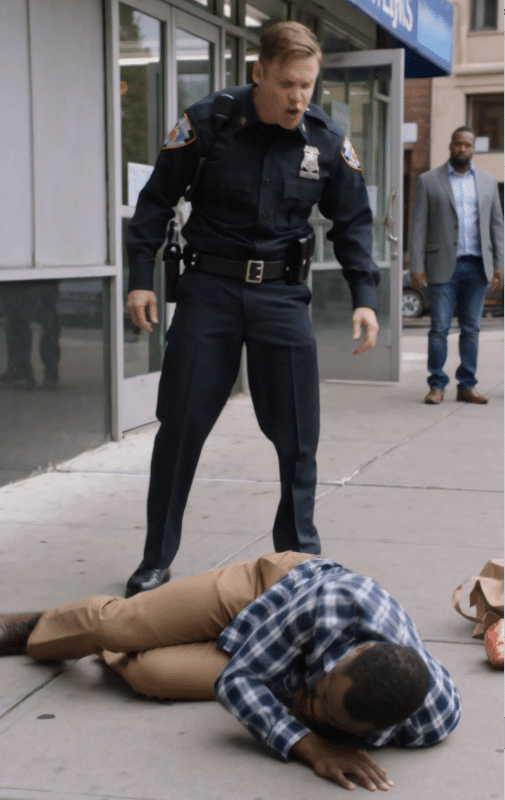
A loaf of bread, a carton of milk, canned soup, and a crumpled receipt scattered over the concrete as a middle-aged man slammed face-first onto the pavement. His faded plaid shirt collected dust, one worn shoe scraped against the curb, and a thin red mark appeared along his cheek where it struck the sidewalk.
Rush-hour traffic continued for another heartbeat before the entire block fell silent.
Standing over the fallen man was a uniformed patrol officer, his jaw locked with anger.
He didn’t ask questions.
He didn’t check for injuries.
Instead, he pointed at the groceries with open contempt.
“Trash,” he barked. “I know what thieves look like.”
The man struggled to lift himself onto one elbow, still trying to catch his breath.
He never raised his voice.
Never argued.
Never begged.
The officer mistook that silence for guilt.
Stepping over the spilled groceries, he drove another kick into the man’s side.
Then another into his lower back.
“Stay down,” he growled.
“And stop lying.”
Around them, pedestrians froze.
A young mother instinctively pulled her child closer.
An elderly couple exchanged horrified glances.
Several customers stood inside the convenience store, staring through the glass without daring to step outside.
The man simply curled around the pain, protecting his ribs with both arms.
His quiet dignity somehow made the scene even more disturbing.
Then, from the far end of the street, the sharp scream of expensive brakes cut through the silence.
Everything changed.
Act II
To everyone on that sidewalk, the injured man looked ordinary.
His clothes were old.
His shopping bag contained discounted groceries.
His shoes had clearly seen better days.
Nothing about him suggested wealth, influence, or power.
That appearance wasn’t an accident.
His name was Daniel Whitmore.
For more than two decades, Daniel had served as chairman of one of America’s largest manufacturing groups, overseeing thousands of employees across several states.
His fortune easily placed him among the country’s wealthiest executives.
Yet almost no one outside boardrooms recognized him.
He avoided interviews.
He refused magazine covers.
He disliked luxury watches, designer clothing, and public attention.
His late wife had once told him something he never forgot.
“The day your clothes become more important than your character is the day you’ve already lost yourself.”
He carried those words with him every day.
That morning, instead of sending an assistant, Daniel had insisted on buying groceries himself from the neighborhood store he had visited for years.
The cashier knew him only as “Mr. Daniel.”
The widowed woman who owned the store appreciated that he always rounded up his bill to help struggling families.
No cameras followed him.
No assistants opened doors.
That was exactly how he preferred it.
Unfortunately, someone else had already decided what kind of man he was.
Officer Ryan Cooper had received a vague report about a suspected shoplifter nearby.
He saw Daniel walking away with an old shopping bag.
He saw worn clothes.
Gray hair.
Cheap shoes.
Without checking surveillance footage.
Without speaking to store staff.
Without asking a single question.
Ryan convinced himself he already knew the truth.
And certainty became cruelty.
What happened next would cost him everything he believed his badge protected.
Act III
Three blocks away, a black luxury sedan turned sharply toward the convenience store.
Inside sat two members of Daniel Whitmore’s executive security team.
Daniel usually dismissed bodyguards whenever he went out alone.
That morning had been no different.
But after finishing a board meeting, his executive assistant had grown uneasy when Daniel stopped answering phone calls.
A routine location check showed his phone hadn’t moved for several minutes.
The security team immediately headed toward the last recorded location.
As they turned the corner, they saw him.
On the ground.
Groceries scattered across the sidewalk.
A police officer standing over him.
One bodyguard didn’t wait for the car to stop completely.
The rear door swung open before the sedan fully halted.
Both men sprinted toward Daniel.
The officer instinctively reached for his duty belt.
“Stay back!” he shouted.
Neither bodyguard even looked at him.
Their attention remained fixed on the injured man.
One carefully lifted Daniel’s shoulders.
The other gathered the scattered groceries before kneeling beside him.
For a moment, Daniel closed his eyes, more embarrassed than angry.
He hated becoming the center of attention.
One of the bodyguards lowered his head respectfully.
“Forgive us, Chairman.”
His voice carried across the silent sidewalk.
“We’re late.”
The words echoed through the crowd.
Chairman?
Several pedestrians looked at one another in confusion.
The convenience store owner suddenly covered her mouth.
She had seen Daniel almost every week for years.
She had never known.
Officer Cooper’s face lost every trace of confidence.
His heartbeat suddenly felt louder than the traffic.
But the worst realization was still coming.
Act IV
Within minutes, additional black vehicles arrived.
Not police cars.
Corporate security.
Senior executives.
Daniel’s personal legal advisor.
No one barked orders.
No one caused a scene.
Their professionalism made the atmosphere even more intimidating.
One executive quietly handed Daniel a clean handkerchief to wipe the dust from his face.
Another retrieved the damaged groceries.
The bodyguards helped Daniel to his feet with remarkable care.
Only after confirming he was steady did they turn toward Officer Cooper.
No threats.
No shouting.
Just silence.
The kind that forced everyone to confront what had happened.
Daniel looked directly at the officer.
His expression held disappointment rather than anger.
“You never asked my name,” he said calmly.
“You never asked for my receipt.”
He glanced toward the convenience store.
“The cashier would have told you I shop here every week.”
Ryan tried to explain.
“I… I thought…”
Daniel interrupted gently.
“Exactly.”
“You thought.”
“You didn’t verify.”
“You judged.”
The officer’s shoulders sagged.
For the first time since arriving, he looked less like an authority figure and more like a man realizing his career might have ended in less than five minutes.
Around him, witnesses quietly stepped forward.
One woman offered cellphone footage.
Another had recorded nearly the entire confrontation from inside her parked car.
The convenience store owner produced surveillance video showing Daniel paying in full before leaving.
Every assumption collapsed.
Every excuse disappeared.
Daniel wasn’t angry because of the kicks.
He was angry because authority had been used without responsibility.
And everyone present understood the difference.
Act V
An internal affairs supervisor arrived before the ambulance did.
Witness statements began immediately.
The officer’s body camera was secured as evidence.
Store surveillance footage confirmed every second of the encounter.
There was no missing context.
No hidden threat.
No resistance.
Only an ordinary man who had been judged by his appearance.
Daniel declined to file a dramatic public complaint.
He requested something far more meaningful.
“I want every new officer,” he said quietly, “to remember that uniforms create responsibility—not permission.”
Those words spread much farther than any lawsuit ever could.
The department announced an immediate review of the incident.
Training procedures were updated.
Supervisors ordered additional instruction on lawful stops, evidence verification, and respectful public interaction.
For Daniel, the greatest victory wasn’t watching someone’s career collapse.
It was knowing another innocent person might never experience what he had endured.
Before leaving, he bent down and picked up the dented can of soup that had rolled beneath a parked car.
One bodyguard instinctively reached for it.
Daniel smiled faintly.
“I’ve carried my own groceries my whole life,” he said.
“I can still carry them today.”
The crowd watched him walk toward the waiting sedan with the same quiet humility he had shown before anyone knew who he was.
His title had changed nothing about him.
Across the sidewalk, Officer Cooper remained frozen beside the scattered receipt that had started it all.
Only minutes earlier, he had believed power came from a badge.
Now he understood that real authority is measured by character, restraint, and the willingness to seek the truth before passing judgment.
The luxury sedan pulled away.
The sidewalk slowly returned to normal.
Traffic resumed.
People continued with their day.
But one image lingered in everyone’s memory.
Not the expensive cars.
Not the bodyguards.
Not even the revelation that the injured man was one of the country’s most respected chairmen.
It was the quiet dignity of a man who never needed to announce his status to prove his worth.
And standing alone against the blank storefront wall, the officer whispered the only word he could manage.
“Chairman…?”
By then, it was already too late.