Act I
The vegetables were still rolling across the muddy ground when the entire market fell silent.
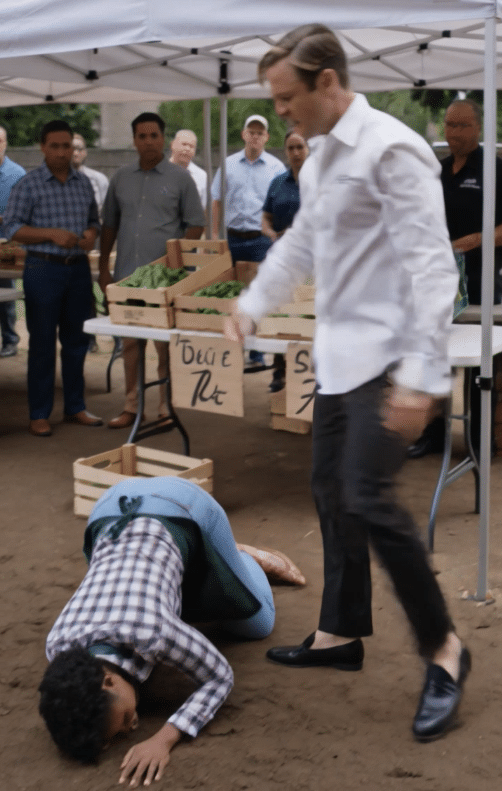
One moment, the woman had been standing quietly behind her modest produce stand, explaining in a calm voice that she couldn’t sell below cost. The next, wooden crates crashed onto the wet earth, tomatoes burst from their boxes, and she was thrown backward into the dirt as shoppers gasped in disbelief.
She was fifty-four years old, her hands rough from decades of working the land before sunrise. Every carrot, every tomato, every bundle of greens on that stand represented months of labor. She wasn’t bargaining for profit. She was simply trying to survive.
The wealthy restaurant owner didn’t care.
His polished loafers splashed through the mud as he glared at her with open disgust.
“Trash,” he spat. “Your vegetables aren’t worth that price.”
The words hurt almost as much as the humiliation.
People looked away. Some reached for their phones. Others froze, unwilling to challenge a man whose expensive clothes and arrogant confidence made him seem untouchable.
The woman struggled to breathe, dirt staining her old green apron, but she refused to beg.
That only made him angrier.
And what happened next would haunt everyone who witnessed it.
Act II
The bully wasn’t just another customer.
He owned one of the city’s trendiest restaurants, the kind where reservations disappeared months in advance and celebrities occasionally dined. Success had convinced him that money entitled him to everything—including deciding what a hardworking farmer’s produce was worth.
When she politely refused his insulting offer, his pride couldn’t tolerate hearing the word “no.”
So he destroyed her stand.
Fresh vegetables scattered across the market aisle like pieces of someone’s life being torn apart.
As she lay in the mud, clutching her aching ribs, he stepped over the ruined produce with absolute contempt.
“Sell from the dirt.”
Laughter didn’t follow.
Only silence.
The surrounding vendors recognized the woman immediately. She arrived before dawn every weekend. She never argued with anyone. She often gave extra vegetables to elderly customers who couldn’t afford much.
Yet now, nobody moved.
Fear can make decent people stand perfectly still.
The restaurant owner mistook that silence for approval.
He smiled.
He believed he’d won.
He had no idea someone else had just entered the market.
Act III
Outside, a sleek black car stopped so abruptly that nearby empty crates tumbled across the pavement.
Several assistants hurried out first.
Then a man wearing an elegant black chef’s jacket stepped into the market.
Conversations stopped.
People recognized him instantly.
His television shows had inspired millions. His restaurants had earned international acclaim. More importantly, those who knew him personally respected him for something far rarer than fame—his loyalty.
His eyes weren’t searching for cameras.
They were searching for someone.
Then he saw the ruined vegetable stand.
The scattered produce.
The woman lying in the dirt.
Everything else disappeared.
He ran.
Ignoring the shocked crowd, he dropped to his knees beside the injured vendor, gently lifting her from the muddy ground as if she were the most precious person in the world.
Because to him…
She was.
She had worked endless seasons under scorching summers and freezing winters so her son could chase a dream that once seemed impossible.
She had skipped meals so he could attend culinary school.
She had never complained.
Not once.
The famous chef wrapped an arm around her trembling shoulders.
Only after making sure she could breathe did he slowly stand.
Then he turned toward the restaurant owner.
The warmth vanished from his face.
Act IV
The market seemed to shrink beneath the weight of his silence.
“Mom…”
The single word echoed louder than any shout.
He looked down at her bruised apron before raising his eyes toward the man responsible.
“Mom, who did this?”
The restaurant owner felt the confidence drain from his body.
He suddenly recognized the face standing before him.
Not from television.
Not from magazines.
From business meetings.
From industry conferences.
This was the very chef whose endorsement every ambitious restaurant owner dreamed of earning—and whose criticism could destroy a reputation overnight.
His mouth opened.
No words came.
Around them, whispers spread through the crowd.
“That’s his mother…”
“The vegetable seller?”
“I had no idea…”
The chef stepped forward, placing himself between his mother and the bully.
His voice remained calm.
That made it even more terrifying.
“My mother spent her life feeding people long before I ever cooked my first meal.”
He glanced at the ruined vegetables covering the ground.
“You looked at dirt on her clothes and thought it meant she had no dignity.”
His eyes hardened.
“You were wrong.”
For the first time that morning, the restaurant owner took a step backward.
Act V
Market vendors quietly began gathering the scattered vegetables.
One elderly customer picked up the handwritten price signs.
Another offered a clean cloth.
Without being asked, strangers started rebuilding the little stand piece by piece.
The chef helped his mother to her feet.
She winced from the pain but stood tall anyway.
She had never needed wealth to possess dignity.
She had carried it with her through every harvest of her life.
Across the aisle, the restaurant owner’s confidence collapsed completely.
The expensive watch.
The polished shoes.
The designer clothes.
None of them could hide the fear spreading across his face.
His voice trembled as understanding finally caught up with him.
“Your… mom?”
The chef didn’t answer.
He didn’t need to.
Everyone already understood.
Respect is never measured by someone’s clothes, their job title, or the size of their bank account. It is measured by how they treat people who have nothing to offer them except honesty.
The market slowly returned to life.
Customers lined up—not at the bully’s side, but at the rebuilt vegetable stand.
Because that morning, people hadn’t just witnessed cruelty.
They had witnessed the quiet strength of a mother whose years of sacrifice had grown into something far greater than wealth.
And the man who had called her “trash” walked away carrying the one burden money could never erase:
The memory of humiliating the woman who had raised the chef everyone else admired.