Act I
The airport lounge was filled with the quiet confidence of people who believed they belonged.
Business travelers typed on laptops. Flight announcements drifted softly through the speakers. Outside the floor-to-ceiling windows, aircraft taxied beneath the afternoon sun.
An elderly Black man stepped inside carrying a worn military duffel, a small suitcase, and a boarding pass that had clearly been folded and unfolded many times.
His jacket was old.
His shoes were polished.
His posture never wavered.
He eased himself into an empty leather chair near the window, letting out the quiet breath of someone whose body had carried decades of service.
Across the lounge, a sharply dressed businessman looked up from his phone.
His expression hardened immediately.
He didn’t see a veteran.
He saw someone he believed didn’t belong.
“Trash,” he muttered loudly enough for nearby travelers to hear. “This lounge isn’t for people like you.”
The room fell uncomfortably quiet.
But the worst part wasn’t the insult.
It was that no one challenged it.
Then the lounge doors opened.
Act II
The veteran’s name was Colonel Isaiah Brooks, though almost nobody in the airport knew it.
After retiring from military service years earlier, he rarely spoke about his career. His medals stayed in a drawer at home. His uniform had long since been packed away.
He preferred anonymity.
To strangers, he looked like another elderly traveler trying to catch a flight.
To those who had served beside him decades earlier, he was remembered differently.
He was the officer who never left anyone behind.
The businessman, however, judged him in seconds.
He complained to lounge staff that the old man looked out of place and demanded that someone “check his credentials.”
The attendant politely confirmed that the veteran’s boarding pass granted him lounge access.
That only seemed to make the businessman angrier.
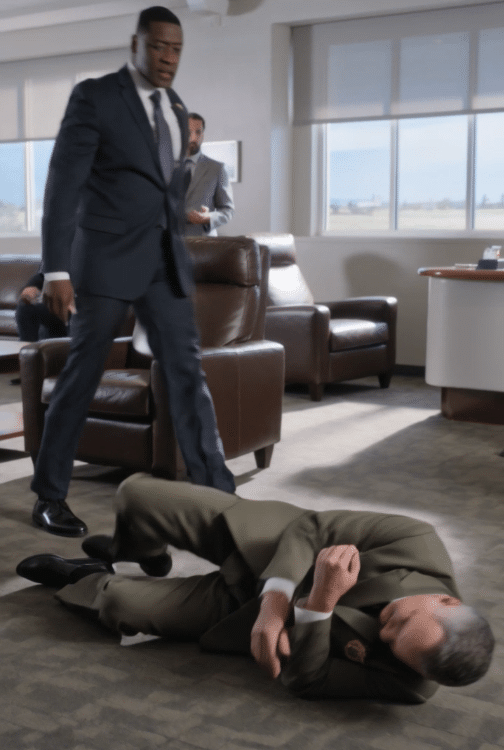
He stepped closer, towering over the seated veteran and telling him to “stay in the cheap terminal.”
Colonel Brooks slowly looked up.
His voice remained calm.
“I’ve spent enough years being told where I don’t belong.”
The businessman laughed.
He thought he had already won.
He couldn’t have been more wrong.
Act III
Moments later, the lounge doors opened again.
Conversation stopped almost instantly.
Airport security entered first.
Behind them walked a white-haired four-star general in full dress uniform.
Every member of the lounge staff straightened instinctively.
Several military travelers stood.
The general’s eyes scanned the room for only a second before settling on the elderly man by the window.
His face changed immediately.
Without hesitation, he crossed the lounge.
Travelers expected him to greet airport executives.
Instead, he stopped directly in front of Colonel Brooks.
Then, before anyone could process what they were seeing, the general raised a crisp salute.
The entire lounge froze.
The businessman stared in disbelief.
The general lowered his hand and spoke with unmistakable respect.
“Sir.”
Just one word.
But it carried decades of history.
Act IV
The businessman suddenly realized every assumption he had made had been wrong.
The general turned slowly toward him.
His voice remained calm, but every syllable carried unmistakable authority.
“Step away from my commanding officer.”
The businessman blinked.
“…Your commanding officer?”
The general nodded once.
“When I was a young lieutenant, this man taught me what leadership meant.”
Silence spread across the lounge.
Airport security remained perfectly still.
No one interrupted.
The general continued.
“He risked his career to protect the soldiers under his command. Many of us are alive because he refused to abandon us.”
He glanced back toward Colonel Brooks.
“I have waited years for another chance to thank him.”
The businessman suddenly found himself unable to meet either man’s eyes.
The confidence that had filled the room only minutes earlier disappeared completely.
Act V
The general bent slightly and shook Colonel Brooks’s hand with both of his.
It wasn’t a ceremonial gesture.
It was personal.
The lounge staff quickly brought fresh coffee and apologized for allowing the confrontation to unfold.
Other travelers quietly approached the veteran—not for photographs or attention, but simply to thank him for his service.
Colonel Brooks accepted every kind word with quiet humility.
“I never served for recognition,” he said. “I served because someone had to.”
The businessman stood frozen a few feet away.
His expensive watch, tailored suit, and elite status suddenly felt meaningless.
He had judged a lifetime of honor by an old jacket and a weathered suitcase.
Finally, his voice broke the silence.
“He… was your commander?”
The general looked directly at him.
“He still is.”
No one in the lounge remembered what flight they had been waiting for that afternoon.
But everyone remembered the lesson.
Respect cannot be purchased with wealth, reserved through status, or guaranteed by appearances.
Sometimes the quietest traveler in the room carries the greatest legacy.