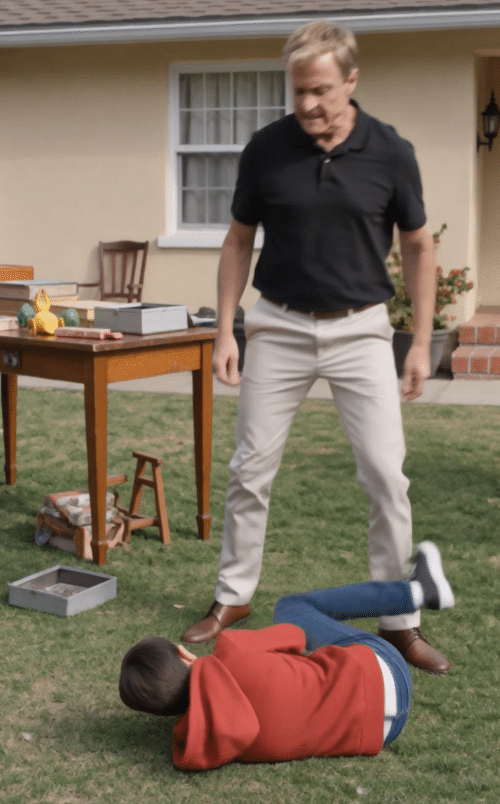
Act I
The old toy hit the grass with a dull thud.
The thirteen-year-old boy immediately bent to pick it up, apologizing before the customer could even complain.
“I’m sorry, sir. It just slipped.”
The wealthy man didn’t look at the toy.
His eyes locked onto the small cash box sitting on the folding table.
Inside were wrinkled bills and scattered coins—the family’s earnings from the entire afternoon.
He sneered.
“Trash. You broke it.“
Without another word, he grabbed the cash box.
The yard fell completely silent.
No one expected anyone to stop him.
Act II
The yard sale wasn’t about clearing clutter.
The boy and his mother were selling treasured belongings because they had fallen behind on bills after months of medical expenses.
Every old book.
Every toy.
Every worn kitchen item on the tables carried a memory—and a price tag they wished they never had to write.
The toy hadn’t even broken.
It had simply fallen into the grass.
The customer knew it.
He didn’t care.
Holding the cash box in one hand, he smiled coldly.
“This pays for the damage.“
The boy pleaded.
“Please… that’s our money.”
The man turned away as though the conversation was already over.
Then the sound of tires rolling onto the driveway broke the silence.
Act III
A luxury sedan stopped in front of the small house.
A distinguished older man stepped out with an assistant.
He had come to visit a nearby property, but the argument drew his attention before he reached the sidewalk.
His gaze immediately settled on the open cash box and the frightened boy.
He walked forward with calm confidence.
The assistant quietly moved beside the child.
The older man’s voice remained even.
“Put the boy’s money back.“
The customer laughed.
“And who exactly are you?”
The newcomer didn’t answer.
Instead, he looked around at the handwritten price tags, the carefully arranged tables, and the family trying to hold onto its dignity.
Then he looked directly at the customer.
“You knew that toy wasn’t damaged.”
Act IV
The customer’s confidence began to fade.
The assistant calmly took out a phone.
Neighbors who had watched from a distance stepped closer.
One quietly admitted he had seen the entire incident.
Another confirmed the toy had simply slipped.
The story the wealthy man had created unraveled in seconds.
The older gentleman finally introduced himself—not with arrogance, but with quiet authority.
He chaired the neighborhood foundation that regularly helped families avoid losing their homes during financial crises.
He had funded community projects throughout the area for years.
People recognized him immediately.
The customer suddenly realized he was no longer the loudest voice in the yard.
He slowly placed the cash box back on the table.
Act V
The boy counted the money with shaking hands.
Nothing was missing.
His mother hugged him tightly before turning to thank the stranger.
The older man smiled gently.
“You don’t owe me thanks.”
He looked at the tables filled with carefully priced belongings.
“You’ve already done the hard part by refusing to give up.”
Before leaving, he quietly purchased nearly every remaining item at full price and arranged for the unsold books and toys to be donated in the family’s name.
As his car prepared to leave, the wealthy customer stood frozen, watching the crowd that had once stayed silent now surround the family with encouragement.
His earlier confidence had vanished.
He looked toward the older man and asked the only question he had left.
“Who are you?“
The answer no longer mattered.
Everyone present had already seen the difference between someone who uses wealth to intimidate—and someone who uses it to protect.