Act I
The first thing anyone saw wasn’t the storm damage.
It was the kick.
The middle-aged volunteer had barely finished pointing toward the end of the relief line when the wealthy stranger’s expression twisted into open contempt.
“Sir, the line starts back there.”
The words were calm. Respectful. Nothing more than a reminder that every family waiting in the school parking lot had lost something to the storm.
Some had lost electricity.
Some had lost their homes.
Some had lost everything.
The man looked over his shoulder at the soaked residents standing quietly behind him. Elderly couples clutched blankets. Parents held sleepy children wrapped in towels. Volunteers hurried between pallets of bottled water and stacks of emergency food boxes.
He laughed.
“Trash. I don’t wait like them.”
The sentence landed harder than the cold wind.
For a heartbeat, the entire line froze.
The volunteer didn’t argue. She didn’t raise her voice.
She simply smiled with the tired patience that comes only after days without proper sleep.
“I’m sorry, sir. Everyone has to wait.”
She never finished another sentence.
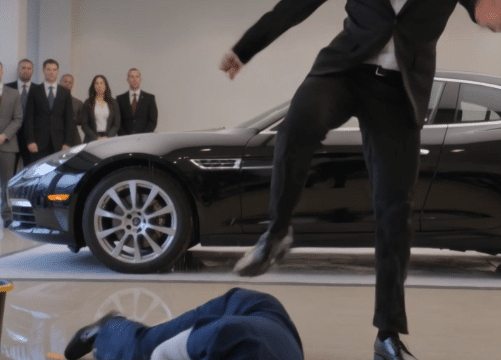
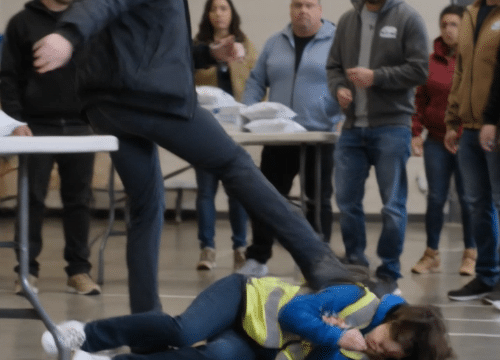
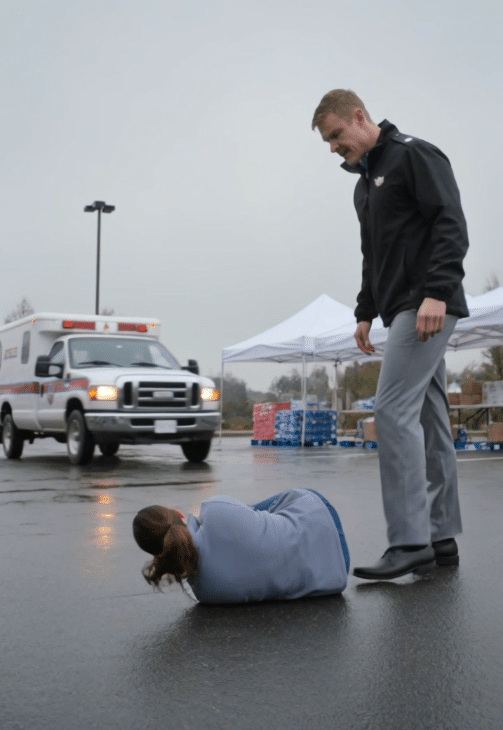
His polished leather shoe slammed into her chest with shocking force.
The impact hurled her backward.
Her body crashed into a tower of relief water boxes.
Plastic exploded across the wet asphalt.
Hundreds of bottles scattered in every direction, spinning through puddles while cardboard collapsed beneath her weight.
Her forearm struck the sharp edge of a box, leaving only a thin streak of blood before disappearing beneath the fallen supplies.
No one screamed.
The crowd simply stopped breathing.
The volunteer tried to inhale, but pain tightened her chest. She struggled to push herself upright, blinking against the rainwater dripping into her eyes.
Before she could move—
He stepped forward again.
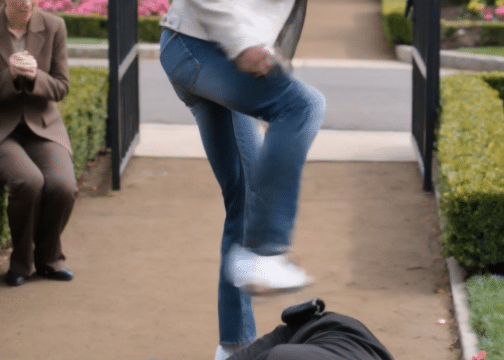
Two more brutal kicks drove into her side and back as she curled instinctively beside the scattered bottles.
Not because she had threatened him.
Not because she had insulted him.
Only because she had asked him to wait his turn.
The parking lot had survived a hurricane.
Yet somehow, this moment felt even colder.
No one knew that someone far more powerful had already arrived.
Act II
The man had spent his entire life believing money erased rules.
His expensive jacket stayed spotless despite the muddy parking lot.
His luxury phone never left his hand.
Even after assaulting a woman nearly twenty years older than him, his breathing never quickened.
He looked down at her as though she were an inconvenience.
“Move before I make you move again.”
The words echoed through the silent relief site.
Around him, volunteers stood frozen.
Not because they didn’t care.
Because disaster zones carried their own cruel reality.
Every volunteer had been trained to avoid escalating violence until security or law enforcement arrived. One reckless move could create panic among hundreds of frightened survivors waiting for food and water.
So they watched.
Every second felt like betrayal.
The woman lying on the asphalt had volunteered through hurricanes, floods, wildfires, and tornadoes over nearly two decades.
She wasn’t paid.
She had retired early after losing her husband years before, choosing to spend her life helping strangers during their worst days.
People remembered her because she never remembered herself first.
She always handed out the last blanket before taking one.
Always skipped meals so children could eat first.
Always stayed until the final truck left.
Few people knew that countless disaster survivors still mailed Christmas cards to the tiny apartment where she lived alone.
She had become the face people trusted after tragedy.
Yet today…
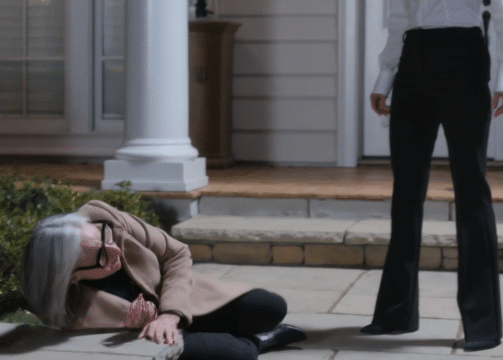
She lay among broken cardboard and rolling water bottles while a wealthy stranger treated her life as disposable.
Then every head turned at once.
The unmistakable sound of heavy brakes cut across the parking lot.
Something had just entered the relief site.
And suddenly, nobody was looking at the man anymore.
Act III
A black emergency command vehicle stopped beside the supply tents with deliberate precision.
Its doors opened before the engine had fully gone silent.
Field coordinators stepped out first.
Then came the man everyone recognized instantly.
The Head of the Emergency Relief Agency.
His face remained unreadable.
Years of leading national disaster operations had carved authority into every movement he made.
He didn’t shout.
He didn’t run.
He simply walked toward the center of the chaos.
One by one, volunteers straightened.
Conversations stopped.
Distribution tables fell silent.
Every coordinator instinctively stood ready.
The wealthy man’s confidence flickered for the first time.
He glanced around.
Why had everyone suddenly stopped working?
Why were they all watching this one man?
The agency head didn’t answer his questions.
He looked only once at the injured volunteer.
His jaw tightened almost imperceptibly.
Then his voice carried across the parking lot.
“Get him away from her.”
It wasn’t loud.
It didn’t need to be.
Within seconds, field coordinators surrounded the attacker.
Others immediately formed a protective circle around the injured volunteer without disturbing her condition, creating space so medical personnel could reach her safely.
For the first time since arriving…
The wealthy man took a step backward.
Because he realized something terrifying.
No one here was following him.
Every single person on that relief site answered to someone else.
And that someone had just spoken.
What he didn’t know was that this wasn’t merely a respected volunteer lying on the ground.
She was the reason the agency itself had changed years earlier.
Act IV
Long before anyone in that parking lot knew her name, the volunteer had been part of the darkest chapter in the agency’s history.
Fifteen years earlier, a devastating flood response had exposed corruption in the distribution of emergency supplies. Powerful contractors had diverted food and medicine away from desperate families, hiding shortages behind polished reports and false paperwork.
Most people stayed quiet.
She didn’t.
Despite having no authority, she meticulously documented missing shipments, altered records, and witness statements. Her evidence triggered a federal investigation that dismantled the scheme, led to criminal convictions, and reshaped how emergency aid was tracked across the country.
Many careers ended because she refused to look away.
The man now leading the agency had never forgotten it.
When he later rose through the ranks, he insisted that volunteers deserved the same protection and respect as uniformed officials.
He often told new coordinators that disasters revealed two kinds of people:
Those who exploited suffering.
And those who carried it for others.
She belonged to the second group.
That was why his expression never softened as he looked toward the attacker.
This wasn’t simply an assault.
It was an attack on the very values holding the relief effort together.
The wealthy man finally found his voice.
“Who are you?”
The question sounded smaller than he intended.
Not arrogant anymore.
Afraid.
The agency head never bothered answering directly.
He didn’t need to.
The dozens of volunteers standing silently behind him already had.
The attacker’s influence had vanished in less than a minute.
Money could skip a restaurant reservation.
Money could buy expensive suits.
Money could purchase attention.
But it couldn’t rewrite what hundreds of honest witnesses had just seen.
And it certainly couldn’t command a disaster relief operation built on service instead of status.
The balance of power had shifted completely.
But the greatest lesson was still waiting.
Act V
Paramedics carefully lifted the injured volunteer onto a stretcher.
Even through the pain, her first question wasn’t about herself.
“Did everyone get their water?”
One young volunteer standing nearby burst into tears.
The agency head closed his eyes briefly before answering.
“They will.”
Then he turned to the waiting families.
Without speeches.
Without cameras.
Without performance.
He quietly removed his own field jacket and began helping unload emergency supplies alongside the volunteers.
One after another, coordinators followed.
The line started moving again.
Children received bottled water.
Elderly residents collected food boxes.
Parents finally smiled for the first time that day.
The storm had damaged buildings.
One selfish act had nearly destroyed something even more fragile—people’s faith that fairness still existed.
But justice doesn’t always arrive with sirens.
Sometimes it arrives in a command vehicle.
Sometimes it speaks only five words.
“Get him away from her.”
And sometimes, the strongest person at a disaster site isn’t the one wearing expensive clothes.
It’s the exhausted woman with tired eyes, old sneakers, and a volunteer badge who refused to let privilege cut ahead of families who had already lost everything.
As for the wealthy man, the last expression anyone remembered wasn’t anger.
It wasn’t confidence.
It wasn’t pride.
It was fear.
The kind that appears only when someone finally realizes that power built on wealth can disappear in an instant…
…but character never does.