Act I
The ticket was already halfway written when the officer looked up from her notebook.
“Move the car, sir.”
Her voice was calm, professional, and impossible to mistake.
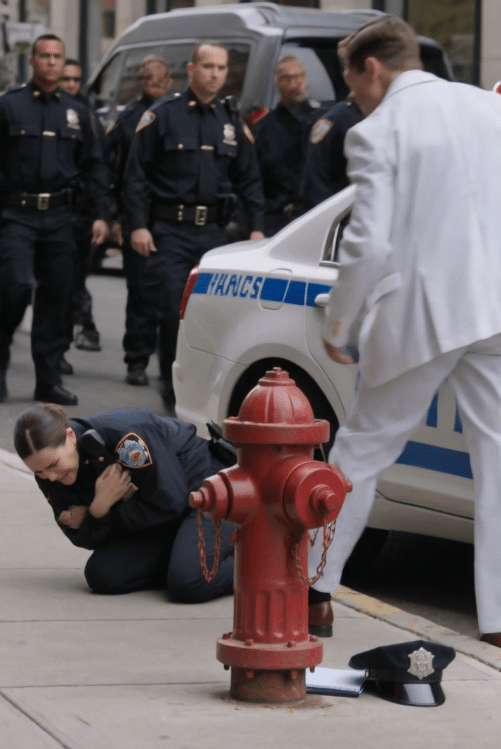
The luxury sedan sat directly in front of a bright red fire hydrant on one of the busiest streets downtown. Just a few feet away, pedestrians flowed along the sidewalk, barely noticing the patrol car parked behind it.
To most people, it looked like an ordinary parking violation.
To the officer, it was something far more serious.
A blocked fire hydrant could cost firefighters precious seconds when every second mattered.
The well-dressed owner of the luxury car glanced at the hydrant, then back at the officer.
Instead of moving his vehicle, he smirked.
“Trash. It’s only a few minutes.”
Nearby pedestrians slowed.
The officer didn’t match his tone.
She simply closed her notebook and repeated the instruction.
“This hydrant has to stay clear.”
She never finished another sentence.
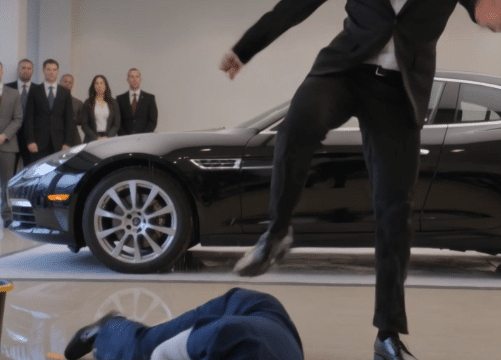
The man drove a brutal kick into her chest.
She slammed sideways into the patrol car before collapsing onto the concrete sidewalk.
Her violation notebook flew from her hands, scattering pages across the pavement.
Her police cap shifted as she hit the ground, and her elbow scraped the sidewalk, leaving only a small trace of blood before she instinctively pulled her arm close.
Pain stole her breath.
She struggled to steady herself.
Before she could recover…
He stepped closer.
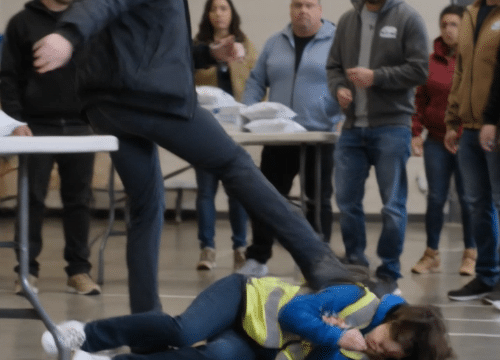
Two more hard kicks struck her side and back as she curled to protect herself, refusing to cry out despite the pain.
The city street fell silent.
No one expected a simple parking citation to become an assault on a uniformed officer.
But what happened next would transform an ordinary violation into something no one present would ever forget.
Act II
The wealthy driver had built his life believing consequences belonged to other people.
Rules delayed ordinary citizens.
Not men like him.
His expensive blazer, polished shoes, and luxury vehicle had opened countless doors over the years.
He assumed this one would be no different.
Standing over the injured officer, he sneered.
“You don’t touch my car.”
The words echoed across the sidewalk.
People watched in disbelief.
Some instinctively reached for their phones.
Others simply froze, unable to process what they had just witnessed.
The officer slowly pushed herself onto one elbow.
Her breathing was uneven, but her expression remained remarkably composed.
She had spent years patrolling crowded streets, responding to accidents, guiding frightened families, and enforcing laws that many people considered inconvenient until disaster struck.
She never viewed a fire hydrant as just another parking space.
She saw what firefighters saw.
A lifeline.
Few people knew that years earlier, she had arrived first at a devastating apartment fire where blocked hydrants forced crews to stretch hoses from much farther away.
The delay lasted only moments.
But she never forgot the heartbreak that followed.
From that day forward, she treated every blocked hydrant as a risk no city should ignore.
Today, that commitment had placed her directly in harm’s way.
Then another sound cut through the stunned silence.
Heavy brakes.
A police command vehicle had just stopped at the curb.
Act III
The command vehicle’s doors opened before the engine settled.
Uniformed officers stepped out first.
Then came the senior officer.
He carried himself with quiet authority earned over decades of service.
No raised voice.
No dramatic gestures.
Only complete control.
Police radios crackled as officers instinctively repositioned themselves.
Pedestrians stepped back.
Traffic seemed to pause.
The wealthy driver frowned.
He had expected more arguments.
Perhaps another ticket.
Instead, the senior officer looked only once toward the injured patrol officer before turning his attention to the attacker.
His voice was steady.
“Hands off my officer.”
Four words.
Nothing more.
Yet every officer moved immediately.
The sidewalk was secured.
The injured officer was shielded.
The attacker suddenly found himself surrounded not by frightened witnesses, but by disciplined professionals carrying out a lawful command.
For the first time, uncertainty crossed his face.
He realized no one was listening to him anymore.
Every badge.
Every radio.
Every uniform.
They all answered to the man who had just arrived.
The wealthy driver still believed this was simply about a parking ticket.
He couldn’t have been more mistaken.
Act IV
Years earlier, before becoming one of the department’s senior commanders, the officer had worked on a task force investigating emergency response failures across the city.
Several incidents shared the same heartbreaking detail.
Blocked hydrants.
Illegal parking.
Critical delays during structure fires.
The young patrol officer assigned to assist the investigation became one of its strongest voices.
She painstakingly documented violations, mapped repeat problem areas, and proposed stricter enforcement around emergency infrastructure.
Some dismissed the effort as unnecessary.
She refused to let it go.
Her recommendations eventually helped reshape enforcement policy throughout the department.
Fire crews reported faster access.
Joint training between police and firefighters improved.
Countless emergency responses became safer because one patrol officer insisted that “only a few minutes” could mean the difference between life and death.
The senior commander had watched that work firsthand.
He remembered her persistence.
He remembered her integrity.
Most of all, he remembered that she never sought recognition.
She simply wanted the next emergency crew to arrive without obstacles.
That was why his expression never softened as he looked toward the attacker.
This wasn’t merely an assault.
It was an attack on someone who had dedicated her career to protecting strangers she would never meet.
The wealthy driver finally spoke.
“Who are you?”
The question carried none of the arrogance he had displayed moments earlier.
Only fear.
The commander never answered directly.
He didn’t need to.
Every officer standing behind him already had.
Respect inside a police department isn’t measured by rank alone.
It’s earned through years of service, sacrifice, and trust.
The injured officer had earned all three.
And in that moment, the balance of power shifted completely.
Act V
Medical personnel arrived to examine the officer as fellow officers quietly gathered her scattered notebook from the sidewalk.
She accepted help only after asking one question.
“Is the hydrant clear?”
An officer looked toward the street.
The luxury car had already been removed.
“It is now.”
Only then did she allow herself to relax.
The commander bent down, handed her the recovered notebook, and gave a small nod that required no speech.
Around them, the city slowly returned to its rhythm.
Pedestrians continued walking.
Traffic resumed.
The fire hydrant stood unobstructed once again, waiting for a moment everyone hoped would never come.
The wealthy driver stood alone, his earlier confidence completely gone.
He had believed convenience outweighed responsibility.
He believed money and status could excuse breaking rules designed to protect everyone.
Instead, he discovered a truth that no expensive car could erase.
Public safety isn’t negotiable.
The officer never wrote that citation because she enjoyed enforcing rules.
She wrote it because emergencies never announce themselves in advance.
A hydrant blocked for “just a few minutes” can become the one hydrant firefighters desperately need.
People would later remember the confrontation.
They would remember the commander whose calm authority restored order without raising his voice.
But above all, they remembered the officer who stayed committed to protecting others, even after being knocked to the ground.
Because true public servants aren’t defined by the uniform they wear.
They’re defined by the people they protect—especially those who may never know their names.