Act I
The kick came before anyone could stop him.
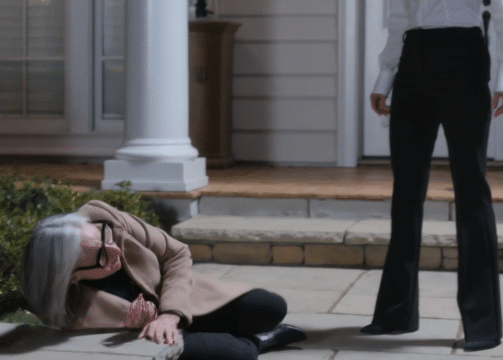
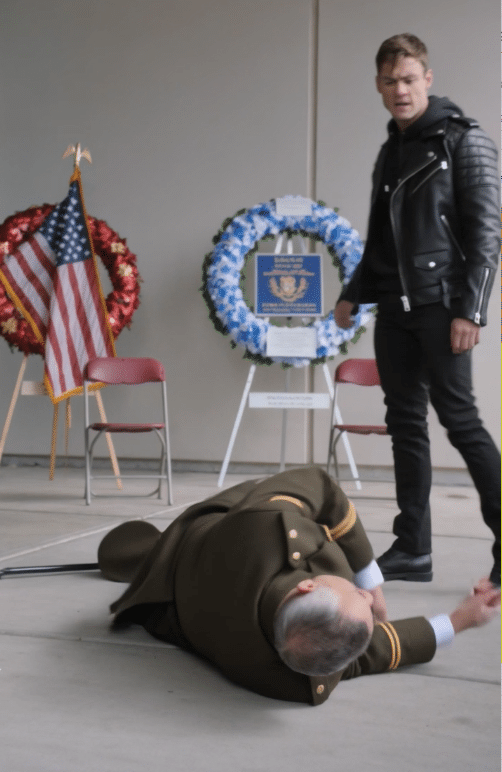
One second, the elderly veteran was making his way across the entrance of the community center, his small cane tapping against the winter-gray pavement. The next, a young man in a black hoodie lunged forward and drove his boot into the old man’s chest.
The impact sent him backward.
His body struck the concrete beside a memorial wreath. His cane clattered away. His black veteran cap rolled across the pavement, stopping beneath one of the folding chairs left behind after the ceremony.
For a moment, nobody moved.
The older man’s face tightened as he tried to breathe. His weathered hand pressed against the ground, searching for leverage, while the artificial leg beneath his gray khakis lay awkwardly beneath him.
Then, in a voice barely louder than the winter wind, he said, “I served this country…”
The young man looked down at him.
There was no hesitation in his expression. No shame.
Only contempt.
“Trash. Nobody cares what you served.”
A few people near the entrance covered their mouths.
The veteran tried to pull himself upright.
The young man stepped forward again.
Two more kicks landed against the old man’s back and side.
The wreath beside him trembled from the movement.
His face twisted with pain, and a thin trace of blood appeared where his elbow had struck the leg of a folding chair. Nothing dramatic. Nothing that could explain the expression in the eyes of the people watching.
Because what frightened them wasn’t the blood.
It was how easily everyone had frozen.
The young man stood over the veteran like the entire entrance belonged to him.
“Stay on the ground, old man.”
The words hung in the cold air.
And then the sound of tires changed everything.
But the people rushing toward the entrance weren’t police.
Act II
The ceremony had ended only minutes earlier.
American flags still stood beside the entrance. Memorial wreaths had been placed along the wall, and folding chairs remained scattered near the doors where families and veterans had gathered to remember those who never came home.
It should have been a quiet afternoon.
Instead, the old veteran had become entertainment.
His name was Daniel Mercer.
Sixty-eight years old.
For decades, he had avoided talking much about his military service. He didn’t tell strangers where he had served or how many decorations were tucked away in a box in his closet.
He simply carried the memories.
Some people carried photographs.
Daniel carried a prosthetic leg.
Years earlier, an overseas operation had changed his life permanently. The details were painful enough that he rarely discussed them, even with people who knew him well.
What remained visible was the result.
A measured walk.
A cane.
An old pair of leather shoes.
And a body that sometimes reminded him, with every cold morning, of the price he had paid.
That afternoon, Daniel had attended the memorial because one of the names on the wreath belonged to a man he had known decades earlier.
He had stood quietly through the ceremony.
He had saluted.
He had listened.
And when everyone else began leaving, he simply wanted to go home.
Then he heard laughter.
A group of young men had gathered near the entrance.
At first, Daniel ignored them.
He had learned long ago that dignity sometimes meant refusing to answer people who were desperate for a reaction.
But the laughter followed him.
One of them pointed toward his prosthetic leg.
Another nudged the young man in the black hoodie.
The leader of the group smiled.
His name was Tyler Reed.
Twenty-four years old.
He wore an expensive pair of sneakers, ripped jeans, a leather jacket, and the kind of grin that seemed permanently attached to his face.
Tyler had spent the afternoon performing for his friends.
He wanted to be the loudest.
The toughest.
The one nobody challenged.
And when he saw Daniel struggling slightly with the uneven pavement, he found what he thought would be the perfect target.
An old man.
A cane.
A prosthetic leg.
A military cap.
To Tyler, those weren’t symbols of sacrifice.
They were opportunities.
He stepped directly into Daniel’s path.
Daniel stopped.
For a moment, the two men simply looked at each other.
Behind them, the memorial wreaths remained in place.
The flags moved gently in the winter wind.
Daniel could have turned around.
He could have waited.
He could have said nothing.
Instead, he tried to walk past.
Tyler blocked him again.
The humiliation wasn’t accidental.
It was deliberate.
And when Daniel finally tried to remind him that the man standing in front of him had once served the country Tyler claimed nobody cared about, the response was immediate.
The kick.
The concrete.
The silence.
Daniel’s cap had rolled several feet away.
He watched it from the ground.
That cap had been with him for years.
His fingers trembled as he tried to reach toward it.
But Tyler’s shadow covered him first.
Nobody knew it yet, but that little black cap was about to become the most important object at the entire entrance.
Because someone had just arrived who knew exactly what that cap represented.
Act III
The first sound was the brakes.
A violent screech cut through the winter afternoon.
Everyone turned.
Three black SUVs had stopped outside the community center.
The doors opened almost simultaneously.
Boots hit the pavement.
A senior military officer emerged from the lead vehicle, accompanied by two uniformed escorts.
The mood changed instantly.
The witnesses who had been whispering fell silent.
People stepped away from the entrance.
Tyler’s friends stopped laughing.
Even Tyler turned toward the vehicles.
He had expected someone to complain.
Maybe security.
Maybe an angry family member.
He had not expected a military convoy.
The senior officer moved quickly.
Not toward Tyler.
Toward Daniel.
That detail mattered.
He crossed the entrance and immediately positioned himself between the young man and the fallen veteran.
One escort moved beside Daniel.
The other shielded the space around him.
The officer looked down.
His eyes landed on the black veteran cap lying on the pavement.
He stopped.
For the first time since the assault began, something changed in his expression.
Recognition.
Not casual recognition.
The kind that reaches deeper than memory.
The officer bent slightly, picked up the cap, and held it carefully.
Tyler watched him.
His confidence began to disappear.
The officer turned toward him.
“Stop right now. Do you know who you just hit?”
The question wasn’t shouted.
It didn’t need to be.
The authority behind it was enough to silence the entire entrance.
Tyler stared at him.
Then at the escorts.
Then at Daniel.
He looked confused.
The young man who had been so certain only moments earlier suddenly seemed to realize that he had walked into something much larger than a confrontation with an old veteran.
But he still didn’t understand.
Not yet.
The officer handed the cap to one of the escorts, who carefully placed it beside Daniel.
Then he looked back at Tyler.
There was history in that look.
History Tyler couldn’t see.
Daniel slowly lifted his head.
Their eyes met.
And for the first time that afternoon, Daniel didn’t look ashamed.
He looked tired.
Because the man standing in front of him wasn’t a stranger.
He wasn’t there by coincidence.
And he hadn’t come merely because someone had assaulted an elderly veteran outside a community center.
He had come because he knew exactly who Daniel Mercer was.
Years earlier, Daniel had been more than a name on an old service record.
He had been the man who saved the lives of others when his own was already falling apart.
He had carried another wounded soldier to safety.
He had refused to leave until everyone who could be evacuated had been moved.
And afterward, when medals were discussed, Daniel had insisted that the credit belonged to the men who never made it home.
He never told that story.
His commanding officers did.
One of them had kept the records.
Another had kept the photographs.
And one particular officer had kept something else.
A promise.
He had promised Daniel decades ago that if the world ever forgot what men like him had sacrificed, he wouldn’t.
That officer was now standing between Daniel and the young man who had called him trash.
Tyler still didn’t know any of that.
He only knew that the crowd had gone completely silent.
Then the officer looked at Daniel again—and Tyler finally asked the question that would expose everything.
Act IV
“Who is he?”
Tyler’s voice sounded different now.
Not powerful.
Not mocking.
Confused.
The man who had spent the last few minutes acting as though everyone around him was beneath him suddenly needed someone else to explain the situation.
Nobody answered immediately.
The silence was almost unbearable.
Daniel slowly reached for the edge of the folding chair.
The escort closest to him remained beside him, giving him room without trying to turn his struggle into a spectacle.
The senior officer stood upright.
His uniform carried visible decorations.
His posture was unmistakable.
But none of that was what made the moment powerful.
It was the way he looked at Daniel.
With respect.
With familiarity.
With the kind of recognition that made everyone else realize they had witnessed only the surface of a much older story.
One of the witnesses finally noticed the medals on the officer’s chest.
Another looked at Daniel’s cap.
Then at the memorial wreath.
Then back at the officer.
The pieces began connecting.
Daniel wasn’t just an elderly man with a prosthetic leg who happened to attend a veterans ceremony.
He was a decorated veteran whose name still appeared in military records that people in Tyler’s world had probably never bothered to read.
And the officer standing before him wasn’t simply outraged.
He had known Daniel for years.
There was a photograph, kept in an old military archive, showing two younger men standing beside a damaged vehicle.
One was Daniel.
The other was the officer now standing at the community center entrance.
They had survived the same operation.
Daniel had lost his leg.
The officer had carried the memory.
For decades, their lives had moved in different directions.
Daniel withdrew from public attention.
The other man continued rising through the military.
But they never completely lost contact.
And that afternoon, when Daniel failed to answer a phone call from a mutual veteran friend after the ceremony, the officer had come looking for him.
He arrived just in time to hear the silence.
Just in time to see Daniel on the ground.
Just in time to see the veteran cap lying beside the wreath.
Tyler looked around.
His friends wouldn’t meet his eyes.
The witnesses who had frozen earlier now stood motionless.
Nobody needed to tell Tyler that the balance of power had changed.
He could feel it.
But the officer wasn’t interested in humiliating him back.
That would have been too easy.
Instead, he looked toward the memorial wreath.
Then toward Daniel.
Then at Tyler.
His expression carried something far more serious than anger.
Accountability.
The escorts remained between Tyler and the veteran.
The crowd had parted completely.
Daniel slowly reached down and touched the brim of his cap.
His fingers rested there for a moment.
It was a small gesture.
But everyone understood it.
He wasn’t asking for pity.
He had never wanted pity.
He wanted the same thing he had wanted all those years ago.
Respect for the people who had paid the price.
Tyler’s friends began backing away.
One of them lowered his phone.
Another stared at the ground.
The performance was over.
There was no audience left for Tyler to impress.
Only witnesses.
And witnesses remember.
The senior officer finally stepped closer.
He didn’t raise his voice.
He didn’t need to.
He simply looked Tyler in the eye, then glanced down at the veteran cap.
And suddenly Tyler understood that the object he had ignored moments earlier carried more weight than anything he had said.
But the greatest shock wasn’t who Daniel had once been—it was what he had refused to tell anyone about the day he lost his leg.
Act V
Later that evening, Daniel sat quietly inside the community center.
The crowd had gone.
The chairs had been gathered.
The memorial wreaths remained beneath the American flags.
Outside, the black SUVs waited beneath the gray winter sky.
Daniel’s cane rested against the wall.
His cap sat in his hands.
For a long time, nobody spoke.
Then the senior officer sat beside him.
For a moment, neither man looked at the other.
They didn’t need to.
Some friendships were built through years of conversation.
Theirs had been built through things neither man could forget.
Daniel finally smiled.
Not because the afternoon had been easy.
It hadn’t.
He had been knocked to the ground.
Mocked.
Called trash.
Made to feel, for a few terrible minutes, as though his sacrifice meant nothing.
But the thing Tyler had never understood was that Daniel’s dignity had never depended on whether strangers respected him.
It had survived worse than insults.
It had survived war.
It had survived loss.
It had survived waking up one morning and realizing his life would never again look the way it had the day before.
And it had survived decades of people asking him what happened to his leg while knowing nothing about what happened to the men around him.
The senior officer finally placed a hand on Daniel’s shoulder.
Daniel looked toward the memorial wreath outside.
Among the names were men who had never received another morning.
That was why he had come.
Not for recognition.
Not for applause.
Not for anyone to call him a hero.
He had come because somebody should remember.
And perhaps that was the cruelest irony of the entire afternoon.
Tyler had tried to erase Daniel’s worth with a few words.
Instead, he had forced an entire crowd to remember it.
The story spread through the community over the following days.
People talked about the elderly veteran who had been attacked after a memorial ceremony.
They talked about the young man who thought cruelty made him powerful.
But most of all, they talked about the black SUVs that arrived without warning.
And about the officer who didn’t ask who had started the confrontation.
He already knew what mattered.
He saw a veteran on the ground.
He saw the cap.
And he stood between the man who had fallen and the person who had put him there.
As for Tyler, the question he asked in those final seconds stayed with him.
“Who is he?”
The answer was never simply a name.
Daniel Mercer was a veteran.
A decorated serviceman.
A survivor.
A friend.
A man who had lost part of his body without surrendering the part of himself that mattered most.
And, to the officer who arrived that afternoon, he was something even simpler.
He was the man who had once gone back when everyone else was told to leave.
The man who had carried others out.
The man who had never asked anyone to remember his sacrifice.
And perhaps that was why the scene at the community center felt so different once the truth came out.
The bully had believed strength meant making an older man fall.
Daniel had already learned, decades earlier, that real strength was what you did after you fell.
Sometimes it was reaching for your cane.
Sometimes it was picking up your cap.
Sometimes it was standing again.
And sometimes, when the whole world seemed to have forgotten, it was simply having one person arrive in time to say:
You are not forgotten.