Act I
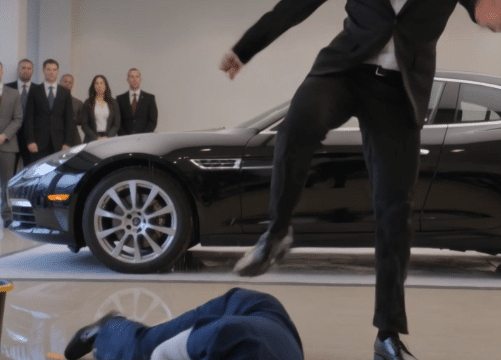
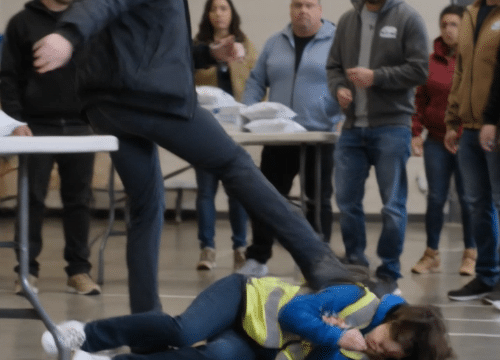
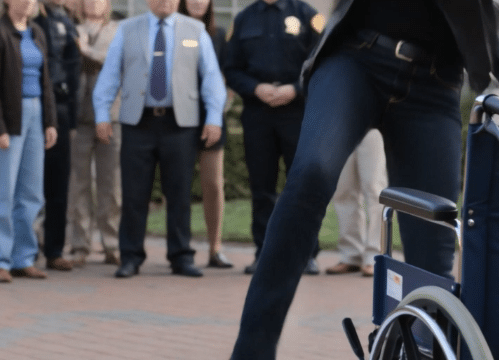
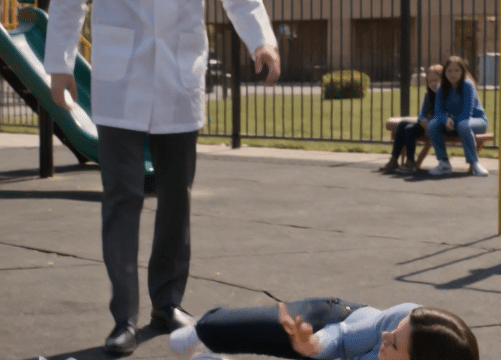
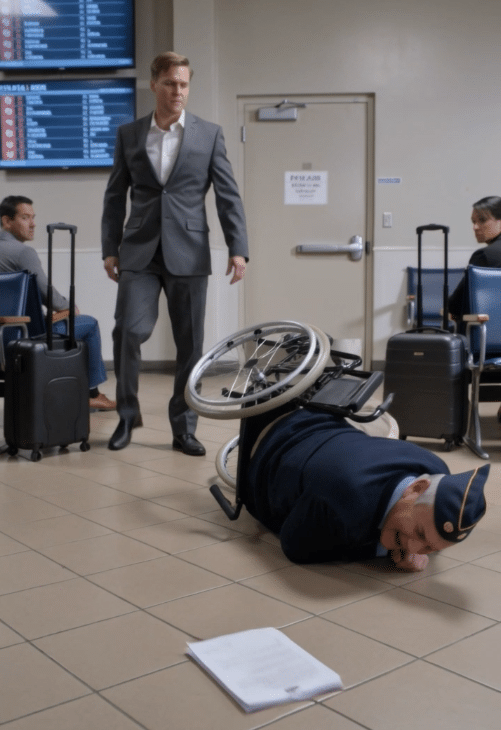
The wheelchair shot forward so violently that the elderly man barely had time to grab the armrests.
A hard kick from behind struck the back of the chair.
Its front wheels jolted upward. The frame tilted, rolled forward, and threw the seventy-two-year-old veteran onto the cold tile floor of the interstate bus terminal.
His small cloth bag dropped beside him.
Medical papers scattered across the boarding lane.
His elbow struck the leg of a waiting chair, leaving a thin trace of blood.
And then came the gasps.
The veteran curled slightly on the floor, struggling to breathe through the pain.
His navy jacket had ridden up. His veteran cap had fallen sideways. His hands trembled as he tried to gather himself.
“I was just trying to board…”
The man standing over him adjusted his blue tie.
He was forty-one, dressed in a gray business suit, polished shoes, and an expensive watch. His suitcase stood beside him like everything else about him—perfectly organized, perfectly controlled.
Except for his temper.
“Trash. You’re holding everyone up.”
The veteran looked up.
There was no anger in his face.
Only disbelief.
He had not asked anyone for special treatment.
He had simply needed a few extra seconds.
The suited passenger stepped over the scattered medical papers.
Then he kicked the old man again.
And again.
The crowd recoiled.
Nobody stepped forward.
Nobody touched the wheelchair.
Nobody picked up the papers.
They simply watched.
The businessman looked down at the veteran as though the entire terminal belonged to him.
“Move faster or stay home.”
For a few seconds, the only sounds were suitcase wheels and the distant terminal announcement.
Then a door behind the boarding area slammed open.
And the man who walked through it was about to make everyone wait.
Act II
The veteran’s name was Robert Hayes.
For most passengers in the terminal, he was simply an elderly man in a wheelchair carrying medical paperwork.
They saw the navy jacket.
The veteran cap.
The worn black shoes.
The small cloth bag resting on his lap.
They didn’t see the years behind those things.
Robert had spent much of his adult life serving his country.
He wasn’t the type to introduce himself with his military history.
If someone asked, he usually gave a short answer and changed the subject.
He had never believed his service entitled him to anything.
Not applause.
Not a faster line.
Not special treatment.
Certainly not pity.
That morning, he had arrived at the terminal early.
His destination was several hours away, and the medical papers on his lap were important. He had organized them carefully before leaving home, placing them in a folder and then inside his cloth bag.
He had checked his ticket twice.
He had reached the boarding area with time to spare.
The problem was the wheelchair.
The boarding lane was narrow.
People were moving around him with suitcases, backpacks, and coffee cups. Robert had to turn carefully before approaching the gate.
It took only seconds longer than usual.
But behind him stood Daniel Cole.
Daniel was the kind of passenger who treated every delay as a personal insult.
He was forty-one.
Successful-looking.
Immaculately dressed.
The expensive suitcase beside him probably cost more than Robert’s entire travel bag.
He kept checking the schedule screen.
Then his watch.
Then the wheelchair.
His irritation became visible.
Robert noticed.
He tried to move faster.
That was when the wheelchair clipped slightly toward the side of the boarding lane.
Daniel’s jaw tightened.
He stepped closer.
Robert didn’t turn around.
Perhaps he assumed the man would simply walk around him.
Perhaps he believed nobody would actually do what happened next.
The kick came without warning.
Robert went down.
His medical papers scattered like white leaves across the floor.
Some slid beneath the waiting chairs.
Others stopped near the boarding gate.
The sight of those papers should have reminded anyone watching that the man on the floor was vulnerable.
Instead, Daniel seemed more offended by the delay.
Robert tried to speak.
He tried to explain.
But Daniel had already decided what Robert was worth.
Nothing.
That was what made the humiliation worse than the fall.
Robert had spent years refusing to ask for sympathy.
Now, lying helplessly on a terminal floor, he found himself apologizing simply for needing time.
Around them, passengers froze.
A woman covered her mouth.
A man stepped backward.
Someone pulled a suitcase away from the scene.
Nobody intervened.
The bus remained waiting outside.
The boarding gate remained open.
The schedule screen continued changing as if nothing had happened.
And then the staff door opened.
Hard.
Everyone turned.
Because someone inside the terminal had seen enough.
Act III
The man who emerged wore a long navy coat over a black suit.
Two station security officers followed closely behind him.
He wasn’t running.
He didn’t need to.
There was something in his expression that made the people closest to the door move aside before he even reached them.
His name was Michael Grant.
Fifty-eight years old.
Executive director of the transportation company operating the terminal.
He had been in a private meeting with senior staff when an employee rushed in with an urgent message.
There had been an incident at the boarding gate.
An elderly passenger had been knocked from his wheelchair.
The gate area had become unsafe.
Michael had stopped listening after that.
He left immediately.
When he entered the lobby, he saw the wheelchair first.
Then the papers.
Then Robert.
And finally, the man standing over him.
Michael’s expression hardened.
The security officers moved forward.
One blocked the boarding lane.
The other positioned himself between Robert and the crowd.
Michael walked straight toward the veteran.
Not the aggressor.
The veteran.
That was the first thing everyone noticed.
He crouched slightly and looked at Robert.
Robert raised his eyes.
Something passed between them.
Recognition.
Michael had seen that face before.
Not recently.
Years earlier.
And not in a bus terminal.
He had seen it in a different setting, surrounded by uniforms, photographs, and names that belonged to another generation.
Michael looked at the medical papers scattered across the floor.
Then at the veteran cap.
Then at the wheelchair lying crooked near the chairs.
His jaw tightened.
He stood.
Daniel finally noticed the difference in the atmosphere.
The security officers weren’t approaching him as ordinary staff.
They were taking positions.
One stood directly between him and Robert.
The other closed off the boarding lane.
Michael turned toward the gate.
“Close the gate. Nobody boards yet.”
The terminal seemed to stop breathing.
The boarding announcement that had been playing moments earlier suddenly felt irrelevant.
Passengers stared.
The bus driver remained outside.
The boarding door stayed open.
But no one was moving.
Daniel looked toward the gate.
Then at Michael.
Then at the security officers.
For the first time, his confidence disappeared.
He had spent the entire confrontation believing the clock was on his side.
He had assumed the veteran was the problem.
He had assumed the terminal belonged to whoever shouted the loudest.
Now the entire boarding process had been stopped because of what he had done.
But there was something else.
Something Michael hadn’t explained.
The executive director didn’t look at Robert like an ordinary passenger.
He looked at him like a man whose name carried weight.
A man whose story mattered.
A man whose presence at that terminal was not an inconvenience.
It was a responsibility.
Michael glanced down at Robert’s medical papers again.
Then he looked back at Daniel.
There was no need to raise his voice.
The entire terminal had already gone silent.
Daniel swallowed.
His eyes moved toward the security officer standing between him and the wheelchair.
Then toward the gate slowly being closed.
And for the first time, a terrifying possibility entered his mind.
Maybe he hadn’t assaulted some random old passenger.
Maybe he had just attacked someone the company would never allow him to treat that way.
But Daniel still had no idea why Michael Grant knew the veteran’s name.
Act IV
The gate shut with a mechanical click.
Daniel stared at it.
“Close the gate?”
The words came out almost as a question.
He had been certain that the only thing that mattered was getting onto that bus.
Now there was no boarding.
No rushing.
No schedule to blame.
The entire terminal had stopped.
Michael remained between Daniel and Robert.
One security officer carefully gathered the medical papers from the floor.
The other stayed beside Robert’s wheelchair.
The crowd had changed too.
Minutes earlier, people had been afraid to interfere.
Now they watched silently as the man in the expensive suit stood alone on one side of the boarding lane.
Daniel looked toward the bus.
It wasn’t leaving.
That somehow made everything worse.
He had wanted everyone to hurry.
Now everyone was waiting because of him.
Michael finally looked at Robert again.
The veteran’s breathing had steadied slightly.
His face still showed pain.
But there was something else there now.
Embarrassment.
Michael recognized it immediately.
He had seen that expression on veterans before.
Not because they were weak.
Because they hated being treated as helpless.
Robert slowly reached toward the scattered documents.
Michael stopped him with a small gesture.
The security officer collected the remaining papers instead.
Robert didn’t protest.
He simply looked down.
Michael knew that look.
He had seen Robert do it years ago.
After a ceremony.
After a difficult conversation.
After people praised him for things he never wanted praised.
Robert Hayes had always been uncomfortable being called a hero.
That was the part Daniel could never have known.
The wheelchair hadn’t made Robert important.
The medical papers hadn’t made him important.
Even the veteran cap hadn’t made him important.
What mattered was the life behind them.
The sacrifices nobody in that terminal could see.
Michael had learned about Robert years earlier through the company’s veterans outreach program.
He had read the records.
He had met former servicemen who still spoke about him with extraordinary respect.
But one story had stayed with him.
Robert had once been responsible for helping evacuate several people during an emergency overseas.
He had stayed behind after others were ordered out.
He had refused to abandon anyone who could still be moved.
The story wasn’t famous.
There were no television cameras.
No viral photographs.
No public ceremony.
Just a military report and the memories of people who survived.
Robert had never talked about it.
When Michael eventually asked him why, Robert had simply shrugged.
He didn’t think he had done anything extraordinary.
He thought he had done what needed to be done.
That was who Daniel had attacked.
Not a helpless man.
Not “trash.”
A veteran who had spent decades refusing to turn his sacrifice into a demand for respect.
And now, because he needed a few extra seconds to board a bus, a stranger had decided those decades meant nothing.
Michael turned toward Daniel.
The businessman suddenly looked much smaller.
His expensive suitcase remained upright beside him.
His tie was still straight.
His shoes were still polished.
But none of those things gave him authority anymore.
The schedule screen continued blinking above them.
The bus remained behind the closed gate.
And every person in the terminal understood the same thing.
This was no longer about a delayed passenger.
It was about what had happened to an elderly veteran in a place where he should have been safe.
Daniel’s eyes shifted toward Robert.
For the first time, he seemed to really look at him.
Not at the wheelchair.
Not at the medical papers.
Not at his age.
At the man.
And that was when Michael stepped aside just enough for Daniel to see the veteran’s cap lying on the floor.
The cap had a faded emblem on the front.
Nothing flashy.
Nothing expensive.
Just an old reminder of a life Daniel had never bothered to understand.
Michael picked it up.
He held it carefully.
Then he placed it back on Robert’s lap.
Robert looked at him.
And Michael gave him the smallest nod.
No speech.
No grand announcement.
No need.
The message was already clear.
The man Daniel had treated as an obstacle was somebody this company had decided to protect.
But there was still one question hanging in the air.
Why had the executive director personally stopped an entire bus from boarding?
The answer would leave Daniel wishing he’d never asked for those extra few seconds.
Act V
The terminal eventually resumed its normal rhythm.
But not immediately.
The boarding process remained paused while security documented what had happened.
Passengers who had witnessed the attack stayed behind.
The scattered medical papers were returned to Robert’s folder.
His cloth bag was placed carefully on his lap.
His wheelchair was brought back into position.
And the veteran cap was straightened.
Robert sat quietly.
He looked exhausted.
Not defeated.
Exhausted.
There was a difference.
Michael stood beside him.
The executive director had dealt with thousands of operational problems over the years.
Late buses.
Weather cancellations.
Mechanical failures.
Angry passengers.
But none of those problems had made him stop an entire gate with a single sentence.
This had.
Because Robert wasn’t just another passenger.
He was one of the people the company had promised to protect.
Years before, Michael had helped establish a small transportation program for veterans and elderly passengers traveling to medical appointments.
Robert had been one of the first people involved.
He hadn’t asked for his name on anything.
He hadn’t wanted publicity.
He had simply helped other veterans navigate the system.
When Michael learned that Robert himself now needed a wheelchair and regular medical care, he quietly made sure staff knew to give him whatever time he needed.
Robert never complained.
He simply arrived.
He waited.
He boarded.
And he went home.
That day should have been no different.
Until Daniel decided that a few seconds were worth more than another man’s dignity.
Robert looked toward the closed gate.
Then at Michael.
There was no triumph in his face.
That mattered.
He hadn’t wanted Daniel punished because of his status.
He hadn’t wanted a crowd to cheer.
He hadn’t wanted revenge.
He had only wanted to board the bus.
The irony was almost painful.
The man who had been desperate to save a few minutes had caused the entire terminal to stop.
The man who had demanded that everyone move faster had become the reason nobody could move at all.
Daniel stood alone beside his suitcase.
His face had lost the arrogance it carried earlier.
He looked at Robert again.
The veteran met his eyes.
For a moment, neither man spoke.
Robert didn’t need to say anything.
The medical papers were back in his hands.
His cap was back on his head.
His wheelchair was upright.
And despite everything, he was still trying to continue his journey.
That was the part Daniel couldn’t understand.
He had expected anger.
He had expected shouting.
He had expected someone to humiliate him in return.
Instead, Robert simply turned toward the gate.
Because his destination hadn’t changed.
His reason for traveling hadn’t changed.
And neither had the man he was.
The incident eventually became a story people at the terminal remembered.
Not because an executive director had stopped a bus.
Not because a businessman had lost his temper.
But because everyone who witnessed it learned something they had forgotten in the rush of ordinary life.
A person’s value isn’t measured by how quickly they move.
A wheelchair isn’t an inconvenience.
A medical document isn’t something to mock.
And a veteran doesn’t stop being worthy of dignity simply because age has changed the way he walks.
Daniel had looked at Robert and seen a delay.
Michael had looked at him and seen a life.
That difference changed everything.
The bus eventually departed.
Robert was safely aboard.
His medical papers rested neatly on his lap.
His cloth bag sat beside him.
And his old veteran cap remained firmly on his head.
Outside the window, the terminal slowly disappeared behind him.
Michael watched the bus leave.
Then he turned back toward the empty boarding lane.
The gate was open again.
The crowd had gone.
But the silence remained for a few seconds longer.
Because everyone there had witnessed the same reversal.
The man who thought power meant forcing someone to move faster had discovered that real authority sometimes means stopping everything.
And the elderly veteran he had treated like trash?
He never needed to prove who he was.
The people who mattered already knew.