Act I
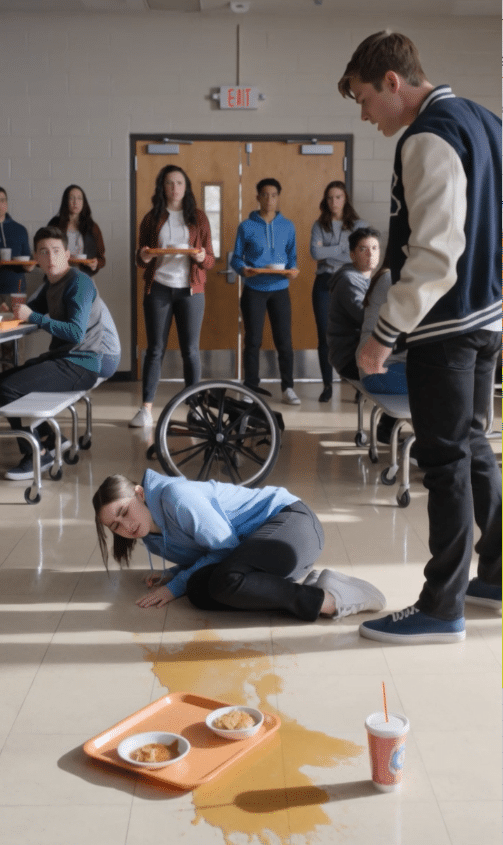
The lunch tray hit the floor before anyone understood what had happened.
A carton of food flipped upside down.
A drink splashed across the tile.
The wheelchair spun sideways.
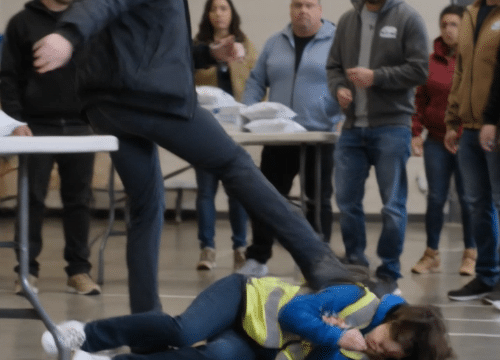
And fifteen-year-old Emily Carter crashed onto the cafeteria floor beside the table.
For one terrible second, the entire lunchroom froze.
Emily’s light blue hoodie was twisted beneath her. Her small backpack had slipped from the back of the wheelchair, and one white shoe had come loose.
The girl tried to breathe.
Her elbow had struck the table leg during the fall, leaving a thin trace of blood.
But the pain wasn’t the worst part.
Everyone was staring.
Standing over her was Madison Blake, seventeen, wearing an expensive varsity jacket and spotless new sneakers.
Moments earlier, Madison had spat into Emily’s lunch because Emily hadn’t moved her wheelchair quickly enough from the crowded aisle.
Now she looked down at the ruined meal with a cruel smile.
Emily swallowed hard.
“Please… I didn’t block you…”
Madison’s expression didn’t change.
“Trash. Eat from the floor.”
A few students covered their mouths.
Someone dropped a fork.
Another student quietly stepped backward.
Emily tried to pull herself closer to her wheelchair.
Madison stepped toward her again.
Two hard kicks struck Emily’s back and side.
Emily curled instinctively, her face tightening as she fought not to cry.
The cafeteria had become strangely quiet.
No laughter.
No conversation.
Just frightened breathing and the squeak of a wheelchair wheel turning slowly against the floor.
Madison looked down at her.
“You don’t belong at this table.”
Emily’s eyes filled with tears.
Not because she believed Madison.
Because she knew everyone had heard it.
Everyone had seen it.
And nobody had moved.
Then the cafeteria doors burst open.
And the person walking through them was about to change what “belonging” meant in that school forever.
Act II
Emily had never wanted attention.
That was what made the humiliation so devastating.
She wasn’t the loud student.
She wasn’t the girl who started arguments in the hallway.
She wasn’t interested in popularity.
She simply wanted to get through high school like everyone else.
Her wheelchair was part of her life, but it wasn’t her identity.
She had friends.
She had favorite classes.
She complained about homework.
She laughed at stupid jokes.
She worried about exams.
She had a favorite seat in the cafeteria.
And that seat happened to be at the table Madison considered hers.
That was where the problem began.
Madison came from a wealthy family.
Everyone knew it.
Her father donated money to the school.
Her mother chaired several community committees.
Madison wore clothes most students recognized immediately as expensive.
Teachers knew her family.
Administrators knew her family.
Other students knew better than to challenge her.
Over time, Madison had developed an invisible territory around herself.
Certain hallway lockers.
Certain lunch tables.
Certain groups of students.
And, eventually, the seat where Emily had begun eating lunch.
Nobody had officially told Emily she couldn’t sit there.
But Madison didn’t believe she needed permission to make the rule.
For weeks, the tension had been building.
A comment here.
A deliberate obstruction there.
A laugh when Emily struggled to maneuver through the crowded lunch line.
Nothing dramatic enough to trigger a formal complaint.
Nothing obvious enough to force adults to intervene.
Until that afternoon.
The cafeteria was packed.
Students were carrying trays in every direction.
Emily had waited patiently for her lunch.
She turned her wheelchair into the aisle.
Madison and her friends were behind her.
Emily heard someone complain.
She kept moving.
She was trying to reach the table without bumping anyone.
Then Madison stepped closer.
Emily moved as quickly as she safely could.
It wasn’t fast enough.
Madison became furious.
She leaned over Emily’s tray.
And spat into the food.
The cafeteria noise seemed to disappear around them.
Emily stared at her lunch.
Then at Madison.
She didn’t understand why someone would do something so deliberately cruel.
She tried to move away.
That was when Madison kicked the wheelchair.
Then Emily.
The chair rolled sideways.
Emily fell.
Her lunch scattered.
And Madison turned the moment into a performance.
“Trash. Eat from the floor.”
That was when something inside Emily broke.
Not her spirit.
Something else.
The last bit of hope that if she stayed quiet, stayed polite, and never caused trouble, people would eventually leave her alone.
She looked around.
Classmates stared back.
Some looked horrified.
Others looked away.
Nobody wanted to become Madison’s next target.
Then Emily heard the cafeteria doors open.
Hard.
The principal entered with the school counselor and two security officers.
Principal David Reynolds didn’t walk casually.
He moved quickly.
His eyes went directly to the floor.
The ruined lunch.
The spilled drink.
The overturned wheelchair.
Then Emily.
His expression changed.
He had known Emily for years.
But there was something else he knew that Madison didn’t.
Something buried inside a school record that almost nobody had ever bothered to read.
The principal looked toward Madison.
Then back at Emily.
The security officers stepped forward.
The cafeteria went silent.
Madison still thought this was about a lunch table. She had no idea what the principal had just recognized.
Act III
Principal Reynolds stopped beside Emily first.
That mattered.
He didn’t walk toward Madison.
He didn’t ask who started the argument.
He didn’t demand an explanation from the loudest student.
He looked at the girl on the floor.
Then at the ruined lunch tray.
Then at the wheelchair lying several feet away.
“Step away from her. This ends now.”
The words were calm.
But they carried through the entire cafeteria.
Security immediately positioned themselves between Madison and Emily.
The counselor moved closer to the student.
The crowd parted.
Madison’s confidence disappeared almost instantly.
She looked from the security officers to the principal.
Then toward the cafeteria doors.
For the first time, she seemed uncertain.
But she still didn’t understand.
“What ends now?”
Her question hung unanswered.
Principal Reynolds looked at her.
Then he looked toward the ruined lunch.
Something about that tray seemed to bother him more than the spilled food itself.
It represented something.
A pattern.
A record.
A problem the school had been trying to address quietly for months.
Emily wasn’t the first student who had been made uncomfortable around Madison.
She was simply the first one who had been publicly attacked.
Several complaints had already been documented.
None had involved violence.
A student had reported being mocked for her clothes.
Another had complained that Madison deliberately excluded students from certain tables.
A third had described Madison’s group blocking a hallway and laughing when younger students tried to get through.
Each incident had been small.
Each could be dismissed as teenage behavior.
But together, they painted a different picture.
A pattern of power.
A belief that some students deserved more space than others.
And Emily had become the easiest target because Madison believed the wheelchair made her unable to fight back.
There was another reason the principal knew Emily so well.
Emily’s mother had once been one of the school’s most dedicated volunteers.
Years earlier, before Emily’s health problems forced her family to change their lives, her mother had helped create several accessibility improvements at the school.
The ramps.
The wider cafeteria routes.
The accessible classroom entrances.
The very infrastructure Madison had used that afternoon without thinking about who had fought to put it there.
Emily had never used her mother’s work as a weapon.
She didn’t tell people.
She didn’t expect special treatment.
She simply benefited from something her family had helped build.
Principal Reynolds remembered.
He remembered because he had been there.
And he knew exactly how hard Emily had worked to make sure other students never had to feel ashamed of needing accommodations.
That was why seeing her on the cafeteria floor affected him so deeply.
Not because she was special.
Because she deserved the same dignity as every other student.
Madison’s parents had influence.
But influence wasn’t immunity.
And for the first time, Madison seemed to realize that the adults in the room weren’t afraid of her family.
The security officers remained between her and Emily.
The counselor carefully collected Emily’s backpack.
The ruined lunch sat untouched on the floor.
Students stared.
Some looked ashamed that they had done nothing.
Others looked angry.
The atmosphere had completely changed.
Madison’s friends began separating themselves from her.
One moved toward another table.
Another lowered her eyes.
The social power Madison had enjoyed minutes earlier was disappearing.
But Principal Reynolds wasn’t finished.
He looked toward the cafeteria staff.
Then toward the hallway.
Then back at Madison.
There was a reason the doors had been opened so suddenly.
The school had already begun documenting the incident.
And the security cameras had captured everything.
The spit.
The kick.
The fall.
The follow-up attack.
The humiliation.
There would be no version of events Madison could rewrite.
No claim that Emily had somehow caused it.
No excuse about an accident.
The cameras had seen the truth.
And the truth was now standing in the middle of the cafeteria.
But the footage wasn’t the only thing waiting behind the principal’s office door.
Act IV
The cafeteria remained frozen.
Madison stood alone.
The expensive jacket suddenly looked strangely out of place beneath the harsh fluorescent lights.
Principal Reynolds didn’t raise his voice.
He didn’t need to.
He simply gestured toward the security officers.
They remained between Madison and Emily.
The counselor stayed beside the younger girl.
Emily had finally managed to sit upright.
Her face was wet with tears.
She looked embarrassed.
Not weak.
Embarrassed.
The kind of embarrassment that comes from being hurt in front of people whose opinions matter when you’re fifteen.
The principal noticed.
He had seen students experience that feeling before.
And he knew something important.
The person who causes humiliation often assumes the victim will remember the pain forever.
Sometimes they do.
But sometimes what the victim remembers most is who finally stood beside them.
Principal Reynolds looked around the cafeteria.
Dozens of students were watching.
He wanted them to understand what had just happened.
Not because Emily needed to become a symbol.
But because Madison had tried to turn cruelty into entertainment.
That ended now.
The school had records.
Security footage.
Witness statements.
And a clear account of what happened.
Madison’s parents might have influence outside the cafeteria.
Inside it, the rules applied to everyone.
The counselor finally helped Emily gather her belongings.
Her small backpack was returned.
Her wheelchair was positioned upright.
The lunch tray was left on the floor for the moment.
Emily stared at it.
It was such an ordinary thing.
A school lunch.
A drink.
A tray.
Yet somehow it had become the center of the entire confrontation.
Madison had believed ruining that meal would make Emily feel powerless.
Instead, the ruined lunch had become evidence.
The spilled drink became evidence.
The scattered food became evidence.
The wheelchair on its side became evidence.
And the security footage became the final piece.
Madison looked toward the cafeteria doors.
Then toward the principal.
Her expression had changed completely.
The cruelty was gone.
The confidence was gone.
What remained was defensive confusion.
She had expected her friends to laugh.
They weren’t.
She had expected students to look away.
Now they were watching her.
She had expected the incident to disappear when lunch ended.
Instead, the entire administration was involved.
And Emily was no longer alone.
The principal’s decision wasn’t about revenge.
It was about boundaries.
A school couldn’t tell students that respect mattered while allowing the most vulnerable student in the room to be publicly humiliated without consequence.
Madison had believed that because of her family’s status, she could control the social rules.
But school rules weren’t family property.
They belonged to everyone.
The cafeteria doors remained closed.
The counselor stayed beside Emily.
Security stood between the two girls.
And the students who had been silent earlier finally understood something uncomfortable.
Silence had protected Madison.
Not because they agreed with her.
Because they were afraid of becoming her next target.
Now that fear was breaking.
One student picked up a fallen napkin.
Another moved a chair away from the spilled drink.
Nobody made a speech.
Nobody applauded.
But the room was beginning to change.
Emily looked around.
For the first time since she had fallen, she wasn’t looking at the floor.
She was looking forward.
Principal Reynolds turned toward Madison.
The next step would happen behind closed doors.
There would be reports.
Parents would be contacted.
The footage would be reviewed.
And the school would decide what consequences followed.
But one thing was already clear.
Madison’s reign over that cafeteria was over.
Because the girl she had tried to isolate had just become the reason the entire school was forced to confront what had been happening in plain sight.
Act V
By the end of the day, the cafeteria looked completely different.
The spilled drink had been cleaned.
The food had been removed.
The chairs had been straightened.
Emily’s lunch was gone.
But the moment itself remained.
Not in the food.
Not in the broken silence.
In the memory of everyone who had witnessed it.
Emily eventually returned to her classroom.
Her wheelchair was beside her desk.
Her backpack was back where it belonged.
The counselor checked on her before leaving.
Emily didn’t suddenly become fearless.
She didn’t forget what happened.
She didn’t magically stop caring what other students thought.
She was fifteen.
Of course it hurt.
But something else had changed.
She no longer believed that staying silent was the only way to survive.
The school administration formally documented what had happened.
The security footage provided an objective record of the confrontation.
The earlier complaints were reviewed.
What had once looked like isolated incidents now had context.
Madison’s behavior had not appeared out of nowhere.
It had grown because people had tolerated it.
Because students laughed.
Because others stayed silent.
Because influence had sometimes been mistaken for permission.
That afternoon forced the school to look at all of it.
Madison eventually faced the consequences of her actions through the school’s disciplinary process.
Her parents could argue.
They could demand explanations.
They could insist their daughter had been misunderstood.
But the footage remained.
And so did the witnesses.
For Emily, however, the most important moment came later.
She returned to the cafeteria the following week.
Same tables.
Same fluorescent lights.
Same lunch line.
Same wheelchair.
She approached the table where everything had happened.
For a moment, she hesitated.
Then she rolled forward.
No dramatic announcement.
No confrontation.
She simply took her seat.
A few students glanced at her.
Then one sat nearby.
Another followed.
Soon the table was no longer empty.
Emily opened her lunch.
She took a breath.
And kept eating.
That was the real ending.
Not Madison being humiliated.
Not the principal raising his voice.
Not the security officers surrounding the cafeteria.
Emily simply reclaiming a place she had never needed permission to occupy.
The table had never belonged to Madison.
Neither had the hallway.
Neither had the cafeteria.
And certainly not the dignity of another human being.
The girl in the wheelchair had entered that lunchroom hoping to eat a normal meal.
She left that day carrying something much heavier.
A painful memory.
But also a lesson.
Being vulnerable doesn’t mean being powerless.
Being quiet doesn’t mean being invisible.
And asking for basic respect doesn’t make someone difficult.
Sometimes it takes one cruel act to expose an entire culture of silence.
Sometimes it takes one adult willing to say enough.
And sometimes the most powerful response to humiliation isn’t revenge.
It’s simply refusing to disappear.
Emily never got her original lunch back.
She never got that ordinary afternoon back either.
But she got something more important.
She got her place at the table back.
And this time, nobody could tell her she didn’t belong.