Act I
The coins scattered across the polished mall floor before anyone moved.
They rolled beneath shopping bags.
One disappeared beneath a bench.
Another spun in a slow circle before finally falling flat.
Thirteen-year-old Noah Ellis stared at it from the ground.
His old brown hoodie was twisted beneath him. His oversized coat had slipped open, exposing a faded shirt underneath.
He had been trying to get out of the way.
That was all.
He had been sitting near the mall exit with a paper cup containing a few coins when the crowd became too heavy.
When he stood to move, his shoulder brushed against a wealthy man’s leg.
Barely a touch.
An accident.
But the man turned as though Noah had committed some unforgivable offense.
He wore a black cashmere coat, gray trousers, polished shoes, and carried several designer shopping bags.
He looked down at the boy.
Then at his own trousers.
His expression hardened.
Noah immediately stepped backward.
“I was just moving away…”
The man’s face twisted with contempt.
“Trash. Don’t touch people like me.”
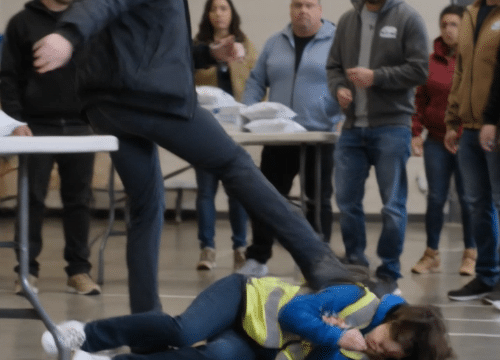
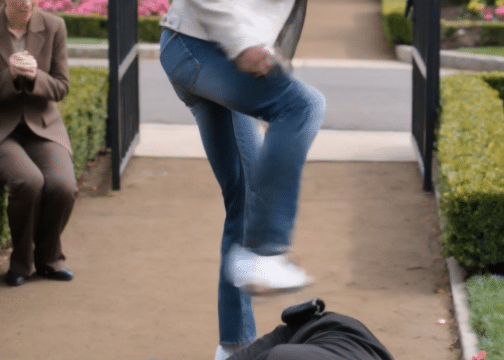
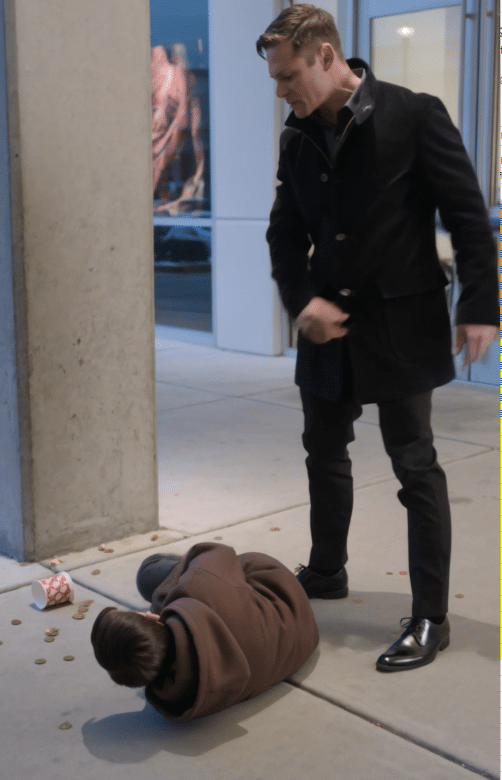
Before Noah could say anything else, the man’s foot struck him hard in the chest.
Noah stumbled backward and slammed against the concrete column beside the exit.
The paper cup flew from his hand.
Coins scattered everywhere.
His elbow caught the edge of the column, leaving a thin trace of blood.
The mall doors chimed behind him as shoppers stopped.
Noah tried to push himself upright.
He couldn’t.
His breath came in short, frightened gasps.
The man stepped closer.
Two more kicks landed while Noah was down.
The boy curled inward, grimacing as he tried to protect himself.
Around them, people froze.
A woman covered her mouth.
A teenager stepped behind his mother.
Nobody moved toward Noah.
The wealthy man looked down at him.
“Beg from the ground.”
Noah stared at the coins.
Those few coins had taken him most of the day to collect.
He reached for one.
His hand trembled.
Then the sound of screeching brakes came from outside.
A black SUV stopped directly beyond the glass doors.
The mall entrance suddenly filled with hurried footsteps.
Security radios crackled.
The automatic doors opened.
A woman in a long black coat stepped inside with an assistant and several mall security officers.
She saw Noah.
She saw the scattered coins.
Then she saw the man standing over him.
Her expression changed.
She moved forward.
“Touch him again, and you answer to me.”
The man turned.
He stared at her.
The crowd went silent.
He looked offended.
Confused.
Almost amused.
“Answer to you?”
He still didn’t know who had just stepped between him and the boy—and why every security officer in the building was suddenly listening to her.
Act II
Noah had learned how to become invisible.
At thirteen, that shouldn’t have been a skill a child needed.
But homelessness teaches children strange things.
Don’t stand in doorways too long.
Don’t block shoppers.
Don’t look into expensive stores.
Don’t ask twice.
Don’t make security angry.
And above all, don’t attract attention.
Noah had spent months moving between temporary shelters, church programs, and nights with people his family barely knew.
His mother had disappeared from his life after a long period of instability.
His father was gone.
Noah rarely talked about either of them.
He carried most of what he owned in a small backpack.
The paper cup was different.
It was his.
He used it when people occasionally gave him coins.
Sometimes someone bought him food.
Sometimes they walked past.
He had stopped expecting either reaction.
That afternoon, he had positioned himself near the mall entrance because it was warmer than the street outside.
He wasn’t trying to bother anyone.
He wasn’t begging aggressively.
He simply sat against the wall, holding the cup in his lap.
Then the man arrived.
His name was Richard Hale.
Forty-two years old.
Successful.
Wealthy.
Used to being recognized.
He had spent the afternoon shopping for gifts before an important private event that evening.
His bags carried things Noah could barely imagine owning.
A watch.
A tailored shirt.
A pair of shoes.
A luxury gift box.
Richard was accustomed to moving through the world without being inconvenienced.
The crowded exit annoyed him.
Then Noah stood.
The boy tried to move away.
His sleeve brushed Richard’s leg.
Richard looked down.
That tiny accident became, in his mind, an insult.
Noah apologized immediately.
It didn’t matter.
Richard had already decided what kind of person the boy was.
Someone beneath him.
Someone who should know his place.
The first kick shocked everyone.
The second changed the atmosphere.
The third made it impossible to pretend this was merely an argument.
Yet the people nearby still didn’t intervene.
They were afraid.
Some worried about making things worse.
Others assumed security would handle it.
And some simply didn’t want to become involved.
Noah understood their silence.
He had seen it before.
People could look directly at someone in trouble and still convince themselves it wasn’t their responsibility.
But there was one person inside the mall who couldn’t ignore what she was seeing.
Her name was Victoria Sterling.
Fifty-five years old.
Elegant.
Controlled.
And connected to the company that owned the mall.
Victoria had arrived unexpectedly that evening for a private meeting with the management team.
Her black SUV had barely stopped before her assistant noticed the commotion.
Then Victoria saw the boy.
She knew his face.
Not personally.
But from a file.
Several weeks earlier, Victoria had reviewed a community outreach report concerning children who regularly passed through the mall’s surrounding district.
One name had stayed with her.
Noah Ellis.
Thirteen.
Frequently seen near the shopping center.
No stable housing.
No reliable guardian.
No criminal history.
No record of aggressive behavior.
The report had contained one additional detail.
Noah was exceptionally protective of a small envelope he carried in his backpack.
It contained copies of documents related to his mother’s estate.
Documents nobody had paid much attention to.
Victoria had.
Because she recognized the name on one of them.
Her own family foundation.
Years earlier, the Sterling Foundation had funded a housing program that had quietly helped dozens of struggling families.
Noah’s mother had once been part of that program.
And something had gone wrong.
A payment had been redirected.
A housing application had vanished.
Records had been altered.
Victoria had never understood why.
Until Noah’s file crossed her desk.
She had started asking questions.
The answers had led somewhere unexpected.
But she hadn’t expected to meet Noah like this.
On the floor.
His coins scattered around him.
A wealthy man standing over him.
The timing was almost impossible.
And Victoria knew something Richard didn’t.
Noah wasn’t simply a homeless child near her mall.
He was connected to a story that had been buried for years.
The boy Richard had treated like invisible was carrying the key to a scandal Victoria had been trying to uncover.
Act III
Victoria stepped farther into the entrance.
Security immediately spread around her.
No one needed to tell them what to do.
They knew who she was.
Richard didn’t.
That was the difference.
He looked at Victoria’s expensive coat and assumed she was another executive.
Perhaps someone who worked for the mall.
Perhaps someone who would apologize for the inconvenience.
He didn’t understand that Victoria wasn’t there to negotiate.
She was there because the situation had crossed a line.
Her attention returned to Noah.
The boy was still on the ground.
His hand had finally reached one of the coins.
He held it tightly.
Victoria’s eyes moved to his backpack.
The small envelope was visible through the partially opened zipper.
She recognized the corner of a document.
A name.
A signature.
A date.
Her expression became colder.
Months earlier, Victoria had ordered an internal review of several charitable housing accounts.
The review had uncovered irregularities.
Money intended for emergency housing had disappeared.
Not millions.
Small amounts.
Amounts scattered across hundreds of transactions.
Small enough to avoid immediate suspicion.
Large enough to devastate families living one missed payment away from the street.
One of those families had been Noah’s.
His mother had applied for temporary housing after losing her job.
The application had been approved.
Then someone had altered the file.
The approval vanished.
The funds were redirected.
The family was never notified.
Victoria had initially suspected administrative incompetence.
Then she found evidence suggesting deliberate manipulation.
Someone inside the system had been taking advantage of families who couldn’t fight back.
Noah’s mother had tried.
She had written letters.
Filed complaints.
Requested copies.
Then she disappeared from the program.
Her son ended up on the street.
The case was still under review.
Victoria had not yet discovered who was responsible.
But she had discovered something else.
Noah still had copies of the original paperwork.
His mother had kept them.
And those documents could connect the missing money to people who believed the past had been buried.
Victoria looked at the boy again.
Suddenly, the scene made sense in a way that had nothing to do with the mall.
Richard thought he was punishing a nuisance.
In reality, he had attacked a child whose existence was already evidence of a much larger failure.
The security officers moved closer to Noah.
Richard took a step backward.
His confidence was beginning to disappear.
He looked around.
Shoppers were watching.
Mall employees were watching.
His own designer bags suddenly seemed meaningless.
Victoria’s assistant whispered something to her.
She nodded.
Security cameras had recorded everything.
Every second.
The accidental contact.
The kick.
The fall.
The follow-up assault.
The coins scattering.
Richard’s words.
There would be no argument about what happened.
No convenient misunderstanding.
No version where Noah had somehow been the aggressor.
The cameras had seen the truth.
But Victoria wasn’t finished.
She had asked her assistant to pull Noah’s file because she wanted to know whether the boy was safe.
Now she knew something much more important.
He had been living near the mall for weeks.
He had been seen repeatedly.
And despite the mall’s extensive security system, nobody had connected him with the housing case.
Nobody had asked why a thirteen-year-old child was sleeping outside.
Nobody had asked why his mother had disappeared from a program that was supposed to protect families like theirs.
Until now.
Richard looked at Victoria.
He was finally beginning to understand that he had chosen the wrong person to intimidate.
But he still didn’t understand why.
Victoria didn’t explain.
Not yet.
Because the real truth wasn’t about her.
It was about Noah.
And what his documents could reveal.
The man who thought he had found a powerless child had unknowingly attacked the one person who could reopen a case powerful people had spent years trying to forget.
Act IV
The next morning, the mall security footage was preserved.
Victoria made sure of it.
No one would overwrite the recording.
No one would “lose” the files.
No one would quietly settle the incident and move on.
The footage showed exactly what happened.
Noah had moved away from the entrance.
His shoulder had accidentally brushed Richard’s leg.
Richard had escalated.
The boy had tried to explain.
Richard had attacked him.
Then he had continued after Noah was already on the ground.
There was no ambiguity.
But Victoria’s attention had shifted to something bigger.
She asked for the old housing records.
Then the financial records.
Then the archived correspondence.
The same names appeared repeatedly.
One contractor.
One former administrator.
Several questionable transfers.
And one signature appearing on documents that were supposed to have been approved years apart.
The investigation began moving quickly.
Noah’s mother’s case had not been an isolated failure.
Other families had experienced similar problems.
Applications disappeared.
Payments were delayed.
Records changed.
People were told they had never qualified.
Families who couldn’t afford lawyers simply gave up.
Noah’s mother hadn’t.
She had kept copies.
That envelope in his backpack contained enough information to challenge the official version of what happened to his family.
Victoria finally understood why his mother had protected those papers.
She had known someone might need them someday.
She had been right.
Noah was eventually placed somewhere safe.
His injuries were treated.
His belongings were collected.
His coins were returned.
But Victoria never treated him like a helpless charity case.
She treated him like a child whose life had been interrupted by circumstances he never chose.
She also made sure the investigation into the housing records continued independently.
Richard, meanwhile, could no longer pretend the mall entrance had been a private stage where he controlled the rules.
His actions had been recorded.
Witnesses had seen them.
Security had intervened.
The incident had consequences.
But the deepest reversal wasn’t Richard losing his composure.
It was discovering that the boy he had called “trash” was now at the center of an investigation involving people with far more influence than he had ever imagined.
Richard had mistaken poverty for weakness.
Victoria had seen something different.
She had seen a child who had survived.
A child who still carried his mother’s papers.
A child who, despite everything, had tried to move out of the way rather than disturb anyone.
That detail stayed with her.
Noah hadn’t asked for a confrontation.
He hadn’t demanded attention.
He had simply tried to disappear.
And Richard had attacked him for taking up space.
Now the entire system was being forced to look at him.
Not as a nuisance.
Not as a statistic.
As a person.
The mall entrance where Noah had once sat became the place where the investigation began.
Security footage became evidence.
The scattered coins became a reminder.
And the little envelope became the thread connecting one child’s homelessness to a much larger story.
Victoria stood outside the entrance later that evening.
The same cold air moved through the parking lot.
The same glass doors opened and closed.
Shoppers carried expensive bags past the place where Noah had fallen.
But the atmosphere was different.
Everyone who knew what had happened understood the same thing.
The boy had not been powerless.
He had simply been unprotected.
There was a difference.
And once the right person decided to protect him, the man who had demanded that he “beg from the ground” was about to discover how quickly power can change hands.
Act V
Weeks later, the investigation reached the families affected by the housing scheme.
Records were reviewed.
Old complaints were reopened.
Missing documents were recovered.
Several people were questioned about decisions that had once seemed too minor to investigate.
Noah’s mother’s name appeared again.
This time, it wasn’t buried in an old file.
It was part of the evidence.
Her original housing application was restored.
The missing approval was found.
The financial records surrounding it were examined.
The story of how Noah became homeless was no longer something people could dismiss as bad luck.
There had been failures.
There had been decisions.
And there had been people who had benefited while families suffered.
Victoria couldn’t change the years Noah had already lost.
Nobody could.
But she could make sure the record told the truth.
Noah eventually received stable housing.
He returned to school.
He had a real bedroom.
A desk.
A place to keep his backpack.
A refrigerator that was always stocked.
Small things.
Ordinary things.
Things most children never think twice about.
For Noah, they felt enormous.
He still kept the paper cup.
Not because he needed it anymore.
Because it reminded him of where he had been.
And he kept the coins too.
He put them in a small glass jar beside his desk.
One evening, Victoria visited him.
She didn’t bring a grand gift.
She brought a folder.
Inside were copies of the documents his mother had protected.
The truth was finally safe.
Noah looked at the papers for a long time.
Then he closed the folder.
For the first time in years, he didn’t need to carry his entire life in a backpack.
Outside, winter was fading.
The mall entrance remained busy.
People still hurried through the glass doors.
Cars still stopped at the curb.
Shoppers still carried designer bags.
But one corner of that building had changed forever.
The place where Noah’s coins had scattered was no longer remembered only as the scene of an attack.
It became the place where someone finally stopped looking away.
Richard had believed the boy’s poverty made him insignificant.
He had believed wealth gave him permission to humiliate someone who couldn’t fight back.
He had believed the crowd would remain silent.
For a few terrible minutes, he was right.
But then the black SUV arrived.
Security stepped forward.
Victoria stood between them.
And the story changed.
Not because Noah suddenly became wealthy.
Not because someone handed him a magical new life.
Because someone finally recognized that dignity doesn’t depend on what a person owns.
The boy with the worn sneakers had always been worth protecting.
The coins had never measured his value.
The old hoodie had never measured his future.
And the concrete floor had never been where he belonged.
It was simply where he happened to fall.
The real victory came later.
When he stood again.
When he went back to school.
When he opened his own front door.
And when he finally realized that being unseen was no longer the same thing as being forgotten.
As for the man who had looked down at him that cold evening, he would probably remember the moment the black SUV stopped.
He would remember the security officers.
He would remember the sudden silence.
Most of all, he would remember the woman who stepped between him and the child.
Because he had asked a simple question.
“Answer to you?”
He had wanted to know who she was.
The truth was bigger than her title.
She was the person who had decided the boy would no longer stand alone.
And once that decision was made, the world around Noah began to change.
Not with a miracle.
With evidence.
With accountability.
With a door finally opening.
And with a thirteen-year-old boy learning, perhaps for the first time, that he never needed to beg for the right to be treated like a human being.