Act I
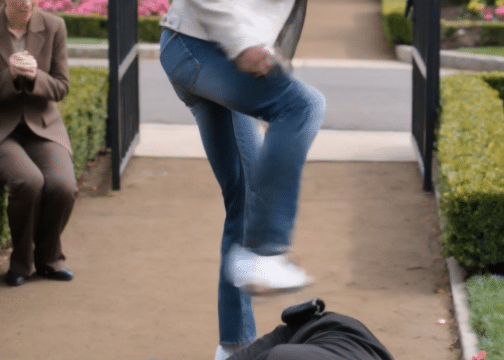
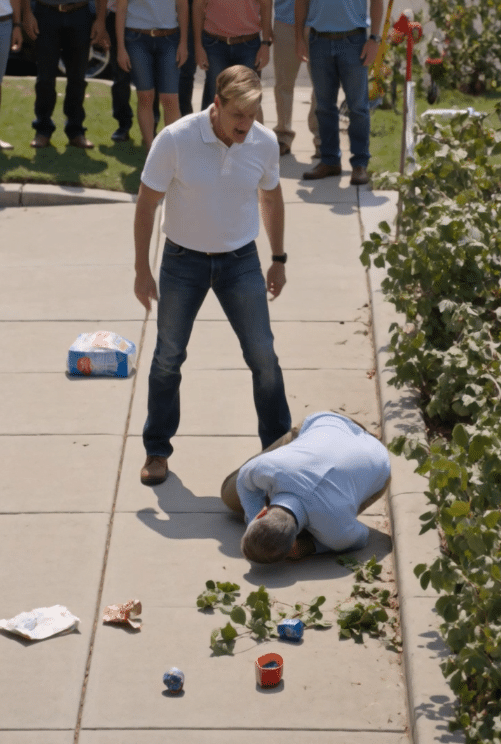
The kick sent the 63-year-old man crashing into the flower fence.
Branches snapped beneath him.
His grocery bag flew from his hand, oranges and a carton of milk rolling across the sidewalk as freshly trimmed clippings scattered around his shoes.
Nobody on the street moved.
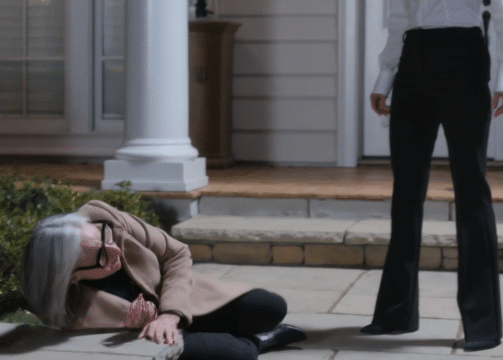
The man in the gray cardigan lay beside the fence, grimacing as he tried to catch his breath. His elbow had struck the base of the fence, leaving only a thin trace of blood, but the pain in his face was impossible to hide.
He had not come looking for a fight.
He had simply pointed toward the sidewalk.
The homeowner had been trimming his flower fence, leaving a pile of branches and clippings directly across the path.
The sidewalk was nearly impossible to use.
The older neighbor had approached politely, grocery bag in hand, and asked him to clear it.
That was all.
Now the homeowner stood over him in garden gloves, white polo shirt stretched across his shoulders, staring down with furious contempt.
The injured man slowly lifted his head.
“I only asked you to clear the sidewalk…”
The homeowner sneered.
“Trash. Don’t lecture me.”
The words were followed by another burst of violence.
Two forceful kicks struck the older man’s back and side while he remained down among the branches.
He curled inward, grimacing and breathing hard.
A woman watching from a porch covered her mouth.
Another neighbor stepped backward.
Someone’s front door opened, then stopped halfway.
Nobody intervened.
The homeowner looked down at the scattered groceries as though they were the victim’s fault.
Then he delivered the sentence that revealed exactly how he saw the neighborhood around him.
“This street isn’t yours.”
The older man said nothing.
He simply stared at him, confused by how quickly a polite request had become an attack.
But the homeowner had made one mistake.
He had assumed the street belonged to whoever shouted the loudest.
He had forgotten that a neighborhood has a memory.
And seconds later, a black SUV came to a hard stop at the curb.
Act II
The street had always been the kind of place where people noticed everything.
Not because the residents were nosy.
Because they lived close enough to know when something changed.
They knew whose porch light stayed on late.
They knew which family had planted roses along the sidewalk.
They knew which elderly residents walked slowly to the mailbox.
And they knew exactly what the neighborhood rules said about maintaining property that bordered shared walkways.
The 63-year-old neighbor had lived there long enough to understand that distinction.
He wasn’t demanding perfection.
He wasn’t trying to control anyone’s garden.
He simply believed that a public sidewalk should remain usable.
Especially for older residents.
Especially for people pushing strollers.
Especially for anyone walking through the neighborhood without wanting to step into the street.
The homeowner saw the request differently.
He had recently spent money renovating his yard.
The flower fence was new.
The landscaping was expensive.
And he had developed a reputation for becoming defensive whenever anyone commented on his property.
He didn’t hear a neighbor asking for cleanup.
He heard criticism.
He heard someone challenging his authority over his own home.
So when the older man pointed toward the branches, the homeowner’s temper exploded.
The victim hadn’t expected it.
Neither had the people watching from nearby houses.
There had been no long argument.
No screaming match.
No history of threats.
Just one ordinary request that somehow became an act of aggression.
Now the sidewalk was covered in groceries and branches.
The victim’s cardigan was dusty.
His face was tense with pain.
And the homeowner stood above him as though nothing had happened.
That was what disturbed the witnesses most.
Not simply the violence.
The complete certainty behind it.
He seemed convinced that because the other man had questioned something on his property, he had somehow earned what happened.
The neighborhood had seen difficult personalities before.
But this was different.
A man had been knocked into a fence over a blocked sidewalk.
And the security camera mounted on a nearby property had captured the entire confrontation.
The homeowner didn’t seem to know that.
Or perhaps he simply didn’t care.
He looked toward the houses.
“This street isn’t yours.”
But the words were already becoming ironic.
Because the street belonged to everyone who lived there.
And one woman had already decided that someone needed to answer for what had just happened.
Her black SUV appeared at the end of the block.
She wasn’t coming alone.
Act III
The SUV braked hard beside the curb.
The door opened.
The homeowners board president stepped out wearing a navy blazer, followed by two board members.
Nearby doors opened wider.
Residents stepped onto porches.
The homeowner’s posture changed almost immediately.
The board president looked first at the injured man.
Not the landscaping.
Not the homeowner.
The victim.
The two board members moved toward him and positioned themselves between the men.
The homeowner stared at them.
He had expected another neighbor.
Instead, he had the people responsible for enforcing the community’s rules standing directly in front of him.
The president looked around.
Branches covered the sidewalk.
Groceries were scattered across the pavement.
The older man remained beside the fence, visibly shaken.
Then she looked toward the homeowner.
She didn’t need to ask what had happened.
There were witnesses.
There were security cameras.
And the condition of the scene told its own story.
For the first time, the homeowner seemed to understand that this wasn’t simply a disagreement between two neighbors anymore.
It was now a community matter.
The president took another step forward.
The homeowner tried to maintain his defiance.
He had always believed neighborhood rules were suggestions meant for other people.
He had never imagined that the board could turn his own behavior into a formal issue.
But the president had something more important than authority.
She had documentation.
Property rules.
Recorded complaints.
And a community that had just watched one of its residents attack another over a sidewalk.
She finally spoke.
“Then answer to the whole neighborhood.”
Silence.
The homeowner’s expression froze.
The sentence wasn’t loud.
It didn’t need to be.
Because everyone understood what it meant.
The same neighbors he had dismissed as irrelevant were now witnesses.
The same street he had claimed wasn’t the victim’s alone was now filled with people watching him.
And the board president wasn’t standing beside him.
She was standing between him and the man he had attacked.
But the most important part was still hidden.
Because the board had been dealing with this property long before today’s confrontation.
And the president had brought more than two people in that SUV.
She had brought the authority to open the neighborhood’s records.
Act IV
The homeowner looked around.
For several seconds, nobody spoke.
The residents who had been watching from their porches remained silent.
The board members stayed beside the injured neighbor.
And the president stood directly in front of the homeowner.
His earlier confidence had begun to disappear.
He had wanted the entire confrontation to remain personal.
A simple dispute.
One neighbor against another.
But the moment the board president arrived, that argument became impossible.
The neighborhood had rules governing sidewalks, common access, landscaping, and property maintenance.
More importantly, those rules applied to everyone.
The homeowner had spent months acting as though his property gave him special authority.
He had planted flowers across the boundary.
He had left clippings on shared walkways.
He had ignored reminders because, in his mind, nobody had the right to tell him what to do.
The older neighbor had finally said something.
And the response had been violence.
The president knew that the issue could no longer be treated as a minor maintenance complaint.
The board members looked toward the security camera.
The homeowner followed their eyes.
His expression changed.
The camera had been there the entire time.
Every movement.
Every kick.
Every moment after the victim fell.
There would be no convincing story about an accidental collision.
No claim that the older man had attacked first.
No way to turn a pile of branches into an excuse.
The evidence existed.
And so did the witnesses.
The victim slowly sat upright.
His breathing remained heavy.
His face showed pain and humiliation, but he wasn’t looking for revenge.
He simply wanted the sidewalk cleared.
That was what made the entire situation feel so absurd.
The request had been reasonable from the beginning.
The response had been completely disproportionate.
The homeowner glanced toward the houses again.
More residents had come outside.
A few stood at the edge of their driveways.
Others watched from behind windows.
His private confrontation had become public.
The president remained calm.
She wasn’t interested in humiliating him.
She was interested in making the rules apply.
That difference mattered.
Because accountability wasn’t about taking someone’s property away simply to punish them.
It was about documenting what happened, addressing the violation, and ensuring that no one believed violence was an acceptable way to settle a neighborhood dispute.
The homeowner had thought the victim was powerless because he was alone.
Now he was surrounded by people who had witnessed the consequences.
The black SUV remained at the curb.
The board president remained standing.
And the homeowner finally looked at the people watching him.
His earlier words suddenly sounded ridiculous.
This street wasn’t his.
It never had been.
It belonged to everyone.
And now everyone was watching.
Act V
The neighborhood eventually returned to quiet.
But it was no longer the same quiet.
The groceries were gathered from the sidewalk.
The branches were moved away from the walkway.
The injured neighbor was given the space he needed to recover and deal with what had happened.
And the board began formally documenting the incident.
There would be no whispered version of events where the older man was somehow blamed for provoking the homeowner.
There was a record.
There were witnesses.
There was video.
And there was a simple fact at the center of everything.
A neighbor had asked for a sidewalk to be cleared.
The request had been met with violence.
The homeowner had believed that defending his property meant defending his pride.
But property ownership had never given him ownership of another person’s dignity.
The older man had not asked him to change his flowers.
He had not demanded that he remove the fence.
He had not tried to control his yard.
He had pointed at branches blocking a shared path.
A small problem.
An ordinary problem.
The kind of problem neighbors should be able to solve with one sentence.
Instead, the homeowner had turned it into something the entire neighborhood would remember.
As residents watched the board members help restore order around the walkway, the meaning of the president’s words became clear.
“Then answer to the whole neighborhood.”
Not because the neighborhood wanted revenge.
Because communities only function when people understand that private property does not erase public responsibility.
The homeowner had spent the afternoon believing that everyone else was beneath him.
Now he was standing beneath the eyes of the people he had dismissed.
The irony was impossible to miss.
He had told the victim that the street wasn’t his.
But he had forgotten something.
It wasn’t his street either.
It was a community.
And a community remembers how people treat one another.
The homeowner looked from porch to porch.
His face tightened.
For the first time, his arrogance gave way to uncertainty.
He seemed to realize that the argument he thought he had won had become the incident everyone would discuss at the next neighborhood meeting.
The black SUV remained behind him.
The board president remained in place.
The witnesses remained silent.
He looked around one final time.
“The whole neighborhood?”
And the question carried something his earlier threats had never contained.
Fear.