Act I
“Please… I need that medicine tonight.”
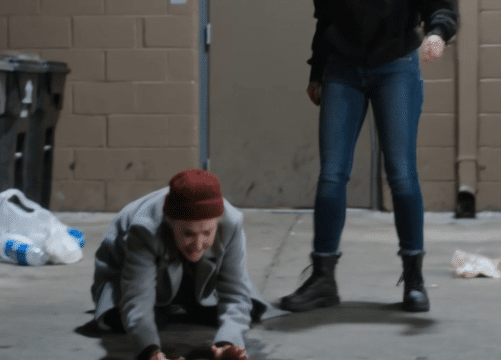
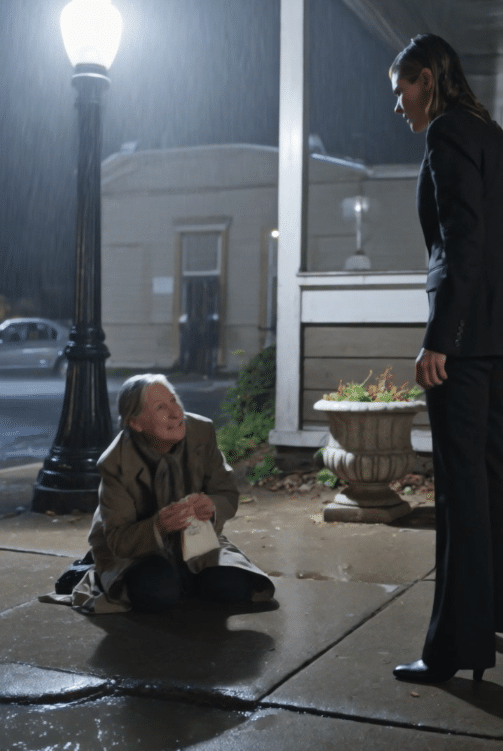
The elderly woman was still reaching toward the puddle when the man kicked her again.
Her thin raincoat clung to her shoulders. Her old scarf had slipped sideways, and her trembling fingers stretched across the wet pavement toward a cheap paper bag that had split open beside a crumbling porch. Small medicine containers and loose pills lay scattered in the rain, some drifting toward the gutter.
The man in the black suit looked down at her with disgust.
“Trash. Walk faster next time.”
He had jumped out of his expensive sedan moments earlier, furious that she had been moving too slowly along the sidewalk near his car. Instead of asking her to move, he had stepped into her path and driven a forceful kick into her chest, knocking her backward onto the slick pavement.
Her elbow struck the edge of a concrete planter. A thin trace of blood appeared against her skin, nearly washed away by the rain.
For a moment, she could only gasp.
Then she saw the medicine.
She tried to push herself forward, grimacing as pain tightened across her face. Her breathing came in short, frightened bursts, and her hands shook so badly that she could barely reach the nearest container.
The man stepped through the puddle and kicked her twice more, striking her back and side as she reached for the scattered medicine.
A woman waiting beneath a nearby awning covered her mouth. A driver slowed at the curb, staring through his windshield. Someone standing outside a closed convenience store took one step forward, then stopped when the man turned his head.
Nobody came to her aid.
The man straightened his jacket.
“You should not be outside.”
His name was Richard Hale, a forty-two-year-old property investor who had spent years confusing wealth with permission. He owned a polished sedan, wore suits tailored to his measurements, and spoke to service workers as though they were obstacles placed in his way for his personal amusement.
That night, the rain had delayed him by eleven minutes.
To Richard, those eleven minutes mattered more than the woman lying at his feet.
Her name was Eleanor Brooks. She was seventy-eight years old, lived alone in a deteriorating house three blocks away, and had spent most of her life trying to remain independent. She hated asking for help. She hated admitting that her hands sometimes shook too much to open a bottle or that the cold made the stairs to her front porch feel steeper every winter.
Most of all, she hated the thought of becoming a burden.
Her medicine was one of the few things she still managed to buy on her own. She had counted her money carefully that afternoon, chosen the least expensive pharmacy, and tucked the small bag beneath her coat to protect it from the weather.
Now the bag lay in a puddle.
Eleanor pressed one hand against her chest and tried to breathe through the pain. Her eyes moved from the scattered medicine to Richard’s polished shoes.
“Please,” she whispered again.
Richard glanced toward his car.
“You people always have an excuse.”
The rain beat against the pavement. A streetlight flickered above them, briefly illuminating Eleanor’s frightened face before the bulb dimmed again.
Then headlights swept across the sidewalk.
A black sedan braked hard beside the puddle.
The driver’s door opened, and a man in a long navy coat stepped into the rain. He carried a small medical bag, and the moment he saw Eleanor on the ground, he stopped looking at anything else.
He hurried toward her and knelt beside her without hesitation.
Richard had no idea who had just arrived.
But the stranger recognized Eleanor immediately.
And what he saw in that puddle would change the night for both of them.
Act II
“Eleanor?”
The doctor’s voice was low, almost disbelieving.
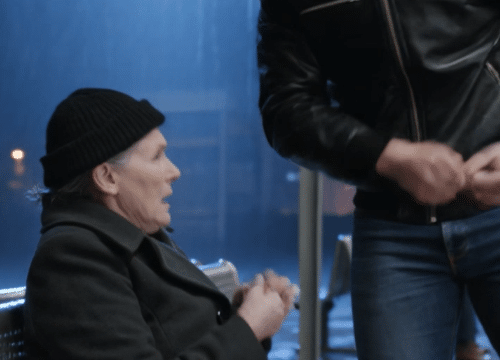
He knelt beside her, shielding her from the rain as best he could with his coat. His eyes moved over her face, her strained breathing, and the way she instinctively curled around her injured side.
“Don’t try to get up yet,” he said gently. “I’m here. Just stay with me.”
Eleanor blinked at him through the rain.
For a few seconds, she seemed unable to reconcile the familiar voice with the man kneeling on the sidewalk. Then recognition reached her, and her expression crumpled.
“Dr. Bennett?”
Dr. Samuel Bennett had spent more than three decades treating patients across the city. At sixty, he was one of the region’s most respected physicians, known not only for his work at St. Catherine’s Medical Center but also for the free evening clinic he had helped establish for people who could not afford regular care.
He had treated Eleanor for years.
He knew that she lived alone, that she was proud, and that she often minimized her symptoms because she worried about the cost of treatment. He knew she would apologize for inconveniencing him even while she was in pain.
He also knew that Eleanor never went anywhere without a small notebook in which she recorded her medications, appointments, and household expenses.
Now that notebook was soaked beside the open medicine bag.
“Can you tell me where it hurts?” he asked.
“My chest,” Eleanor managed. “My side. I fell.”
Samuel glanced at Richard, who was standing only a few feet away, brushing rain from his sleeve.
“You did this?”
Richard let out an irritated breath.
“She walked in front of my car. I had to stop.”
Samuel turned back to Eleanor before answering. Her condition mattered more than Richard’s excuses. He checked her responsiveness, kept her as still and comfortable as possible, and called for emergency medical assistance.
Then he noticed the medication scattered in the puddle.
One container had rolled against the curb. Another lay near Richard’s shoe. The paper bag had dissolved at the bottom, and several pills were already washing away.
Eleanor tried to reach for them.
“No, no,” she whispered. “I need those. I can’t replace them until next week.”
Samuel gently stopped her from stretching toward the gutter.
“We’ll sort that out. Don’t move.”
“But they’re all I have.”
“I understand.”
He did not tell her that medicine could always be replaced, because he knew the price was not the only problem. Replacing a prescription could mean another trip through the rain, another conversation with a pharmacist, another expense she could not afford, and another night wondering whether she had enough left to get by.
He also knew that she had not come outside to take a walk.
She had gone to collect something essential, and now she was hurt, frightened, and lying in the rain.
Richard looked increasingly impatient.
“Are you going to keep talking to her, or are you going to move her? She’s blocking the sidewalk.”
Samuel slowly raised his eyes.
For the first time, Richard seemed to notice the change in the doctor’s expression.
There was no shouting. No theatrical anger. Just a sudden, unmistakable stillness.
Samuel stood enough to place himself between Richard and Eleanor.
“You need to step back.”
Richard gave a disbelieving laugh.
“Do you know who I am?”
“No,” Samuel replied. “And right now, it doesn’t matter.”
Richard’s face reddened.
He was accustomed to introductions changing the atmosphere. He had watched people soften when they learned his name, seen managers become accommodating, and heard apologies from strangers who had done nothing wrong.
But Samuel turned away from him and signaled to his driver.
“Open the rear door. Get a blanket. Keep the car warm.”
Then he looked back at Eleanor.
“You’re not staying out here in this weather.”
Eleanor’s eyes filled with tears.
“I didn’t want to cause trouble.”
Samuel’s expression softened.
“You haven’t caused any trouble, Eleanor.”
Behind him, Richard went quiet.
He had expected the doctor to scold the old woman for being careless, or perhaps tell her to wait somewhere else while he handled the situation. Instead, the physician treated her as though she were the most important person on the street.
And when Samuel looked again at the soaked medicine bag, his concern became something much more serious.
Because he knew Eleanor’s medical history.
He knew what those medications meant.
And he understood that the damage could be far worse than Richard imagined.
Act III
The black sedan’s rear door opened, and the driver returned with a thick blanket.
Samuel wrapped it around Eleanor’s shoulders, careful not to put unnecessary pressure on her chest or side. He spoke to her throughout, explaining what he was doing and reassuring her that the ambulance was on its way.
Then he turned toward Richard.
“Get her inside my car.”
The command was directed at the driver, but Richard reacted as though someone had struck him.
“Excuse me?”
Samuel didn’t answer him immediately. He was watching Eleanor, who had begun shivering harder. He asked the driver to keep the door open and the interior warm while he continued assessing her condition.
Richard stepped closer.
“She’s your patient?”
The question carried a strange mixture of disbelief and accusation, as if Eleanor’s relationship with the doctor were the one fact that might make the situation unreasonable.
Samuel finally faced him.
“Yes. She’s my patient.”
Richard looked Eleanor up and down.
The thin coat. The worn shoes. The old scarf. The house behind her, its porch sagging beneath years of neglect.
“She doesn’t look like someone who can afford a private doctor.”
Samuel’s expression hardened.
“Medical care isn’t a reward for being wealthy.”
Richard scoffed.
“I’m just saying, if she’s your patient, you should have told her not to wander around in the rain.”
Samuel stared at him.
“She was collecting medicine.”
“And now look at the mess.”
For a moment, the rain seemed to be the only sound on the street.
Samuel looked down at the torn bag, then at the pills scattered near the gutter. He had seen patients lose access to treatment because of a missed paycheck, a closed pharmacy, or a prescription they could not afford to refill. He had watched people cut tablets in half to make them last longer, and he had spent countless evenings helping families find assistance before a manageable illness became an emergency.
Eleanor had never asked him to solve her life.
She had asked for help when she needed it and tried to manage the rest herself.
Now Richard was standing over her, complaining about the inconvenience of her suffering.
Samuel’s voice became quieter.
“Did you strike her?”
Richard looked away.
“She fell.”
“Did you kick her?”
“She was in my way.”
It was not a denial.
The woman beneath the awning lowered her hand from her mouth. The driver looked toward the street, then back at Richard. Even the man who had been standing outside the convenience store seemed to understand that the answer had revealed more than Richard intended.
Samuel reached for his phone.
He gave the emergency dispatcher the information they needed and made sure the incident was documented. He instructed his driver to preserve any available dash-camera footage and asked the nearby witnesses to remain until the responding officers arrived, if they felt safe doing so.
Richard watched him with growing irritation.
“You’re making this into something it isn’t.”
“No,” Samuel said. “I’m making sure the truth doesn’t disappear.”
The words seemed to unsettle Richard more than an angry threat would have.
He looked toward the black sedan, then at the doctor again.
“You think you can threaten me because you’re some famous physician?”
Samuel shook his head.
“This isn’t about my reputation.”
He glanced down at Eleanor, who was still trying to look composed despite the pain.
“It’s about what happened to her.”
For the first time, Richard had no immediate reply.
He had expected the situation to be controlled by the person with the most money, the most expensive car, or the greatest ability to make other people uncomfortable. He had not considered the possibility that the facts themselves might become the strongest presence on the street.
The ambulance siren grew louder.
Samuel returned his attention to Eleanor and kept his voice gentle. He told her that the responders would assess her injuries and help determine what care she needed. He also promised that he would make sure the damaged medication was accounted for and that her treatment would not be abandoned because of what had happened.
Eleanor gripped the edge of the blanket.
“I’m sorry,” she whispered.
Samuel paused.
“For what?”
“For making you come out in this weather.”
He looked at her for a long moment, and something painful passed through his face.
Then he shook his head.
“You never have to apologize for needing help.”
Richard heard every word.
And as the ambulance lights began to flash across the wet pavement, he finally understood that Samuel Bennett was not going to leave Eleanor alone with the consequences of his actions.
But Richard still believed he could talk his way out of what came next.
He was about to learn how little his money could do against a truth that had already been witnessed.
Act IV
The paramedics arrived within minutes.
They approached Eleanor carefully, speaking to her before examining her and explaining that they needed to assess her chest pain and other injuries. Samuel gave them the information he had gathered and described what he had observed without pretending to know more than he did.
Eleanor was frightened when they prepared to move her.
“Will my medicine be there when I get back?” she asked.
One of the paramedics reassured her that they would help account for her belongings. Samuel promised to contact her pharmacy and arrange for the medication to be reviewed and replaced as appropriate, with her medical needs and prescription requirements taken into account.
He would not let her go home believing that the treatment she depended on had simply vanished into the gutter.
As the paramedics prepared to transport her for further evaluation, Samuel stayed close enough for her to see him.
“You’re going to be looked after,” he told her.
Eleanor nodded, but her eyes remained fixed on the broken bag.
The ambulance doors closed.
Only then did Samuel turn fully toward Richard.
The man in the black suit had begun pacing beside his sedan. He kept checking his phone, muttering about delays and insisting that the whole incident had been blown out of proportion.
When he noticed Samuel approaching, he straightened.
“Look, Doctor. I understand you’re upset. But I have a business meeting in the morning, and I don’t need this becoming some ridiculous public spectacle.”
Samuel stood a few feet away.
“An elderly woman is being taken to the hospital after you assaulted her. That’s not a spectacle. It’s the situation you created.”
Richard’s expression sharpened.
“You can’t prove that.”
Samuel glanced toward the witnesses.
“There are people here who saw what happened. My driver has a record of the incident. The police can collect statements and review any available footage.”
Richard’s eyes darted toward the people under the awning.
They had been silent when Eleanor was on the ground. Their fear had kept them still, their uncertainty had made them hesitate, and Richard had mistaken that silence for permission.
Now they were watching him without looking away.
The woman beneath the awning stepped forward enough to make herself heard.
“I saw you kick her.”
Richard turned sharply.
“You stay out of this.”
She flinched, but she did not retreat.
“I saw it,” she repeated.
The man from the convenience store nodded.
“So did I.”
Richard stared at them.
A few minutes earlier, he had been the only person on the sidewalk who seemed certain of his own power. Now every attempt to intimidate the witnesses only made his position more obvious.
Samuel did not celebrate the change. He did not need the crowd to turn against Richard for the sake of revenge. He needed the facts preserved, Eleanor protected, and the people responsible for investigating the assault to have the information they required.
He gave Richard one final instruction.
“Wait here for the officers. Do not approach the witnesses or interfere with their statements.”
Richard laughed, but the sound was thin.
“You don’t get to order me around.”
“No,” Samuel said. “The authorities will determine what happens next.”
The distinction left Richard with nothing useful to argue against.
He looked toward the ambulance’s fading lights, then back at the doctor. He seemed to be searching for some personal connection he could exploit, some secret weakness, some reminder that Samuel was merely another man who could be pressured.
But Samuel had already turned away.
He was speaking with his driver, arranging a safe plan for Eleanor’s return home once her medical team determined it was appropriate. He also asked his office to contact the clinic’s patient-support staff in the morning. They could help Eleanor navigate replacement medication, transportation, and any other immediate needs without forcing her to manage every detail alone.
It was not charity performed for an audience.
It was the practical work of caring for someone who had been hurt.
Richard watched, increasingly unsettled, as Samuel’s attention remained fixed on Eleanor even after she was no longer there to see it.
He had assumed that a poor, elderly woman had no one who would stand up for her.
He had assumed that a respected doctor would protect his own schedule before protecting a stranger.
And he had assumed that if he spoke with enough confidence, the people around him would eventually agree that the whole thing was unimportant.
Every assumption had failed.
The first patrol car turned onto the street, its lights reflecting in the pothole puddle.
Samuel stepped aside to give the officers room.
Richard straightened his tie and prepared to explain himself. He was still convinced that, once he told his version of the story, the matter would shrink back into something manageable.
Then one of the officers approached him and asked him to remain available while they spoke with the witnesses.
Richard’s mouth opened.
For once, the words did not come easily.
And Samuel, standing beside the open door of the black sedan, looked at him with a calmness that made the silence even harder to bear.
Act V
By the time the rain began to ease, the sidewalk had become a record of the evening.
The torn medicine bag lay inside a clear evidence container. The witnesses had given their accounts. The officers were gathering the details they needed to establish what had happened, and Samuel had provided his own observations without embellishment.
Richard’s sedan remained parked beside the curb, its polished surface shining beneath the flickering streetlight.
It looked exactly as it had when he first stepped out of it.
Richard did not.
His suit was damp at the cuffs. His shoes were splashed with dirty water, and the confidence that had filled his face earlier had given way to a restless, defensive expression. He kept glancing toward Samuel, as if waiting for the doctor to reveal some hidden motive that would make the evening easier to understand.
But Samuel had no interest in humiliating him.
He wanted Eleanor safe.
He wanted her injuries evaluated, her medication needs addressed, and her return home arranged with care. He wanted the witnesses’ accounts preserved and the authorities allowed to do their work.
That was all.
For Richard, that restraint was almost more unsettling than anger.
Anger would have offered him something familiar to fight against. He could have called Samuel unreasonable, accused him of acting out of spite, or complained that the doctor was abusing his status.
Instead, Samuel’s attention remained on the woman Richard had tried to make invisible.
When the ambulance pulled away, Samuel had watched it go. When the officers arrived, he had cooperated. When his driver asked whether he should follow Eleanor to the hospital, Samuel told him to make sure the medical team had his contact information and then wait for further instructions.
Every decision returned to the same point.
Eleanor mattered.
Not because she was his patient. Not because he was a famous doctor. Not because witnesses were watching or because Richard had made a terrible mistake in public.
She mattered because she was a human being who had been hurt and needed help.
Later that night, Samuel would contact Eleanor’s care team and make sure someone checked on her living situation. He would ask the clinic’s support coordinator to help arrange practical assistance if she needed it. He would not promise a miraculous transformation or pretend that one encounter could repair years of loneliness, financial strain, and an aging house that was slowly falling apart.
But he could make certain she did not have to face the immediate aftermath alone.
For Eleanor, that would matter.
She had spent years trying not to take up too much space. She had learned to walk carefully, speak softly, and apologize when her needs inconvenienced someone else. Even while lying injured in the rain, her first instinct had been to worry about the trouble she might have caused.
Samuel had reminded her that needing help was not a crime.
Richard, meanwhile, was left with the question he had never thought to ask himself: what did he believe made another person’s life worth protecting?
He had looked at Eleanor’s age, her clothes, her medicine bag, and her slow steps, and concluded that she was beneath his patience. He had treated her vulnerability as an invitation to cruelty, then expected the world to accept his explanation because he was wealthy enough to be accustomed to getting his way.
Now the witnesses knew what they had seen.
The officers had begun their work.
And the doctor he had dismissed as just another man with a respectable title had made one thing unmistakably clear: Eleanor would not be abandoned simply because Richard believed she was unimportant.
Richard looked toward Samuel one last time.
The doctor was standing beside his black sedan, rain shining on the shoulders of his navy coat. He was speaking quietly with his driver, already focused on what Eleanor would need next.
Richard’s expression tightened.
His arrogance had not disappeared. It had simply collided with a reality it could not command. Beneath it, confusion gave way to a rising fear that the evening would not end when he drove away.
He looked from the officers to the witnesses, then back toward the doctor.
For the first time, he seemed to understand that the question was no longer whether Eleanor belonged on that sidewalk.
The question was what kind of man could look at an injured old woman in the rain and decide that she deserved it.
Richard swallowed, his eyes narrowing as he tried to reconcile the doctor’s urgency with the familiar face of the woman he had treated as worthless.
“She’s your patient?”