Act I
The wealthy man kicked him before the father could even explain why he was holding the coat.
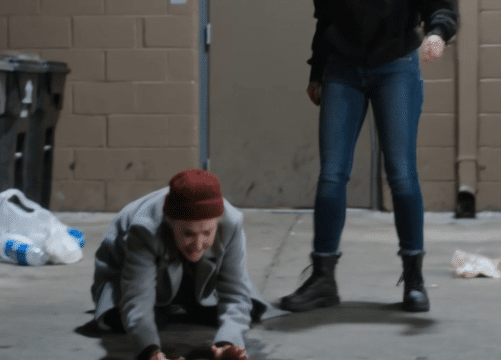
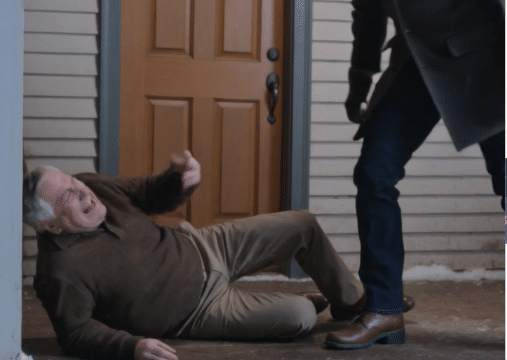
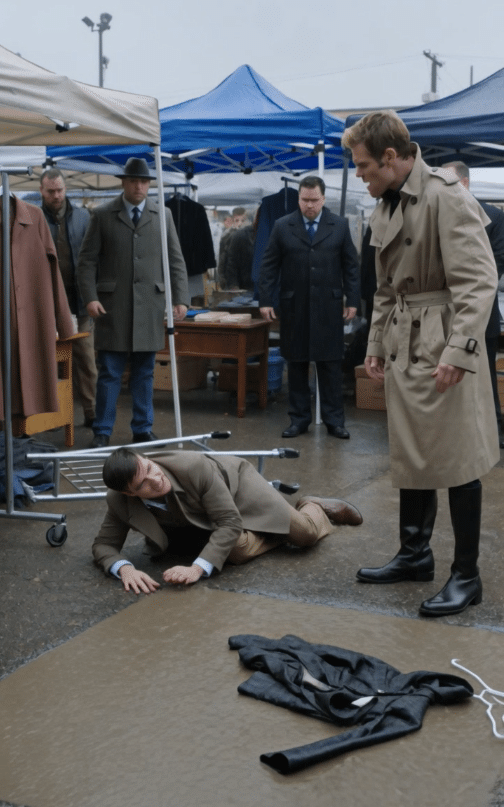
One moment, Daniel Brooks stood beneath a flapping tarp at an outdoor thrift market, clutching a small blue winter coat against his chest. The next, a polished boot struck him hard in the chest, sending him backward into a rack of used clothing.
Metal hangers rattled violently. Jackets tumbled from their hooks. The child’s coat flew from Daniel’s hands and landed in a muddy puddle, soaking through the fabric his son desperately needed to survive the coming winter.
Daniel hit the stall’s metal support with his elbow. A thin trace of blood appeared where the skin scraped against the edge, but the pain in his chest was worse. He curled onto his side, grimacing as he struggled to catch his breath.
Rain drummed against the market tarps. Water streamed through the muddy lanes, carrying loose paper and cigarette wrappers toward the storm drains. Vendors and shoppers stared in disbelief as a man in an expensive trench coat stood over Daniel, looking down at him as if he had deliberately ruined the man’s morning.
Daniel was forty-two years old. His shoes were worn, his thin coat had lost much of its lining, and mud covered the hems of his trousers. He looked like someone who had spent too many nights worrying about bills and too few sleeping comfortably.
But the coat he had bought was new enough to keep his eight-year-old son warm.
That was all that mattered.
“Sir,” Daniel gasped, trying to push himself upright. “Please. I just bought that for my boy.”
The man ignored him.
He bent down, retrieved the little blue coat from the muddy water, and held it between two fingers. His name was Richard Caldwell, a wealthy property investor known among certain collectors for his interest in vintage clothing and rare secondhand finds.
Richard had noticed the coat earlier. He liked its old-fashioned cut and sturdy buttons, and he had decided he wanted it.
He had not asked how much it cost.
He had not offered to buy it.
He had simply seen a poor man carrying something he wanted and assumed the man could be forced to surrender it.
Daniel dragged himself closer to the fallen coat.
“Please,” he said again. “My son has nothing warm…”
Richard looked at him with open contempt.
“Trash. Then buy him pride.”
A woman standing near a rack of used dresses covered her mouth. An older vendor took a startled step backward, his hands hovering uselessly above his stall. Nobody moved toward Daniel.
Richard glanced at the small pile of coins that had fallen from Daniel’s pocket during the impact. They were scattered across the muddy ground, mixed with rainwater and grit.
He pulled a few coins from his own pocket and tossed them down beside Daniel.
The coins landed with faint metallic clicks.
“There,” Richard said. “Now stop whining.”
Daniel stared at the money.
It was not enough to buy another coat. It was not enough to replace the one he had just purchased. It was not even enough to repair the damage Richard had done to the dignity Daniel had struggled to preserve in front of strangers.
Still, Daniel reached for the blue coat.
Richard stepped closer.
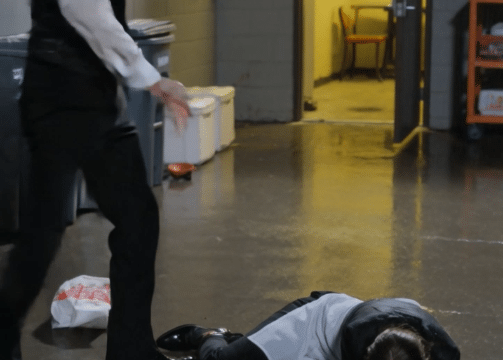
Then he delivered two more forceful kicks, striking Daniel in the back and side as the father stretched toward the garment. Daniel recoiled with each impact, curling inward and drawing sharp breaths through clenched teeth.
The coat remained in Richard’s hand.
Daniel’s face tightened with pain, but he kept looking at it.
He was not thinking about his own injury. He was imagining his son, Noah, waiting at home in a sweatshirt that had become too small at the wrists, trying to pretend he wasn’t cold because he knew his father was worried about money.
Daniel had promised him a proper winter coat.
He had promised it would come before the next cold snap.
Richard looked around at the watching crowd, apparently satisfied that everyone understood who had the power in the lane.
“Poor fathers should not shop.”
The words hung beneath the tarps, more cruel than the rain.
Daniel stopped reaching.
For a second, he simply lay there, his cheek close to the muddy ground, staring at the little blue coat in Richard’s hand. His expression shifted from pain to a quiet, unbearable shame.
He had worked extra shifts, skipped lunches, and walked home instead of taking the bus to save enough money for that coat. He had calculated the price three times before handing the vendor his cash.
Now a stranger had taken it, beaten him, and told him that being poor meant he had no right to buy something for his child.
The vendors and shoppers stood frozen.
Then a man appeared at the far end of the market lane.
He wore a long black coat, and rain ran from his shoulders as he walked quickly toward the scene. A discreet assistant followed a few steps behind him, holding a phone and watching the people around them.
The newcomer was sixty-one, silver-haired, and carried himself with the quiet certainty of someone accustomed to being heard without raising his voice.
His name was Nathaniel Pierce.
To the public, he was one of the wealthiest men in the region, a billionaire whose company owned commercial properties, warehouses, and several redevelopment projects across the city. To the people who ran this market, however, he was something else: the man who had financed the drainage repairs that kept their stalls from flooding and funded the winter assistance program that helped struggling vendors stay in business.
Nathaniel stopped when he saw Daniel on the ground.
Then he looked at the child’s coat in Richard’s hand.
His expression hardened.
He moved between Richard and the injured father, blocking the wealthy shopper’s path. His assistant immediately made a call.
Nathaniel looked down the market lane and spoke with calm authority.
“Close this market lane for me.”
Richard stared at him.
He had spent the last several minutes making everyone else feel small.
Now, for the first time, someone had entered the scene who did not look intimidated by him.
And Richard had no idea what that meant.
Act II
Daniel Brooks had never imagined that buying a winter coat could become the most humiliating moment of his life.
He worked maintenance shifts at a distribution warehouse on the edge of town. The hours were long, the work was physical, and the schedule changed whenever management needed extra coverage. He accepted the difficult shifts because the overtime helped cover the rent on the small apartment he shared with Noah.
His wife, Emily, had died three years earlier after a sudden illness.
Since then, Daniel had become both parents to a boy who still sometimes woke in the middle of the night asking when his mother would come home. Daniel learned to pack lunches, sew loose buttons, braid nothing because Noah hated having his hair touched, and keep a steady voice even when the bills on the kitchen table frightened him.
He had become skilled at hiding the things he could not afford.
When Noah outgrew his shoes, Daniel found a secondhand pair in nearly perfect condition. When the heating bill climbed, he wore two sweaters indoors and told his son the apartment was simply chilly that year. When Noah asked why they never went on expensive school trips, Daniel explained that some adventures cost money and others only required imagination.
He never told Noah how often he lay awake calculating what could be postponed.
The winter coat had been a promise.
Two weeks earlier, Noah had come home from school with his shoulders hunched inside a thin sweatshirt. He had spent the afternoon outside during recess, and his teacher had noticed that his hands were red from the cold.
The school sent home a polite reminder about appropriate winter clothing.
Daniel read the note at the kitchen table while Noah pretended to be busy with his homework.
“I’ll get you a coat,” Daniel said.
“It’s okay, Dad. I can wear my hoodie.”
“You need something warmer.”
Noah looked up.
“Can it be blue?”
Daniel smiled, though his mind was already working through the numbers.
“Blue it is.”
The following Saturday, he took Noah to a thrift store. They found several coats, but most were too large, too thin, or too expensive for what Daniel had available. Noah tried not to show his disappointment.
Daniel noticed anyway.
That evening, after Noah went to bed, he checked the market listings online and discovered an outdoor thrift market that sold donated clothing at low prices. He decided to go alone the next morning, hoping he could find something suitable without making Noah endure another round of trying on clothes that didn’t fit.
He found the blue coat beneath a tarp near the middle of the market.
It was simple, with a warm lining, strong buttons, and a hood that could be pulled tight around a child’s face. It was not fashionable or new, but it was in good condition.
The vendor asked for a price Daniel could just manage.
He counted his money twice, then paid.
For the first time in days, he felt relief.
He pictured Noah opening the front door and seeing the coat. He imagined the boy sliding his arms into the sleeves, pulling up the hood, and looking in the mirror with a grin he would try to hide.
Daniel carried it carefully through the rain.
He was almost at the end of the lane when Richard Caldwell saw it.
Richard had arrived at the market in a luxury car, accompanied by a driver who waited near the main road. He liked thrift markets because they sometimes yielded unusual pieces that could not be found in fashionable stores. He called his hobby collecting, although his interest often had less to do with the items themselves than with the pleasure of acquiring something other people wanted.
When he spotted the blue coat, he immediately decided it belonged in his collection.
He had approached Daniel with an assumption rather than a question.
“Let me see that.”
Daniel had tightened his grip.
“Sorry. It’s for my son.”
Richard had barely glanced at him.
“Everything has a price.”
“I already bought it.”
That answer had offended Richard more than a refusal would have. Daniel had spoken politely, but he had not shown the deference Richard expected from someone dressed in worn clothes and muddy shoes.
Richard had mistaken modesty for weakness.
And when Daniel refused to hand over the coat, Richard had responded with violence.
Now Nathaniel Pierce stood between them, and the market lane was beginning to change around him.
At first, the vendors did not understand why the billionaire had appeared in person. Nathaniel often visited the market without a formal announcement, checking on the businesses that relied on his foundation’s assistance. He preferred seeing conditions for himself rather than reading reports written by people who never had to stand in the rain.
His assistant had been following up on a drainage problem near the market’s eastern entrance. Nathaniel had been on his way to meet the market coordinator when he heard the commotion.
He had seen Richard standing over Daniel.
He had seen the coat.
And he had seen the coins scattered in the mud.
That last detail had stopped him cold.
Nathaniel had grown up in a family that struggled to pay rent. His mother worked two jobs, and his father disappeared from their lives before Nathaniel reached high school. There had been winters when the family kept the thermostat low and slept in layers of clothing.
He remembered a neighbor who had given him a secondhand coat when he was twelve.
It had been too large, with a torn pocket and a missing button. Nathaniel had worn it for three winters.
He still remembered the feeling of pulling its sleeves over his hands on the walk to school.
That coat had not made him rich. It had simply made it possible for him to get through the winter without being cold.
He looked at Daniel and recognized something painfully familiar in the way the father had kept reaching for the garment despite his injuries.
Daniel was not trying to win an argument.
He was trying to take home the one thing he had bought for his child.
Nathaniel turned toward his assistant.
“Call the market coordinator. No one leaves until we’ve secured the footage and identified the witnesses. And get medical help for this man.”
His assistant nodded and moved away to make the necessary calls.
Richard let out a short, disbelieving laugh.
“You can’t close a public market because of a personal disagreement.”
Nathaniel finally looked directly at him.
“This isn’t a disagreement.”
Richard adjusted his trench coat, attempting to recover the confidence that had begun to slip away.
“Do you know who I am?”
Nathaniel’s face remained unreadable.
“Yes,” he said. “I know exactly who you are.”
Richard’s smile faded.
He had expected the name to intimidate the stranger.
Instead, Nathaniel appeared to have been waiting for a reason to ask a few questions.
And the first question he asked would reveal that this encounter was far more serious than Richard understood.
Act III
Nathaniel Pierce had not become a billionaire by assuming that money told him everything about a person.
He knew wealthy people who were generous and wealthy people who were cruel. He knew business owners who treated their employees like family and others who treated them as disposable. He had learned early that a person’s character was most visible when they believed no one important was watching.
Richard Caldwell had just offered a public demonstration.
Nathaniel turned to the market coordinator, who had hurried toward the scene with a raincoat pulled over his head. The coordinator looked frightened by the crowd and uncertain about what to do.
“Were there cameras covering this lane?” Nathaniel asked.
“Yes, sir. Several. We installed them after the last theft complaint.”
“Make sure the recordings are preserved.”
The coordinator nodded.
Nathaniel then looked toward the vendors.
“I need the names of anyone who saw what happened. Nobody is required to make a statement to me right now, but the footage and any witness accounts need to be preserved properly.”
Several people nodded. The woman who had covered her mouth stepped forward enough to make it clear that she had witnessed the attack. The older vendor remained beside his stall, his expression troubled but no longer frozen.
Richard scoffed.
“You’re turning this into a criminal investigation over a coat.”
Nathaniel glanced at him.
“No. You turned it into something serious when you attacked a man over it.”
“I barely touched him.”
Daniel was still on the ground, breathing carefully, one hand pressed against his side. His elbow had begun to sting where it had struck the stall. He looked up at Richard, and for a moment the humiliation in his face gave way to disbelief.
The man had kicked him three times, thrown coins at him, and taken the coat from his hands.
Now he was pretending nothing had happened.
Richard followed Nathaniel’s gaze and seemed irritated that Daniel had not disappeared from the scene.
“He was being difficult,” Richard insisted. “I offered to compensate him.”
“You threw coins on the ground,” said the market coordinator before he could stop himself.
Richard turned sharply.
“What did you say?”
The coordinator swallowed, but he did not take the words back.
“I saw you throw them.”
The crowd seemed to draw a collective breath.
It was a small statement, almost insignificant compared with the violence everyone had witnessed. But it mattered because it was the first time someone had openly contradicted Richard.
For years, Richard had cultivated a reputation as a demanding but successful businessman. He was known for buying old commercial properties, restoring selected buildings, and selling them at substantial profits. He attended charity dinners and sponsored private events where people praised his eye for value.
He had learned to turn money into a shield.
When someone objected to his behavior, he suggested they were jealous. When employees complained, he reminded them that he signed the checks. When a vendor refused a demand, he threatened to take his business elsewhere.
Most people eventually gave in because the argument cost more than the original problem.
Daniel had no such leverage.
He had simply refused to surrender his son’s coat.
Richard pointed at him.
“That man is trying to make trouble for me.”
Nathaniel stepped closer, placing himself firmly between Richard and Daniel.
“Stop pointing at him.”
The command was quiet.
Richard lowered his hand, but anger flashed across his face.
“Who do you think you are?”
Nathaniel did not answer immediately. He looked down at Daniel, whose fingers were still curled against the muddy ground.
“Can you tell me if you have any trouble breathing?” he asked.
Daniel nodded weakly.
“My chest hurts.”
“Don’t try to stand yet. Help is coming.”
Daniel glanced toward the coat.
“Please. He has my son’s coat.”
Nathaniel followed his eyes.
Richard still held the garment, its blue fabric darkened by rain and mud. He gripped it as though he had forgotten that it was the center of the confrontation.
Nathaniel extended his hand.
“Give it back.”
Richard stared at him.
“Excuse me?”
“The coat. Give it back to its owner.”
“I found it on the ground.”
“You took it from him.”
Richard’s face hardened. For a second, he seemed to consider refusing simply because someone had ordered him to do something.
Then he looked around and saw the witnesses watching.
Reluctantly, he dropped the coat onto a dry section of the stall counter rather than handing it directly to Nathaniel.
Nathaniel picked it up.
The fabric was wet and muddy. One sleeve had caught on a hanger, leaving a small tear near the cuff. He brushed away what mud he could without damaging it further.
Then he crouched beside Daniel and held it where the father could see.
“We’ll get this cleaned,” he said. “And we’ll make sure your son has something warm.”
Daniel’s eyes filled with tears.
“I paid for it,” he whispered. “I didn’t steal anything.”
“I know.”
Those two words broke through the last of Daniel’s restraint.
He turned his face away, embarrassed by the tears, but Nathaniel did not ask him to explain himself. He did not tell him to be strong or suggest that he should be grateful. He simply remained beside him until the medical responders arrived.
Behind them, Richard paced in a tight circle.
He was beginning to understand that this stranger had no intention of letting him dictate the story. The market cameras would show the assault. The vendors would confirm what they saw. Nathaniel had witnessed the aftermath himself.
But Richard still believed there was one thing that would restore his advantage: his wealth.
He looked at Nathaniel’s black coat and expensive watch.
“You’re making a mistake,” he said. “People like us don’t need to be treated this way over some cheap secondhand clothing.”
Nathaniel slowly stood.
“People like us?”
Richard gestured impatiently between them.
“Successful people. Investors. People who keep businesses running.”
Nathaniel’s expression became colder.
“You think that makes you different from him?”
Richard glanced toward Daniel.
“He can barely afford a coat.”
“And you can afford anything you want,” Nathaniel replied. “Yet you chose to take his.”
The words silenced the lane.
Richard’s confidence faltered, but he forced a smirk onto his face.
“You don’t know anything about me.”
Nathaniel’s assistant returned, ending the exchange before it could continue. She leaned close and spoke quietly to him, showing him something on her phone.
Nathaniel studied the screen.
Then he looked back at Richard.
His expression made the wealthy shopper’s stomach tighten.
Whatever he had expected from this confrontation, he had not expected Nathaniel Pierce to recognize his name—and to know that the market was connected to a much larger decision.
Act IV
The rain intensified, drumming against the tarps and turning the market lane into a slick ribbon of mud.
Nathaniel’s assistant stood beside him with her phone in hand. She had reached the market coordinator and confirmed that the cameras covered the main aisle, including the spot where Richard had confronted Daniel.
The footage had not yet been reviewed in full, but the recording system was functioning. The coordinator had secured the relevant files and was arranging to preserve them for the appropriate authorities.
Nathaniel nodded.
“Good. Keep everything intact.”
He then turned to the coordinator.
“Close this market lane for me.”
This time, the order was not a vague display of wealth. Nathaniel explained that the lane needed to be cleared so the injured man could receive care without people crowding around him, the witnesses could be identified, and the stall area could be secured while the evidence was preserved.
The coordinator immediately began directing shoppers toward the side exits. Vendors pulled their tarps tighter and moved their merchandise out of the way. The assistant continued making calls, coordinating with the market’s management and arranging for the responders to reach Daniel without obstruction.
The crowd fell silent as the lane began to clear.
Richard looked around in disbelief.
“You’re actually shutting the place down?”
“For now,” Nathaniel replied.
“You can’t do that just because you happen to be wealthy.”
Nathaniel regarded him steadily.
“I’m not asking them to close because I’m wealthy. I’m asking them to secure the scene because a man has been assaulted.”
Richard’s jaw tightened.
The distinction was obvious to everyone except the man who needed to believe that money was the only reason anyone listened.
The medical responders arrived and knelt beside Daniel. They asked him questions, checked his condition, and helped him remain comfortable while they assessed his injuries. Daniel answered as clearly as he could, though each breath reminded him of the impact to his chest.
Nathaniel stepped back to give them room but stayed close enough to ensure Richard could not approach.
Richard watched with growing irritation.
“This is completely unnecessary,” he said. “He’ll be fine.”
One of the responders glanced up at him.
“Sir, please step back.”
Richard looked offended.
“I wasn’t talking to you.”
“Then please don’t interfere.”
For once, Richard had no immediate response.
He turned toward Nathaniel instead.
“Do you understand how much business I bring into this city? I have properties, partnerships, people depending on me. You could ruin a man’s reputation over an incident you didn’t even see from the beginning.”
Nathaniel’s eyes narrowed slightly.
“I saw enough to know that he was on the ground and you were standing over him holding his child’s coat.”
“You don’t know what happened before that.”
“Then the footage can help establish what happened.”
Richard opened his mouth, then stopped.
He could argue with a person. He could intimidate a vendor or pressure an employee into silence. But the existence of a recording meant that his version of events would not be the only one available.
Nathaniel’s assistant approached again.
“Mr. Pierce,” she said, “the coordinator has confirmed the cameras captured the confrontation. The witnesses are willing to provide their names.”
“Thank you,” Nathaniel replied. “Make sure the information goes through the proper channels.”
Richard’s face tightened at the phrase.
Proper channels.
It meant the incident would not vanish because he demanded it. It meant his wealth would not substitute for evidence. It meant that other people—not Richard himself—would determine what the footage showed and what consequences might follow.
He looked toward Daniel, who was now being helped into a more comfortable position.
The father had not asked Nathaniel to punish anyone. He had not threatened to sue or demanded compensation. Even now, he kept glancing toward the blue coat, worried that it might be too damaged to protect his son.
That concern seemed to irritate Richard more than anything else.
“You’re acting like that coat is some priceless object,” he muttered.
Nathaniel heard him.
“To you, it’s a piece of clothing. To him, it’s what his son will wear when the temperature drops.”
Richard gave a bitter laugh.
“Then he should have bought something better.”
Daniel closed his eyes briefly, his face tightening with pain.
Nathaniel turned toward Richard.
“You had the money to buy the coat yourself. You chose not to. You had the strength to leave him alone. You chose not to do that, either.”
He paused.
“And now you’re going to let the evidence speak.”
There was no grand threat in his voice. No promise that Richard would lose everything. No declaration that a billionaire could destroy him with one phone call.
The consequences would come through the ordinary mechanisms Richard had assumed he could avoid: witness accounts, preserved recordings, medical documentation, and decisions made by people who were no longer willing to look away.
The market coordinator confirmed that the lane had been cleared. Vendors stood near the edges beneath their tarps, watching in silence as the responders prepared to move Daniel for further assessment.
Nathaniel’s assistant arranged for a replacement winter coat to be delivered to Daniel’s home, along with cleaning assistance for the original garment if it could be salvaged. Nathaniel also asked the market’s community liaison to contact Daniel privately about available family support services.
He did not announce those arrangements to the crowd.
They were not meant to impress anyone.
They were meant to solve the immediate problem Richard had created.
Daniel heard enough to understand what Nathaniel was doing.
“Sir,” he said weakly, “I can’t repay you for all this.”
Nathaniel looked at him.
“You don’t owe me anything for helping you.”
Daniel swallowed hard.
“My boy was so excited about this coat.”
“Then we’ll make sure he gets one.”
The father looked down at his hands. Mud had worked into the creases of his palms. His fingers trembled as he tried to straighten them.
For a moment, he could not speak.
Nathaniel rested a hand briefly on his shoulder, then moved aside as the responders continued their work.
Across the lane, Richard stood alone in his expensive trench coat.
The market was closing around him. His audience was disappearing. The witnesses were speaking to the coordinator, and his assistant had stopped looking at him with anything resembling admiration.
He had arrived believing that his money made him untouchable.
Now everyone was watching him for a different reason.
Nathaniel turned toward him one final time.
“Do you understand what happens next?”
Richard forced a dismissive expression onto his face, though uncertainty had begun to show beneath it.
He looked at the billionaire, then at the market lane that had been closed at his command.
His voice carried a note of challenge.
“For you?”
Act V
Richard Caldwell had expected Nathaniel Pierce to leave once the immediate disturbance was over.
He expected the billionaire to make a donation, offer a few reassuring words, and return to whatever world he occupied beyond the market tarps. Richard had seen wealthy men intervene in public disputes before. Most preferred gestures that looked generous without requiring them to remain involved.
Nathaniel did not disappear.
He stayed until Daniel had received medical attention and the market coordinator had confirmed that the evidence was secured. He made sure the father had a safe way to leave and that someone would contact him about the replacement coat.
Only then did Nathaniel turn his attention to the administrative consequences of the incident.
The market’s management cooperated with the review. The recording was preserved, and the witnesses who had seen the assault provided their accounts. The incident was referred to the appropriate authorities, who would determine what further steps were warranted.
Nathaniel did not ask anyone to embellish what they had seen.
He did not need them to.
The truth was already difficult enough to watch.
Daniel had been holding a child’s coat. Richard had attacked him, thrown coins into the mud, and continued kicking him while he reached for the garment. The footage and witness accounts would be evaluated on their own merits.
Richard’s lawyers later attempted to characterize the confrontation as a misunderstanding that had escalated unexpectedly. Richard described himself as the target of a public overreaction and insisted that the billionaire’s involvement had made an ordinary dispute unnecessarily dramatic.
But the recording was not a rumor.
The witnesses were not all employees of Nathaniel’s company.
And Daniel had not been the one who turned a purchase into a violent confrontation.
The review of the incident also reached the people who managed several commercial properties in which Richard had an interest. Some of those relationships were entirely separate from the market, and they would be evaluated independently. Still, the event raised questions about the judgment of a man who expected others to accept his conduct simply because he could afford expensive clothes and influential advisers.
Nathaniel made no demand that anyone punish Richard to satisfy him.
He insisted only that the evidence be preserved and that the market’s workers be protected from retaliation.
That restraint made the consequences harder for Richard to dismiss as a personal feud.
There was no single dramatic phone call that ended his career overnight. Instead, he faced the slower, more uncomfortable process of being asked to account for what he had done. His explanations were compared with the available evidence. His conduct became a matter of record rather than a story he could control through force of personality.
The market eventually reopened.
The vendors returned to their stalls, and the used clothing racks were restocked. The rain eased, leaving water dripping from the tarps and shallow puddles between the tables. The older vendor who had watched Daniel fall repaired the bent section of his rack, while the woman near the dresses helped organize the remaining coats.
For days, the story traveled through the market.
People talked about the wealthy shopper who had attacked a father over a child’s coat. They talked about the billionaire who had ordered the lane closed, not to protect his own interests, but to ensure that the injured man received help and that the witnesses could speak freely.
But the most important change happened away from the market.
Daniel returned home with a bruised chest, a painful elbow, and a story he struggled to explain to his son.
Noah was waiting by the apartment door.
“Dad? Where’s my coat?”
Daniel stood still for a moment.
He had rehearsed several explanations during the ride home. He had thought about saying the coat had been damaged, that he needed to exchange it, or that they would find another one tomorrow.
He did not want Noah to know that someone had hurt him.
He did not want his son to imagine that the world was a place where a person could be attacked simply for being poor.
But Noah looked at his father’s face and immediately understood that something was wrong.
“Dad, what happened?”
Daniel knelt carefully, wincing as he lowered himself.
“Someone took it from me,” he said. “He hurt me, too.”
Noah’s expression changed.
“Why?”
Daniel searched for an answer that would make sense to an eight-year-old.
“I don’t know, buddy. Some people make terrible choices.”
“Did you do something bad?”
The question hurt more than Daniel expected.
“No.” He took his son’s hands. “Noah, listen to me. I didn’t do anything wrong by buying you a coat. You didn’t do anything wrong by needing one.”
Noah stared at him for a moment, then wrapped his arms around his father’s neck.
Daniel held him close, trying not to let the pain in his chest show.
For a long time, neither of them spoke.
The following morning, a representative from the market’s community liaison program called. They arranged for a replacement winter coat to be delivered and offered Daniel information about local family assistance programs. Daniel was wary at first. He had learned to distrust promises that arrived too easily, but the representative explained everything plainly and left him free to decide what help he wanted.
Later that day, a package arrived.
Inside was a warm blue winter coat in Noah’s size, along with a note explaining that the original purchase would be covered and that the market wanted to make sure the child had what he needed.
Noah pulled it on immediately.
The sleeves reached his wrists. The hood fit comfortably around his head. He turned toward the mirror, then looked at his father with a grin that made the previous night’s fear seem, for one brief moment, far away.
“It’s blue,” Noah said.
Daniel laughed softly.
“I promised you blue.”
Noah ran to him and hugged him again.
Daniel closed his eyes.
The coat had never been about fashion or status. It had been about keeping a child warm. It had been about a father fulfilling a promise despite the pressure of bills, exhaustion, and grief.
And now his son had what he needed.
A few weeks later, Nathaniel visited the market again. The rain had passed, and the stalls stood beneath patched tarps in the weak winter sunlight. He walked through the lane with his assistant, checking on the vendors and asking whether the market had returned to normal.
When he reached the used clothing stall, Daniel was there.
He had come to thank the vendor who had sold him the original coat, though he still carried a little stiffness in his movements. Noah stood beside him wearing the new blue jacket, his hands tucked into the pockets.
Nathaniel stopped.
“Is that the coat?” he asked.
Daniel smiled.
“It’s the replacement. The other one couldn’t be saved.”
Nathaniel nodded, then crouched slightly to meet Noah’s eyes.
“Does it keep you warm?”
Noah nodded enthusiastically.
“Really warm.”
“Good. That’s what a coat is supposed to do.”
Noah looked at his father, then back at Nathaniel.
“Did you help my dad?”
Nathaniel glanced at Daniel before answering.
“I made sure he wasn’t left alone when he needed help.”
Noah seemed to consider that.
Then he held out his hand.
“Thank you.”
Nathaniel shook it solemnly, as though Noah had just offered him a business deal.
“You’re welcome.”
Daniel’s eyes shone, but he managed a smile.
“I don’t know how to repay you.”
Nathaniel stood.
“You already have.”
Daniel frowned slightly.
“How?”
Nathaniel looked at Noah, who was busy examining the buttons on his coat.
“You kept your promise to your son. That’s what mattered.”
He did not stay long. He had other places to visit and other responsibilities to attend to, but before he left, he checked that the market’s management had established a clear process for handling future safety incidents and preserving evidence when someone was threatened.
The lane was open again. Vendors were selling secondhand clothes, old books, kitchenware, and small household treasures. Rainwater still collected in a few shallow depressions, but the market coordinator had arranged for further drainage work.
Life had resumed, not because the incident no longer mattered, but because the people who worked there had been given a chance to address what had happened and move forward.
Daniel watched Nathaniel disappear toward the end of the lane.
Then he looked down at Noah.
The boy was standing straighter now, his blue coat zipped to the chin. He was no longer trying to hide his hands inside his sleeves or pretending the cold did not bother him.
Daniel rested a hand on his son’s shoulder.
They had not become wealthy overnight. Their bills had not vanished, and the world had not suddenly become fair. But Daniel had learned that accepting help did not mean surrendering his dignity, and Noah had learned that needing something did not make a person less deserving of respect.
Across the market, Richard Caldwell’s name continued to be discussed, but the story was no longer entirely his to shape. The footage and witness accounts had established what happened, and the appropriate authorities would handle the matter through the proper process.
He had tried to make a poor father feel too small to stand up for his child.
Instead, he had exposed the smallness of his own character.
And the man he had treated as powerless had walked away with something Richard could never purchase: the knowledge that he had refused to abandon his son, even when the entire world seemed to be looking away.
Richard’s last question had been meant as a challenge, a way to make Nathaniel explain why a billionaire would bother with a stranger’s problem.
But the answer was already visible in the blue coat, in the father standing beside his son, and in the market lane that had fallen silent long enough for the truth to be heard.
For you?