Act I
The coins were still falling when the young man started laughing.
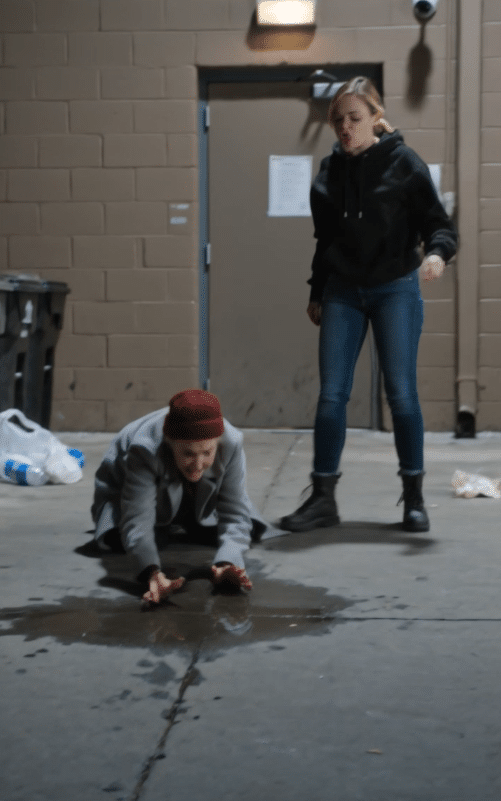
They struck the wet pavement behind the supermarket, bounced off a recycling bin, and scattered through dirty puddles beneath the harsh white light of the back door. A few rolled beneath plastic bags stuffed with empty bottles. Others spun toward the storm drain, carrying away the only money a seventy-nine-year-old grandmother had earned all day.
“Please,” the old woman whispered, dropping to her knees. “Please, those are mine.”
The young man in the black hoodie watched her scramble for the coins as if he had just performed a trick for an audience. Two of his friends stood several feet behind him, grinning uneasily. Nearby shoppers and employees had stopped in the alley, their faces illuminated by the supermarket’s security light.
Nobody moved.
The grandmother wore a thin gray coat and a red knit cap that had grown damp in the freezing rain. Her hands trembled as she reached beneath a plastic bottle bag, trying to retrieve a dime that had lodged against the curb. Her fingers were stiff from hours of collecting discarded bottles, but she kept searching.
She had counted those coins twice before coming to the supermarket. They were supposed to buy her something warm to eat that night.
Then the young man stepped behind her.
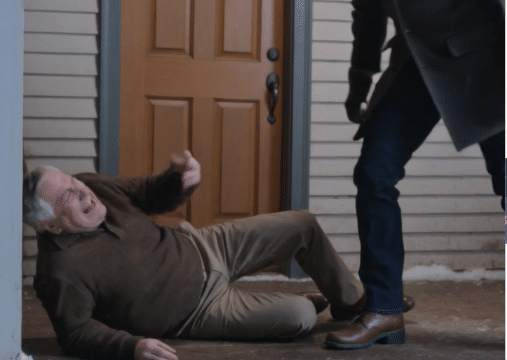
While she was still kneeling, he drove a hard kick into her back.
The impact knocked her forward, sending her face-down beside the plastic bottle bags. Empty containers spilled across the pavement with a hollow clatter. Her elbow struck the recycling bin, and a thin trace of blood appeared where the skin had scraped against its edge.
For a moment, she could not do anything except grimace and struggle to catch her breath.
Then she saw another coin rolling away.
She tried to push herself up.
“I need those coins for food…”
The young man looked down at her, his expression empty of anything resembling regret.
“Trash. Count faster.”
One of his friends let out a short, nervous laugh before immediately looking away. The others exchanged glances, suddenly less certain that the spectacle was as entertaining as their leader seemed to think.
But the young man was enjoying himself too much to notice.
He moved closer and delivered two more forceful kicks into the grandmother’s back and side as she tried to gather the scattered money. She curled instinctively against the blows, her face tightening with pain. Her red cap slipped sideways, and a trembling hand reached toward a quarter lying in a puddle.
The coins kept moving whenever the rainwater rippled beneath them.
The grandmother reached for one, missed it, and tried again.
The young man leaned over her.
“Your dinner is rolling away.”
The words carried farther than he expected.
A woman standing near the employee entrance covered her mouth. An older shopper stepped backward, nearly colliding with a stack of empty crates. Someone whispered that they should call for help, but nobody broke the frozen silence.
The grandmother heard them. She knew they were watching.
That knowledge hurt almost as much as the blows.
She had spent years trying to make herself invisible whenever she collected bottles behind stores. She never asked for much, never wanted trouble, and never expected strangers to understand the circumstances that had brought her there. All she wanted was enough money to eat.
Now her few coins lay scattered in the filth while a young man turned her desperation into entertainment.
He seemed certain that nothing could happen to him.
He was about to discover how wrong he was.
Act II
Her name was Margaret Ellis, and she had not always lived at the edge of other people’s attention.
For nearly four decades, Margaret had worked in a neighborhood laundromat, first folding towels and later managing the counter. She knew which customers needed an extra day to pay, which families were struggling, and which elderly neighbors would quietly bring her homemade soup when they heard she had caught a cold.
She had a husband once, a quiet mechanic named Thomas who could repair almost anything except the illnesses that eventually weakened his heart. After he died, Margaret kept their small apartment for as long as she could, paying the bills with her savings and the pension he had left behind.
Then came a series of expenses she had not planned for.
A rent increase. A medical bill insurance would not fully cover. A plumbing repair that emptied what remained of her emergency savings. Each problem seemed manageable by itself, but together they became a staircase leading downward, one step at a time.
By the time she finally lost the apartment, she had already sold most of the things that made it feel like home.
She kept Thomas’s old photograph, a knitted blanket, and a small tin containing the few personal papers she could not bear to discard. The photograph remained tucked inside her coat, close to her heart.
During the day, Margaret collected recyclable bottles and cans. She returned them for whatever deposit money she could get, sometimes spending hours searching public bins and walking between parking lots. On better days, she earned enough for groceries. On worse ones, she bought a piece of bread and saved the rest for tomorrow.
She had learned to measure life in small amounts.
A few coins could mean soup instead of crackers. A dollar could mean a hot drink that warmed her hands long enough to stop them shaking. A little extra might allow her to buy something other than the cheapest food on the shelf.
That evening, she had counted the contents of her coin bag beneath a streetlamp before walking behind the supermarket.
She was short of what she needed, but not by much.
She had hoped to buy a small meal from the discount section before the store closed. The staff sometimes marked down items near the end of the evening, and Margaret knew exactly when to arrive without getting in anyone’s way.
She had never imagined that the trip would become a public humiliation.
The young man who had attacked her was named Brandon Cole. At twenty-three, he had become accustomed to mistaking other people’s discomfort for proof of his own importance. He worked irregularly, lived with relatives who repeatedly rescued him from consequences, and surrounded himself with friends who had learned that disagreeing with him was more exhausting than laughing at his jokes.
Brandon had noticed Margaret collecting bottles earlier that evening.
He had made a comment about her plastic bags. She had ignored him.
That should have been the end of it.
Instead, he followed her toward the back alley, where he saw her counting the coins in her small bag. The sight amused him. He snatched it from her hand, emptied it into the air, and watched the money scatter.
To Brandon, it was a prank.
To Margaret, it was dinner disappearing beneath a row of dirty recycling bins.
When she knelt to retrieve the coins, he escalated the cruelty. Even after she fell, even after she pleaded, he continued because the crowd had not stopped him and because he had never learned to recognize another person’s suffering as a reason to stop.
The witnesses saw the same thing Margaret saw: a young man who believed he could do whatever he wanted.
What they did not yet understand was that the supermarket had been watching the alley for years.
Its cameras covered the employee entrance, the recycling area, the loading lane, and the narrow strip of pavement beside the back wall. The system had been upgraded after repeated thefts and damage to the delivery area. Every evening, the recordings were checked as part of the store’s closing procedure.
And the manager, a fifty-seven-year-old man named Daniel Mercer, took those procedures seriously.
Daniel had spent twenty years working his way up from a stockroom position. He knew every loading schedule, every delivery driver, and every blind corner where an employee might be vulnerable after dark. He had also built a reputation for refusing to dismiss misconduct simply because the person responsible was wealthy, connected, or loud enough to intimidate everyone around them.
That night, Daniel was inside reviewing an inventory discrepancy when a security guard noticed movement on one of the monitors.
At first, the guard thought someone had knocked over a recycling bin.
Then the screen showed a woman on the ground.
Daniel looked up.
And the moment he saw the young man standing over her, he stopped the recording and headed for the back door.
Brandon still believed the alley belonged to him.
He had no idea who was coming through that door.
Act III
The supermarket’s back door swung open sharply.
The sudden sound cut through the rain, and every face in the alley turned toward the light.
Daniel Mercer stepped outside in a long black coat, accompanied by two security guards. He did not rush toward Brandon shouting threats. He did not waste a second demanding an explanation from the people who had watched the attack unfold.
His eyes moved first to Margaret.
She was curled beside the recycling bins, one arm held close to her body. Her gray coat was soaked at the shoulder, and her red cap had fallen onto the pavement. Coins surrounded her in the shallow water, mixed with the empty bottles that had spilled from her bags.
Daniel’s expression hardened.
One security guard moved immediately toward Margaret, positioning himself between her and Brandon. The second stayed close enough to prevent the young man from approaching her again. Daniel stepped into the space separating the two, creating a barrier that Brandon could no longer ignore.
For the first time that evening, the young man had someone standing in front of him who was not afraid to meet his eyes.
Daniel looked at the scattered coins.
Then at the camera mounted high on the brick wall.
Finally, he turned toward the security guard beside the door.
“Review the back cameras.”
His voice was controlled, almost quiet.
That made it more unsettling than a shout.
The guard nodded and spoke briefly into his radio. He had already seen enough to know that this was not an ordinary dispute behind a store. The camera footage would establish exactly what had happened, including the moments before the attack and everything that followed.
Brandon’s smile began to falter.
He glanced at the camera for the first time.
Until that moment, he had treated the alley as a stage where he could humiliate someone without consequence. He had assumed that the darkness, the rain, and the crowd’s silence made him untouchable.
Now he was looking directly at the object that had recorded him.
Daniel lowered himself beside Margaret without taking his attention entirely away from Brandon. He asked the security guard to keep her protected and to arrange medical assistance. Another employee retrieved a clean blanket from inside the store, placing it within reach rather than forcing the injured woman to move.
Margaret tried to sit upright.
“I didn’t do anything,” she whispered.
Daniel’s face softened.
“I know,” he said. “You don’t have to explain anything right now.”
The words nearly broke her.
For hours, Margaret had been bracing herself against the possibility that someone would accuse her of trespassing, stealing, or making a mess. She had expected to be told to leave, perhaps even before anyone asked why she was hurt.
Instead, a stranger had placed himself between her and the person who had attacked her.
And he believed her without asking her to earn that belief.
Brandon shifted his weight.
“Come on,” he muttered. “It was a joke.”
Daniel stood.
He did not accept the explanation, and he did not argue about whether Brandon had intended to be funny. The coins on the ground, the injured woman, and the recording system made the important facts painfully clear.
“You can explain what happened when the footage has been reviewed,” Daniel said.
Brandon’s friends had stopped smiling completely. One stared at the pavement. Another looked toward the alley entrance as if measuring how quickly he could leave without attracting attention.
But leaving would not erase what had happened.
The cameras had captured the attack from above. They had recorded the scattered coins, Margaret’s attempts to gather them, and Brandon’s actions while she was down. The recording would not depend on the memories of frightened witnesses or the changing story of a young man who had mistaken silence for permission.
Daniel looked toward the security office.
He knew the next steps. The recording would be preserved, the police would be contacted, and the appropriate incident reports would be completed. Any questions about criminal charges would be left to the authorities, but the supermarket would not bury what had occurred on its property.
Brandon swallowed.
For the first time, he seemed to understand that this was no longer a performance he controlled.
But the recording held more than a single terrible moment.
And Daniel intended to make sure every second was preserved.
Act IV
The alley fell quiet except for the rain tapping against the plastic bags and the steady drip of water from the loading awning.
The security guard closest to Margaret crouched beside her, keeping his body between her and Brandon while checking whether she needed immediate medical attention. The second guard remained standing, his attention fixed on the young man who had spent the last several minutes acting as though nobody could challenge him.
Margaret tried to reach for a quarter near her knee.
The guard gently told her not to move until they had made sure she was all right. She withdrew her hand, ashamed of how instinctively she had reached for the money even while she was hurting.
Daniel noticed.
He looked down at the coins again, and his expression changed from anger to something more personal.
He had worked at the supermarket long enough to know that people arrived at the back entrance for all kinds of reasons. Some needed directions. Some had lost their jobs and were looking for day work. Others quietly asked whether the store had food that would otherwise be thrown away.
Margaret was not the first person to struggle in that alley.
But she was the person standing there now, injured because a young man had decided her hardship was entertaining.
Daniel turned toward the security office door.
“Preserve the entire recording,” he instructed. “Not just the assault. Start before he approaches her, and keep everything through the moment we arrived.”
The guard acknowledged the order.
That distinction mattered. Daniel did not want a short clip stripped of context, passed around as gossip, or dismissed as a misunderstanding. He wanted the full sequence preserved so the authorities could determine what had happened from the beginning.
Brandon’s face tightened.
“You’re seriously making a big deal out of this?”
Daniel looked at him.
“You attacked an elderly woman over the money she needed to eat.”
Brandon opened his mouth, but the words seemed to stall before they came out. He glanced at his friends, searching for the easy laughter that had encouraged him earlier.
Neither friend met his eyes.
One had turned pale. The other stood with his arms folded tightly across his chest, no longer looking like someone enjoying an evening out. They had witnessed the same attack, and the arrival of the manager had stripped away the illusion that their presence made Brandon powerful.
It had only made them witnesses.
A shopper who had been standing near the alley entrance quietly moved aside as another employee came through the door. Nobody tried to turn the incident into an argument. Nobody stepped forward to defend Brandon’s behavior.
The crowd’s silence had changed.
Before Daniel arrived, it had been the silence of fear and hesitation. Now it was the silence of people beginning to recognize the seriousness of what they had watched.
Margaret sat beneath the awning with a clean blanket around her shoulders. Her breathing was still uneven, and her fingers shook when she tried to hold the edge of the fabric. A staff member stayed nearby while arrangements were made for her to receive medical attention.
Daniel asked whether she had someone she could call.
Margaret lowered her eyes.
“My husband is gone,” she said. “I don’t have anyone close by.”
She hesitated before adding the words she seemed most embarrassed to say.
“I only wanted to buy something for dinner.”
Daniel glanced toward the coins scattered in the dirty water. A quarter had settled beside the storm drain, and a nickel rested near a crushed plastic bottle. Together, they were worth almost nothing to the people who had watched the assault.
To Margaret, they represented hours of cold, sore feet and aching hands.
Daniel instructed an employee to collect the money once the immediate scene had been secured. He also made sure that Margaret would not be sent away alone into the freezing night. Whatever happened next, she would not have to negotiate for help while she was injured.
Brandon watched these arrangements with mounting discomfort.
He had expected anger, perhaps a brief confrontation and then an order to leave. He had expected the incident to dissolve into competing accusations once everyone went home.
Instead, the manager was preserving evidence, protecting the victim, and involving the proper authorities.
The difference between a threat and a consequence was becoming impossible to ignore.
Daniel turned once more toward the security office.
The guards were waiting for the footage to be reviewed and saved. The camera above the alley remained fixed on the scene, its small dark lens reflecting the white back-door light.
Brandon followed Daniel’s gaze.
His mouth had gone dry.
He had laughed when the coins flew through the air. He had laughed when Margaret fell. He had laughed again when she tried to gather her dinner from the puddles.
Now the only thing he could think about was what that camera had seen.
And the recording had not looked away.
Act V
The first person to speak after the silence was Margaret.
“Did I get any of them back?”
Her voice was small, but Daniel heard her clearly.
He looked toward the security guard, who had begun gathering the coins from the pavement after the area was safe. Some had stopped beneath the recycling bins. Others had collected along the curb, their copper surfaces darkened by dirty water.
The guard placed the recovered coins in a clean paper envelope.
Not all of them had been found, but most were there.
He brought the envelope to Margaret and set it carefully beside her blanket. She stared at it for a long moment before touching it with her trembling fingers.
It was such a little thing.
A handful of coins. A thin paper envelope. The smallest possible acknowledgment that what belonged to her had mattered.
Margaret pressed the envelope against her coat and began to cry.
She did not cry loudly. Her shoulders simply folded inward as years of keeping herself composed gave way. She had endured losing her home, watching her savings disappear, and learning how easily strangers could look through her as if she were part of the pavement.
Tonight, she had been knocked to the ground for trying to save the money she needed to eat.
The manager had not undone any of those losses.
But he had stopped the humiliation from becoming the final word.
Daniel remained nearby while the security guards documented the scene. The store’s recording system was secured, and the police were contacted. Brandon would have to answer questions about his actions, while the footage and witness accounts would provide the authorities with evidence to review.
No one promised Margaret that every part of her life would suddenly become easy.
Daniel knew better than to make promises he could not guarantee. He could ensure that the store took the incident seriously, that the evidence was preserved, and that she received immediate assistance. Those were concrete responsibilities, and he intended to see them through.
He also made arrangements for Margaret to receive a warm meal and a safe ride rather than being left to find her own way through the cold.
When an employee returned with food, Margaret held the container in both hands. The warmth seeped slowly into her stiff fingers. For the first time that night, she had something to hold that could not roll away into the gutter.
Brandon stood several feet away, separated from her by the security guards.
His friends had gone quiet, and the people who had watched the attack were no longer looking at him with admiration. He could not reclaim the laughter that had surrounded him earlier. Every glance at the camera reminded him that the moment he had treated as a joke had been recorded in full.
Daniel did not need to shout at him.
The manager did not need to invent a punishment or threaten to destroy his life. The facts were enough. A vulnerable elderly woman had been assaulted, the evidence had been preserved, and the proper authorities would decide what followed.
Brandon looked toward the back door, then at the camera mounted above it.
His expression still carried a trace of the contempt he had worn when he first snatched the coin bag. But beneath it, something else had surfaced: the sudden realization that he could no longer control how the story would be told.
For the first time, he was not the person making everyone else uncomfortable.
He was the one waiting for an answer.
And all he could manage was one startled word.
“Cameras?”