Act I
The birthday gift hit the dirty mop water before the mother could stop it.
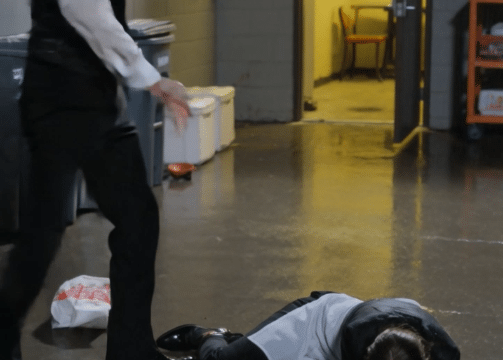
A wealthy man in a tailored gray suit had kicked the small paper bag across the wet marble floor of the nearly empty shopping mall. It skidded beneath a cleaning cart, struck the base of a closed storefront, and tipped onto its side. Rain hammered the glass walls outside, while the mall’s dim overhead lights reflected in the puddles stretching along the corridor.
The woman in the blue janitor’s uniform stared at the bag.
“No, no—please.”
She dropped to her knees, reaching for it before the water could soak through the wrapping paper. Her name was Rachel Miller. She was thirty-six years old, a single mother, and she had spent the last three hours cleaning the mall after most of its stores had closed.
Inside that little bag was a birthday present for her daughter, Lily.
It was not expensive. It was a small music box Rachel had found in a discount store, with a painted wooden lid and a tiny ballerina that turned when the melody played. Lily had mentioned wanting one months earlier, then forgotten about it when Rachel explained that they needed to save money for more important things.
Rachel had not forgotten.
She had put aside a few dollars from each paycheck, skipped coffee on her breaks, and waited for the right sale. The music box had cost less than a family dinner at one of the mall’s restaurants, but buying it had meant choosing between the gift and several small comforts she had gone without for weeks.
Now the wrapping paper was darkening in the dirty water.
Rachel bent forward to retrieve the bag.
The man moved behind her.
Without warning, he drove a hard kick into her back, knocking her face-first onto the wet marble beside the cleaning cart.
The impact sent a sharp burst of pain through her body. Her forearm struck the cart’s metal edge, leaving a thin trace of blood along the scraped skin. The cleaning supplies rattled, a bottle rolled across the floor, and the paper bag tore slightly as Rachel landed beside it.
She tried to catch her breath.
For a moment, she could only lie there, her cheek pressed against the cold floor, her fingers curled around the soaked gift bag. Her face tightened with pain as she struggled to push herself upright.
Several people near the mall’s central corridor gasped.
A security contractor standing by a closed storefront froze. Two late shoppers stopped beside an escalator, their mouths falling open. A woman carrying a handbag took a step backward and covered her lips.
Nobody moved toward Rachel.
The man looked down at her with irritation, as if her attempt to save the present had inconvenienced him.
His name was Victor Hale. He was forty-one, wealthy, well-dressed, and accustomed to getting his way. His polished shoes had left muddy marks across the floor Rachel had just cleaned, and when she had politely asked him to avoid the freshly mopped section, he had treated the request as an insult.
He had deliberately dragged his shoes through the damp area, then laughed when she brought the wet-floor sign closer.
Now he seemed determined to make sure she regretted speaking to him at all.
Rachel pulled the bag against her chest.
“It’s my child’s birthday…”
Victor’s expression twisted into a sneer.
“Trash. Buy a better gift.”
Rachel stared at him, stunned.
She had spent the entire evening imagining Lily opening the package at their small kitchen table. She had pictured her daughter’s eyes lighting up when the ballerina began to turn, followed by the excited questions Rachel would answer as though she had discovered the music box herself.
She had wanted one ordinary, happy moment.
Victor had looked at that hope and decided it was something he could crush.
Rachel tried to crawl toward the bag, shielding it with her arms. Her movements were slow and painful, but she kept reaching for the present.
Victor stepped closer.
Then he delivered two more forceful kicks into her back and side as she reached for the gift. Rachel recoiled with each impact, curling inward and gasping as pain spread through her body. The torn bag slipped from her hands, and a corner of the damp wrapping paper peeled away.
The witnesses recoiled.
The woman near the escalator covered her mouth with both hands. The security contractor hesitated, looking from Victor to Rachel and back again, apparently struggling to decide what to do.
Victor stood over the injured mother.
“Clean your tears too.”
Rachel’s eyes filled, but she did not answer him.
She was thinking about Lily waiting at home, probably checking the clock and wondering why her mother was late. She was thinking about the birthday candle she had hidden in the kitchen drawer and the cake mix she had promised to make when she finished her shift.
She was thinking about how she would explain the ruined present to a child who had already learned to ask for very little.
Then the VIP elevator at the far end of the corridor opened with a sharp metallic impact.
A man in a navy suit beneath a long dark coat stepped out, accompanied by two security officers. He was fifty-nine, silver-haired, and carried himself with the quiet authority of someone who rarely needed to repeat an instruction.
His name was Richard Sterling.
He owned the shopping mall.
Richard had been reviewing renovation plans in a private office upstairs when security alerted him to a disturbance on the lower level. He had expected a complaint about a spill or an argument between customers.
Instead, he saw a woman in a blue cleaning uniform lying beside a cart, a soaked birthday gift near her hand, and a man in a gray suit standing over her.
Richard walked straight toward Rachel.
He positioned himself between her and Victor, then signaled for security to protect the area while the woman received help.
His eyes moved to the ruined gift.
Then he looked at the man who had kicked her.
“Close every entrance.”
The security officers immediately began moving toward the mall’s access points to secure the scene and control movement while assistance was arranged.
Victor blinked.
For the first time that night, someone had issued an order he could not dismiss with a sneer.
He looked toward the closed storefronts, then back at the mall owner.
His anger shifted into alarm.
“Every entrance?”
And suddenly, the man who had treated the entire mall like his private playground had no idea what was about to happen.
Act II
Rachel Miller had learned to measure her life in small victories.
A full refrigerator was a victory. A paid electricity bill was a victory. Finding a pair of shoes that fit Lily’s growing feet without taking money from the rent was a victory.
She had not always lived that way.
Before her marriage fell apart, Rachel had worked part-time at a dental office and imagined she might eventually train as a medical receptionist. She liked organized schedules, neat paperwork, and the satisfaction of solving problems that other people had overlooked.
Then her husband left, taking most of their savings and leaving behind debts he had promised were temporary.
Rachel tried to keep everything stable for Lily. She worked days at the dental office and took evening shifts wherever she could find them. When the dental practice reduced its staff, she accepted a cleaning job at the mall because it offered reliable hours and a paycheck she could count on.
The work was exhausting.
She scrubbed food stains from restaurant floors, emptied overflowing bins, polished fingerprints from glass doors, and cleaned restrooms after the crowds had gone home. She learned which elevators broke most often and which storefront managers complained if a single smudge remained on their windows.
She also learned that many people barely saw her.
They stepped around her mop, dropped trash beside empty bins, and left coffee cups on the counters she had just wiped. Some apologized. Most did not.
Rachel rarely complained.
She needed the job, and she wanted Lily to grow up believing that honest work was something to be proud of.
Her daughter was turning nine.
Lily loved music. She hummed while brushing her teeth, made up songs about the family cat they could not afford to adopt, and tapped rhythms against the kitchen table while doing homework. When she saw a music box in a shop window several months earlier, she had pressed her nose close to the glass and watched the tiny dancer turn.
“Mom, imagine having something that plays a song whenever you open it.”
Rachel had smiled.
“Maybe one day.”
Lily had immediately shaken her head.
“It’s okay. I was just looking.”
That was what made Rachel determined to buy it.
Her daughter had begun editing her wishes before she even spoke them aloud. She no longer asked for expensive toys, trips, or new clothes unless something was genuinely necessary. She knew her mother worked late and often came home with aching feet.
Rachel wanted to give her something that said a child’s happiness did not have to wait until life became easier.
She found the music box at a discount shop on the second floor. It had a small scratch on the wooden lid, but the mechanism worked, and the ballerina turned smoothly when the melody began. Rachel tested it twice, then asked the cashier to wrap it carefully.
She carried the bag with her through the evening shift, setting it on a dry shelf in the cleaning room whenever she needed both hands.
At the end of the night, she was almost finished.
Then Victor Hale came through the corridor.
He had been dining at one of the mall’s upscale restaurants and was irritated that the valet service had made him wait for his car. When he entered the corridor, he stepped through the wet area Rachel had just cleaned.
“Sir, please watch your step,” she said politely. “The floor is still wet.”
Victor looked down at his shoes.
“Then clean it faster.”
Rachel lowered her eyes and moved the wet-floor sign to make the path more visible.
“I’ll be finished in a moment.”
He deliberately dragged one shoe through the damp patch, leaving a long, dirty streak across the marble.
Rachel stared at the mark.
“Sir, I just cleaned that section.”
Victor laughed.
“Then I guess you have something to do.”
She could have said nothing. She had done exactly that hundreds of times before. But she was tired, her feet hurt, and the gift bag sitting on the cleaning cart reminded her that she had spent her last break wrapping a present instead of resting.
Still, she kept her voice respectful.
“Please don’t make extra work for me.”
Victor’s face changed.
To him, the request was an act of defiance. He was used to people agreeing with him because he paid for expensive dinners, drove a luxury car, and wore a suit that cost more than Rachel earned in several weeks.
He did not see a worker trying to finish her shift.
He saw someone he believed had forgotten her place.
When his eyes landed on the small birthday gift bag, his contempt deepened.
“What is that? Something you found in the trash?”
Rachel moved to pick it up.
“It’s for my daughter.”
Victor smiled without warmth.
“Your daughter?”
Rachel nodded.
“Her birthday is tomorrow.”
Something about the simplicity of the answer seemed to amuse him. He looked at the bag, then at Rachel’s uniform, as if the two things proved a point he had already decided to make.
He kicked the gift into the puddle.
Rachel reacted before she could think. She dropped to her knees to save it, and Victor attacked her from behind.
Now, with Richard Sterling standing between them, Rachel was beginning to understand how badly the night had changed.
The mall owner crouched beside her and asked whether she could move without worsening the pain. He did not touch her back or try to lift her before help arrived. Instead, he asked one security officer to call for medical assistance and another to preserve the corridor’s surveillance recordings.
Rachel looked at him through tears.
“Please don’t let him take the gift.”
Richard followed her gaze.
The paper bag was torn. The wrapping was soaked through. One corner had collapsed, and a dark stain was spreading toward the ribbon.
“I won’t let anyone take it,” he promised.
Victor gave a short, incredulous laugh.
“Are you seriously doing this over a cheap present?”
Richard looked up at him.
“I’m doing this because you assaulted one of my employees.”
Victor’s smile vanished.
He had assumed the janitor was an invisible worker with no influence over the people who mattered. He had not considered that the owner of the building might know her name, might care what happened to her, or might be willing to stop the entire corridor from operating until the situation was handled properly.
Richard turned toward his security team.
“Preserve every camera angle covering this corridor. Keep the witnesses available, and make sure the responding officers have access to the footage.”
One officer nodded and moved away to carry out the instructions.
Victor adjusted his jacket.
“You don’t need to turn this into a public spectacle.”
“You did that when you attacked her in front of everyone,” Richard replied.
Victor glanced toward the distant shoppers, who were now watching in complete silence.
He tried to laugh again.
“You can’t possibly believe her over me.”
Richard’s expression did not change.
“I believe what I saw. The cameras can help establish what happened before I arrived.”
Victor’s gaze shifted toward the security officers.
For the first time, he seemed to notice that they were not there to protect him.
And he began to wonder how much of his behavior had already been recorded.
Act III
Richard Sterling had owned the mall for eleven years, but he had never believed that ownership gave him the right to treat the people who worked inside it as possessions.
He had bought the property when the previous company was struggling. At the time, the mall was losing tenants, the roof leaked during heavy storms, and maintenance workers were expected to keep a failing building running with inadequate equipment.
Richard had spent years rebuilding it.
He funded roof repairs, modernized the security system, and renegotiated leases so smaller businesses could remain open. He insisted that the cleaning contractor provide proper equipment and that overnight staff have access to a heated break room.
Those decisions were not acts of charity. A building could not thrive if the people who maintained it were treated as disposable.
Richard had learned that lesson from his father, who worked as a night custodian at a public school for more than thirty years. As a child, Richard sometimes waited for him after evening classes, sitting in a hallway while his father swept classrooms and emptied wastebaskets.
He remembered how his father straightened the chairs before leaving each room.
“No one notices the work when it’s done right,” his father had once told him. “They only notice when you stop doing it.”
Richard had asked whether that bothered him.
His father had shrugged.
“Not if I know I did it well.”
Years later, when Richard built his own business, he kept that conversation with him. He knew how much labor went into making a place appear effortless, and he was especially sensitive to managers who confused authority with permission to humiliate employees.
Victor had no idea of that history.
He only knew that the man standing before him owned the mall and had ordered every entrance closed.
“I’m a customer,” Victor said. “You can’t detain me because a cleaner got upset.”
Richard remained calm.
“No one has detained you. Security is securing the area while we arrange assistance and preserve the evidence. The police will determine what happens next.”
“Evidence?” Victor scoffed. “She slipped. That’s all.”
Rachel, still seated beside the cleaning cart, looked up.
“I didn’t slip.”
Her voice was quiet, but everyone heard it.
Victor turned toward her sharply.
“Don’t start.”
Richard moved a step to block his line of approach.
“Do not speak to her that way.”
Victor stared at him.
The security officers were now positioned near the corridor’s exits, preventing the crowd from pressing closer while leaving clear routes for emergency personnel. The mall’s operations manager had joined them and was coordinating with the responding officers.
A supervisor retrieved the incident log from the cleaning station. It recorded the time Rachel had placed the wet-floor sign, the section she had cleaned, and the complaint she had made about a customer deliberately dirtying the floor.
The record did not prove the assault by itself, but it helped establish the sequence of events.
Then one of the security officers returned with the first available camera view.
The footage showed Victor entering the corridor. It showed him walking through the freshly cleaned section and dragging his shoe across the wet marble. It showed Rachel speaking to him and pointing toward the wet-floor sign.
Most importantly, it showed him kicking the gift bag into the dirty water.
A second camera captured what happened when Rachel bent to retrieve it.
The recording was clear enough to make the surrounding witnesses fall silent all over again.
Victor watched only a few seconds before turning away.
“That doesn’t show the whole story.”
Richard looked at him.
“What part of the story explains kicking a woman who was trying to pick up her child’s birthday present?”
Victor’s jaw tightened.
“She was disrespectful.”
“She asked you to watch your step.”
“She talked back.”
Richard stared at him with open disbelief.
“You think that gives you the right to hurt her?”
Victor said nothing.
Richard turned to the operations manager.
“Make sure the footage is preserved in its original form. No edits, no copies that overwrite the original file. Provide it to the authorities through the proper process.”
The manager nodded.
Victor’s eyes narrowed.
“You’re going to regret this.”
Richard did not rise to the threat.
“Maybe. But that has nothing to do with what happened here.”
That answer seemed to unsettle Victor more than an angry outburst would have. He was accustomed to turning confrontations into contests of ego. If the other person shouted, he could accuse them of being emotional. If they threatened him, he could call his lawyers.
Richard was doing neither.
He was preserving the facts.
A medical team arrived and began assessing Rachel’s injuries. She grimaced when they helped her adjust her position, and one responder asked her not to move more than necessary until they had completed their initial evaluation.
The forearm scrape was cleaned and dressed. Given the force of the assault and her pain, the responders recommended further medical assessment.
Rachel nodded, but her eyes kept returning to the gift bag.
“Could someone please pick it up?” she asked. “I don’t want it to get any wetter.”
A security officer carefully retrieved the bag and placed it on a clean, dry section of the cleaning cart. The soaked wrapping paper clung to the small box inside. The ribbon had come loose, and the paper was torn along one side.
Rachel’s face crumpled.
“I worked so hard to get it.”
Richard crouched beside her.
“I know.”
“I know it’s not much.”
“It’s a birthday present,” he said. “It doesn’t have to be expensive to matter.”
Rachel covered her face for a moment.
She had not cried when Victor kicked her. She had not cried when she hit the floor or when the witnesses stared at her. But the sight of the ruined present finally broke through the careful control she had maintained throughout her shift.
Richard waited without rushing her.
Across the corridor, Victor watched the scene with growing anger.
He had wanted Rachel to feel small.
Instead, the man who owned the building was treating her as though her pain mattered more than Victor’s pride.
And that was the one thing Victor could not bear.
Act IV
By the time the responding officers began taking formal statements, the mall’s central corridor had been secured.
The VIP elevator remained open for authorized staff, but the nearby public entrances were temporarily controlled so the scene could be documented and the officers could work without interruption. The instruction to close every entrance had not been a theatrical threat. It was a practical measure to keep the area secure, protect the evidence, and prevent the gathering crowd from interfering.
Richard made sure the staff understood that the closure was temporary and that emergency access had to remain clear.
Then he turned back to Rachel.
She had been moved to a dry area near the cleaning office while the medical team continued its assessment. A blanket had been placed around her shoulders, and a colleague had retrieved her bag from the staff room.
Rachel looked embarrassed by the attention.
“I’m sorry about the floor,” she said.
Richard blinked.
“The floor?”
“I didn’t finish the corridor.”
For a moment, he could not find an answer.
She had been assaulted in the middle of her shift, and she was apologizing because a patch of marble remained dirty.
“Rachel,” he said gently, “you don’t need to worry about the floor.”
“But my supervisor—”
“Your supervisor can wait. Your health comes first.”
She lowered her eyes.
Richard knew that people who worked under constant pressure often learned to apologize before anyone accused them of anything. It was a defense mechanism: if they accepted blame quickly enough, perhaps the person in authority would leave them alone.
He did not want her to carry that habit into this moment.
He turned toward the operations manager.
“Please make sure Rachel receives paid leave while she recovers. Her employment will not be affected by this incident, and nobody is to pressure her about returning before she’s ready.”
The manager confirmed the arrangement.
Richard also asked that the cleaning contractor be informed that Rachel had been assaulted while working and that all communications about the incident should go through the appropriate management and legal channels.
He did not promise a particular legal outcome. He did not instruct anyone to invent a disciplinary violation against Victor. He simply made it clear that Rachel would not lose her livelihood because someone had decided to hurt her.
Victor overheard the conversation.
“You’re giving her paid leave now?” he demanded. “For what? A little fall?”
Richard faced him.
“She was kicked to the floor.”
“You can’t prove what I intended.”
“No one has claimed to read your mind. The footage shows what you did.”
Victor looked toward the officers.
“I want my lawyer.”
“You’re entitled to contact one,” an officer replied. “We’ll continue handling this according to procedure.”
Victor turned back to Richard.
“Do you know who I am? I have business with companies that lease space here. People will hear about this.”
Richard regarded him steadily.
“If you have business with the mall, the appropriate people can review it separately. It won’t change the evidence from tonight.”
Victor’s face reddened.
He had expected the mention of money and connections to make Richard hesitate. Instead, Richard was drawing a clear line between commercial relationships and the assault.
Victor could not buy a different recording.
He could not intimidate the people who had seen him kick Rachel.
And he could not force the mall owner to pretend the incident had never happened.
One of the officers asked Victor to step aside for a more detailed account of his actions. Victor protested, but the officer repeated the request in the same calm tone.
The witnesses were then interviewed separately.
The woman near the escalator confirmed that she had seen Victor kick the bag and then kick Rachel when she bent to retrieve it. The security contractor described hearing the impact and seeing Rachel fall beside the cleaning cart. Other witnesses provided accounts that could be compared with the recordings.
Nobody was asked to exaggerate.
Nobody needed to.
The facts were already serious.
As the process continued, Richard’s attention returned to the gift bag. He asked whether it could be moved to a dry place and whether the box inside had been damaged.
The operations manager carefully opened the outer bag only after Rachel gave permission. The music box was still inside, but the wrapping paper had soaked through, and one corner of the cardboard package had softened.
Rachel looked at it with exhausted sadness.
“I wanted her to open it herself.”
Richard nodded.
“Then let’s see what can be saved.”
He asked a staff member to find clean paper and a dry box. They would not attempt to repair the music box before Rachel had a chance to inspect it herself, but they could keep it from being damaged further.
Rachel reached out and touched the damp ribbon.
“Lily doesn’t ask for much,” she whispered. “She knows things are hard.”
Richard listened.
“She never complains when I work late. She makes her own breakfast sometimes because she doesn’t want to wake me up. She even tells me she doesn’t need birthday presents anymore.”
Rachel’s voice cracked.
“She shouldn’t have to think like that.”
“No,” Richard said softly. “She shouldn’t.”
He did not tell her that money could solve everything. He understood that the hardest part of the moment was not the price of the music box. It was the cruelty of watching a mother try to preserve a small promise for her child while a stranger treated that promise as something ridiculous.
Richard asked the mall’s community liaison to help Rachel identify any available support she wanted, including assistance with replacing the damaged gift. He made clear that she could decide what to accept.
Then he turned toward the officers one last time.
“Please make sure she has a safe way home when she’s ready to leave. And make sure the footage and witness accounts are preserved.”
The lead officer acknowledged the request.
Victor stood several feet away, his expression shifting between anger and disbelief. His polished shoes were still marked with the dirty streaks from the floor he had deliberately ruined.
He had wanted to humiliate a janitor for asking him to show basic consideration.
Instead, his behavior had been recorded, witnessed, and documented.
As security began reopening the unaffected sections of the mall, Victor glanced toward the entrances that had been closed.
He seemed to understand that the doors were not the real problem.
The real problem was that he could no longer control who knew what he had done.
Act V
The rain continued for another hour, streaking the glass walls while the mall staff worked to restore order.
Once the responding officers had completed their initial work and the scene was no longer at risk of being disturbed, the temporary entrance restrictions were lifted. Shoppers were allowed to leave through the designated routes, and the cleaning team began carefully drying the marble floor.
Rachel was taken for further medical evaluation.
Her injuries were painful, and the doctors advised her to rest rather than return to work immediately. The scrape on her forearm was cleaned and dressed, and she received instructions for monitoring her symptoms after the assault.
Richard made sure she had transportation home.
He also arranged for her to receive paid recovery time through the proper employment process, without requiring her to argue for it or prove that she deserved compassion. The cleaning contractor confirmed the arrangement, and Rachel was told that her job would remain available when she was ready to return.
She had expected to spend the rest of the night worrying about whether she would be fired.
Instead, she was finally allowed to think about something other than survival.
The small birthday gift remained on the cleaning cart while the staff worked to dry its packaging. The outer bag had torn, and the wrapping paper could not be saved, but the music box itself appeared intact.
Richard asked the operations manager to keep it somewhere dry until Rachel could take it home.
He did not want to replace it without asking her. It was the gift she had chosen for her daughter, and he understood that the meaning of a present could not always be measured by its price.
The following afternoon, Rachel returned to the mall with Lily.
The little girl was nine, with bright eyes and a habit of asking questions the moment something caught her attention. She had spent the morning wondering why her mother was home when she was usually working. Rachel had explained that she had been hurt and needed to rest, but she had not described the full confrontation.
She did not want Lily to remember her birthday as the day someone had attacked her mother.
At the mall, the operations manager greeted them and led them to a quiet office. The music box was waiting on the desk in a clean package, with fresh wrapping paper and a ribbon.
Rachel stood beside Lily.
“Your present got a little wet,” she explained. “But I think we can still open it.”
Lily looked at the package, then at her mother.
“Did you get it for me?”
Rachel nodded.
“I did.”
Lily’s face lit up.
She carefully untied the ribbon and peeled back the paper. When she lifted the lid, the ballerina began to turn to a delicate melody.
For a moment, Lily said nothing.
Then she gasped.
“Mom! It’s the one!”
She looked up with a smile so wide that Rachel felt her eyes fill again.
“You remembered!”
“Of course I remembered.”
Lily hugged the music box against her chest, then wrapped her arms around Rachel’s waist.
“It’s the best present ever.”
Rachel held her daughter close.
She had imagined this moment for weeks. She had pictured the smile, the surprise, the way Lily would lean closer to watch the tiny dancer spin.
She had never imagined that she would arrive at it after lying injured on a mall floor, listening to a wealthy stranger mock her for buying something inexpensive.
But the gift was here.
The music was playing.
And Lily was happy.
Richard Sterling stood quietly near the doorway, giving them space. He had not asked to be thanked, and he did not interrupt the moment to explain what he had done. He watched Rachel hold her daughter and understood that this was the part of the evening that mattered.
Later, he spoke with the mall’s management team about the incident.
The security recordings and witness accounts were provided to the authorities through the established process. The mall also reviewed its response procedures to ensure that employees who experienced violence could receive immediate assistance and that security staff knew when to secure a scene and preserve evidence.
Richard insisted that Rachel’s employment and recovery arrangements remain separate from any dispute over the mall’s public image.
He did not want the incident buried, but neither did he want Rachel turned into a publicity story she had never asked to be part of.
The authorities would determine the appropriate consequences for Victor’s actions.
The mall would cooperate fully.
And Rachel would be allowed to recover without being pressured to defend her own worth.
Victor’s version of the story did not erase the recording. He could argue about his intentions, complain about the response, or insist that the situation had been exaggerated, but the footage and the witness statements remained available for review.
His behavior had consequences because people had documented it—not because Richard had promised revenge.
That distinction mattered.
For years, Rachel had believed that her safest choice was to stay quiet, finish the job, and avoid giving anyone a reason to complain about her. She had swallowed insults because she needed the paycheck. She had accepted extra work because she feared being replaced.
But the night Victor attacked her, she had done nothing wrong.
She had cleaned the floor, asked a customer to watch his step, and tried to save a birthday present for her daughter.
There was no shame in any of that.
A few days later, Rachel returned to work after receiving medical clearance. Her supervisor checked in with her privately and reminded her that she could report any concerns about the incident without fear of retaliation.
She walked back into the corridor where the assault had happened.
The marble had been polished. The storefronts were open again. The wet-floor sign stood beside a freshly cleaned section, and the cleaning cart was stocked with new supplies.
For a moment, Rachel remembered the sound of the gift bag skidding across the floor.
Her shoulders tightened.
Then she took a slow breath and continued with her work.
She was not the same woman who had knelt in that puddle, convinced that one ruined present would become another promise she could not keep.
She knew now that asking for basic respect was not an act of defiance. She knew that being a cleaner did not make her invisible, and that needing a paycheck did not mean she had to accept cruelty as part of the job.
Most importantly, she knew that Lily’s happiness did not depend on how much the gift cost.
On the night of her birthday, Lily placed the music box on the small kitchen table and opened it again. The ballerina turned beneath the warm light, and the familiar melody filled the room.
“Mom,” Lily said, “when I’m older, I’m going to buy you something really special.”
Rachel smiled.
“You don’t have to buy me anything.”
“I know.” Lily thought for a moment. “But I want to.”
Rachel reached across the table and took her daughter’s hand.
“Then just remember this. Whatever you do, never make someone feel small because they have less than you.”
Lily nodded solemnly, as though Rachel had entrusted her with something important.
Then the girl opened the music box one more time.
The ballerina began to turn.
And for the first time since that terrible night, Rachel heard the melody without remembering the sound of her body hitting the floor.
Victor Hale had tried to turn a small birthday gift into a reason for humiliation. He had believed that money made him important and that a woman in a cleaning uniform had no right to challenge him.
But when the mall owner stepped from the VIP elevator, the balance changed.
The doors were closed long enough to preserve the truth. The witnesses were heard. The evidence was secured. And the mother he had tried to shame went home with her daughter, her job, and the present she had worked so hard to buy.
The music box had cost only a few dollars.
To Lily, it was magic.
To Rachel, it was a promise kept.
And to everyone who witnessed what happened that night, it became a reminder that the true measure of a person is not the price of their clothes, the size of their bank account, or the authority they can command.
It is what they choose to do when they believe nobody can make them answer for it.