Act I
“That was my dinner money…”
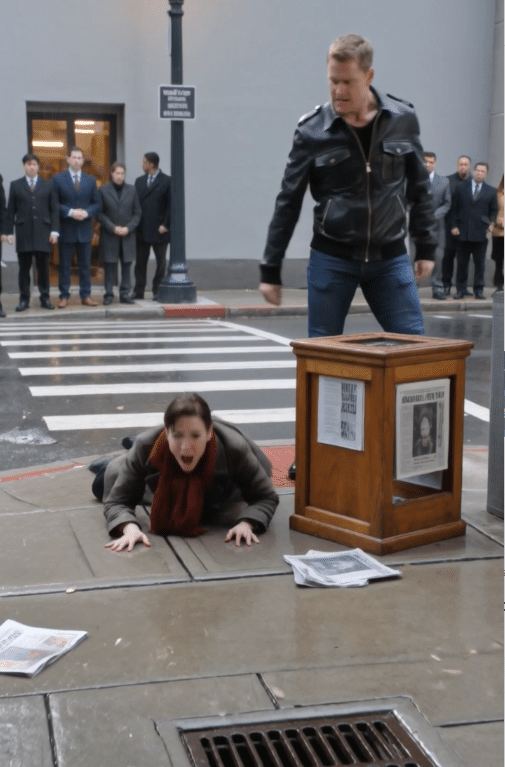
The woman was still reaching for her scattered coins when the man in the leather jacket kicked her hard in the back.
She pitched forward, striking the wet pavement beside her wooden newspaper stand. Her elbow hit one of the stand’s legs, leaving a thin trace of blood against her skin. Newspapers spilled across the sidewalk, their pages darkening in the rain, while coins bounced and rolled toward the storm drain.
For a moment, she could only gasp.
Then she saw a quarter spinning toward the gutter.
She stretched out her hand.
The man stepped closer and delivered two more forceful kicks into her back and side as she tried to gather the coins against her chest. She curled in pain, her face tightening as she struggled to breathe, but one hand remained closed around the money she had managed to save.
“Trash. Count your pennies quietly.”
The words carried beneath the yellow streetlight, sharp enough to make the people waiting at the nearby bus stop turn around.
The woman was forty-eight-year-old Margaret Ellis. She wore a worn wool coat, an old red scarf, and flat shoes that had absorbed so much rain that every step made a faint squelching sound. She had been standing at the corner since early morning, selling newspapers to commuters who barely looked at her.
She was not begging.
She was working.
Every coin in that box represented someone who had stopped long enough to buy a paper, and every sale had brought her a little closer to the money she needed for dinner. She had counted her earnings twice that afternoon, separating the amount for food from the small sum she was trying to save for her electricity bill.
There had been no extra money for a hot drink. No break long enough to warm her fingers. Just the stand, the rain, and the hope that the evening rush would bring a few more customers.
Then the man had taken a newspaper without paying.
When Margaret asked him for the price, he had smirked, knocked her coin box toward the storm drain, and watched her scramble after the money.
Now he stood above her as if she had insulted him by asking to be paid.
“Nobody cares about your coins.”
His name was Derek Lawson, a thirty-eight-year-old man who wore his leather jacket like a uniform and treated ordinary courtesy as something other people owed him. He had the smug confidence of someone accustomed to escaping uncomfortable situations by becoming louder than everyone else.
Behind him, a woman under a shop awning covered her mouth. A delivery driver stood beside his van, staring at the scene. Two pedestrians stopped beneath their umbrellas, but neither stepped forward.
Derek noticed their attention and seemed to enjoy it.
Margaret tried to push herself up, but pain forced her back onto one knee. Her fingers trembled as she gathered the coins still within reach. A few had disappeared into the drain, swallowed by the rushing rainwater.
She looked at the empty space where her coin box had been.
Then she looked up at Derek.
“I only asked you to pay.”
He gave a contemptuous laugh.
“You should be grateful someone even looked at your stand.”
Margaret lowered her eyes.
It was not the first time someone had treated her as though her work made her insignificant. She had been ignored, insulted, and cheated before. But she had never expected a simple request for payment to end with her lying on the pavement, struggling to protect the money she needed to eat.
A car engine suddenly rose above the sound of the rain.
A black sedan braked sharply beside the curb.
The rear lights glowed red against the wet street. The driver’s door opened, and a woman in a long black coat stepped out beneath a black umbrella.
She looked first at the coins gathered near the storm drain.
Then she saw Margaret on the ground.
Her expression changed.
She crossed the sidewalk, positioned herself between Margaret and Derek, and looked at the man who had been laughing.
“Say that again in court.”
Derek’s smirk faltered.
He had no idea who she was.
But the woman beneath the umbrella knew exactly what she had just witnessed—and she was not about to let it disappear into the rain.
Act II
The woman lowered her umbrella enough to shield Margaret from the worst of the downpour.
“Don’t try to stand yet,” she said gently. “Help is coming.”
Margaret stared at her, bewildered. She had expected another stranger to look away, perhaps offer a sympathetic expression before continuing down the street. Instead, this woman had stepped directly between her and the man who had hurt her.
The stranger crouched beside the newspaper stand, careful not to move Margaret’s injured arm. She asked whether Margaret could hear her clearly and whether she was having trouble breathing. Then she turned toward the driver, who had emerged from the sedan.
“Call for medical assistance. And ask those witnesses to stay nearby if they feel safe doing so.”
The driver nodded and immediately reached for his phone.
Derek let out an impatient breath.
“What’s this supposed to be? Some kind of performance?”
The woman did not answer him.
She helped keep the umbrella positioned over Margaret while the driver moved closer to block Derek from approaching her again. The witnesses fell silent, their attention shifting from the injured woman to the stranger whose calm authority had changed the entire atmosphere of the sidewalk.
Margaret looked down at the coins in her palm.
“Some of them went down the drain,” she whispered.
The woman followed her gaze.
“I see that.”
“That was all I made after lunch.”
Her voice broke on the last word. She pressed her fingers together, trying to keep the remaining coins from slipping away.
“I was going to buy something to eat.”
The stranger’s expression softened, but she did not offer a grand promise or tell Margaret that money did not matter. She understood that the coins mattered precisely because Margaret had worked for them.
“What is your name?” she asked.
“Margaret.”
“I’m Catherine Hayes.”
The name meant little to Margaret in that moment. She was cold, frightened, and struggling to make sense of what had happened. But the people standing nearby began to recognize it.
Catherine Hayes was a senior judge in the county’s judicial system, respected for her measured temperament and her insistence that the law be applied without regard to a person’s wealth or influence. She had spent years presiding over cases involving fraud, assault, exploitation, and people who believed their social position placed them beyond ordinary accountability.
She was not a police officer, and she could not decide Derek’s fate on a sidewalk. She knew better than anyone that a person’s guilt had to be established through evidence and due process.
But she also knew that an assault should not be ignored simply because the victim was poor.
And she had seen Derek kick Margaret.
Catherine turned toward the witnesses.
“Please give the responding officers an accurate account of what you saw. Don’t speculate. Just tell them what happened.”
The delivery driver nodded. The woman under the awning lowered her hand and said quietly that she had witnessed the attack. One of the pedestrians stepped closer to confirm that he had seen Derek knock the coin box toward the drain.
Derek’s expression tightened.
“You’re all making this bigger than it is.”
Catherine finally looked directly at him.
“You were asked to pay for a newspaper. What happened next?”
“He started yelling at me,” Derek said, gesturing toward Margaret.
Margaret stared at him.
“I asked you to pay.”
Derek ignored her.
“She got in my face. I moved her out of the way.”
Catherine’s gaze remained steady.
“You kicked her while she was on the ground.”
Derek scoffed.
“You didn’t see the whole thing.”
“I saw enough to know that medical assistance is needed and the incident must be reported.”
He took a half step forward, but the driver remained between him and Margaret.
“Do you know who you’re talking to?” Derek demanded.
Catherine’s expression did not change.
“No,” she replied. “And neither does that woman need to know who you are before you treat her with basic decency.”
The rain hammered against the black umbrella.
Margaret looked at Catherine with a mixture of relief and disbelief. She had spent years feeling that her problems were too small to matter to anyone with power. Now someone with authority had stopped in the middle of a rainy evening because a woman selling newspapers had been hurt.
Catherine glanced at the scattered coins again.
She could not restore the money that had washed away, but she could make sure the incident was documented and that Margaret received the help she needed.
What she did next, however, would make Derek realize that the words he had thrown at Margaret could carry consequences far beyond the sidewalk.
Act III
Derek folded his arms.
“You can’t threaten me with court just because you don’t like what you saw.”
Catherine looked at him calmly.
“I’m not threatening you.”
“Then stop acting like I’m already guilty.”
“I haven’t decided anything about your guilt.”
The answer seemed to frustrate him. He had expected the judge to announce some punishment, giving him a chance to accuse her of abusing her position. Instead, she was drawing a clear distinction between what she had witnessed and what the legal process would determine.
She would not promise an outcome.
She would not bargain with him.
And she would not pretend the incident had never happened.
Catherine gave her driver a brief instruction to preserve any relevant dash-camera footage. She asked the witnesses to remain available for the responding officers and made sure the restaurant across the street knew that its exterior camera might have recorded part of the encounter.
Then she turned back toward Margaret.
“Do you have anyone you can call?”
Margaret hesitated.
“My sister lives across town. I don’t like worrying her.”
“Would you like us to contact her?”
Margaret’s eyes filled with tears.
“I just wanted to get through today.”
Catherine nodded slowly.
“I understand.”
But she did not truly understand the full weight of Margaret’s life—not yet. She did not know how many evenings Margaret had gone to bed with a cup of tea instead of dinner, or how carefully she measured the distance between buying groceries and paying her bills. She did not know that Margaret had once worked in a department store and later as a receptionist, until a series of family difficulties and a long period of caring for her ill mother had left her with little savings.
When her mother died, Margaret had tried to rebuild her life. She found a small room, took whatever work she could, and eventually began selling newspapers at the corner. The stand belonged to a local distributor who allowed her to keep a modest share of each sale.
It was not glamorous work.
But it was honest work, and it gave her a reason to get up each morning.
She had learned to count every coin because a few dollars could determine whether she ate a proper meal or waited until breakfast. She had learned to accept bad weather because a day away from the stand meant a day without income.
And she had learned not to complain.
People were more comfortable helping someone who seemed grateful than someone who seemed angry. Margaret knew that. So even when customers took newspapers without paying, she usually let them go rather than risk an argument that might cost her the place where she worked.
Derek had mistaken that restraint for weakness.
Now he was watching the consequences of that mistake gather around him.
A police cruiser turned onto the street, its lights reflecting across the rain-slick pavement. Two officers approached, one speaking with Catherine while the other checked on Margaret and arranged for medical responders to assess her injuries.
Catherine identified herself and explained that she was a witness. She made it clear that she would provide an account of what she had seen, but that she would not involve herself in the investigation beyond her role as a witness.
The officers began speaking separately with the people who had been present.
Derek’s confidence started to erode.
He looked from one witness to another, searching for someone who might soften their account or claim that the rain had made everything difficult to see. But the witnesses were no longer looking away.
The delivery driver described the kicks. The woman under the awning explained how Derek had knocked the coin box toward the drain. The pedestrian confirmed that Margaret had been kneeling to collect her money when the assault continued.
Derek shifted his weight.
“This is absurd,” he muttered. “All this over a newspaper.”
Catherine heard him.
“No,” she said quietly. “It began with a newspaper. What happened afterward is what matters.”
He looked at her, trying to find a trace of uncertainty in her face.
There was none.
Then an officer asked Derek to remain available while they continued the investigation.
Derek’s mouth tightened.
He had spent the evening treating Margaret as if she had no voice, no dignity, and no power to challenge him. Now every person who had witnessed his behavior was being asked to speak, and every answer was becoming part of an account he could not control.
Catherine turned back to Margaret, whose fingers were still wrapped around the few coins she had managed to save.
And for the first time, Derek seemed to understand that the judge had not arrived to rescue him from consequences.
She had arrived to make sure Margaret was no longer facing him alone.
Act IV
The paramedics arrived and began assessing Margaret beneath the shelter of the sedan’s open door.
They asked her questions, checked her condition, and explained what they needed to do before moving her. She winced when she shifted her injured arm, and her breathing remained shallow from the pain in her back and side.
Catherine stayed nearby until the responders confirmed they could take over.
Margaret kept looking at the coins in her hand.
“I should have put them somewhere safer,” she whispered.
One of the paramedics gently told her that she did not need to worry about the money right now.
But Margaret looked as though she could not help it.
Those coins were not just money. They were proof that her day had amounted to something. They were the result of standing for hours in the rain, greeting customers who rarely returned the greeting, and enduring the cold because she could not afford to lose a day’s earnings.
Losing them felt like losing the work itself.
Catherine understood enough to crouch beside her once more.
“Your safety comes first,” she said. “We’ll make sure the officers know what happened to your money, too.”
Margaret nodded, still embarrassed by the attention.
Across the sidewalk, Derek was speaking rapidly to one of the officers. He insisted that the entire incident had been a misunderstanding and complained that the witnesses were exaggerating.
When he noticed Catherine watching, he turned toward her.
“You must enjoy this,” he said. “Standing there with your umbrella, making everyone think you’re some kind of hero.”
Catherine’s expression remained composed.
“I didn’t make you do anything.”
“You’re a judge. You can make one phone call and ruin my life.”
“No,” she replied. “I can give an accurate account of what I witnessed. The authorities will investigate, and the court will follow the law if the matter comes before it.”
Derek laughed nervously.
“Then why did you say that thing about court?”
“Because you seemed to think nobody would ever hold you accountable for the way you treated her.”
The answer stripped away his last excuse.
Catherine did not need to raise her voice. She did not need to threaten his job, his reputation, or his future. The witnesses were present, the incident was being documented, and the officers were doing their work.
That was enough.
Derek glanced at Margaret.
She was sitting carefully while the paramedics prepared to move her, her red scarf darkened by rain. She looked tired and frightened, but she was no longer alone beneath the streetlight.
The sight seemed to irritate him.
“She should have kept her mouth shut,” he muttered.
One of the officers immediately asked him to stop addressing the witnesses and remain where he was.
Catherine’s expression grew colder.
“You have had several opportunities tonight to show some concern for the woman you hurt. You have chosen instead to blame her.”
Derek stared at her.
“She was counting pennies on the sidewalk. What was I supposed to do?”
“Pay for the newspaper,” Catherine said. “Or walk away.”
For a moment, even the rain seemed to fall more softly.
The answer was so ordinary that Derek could not turn it into an argument. He had been asked to pay for something he had taken. He could have apologized, left the coins where they fell, or continued on his way.
Instead, he had attacked a woman whose earnings were already barely enough to cover dinner.
The paramedics helped Margaret toward the ambulance for further evaluation. Catherine made sure the officers had her contact information and offered to help connect Margaret with appropriate assistance if she needed support after the incident.
She would not interfere with the investigation. She would not promise special treatment. But she would not forget Margaret the moment the ambulance left.
As the doors closed, Margaret looked through the window and found Catherine standing beneath her black umbrella.
She raised one hand in a small, uncertain gesture.
Catherine nodded back.
The ambulance pulled away, leaving the newspaper stand, the scattered papers, and a few remaining coins beneath the yellow streetlight.
Derek watched the vehicle disappear.
His expression had changed from contempt to resentment, and from resentment to something less certain. He had expected the night to end with Margaret apologizing for the inconvenience she had caused him.
Instead, she was receiving medical attention, the witnesses were cooperating, and the judge had made clear that the incident would be reported honestly.
The rain continued to fall.
Then one of the officers turned toward Derek and asked him a question that made his face go still.
Act V
“Do you understand that we need to document what happened here?”
Derek looked at the officer, then at Catherine.
For once, he did not answer immediately.
The sidewalk had become a record of the evening. Wet newspapers clung to the pavement. The coin box lay on its side near the wooden stand, and the storm drain had swallowed several of the coins Margaret had earned during the day.
The witnesses had provided their accounts. The officers were gathering the information they needed, and Catherine had agreed to provide her own statement as someone who arrived during the aftermath and witnessed part of the scene.
No one had promised Derek a particular outcome.
No one had declared him guilty on the sidewalk.
But the facts were no longer his to reshape simply by speaking louder.
He glanced toward the newspaper stand, where Margaret’s remaining papers were still exposed to the rain. A few minutes earlier, he had treated the entire business as a joke, as though the woman’s work and the money she earned were beneath his attention.
Now he could see how much effort had gone into keeping that small stand operating. The wooden frame was weathered, its corners worn smooth by years of handling. Margaret had arranged the papers carefully, protecting them as best she could from the weather.
It was a modest livelihood.
It was still a livelihood.
Catherine stood near the curb while her driver held the umbrella over her. She was not smiling, and she did not look pleased with herself. Her attention remained on the officers and the information they needed to complete their work.
Derek had expected a powerful person to arrive and make a dramatic threat.
Instead, the judge had done something much more difficult for him to dismiss: she had refused to turn away.
She had protected Margaret first, made sure medical assistance arrived, and helped preserve the witnesses’ accounts. She had not promised revenge or used her title to dictate an outcome. She had simply insisted that what happened mattered enough to be recorded.
That insistence changed the meaning of the entire encounter.
Margaret was not just a woman counting pennies in the rain.
She was a person who had been hurt, a worker whose earnings had been stolen from her by force, and a witness whose account deserved to be heard.
When the ambulance disappeared around the corner, Catherine looked once more at the coins near the drain. Her driver carefully collected the ones still within reach, leaving them with the officer so they could be returned to Margaret if appropriate.
It was a small gesture, not enough to replace what had been lost.
But it acknowledged that the money mattered.
Catherine then turned toward the officer and confirmed that she would provide a full account of what she had seen. She did not discuss the case further with Derek, and she made no attempt to influence the investigation.
Her work was not to punish him in the street.
It was to make sure the truth could follow the proper path.
Derek stood beneath the yellow streetlight, rain running from the edge of his leather jacket. The smug expression that had dominated his face earlier was gone. In its place was a brittle attempt at disbelief, as though he still expected someone to laugh and tell him the whole thing had been a misunderstanding.
Nobody did.
The witnesses had stopped looking at Margaret as though her problems were too small to matter. They had seen the injury, heard the insults, and watched the woman struggle to gather the money she needed for dinner.
They could no longer pretend they had seen nothing.
Derek looked at Catherine one last time. He seemed to want her to explain why a few coins had brought a judge into his evening, why a woman in a worn coat had attracted the attention of people he assumed would never care about her.
But Catherine offered no speech.
She simply stood beside the curb, calm beneath her umbrella, while the officers continued their work.
Derek’s jaw tightened.
He had believed that courtrooms were places for other people’s problems, places where consequences could be delayed, negotiated, or avoided. He had never imagined that a single act of cruelty toward a stranger could lead him to face the prospect of answering for himself.
The officers asked him to remain available while they completed their investigation.
His smirk faded.
For the first time, the thought of court no longer sounded like an empty threat. It sounded like a real possibility—one he could not dismiss simply because he disliked the person who had spoken the word.
He stared at Catherine, his expression caught between disbelief and rising fear.
“In court?”