Act I
The blanket was the only thing standing between an eighty-year-old man and the freezing night.
And the wealthy man standing over him had just ripped it from his hands.
“It’s the only warm thing I have…” the old man whispered, his trembling fingers reaching toward the blanket as it landed in the muddy snow beneath the leaking porch roof.
The man in the expensive coat glanced down at it as if someone had thrown garbage at his feet. His leather gloves were spotless. His polished shoes were barely touched by the slush. Behind him, the peeling wooden door of the old house hung crooked in its frame, rattling whenever the wind forced its way through the broken seals.
“Trash. You make this street look poor.”
The old man stared at him, unable to understand how a blanket could provoke such hatred. His name was Walter Bennett, and for the past eleven years, he had lived alone in the small house at the end of the street. The house had once belonged to his wife, Margaret. Now the paint peeled from its siding, the porch roof leaked, and the heating system worked only when it felt like it.
Walter had learned to endure most things quietly.
He had endured the loss of his wife. He had endured the humiliating paperwork required to qualify for winter assistance. He had endured neighbors looking away when they passed his house, pretending not to notice the grocery bags he carried or the way his hands shook in the cold.
But he had never expected a man who lived three houses away to treat his suffering as a personal insult.
The wealthy neighbor, Richard Lawson, had complained about Walter before. He had complained about the weathered fence, the uncut grass in summer, and the charity workers who occasionally parked near the house. Once, he had even suggested that Walter should move somewhere less visible.
Tonight, Richard had decided that suggestion was no longer enough.
Walter tried to push himself upright and reach for the blanket.
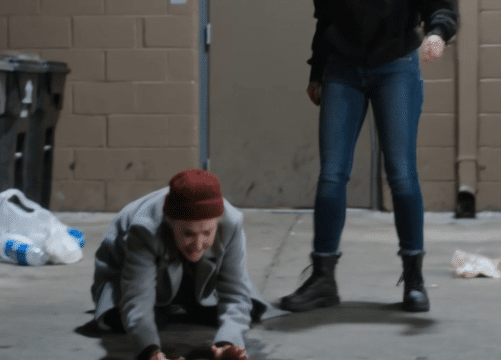
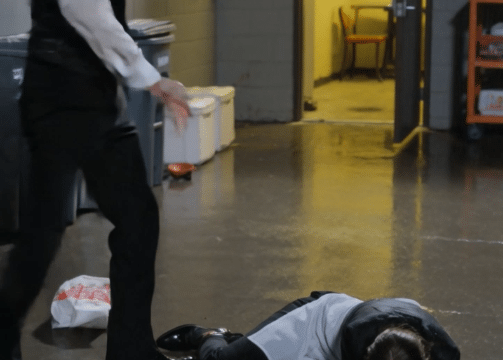
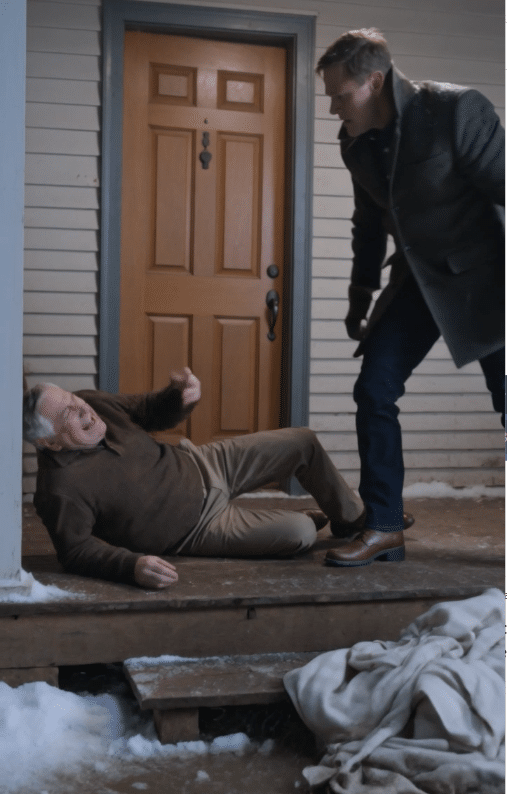
Richard drove a forceful kick into his chest.
Walter was knocked backward onto the wooden porch step. His shoulder struck the railing, and his elbow hit the edge of the boards hard enough to leave a thin streak of blood. The charity supply bag beside him toppled over, scattering a few basic necessities into the muddy snow.
For a moment, Walter could not draw a full breath.
The cold pressed against his face. Pain tightened his expression as he curled inward, one arm wrapped around his chest. His eyes remained fixed on the blanket, now darkened by wet dirt and melting snow.
He had been given that blanket three days earlier by a local relief volunteer. It was thick, worn around the edges, and hardly beautiful. But it had kept him warm enough to sleep through the worst of the wind.
It was the one thing he had been afraid of losing.
Richard stepped closer.
Walter dragged himself forward, reaching again for the blanket.
Richard kicked him twice more, striking his back and side. Walter recoiled with a strangled gasp, his body curling around itself as the second impact drove the remaining strength from his arms.
Behind the windows of the neighboring houses, faces appeared.
A woman covered her mouth. A man stood frozen behind a curtain, his phone hanging uselessly at his side. Someone opened a front door a few inches, saw Richard standing over Walter, and quietly pulled it shut again.
No one came forward.
Richard looked at the watching windows and seemed almost satisfied that they had witnessed the scene. He wanted everyone to understand that he considered Walter a problem—and that he believed he had the right to decide what happened to him.
“Freeze somewhere else.”
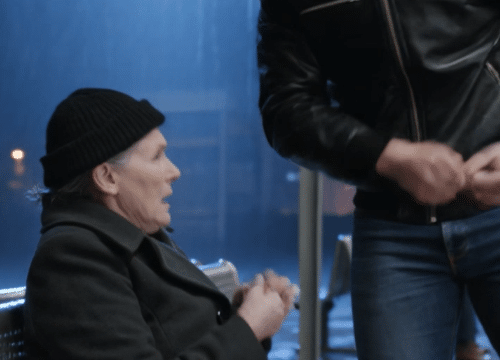
Walter lay on the porch, breathing hard. Snow gathered in the folds of his old brown sweater, and his faded khaki pants were soaked at the knees. He tried to lift his head, but the effort made him wince.
Then headlights swept across the broken house.
A black SUV came around the corner too fast for the conditions, its tires sliding briefly before the driver slammed on the brakes. The vehicle stopped directly in front of the porch.
The door opened.
A tall man in a long gray coat stepped into the storm, followed by two volunteers carrying emergency supplies. He looked first at the damaged house, then at the scattered charity bag, and finally at the blanket lying in the muddy snow.
His expression changed.
He crossed the distance without hesitation and positioned himself between Richard and Walter.
And when he spoke, it was not the blanket he offered to replace. It was something Richard had never imagined Walter could receive.
Act II
The man in the gray coat was named Thomas Whitmore, a sixty-three-year-old businessman who had spent the better part of two decades building one of the region’s largest privately funded housing charities.
He was not a celebrity, though his foundation’s work had appeared in newspapers. He rarely attended glamorous events and almost never gave interviews about his personal life. His organization specialized in emergency shelter, winter housing, and helping elderly residents remain safe in their homes.
To Richard Lawson, however, Thomas was simply an unfamiliar man who had arrived in an expensive vehicle.
Richard had built his own life around the belief that money was proof of good judgment. He owned a renovated house with a heated driveway, a second property near the lake, and a consulting firm that handled real estate investments. He donated to causes when there was a photographer nearby, and he spoke often about neighborhood standards.
He had never considered that a neighborhood might be judged by how it treated its most vulnerable resident.
Thomas crouched beside Walter, careful not to move him too quickly.
One volunteer knelt nearby and placed a dry blanket over Walter’s shoulders while the other retrieved the relief blanket from the snow. They did not lecture him about his clothing or ask why he had remained in the house. They simply shielded him from the wind and checked whether he could answer their questions.
Walter’s hands shook beneath the fresh covering.
“Can you hear me, sir?” one volunteer asked.
Walter nodded faintly.
“Good. Just stay with us. We’re going to get you somewhere warm.”
Thomas glanced at the thin mark of blood near Walter’s elbow. His jaw tightened, but his voice remained controlled. He asked the volunteer to contact emergency medical services and make sure Walter was assessed before being moved.
Only then did he look toward the house again.
The roof above the porch sagged beneath accumulated ice. Water dripped through a crack near the doorway, freezing along the edge of the steps. A single dim bulb flickered over the entrance, illuminating the place where Walter had been trying to protect the only warmth he possessed.
Thomas knew the address.
That was what made the sight so difficult to accept.
For nearly a year, his foundation had been working with the town on a winter emergency program. Volunteers had delivered food, blankets, portable heaters, and temporary accommodation to residents who could not safely remain in their homes. Walter had been referred to the program after a heating inspection revealed serious problems.
He had accepted the blanket and a small bag of supplies.
He had refused a temporary room.
Not because he thought he deserved to suffer, but because the house was the last place where he could still feel close to Margaret. The two of them had spent forty-two years there, raising a daughter, planting a small garden, and measuring their lives in ordinary rituals that had once seemed too insignificant to remember.
After Margaret died, Walter could not bear the thought of abandoning the home where her voice still seemed to linger in the rooms.
Thomas had learned that part of the story from a volunteer named Denise, who had visited Walter twice. He also knew that Walter’s daughter lived several states away and had been trying to arrange a safer living situation for him.
The process had stalled over insurance paperwork, repairs, and a dispute about the condition of the property.
None of those details mattered to the man who had just attacked Walter.
Richard folded his arms and looked toward the watching houses.
“This is private property,” he announced, as though the sentence explained everything. “You can’t just show up here and turn the street into a shelter.”
Thomas did not answer him.
He watched as the volunteers helped Walter sit more comfortably. He watched Walter glance at the muddy blanket, his face tightening with a shame that had nothing to do with anything he had done.
That expression told Thomas more than Richard’s speech ever could.
Walter was not only hurt. He was embarrassed to have been seen needing help.
The realization stirred a memory Thomas had carried for years: his own father, a proud man who had spent his final winter pretending that the cold did not bother him because he feared becoming a burden to his family.
Thomas had once mistaken that silence for strength.
He had learned too late that pride could keep a person standing long after they needed someone to hold out a hand.
Tonight, he would not make that mistake again.
Richard, meanwhile, believed the arrival of a charity worker had merely complicated an unpleasant scene. He expected the stranger to offer money, replace the blanket, perhaps threaten to call the police, and then leave.
He had no idea that Thomas had a personal reason for knowing the house.
And he certainly did not know what stood just beyond its peeling front door.
Act III
The first time Thomas Whitmore had seen Walter Bennett’s house, it had not been in a charity report.
It had been on a photograph taken in the summer of 1989.
In the picture, the porch was freshly painted, the garden was full of flowers, and Walter stood beside Margaret with one arm around her shoulders. A little girl sat on the front steps, grinning at the camera while a golden retriever tried to steal a ribbon from her hair.
The photograph had belonged to Thomas’s mother.
She had kept it in a wooden box with letters, receipts, and the papers from a small housing project that had never become the success its founders intended. Thomas had discovered the box after her death and spent years trying to understand why the photograph mattered so much to her.
Eventually, he learned the story.
Decades earlier, Thomas’s father had been a young contractor struggling to keep his business alive. After a severe financial setback, he had nearly lost the first home his family had purchased. Walter Bennett, then a skilled carpenter with a modest repair business, had helped him rebuild the damaged porch and complete several overdue jobs.
Walter refused to charge the full amount.
When Thomas’s father tried to repay him, Walter told him to help another family when he was able.
It was not a grand gesture. There had been no ceremony, no newspaper article, and no signed promise. Walter had simply recognized a man on the edge of losing everything and decided that he did not need to make the fall any harder.
Thomas’s father eventually recovered. His business grew, and the family became financially secure. He honored Walter’s generosity by supporting local housing projects, but the connection between the families faded as the years passed.
Thomas only understood the significance of the story after he began his own foundation.
He searched for Walter, hoping to thank him in person. By then, Walter had retired, Margaret had died, and the house had fallen into disrepair. Thomas’s staff eventually located him through an old municipal record and a referral from a winter assistance program.
Thomas had planned to visit that evening with a housing proposal.
He had arranged for a vacant house owned by his foundation to be prepared for emergency occupancy. It was a modest, fully heated property only a few streets away, normally used for short-term accommodation while repairs were made to residents’ homes. The foundation had already approved an extension to its winter program, and Thomas had come to offer Walter a place there while the damage to his own house was assessed.
He had expected a quiet conversation.
Instead, he had arrived in time to see a man kick an elderly stranger onto a porch step and leave him struggling in the snow.
The irony was almost unbearable.
Walter had once helped Thomas’s family survive a financial crisis. Now Thomas had found him being punished for being poor enough to need help himself.
Richard was still speaking.
“You people encourage this,” he said, gesturing toward the volunteers. “You hand out blankets, and suddenly everyone thinks they can live however they want. Look at the place. It brings down the entire street.”
Thomas rose slowly.
For the first time, he looked directly at Richard.
“Did you kick him?”
Richard’s expression hardened. “He was in the way.”
“Did you kick him?”
“He was making a scene.”
Thomas waited.
The question had been simple. Richard’s refusal to answer it was more revealing than any confession could have been.
One of the volunteers had already called emergency services. Another had taken note of the scattered supplies and the damage to Walter’s belongings. Behind them, the neighbors remained at their windows, their earlier gasps replaced by an uncomfortable silence.
Richard seemed to notice the change.
He straightened his coat and adopted the confident tone he used whenever he wanted a conversation to become a negotiation.
“Listen, I don’t know who you are, but this is a private neighborhood. I have property here. I have people I can call. If you’re planning to make trouble, you’d better understand who you’re dealing with.”
Thomas turned briefly toward Walter.
The old man was conscious, wrapped in the dry blanket, his face still drawn with pain. He looked frightened when Richard raised his voice, and Thomas moved half a step closer, keeping himself between them.
Then Thomas made a decision.
He would not let Richard’s money, reputation, or threats determine whether Walter spent another night exposed to the storm.
There was a house ready for him.
There were people prepared to help.
And there was no reason in the world for Walter to spend one more hour shivering beneath a leaking roof.
Thomas faced the volunteers and gave the order that would change the entire night.
“Move him into my vacant house tonight.”
Richard blinked.
For the first time since he had ripped the blanket away, the wealthy neighbor looked uncertain.
He had expected an argument over charity.
He had not expected a man with the power to open a door that money alone could never have made him notice.
Act IV
The order was carried out immediately.
One volunteer remained beside Walter while the other went to the SUV to retrieve a medical kit and additional winter clothing. Thomas asked that an ambulance assess Walter before transportation, and the driver moved the vehicle closer to the porch to provide shelter from the wind.
The neighbors who had been watching through their windows began to emerge.
A woman in a knitted hat stepped onto her porch but stopped at the edge of the walkway. An older man stood behind her, looking at Walter with an expression that mixed concern with shame. They had heard Richard’s insults. Some had seen the kicks.
Now they watched as Thomas’s team worked with quiet urgency, and the contrast was impossible to ignore.
Richard had made a spectacle of an old man’s suffering.
Thomas treated that suffering as something that required action.
“Where exactly are you taking him?” Richard demanded.
Thomas did not look away from Walter.
“Somewhere warm.”
“I heard what you said. Your vacant house?”
“Yes.”
Richard let out a short, disbelieving laugh. “You can’t simply move people into houses whenever you feel like it.”
“This is a property owned by my foundation,” Thomas replied. “It has been prepared for emergency housing. Walter will have a safe place to stay while we arrange an assessment of his home.”
Richard’s mouth tightened at the use of Walter’s name.
He had lived near the old man for years. He had seen him carrying groceries in winter and clearing snow from his walkway with a shovel that was too heavy for his hands. Yet he had never bothered to learn his name beyond what appeared on the mailbox.
Thomas knew it.
The volunteers knew it.
And the neighbors were beginning to understand what that said about them all.
Richard tried another approach.
“You’re rewarding him for letting his property deteriorate. What about the rest of us? What about property values?”
Thomas finally turned toward him.
“An elderly man was lying in the snow, injured, after you attacked him. And your concern is property values?”
Richard’s cheeks flushed.
“He should have stayed inside.”
“His house has a failing heating system.”
“Then he should move.”
“He was being offered assistance.”
“Then why was he still here?”
The question hung in the air.
For a moment, Thomas saw the shape of Richard’s reasoning. In his mind, the existence of a solution meant the suffering person had forfeited the right to compassion. If a person was cold, they should have found shelter. If they were poor, they should have moved. If their home was falling apart, they should have disappeared before anyone important had to see it.
Richard had built an entire worldview around the idea that hardship was an inconvenience other people were responsible for concealing.
Thomas’s expression grew colder.
“Because a house isn’t always just a building,” he said. “Sometimes it’s the last piece of a life someone is trying to hold together.”
Walter heard him.
Beneath the blanket, the old man’s eyes filled with tears. He looked toward the crooked door of his home, then down at his trembling hands. He had spent so long apologizing for the things he could no longer afford that he had almost forgotten he was allowed to grieve them.
Thomas knelt beside him again.
“We’re going to get you checked by a doctor,” he said gently. “Then we’ll take you somewhere warm. You don’t have to decide what happens to this house tonight.”
Walter swallowed.
“Margaret wanted me to keep it.”
“You can keep loving her without freezing here,” Thomas replied.
Walter’s face crumpled. For the first time that night, he stopped trying to hide his tears.
The volunteers stayed beside him, shielding him as the wind swept across the porch. They did not rush him, and they did not ask him to surrender the memories attached to the house. They simply made room for him to accept help.
Behind them, Richard looked increasingly cornered.
He had assumed the stranger was an ordinary donor, someone whose generosity ended when the cameras disappeared. But one of the neighbors had recognized Thomas from a local news report about a housing initiative. Another had heard of his foundation’s emergency property program.
The whispers spread.
Richard heard them and looked toward the black SUV.
His eyes settled on the discreet emblem attached to the vehicle’s side, then returned to Thomas. The man in the gray coat was not merely wealthy. He controlled the organization responsible for several emergency housing properties in the district, and he had arrived with volunteers who could document what had happened.
The realization did not make Richard remorseful.
It made him afraid of consequences.
“You’re not going to make me the villain here,” he said. “You don’t know what this man is like. You don’t know how long he’s let that house deteriorate.”
Thomas stood.
“No,” he answered. “But I know what you did tonight.”
Richard looked around, searching the windows and doorways for someone willing to support him. No one stepped forward. The people who had watched silently before were now looking at him with a mixture of horror and disgust.
For once, the neighborhood’s silence was no longer protecting him.
The ambulance arrived, its lights flashing against the snow. The paramedics approached Walter and began their assessment while Thomas gave them the information he had observed. The volunteers gathered the supplies that had not been damaged and set the muddy blanket aside.
Walter was going to be warm.
He was going to be examined.
And he was not going to be left alone with the man who had hurt him.
But Thomas had one more thing to make clear.
The house Richard considered a stain on the neighborhood was not the only property he had the power to open.
It was simply the first door he had chosen to open that night.
Act V
By midnight, Walter Bennett was inside a warm room with clean sheets, a working heater, and a cup of tea resting on the table beside him.
The paramedics had assessed his injuries and arranged further medical evaluation. He remained sore and shaken, but he was no longer exposed to the storm. A volunteer had helped him change into dry clothes, and another had placed his scattered belongings in a small bag so that nothing else would be lost.
Thomas visited after the immediate arrangements were complete.
The vacant house was simple but comfortable. Its walls had been freshly painted, the windows were sealed, and a small lamp illuminated the living room. It was not Walter’s old home, and Thomas did not pretend that it could replace the life he had built with Margaret.
Instead, he brought the old photograph.
He had retrieved it from a folder in his vehicle before coming inside. The edges were worn, and the colors had faded, but Walter recognized the image almost instantly.
He stared at the photograph for several seconds before lifting his eyes.
“Where did you get this?”
“My mother kept it,” Thomas said. “She told me what you did for my father when he was starting over. I’ve wanted to thank you for years.”
Walter looked back at the picture.
For a moment, the storm seemed to fall away. He could almost see Margaret standing beside him on the old porch, laughing as their daughter tried to keep the dog from stealing her ribbon. He remembered the summer evenings, the smell of fresh paint, and the years when the house had felt too small for all the life inside it.
“I didn’t do anything special,” he whispered.
Thomas sat opposite him.
“You helped someone when he needed it. My father spent the rest of his life believing that kindness should be passed on, not repaid.”
Walter’s fingers moved over the edge of the photograph.
“I just wish he’d told more people.”
Thomas understood what he meant.
There had been a time when Walter’s business was thriving, when he could repair a porch in a day and carry lumber without thinking about the weight. He had helped neighbors after storms and fixed broken steps for families who could not afford a contractor. He had never kept a record of those favors.
After Margaret died, the calls grew less frequent. Friends moved away or passed on. The world became quieter, and Walter found himself on the receiving end of the help he had once given so freely.
He had not known how to accept it.
Thomas reached across the table and rested a hand near the photograph.
“You don’t have to earn a warm room,” he said. “You don’t have to prove you’ve been useful enough to deserve one.”
Walter lowered his head.
The tears came quietly at first, then with the force of something he had held back for far too long. He wept for Margaret, for the house, for the humiliation on the porch, and for the years he had spent believing that asking for help made him less of a man.
Thomas stayed with him until the worst of it passed.
Outside, the blizzard continued to bury the street. The old house remained dark beneath its leaking roof, but it was no longer the only place Walter could imagine himself belonging. In the days that followed, the foundation arranged a full safety assessment, began planning essential repairs, and coordinated with Walter’s daughter so that she could be part of the decisions about his future.
Nothing about the night could be undone.
The kicks had happened. The neighbors had watched. The blanket had been thrown into the mud, and Walter would remember the sound of Richard’s voice for a long time.
But the story did not end with a broken man on a porch.
It ended with a door opening.
Richard, meanwhile, discovered that the neighborhood had a longer memory than he expected. The incident was reported to the appropriate authorities, and witnesses who had remained silent during the assault eventually provided accounts of what they had seen. Thomas’s foundation preserved its documentation and cooperated with the investigation.
Richard’s money did not erase the record of that night.
Nor did his insistence that he had been protecting property values change the central fact: an elderly man had been hurt because Richard considered his poverty an embarrassment.
In the weeks that followed, Walter’s original home was inspected. Some repairs could be made, though the foundation and heating system required substantial work. Thomas offered to coordinate the work through the foundation’s housing program, leaving Walter free to decide whether he wanted to return or remain in the temporary house.
The choice mattered.
For the first time in years, Walter was not being told what he had to do in order to remain acceptable to other people. He could mourn his old life without being forced back into danger, and he could accept help without surrendering his memories.
One afternoon, he returned to the house with his daughter.
They stood together on the porch, looking at the fresh boards that had replaced the damaged step. The roof still needed work, and the front door still bore the marks of years of weather, but the house no longer felt like a place he had to defend against the world alone.
Walter touched the railing where Margaret used to hang flower baskets.
“I thought leaving it would mean losing her,” he said.
His daughter took his hand.
“You haven’t lost her, Dad.”
He looked at the doorway, then toward the street where Richard’s immaculate house stood among the other well-kept homes. For years, he had measured his own worth against the things he could no longer maintain. Now he understood that the broken paint, the leaking roof, and the faded clothes had never made him less deserving of kindness.
The night of the blizzard had revealed two men.
One had seen an old man’s suffering and called it trash.
The other had seen the same suffering and remembered a kindness that had crossed generations.
And when Richard finally understood who Thomas Whitmore was, he discovered that the man he had dismissed as an ordinary charity worker had the resources to offer Walter a safe home, the authority to organize real assistance, and the evidence to ensure that the attack would not simply disappear into the snow.
The vacant house had been only the beginning.
On the night Walter needed warmth most, Thomas had opened a door that Richard believed should remain closed.
And the question that remained was no longer whether Walter belonged on the street.
It was how a man could live so comfortably among other people and still fail to recognize their humanity.
Richard stared at Thomas, disbelief draining the color from his face.
“Your house?”