Act I
“Control your family.”
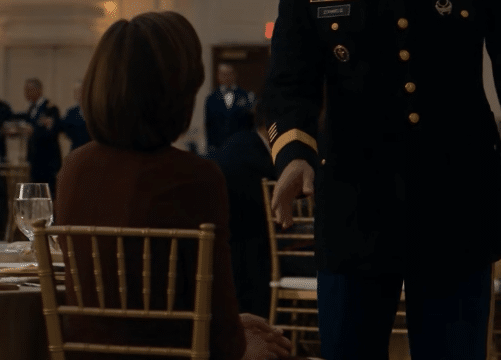
Colonel Richard Vance’s voice cut through the elegant ballroom, sharp enough to turn heads at three nearby tables. He stood in his immaculate dress uniform, medals catching the chandelier light, staring down a silver-haired woman in a navy evening dress as though she had personally insulted every rank he had ever earned.
Her young grandson had accidentally bumped the Colonel’s adult daughter while squeezing between the gala tables. The girl’s suitcase shifted a few inches, nothing more. She was unharmed, her dress untouched, and the room had already begun moving on.
Richard had not.
The woman, Margaret Hale, steadied the little boy with one hand. Her silver-blonde hair remained neatly pinned into a low bun, and her pearl earrings glimmered as she looked at the officer without flinching.
“They’re children.”
It was a simple answer. No accusation. No raised voice. Just a fact.
But Richard had spent too many years mistaking deference for respect, and he heard her calmness as a challenge.
His daughter glanced between them, embarrassed. “Dad, it’s fine,” she murmured, trying to end the exchange before the surrounding guests paid any more attention.
Richard ignored her.
He was a colonel with an impressive record, a polished uniform, and ambitions that extended well beyond his current command. Tonight’s anniversary gala was filled with senior officers, retired commanders, decorated veterans, and families whose names carried weight in military circles.
He wanted everyone to see him as a man who controlled a room.
Instead, a grandmother in an ordinary evening dress had refused to be intimidated by him.
His expression hardened.
Margaret quietly moved her grandson behind her, putting herself between the child and the increasingly agitated officer. She did not know what Richard expected her to do. Apologize repeatedly? Beg for permission to remain at the table? Offer some explanation for the unforgivable crime of a child brushing against another suitcase?
Whatever he wanted, she would not give it to him.
Richard looked at her navy dress, her modest jewelry, and her practical black heels. His eyes traveled over her as though he were assigning her a place in an invisible hierarchy.
He decided she belonged near the bottom.
And then he crossed a line that would change the entire evening.
Act II
Richard snatched a wineglass from the nearest table.
Before Margaret could move, he hurled the red wine directly into her face.
The liquid struck her cheeks and soaked the front of her navy dress. A few guests gasped as the wine ran down the fabric, staining the elegant simplicity of her clothing in a single, deliberate act.
Margaret blinked against the liquid. For one brief second, the ballroom seemed to lose its sound.
Richard did not stop.
He smashed the empty glass against the polished floor. It shattered beside the table, sending nearby guests recoiling from the sharp crack.
Then he stepped forward and slapped her hard across the face.
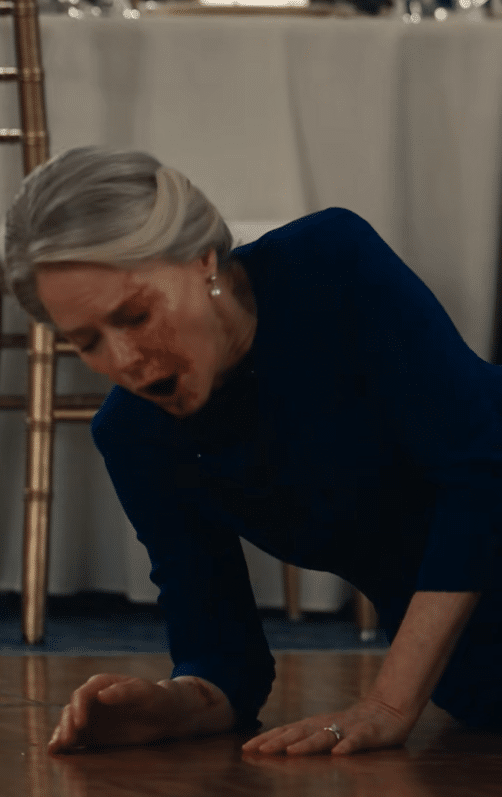
The impact turned Margaret’s head. Her cheek reddened almost immediately, swelling beneath the skin, while a faint trace of blood appeared at the corner of her mouth.
She staggered but remained conscious.
Before she could regain her balance, Richard drove a forceful kick into her stomach.
Margaret folded forward, the breath knocked out of her. Her knees buckled, and she fell beside a chair, scraping her palm against the floor as she tried to catch herself.
For several seconds, she could not draw a full breath.
Her hand moved instinctively to her abdomen. Her other palm pressed against the floor, wine dripping from her sleeve onto the polished surface.
No one touched her during the assault.
A man near the head table took a startled step backward. A woman covered her mouth. Margaret’s grandson stood frozen beside his mother, too young to understand how an ordinary mistake had become something so frightening.
Richard looked down at the woman he had just attacked.
He seemed almost pleased with the silence.
It was the silence he had wanted all along—the kind that made people afraid to question him.
“Stay away from people above your class.”
The words landed with a cruelty that outlasted the slap.
Margaret remained beside the chair, one arm guarding her stomach. Her cheek burned, her breathing came in short, careful pulls, and the wine had soaked through the front of her dress.
Yet when she looked up, there was no pleading in her eyes.
Richard expected tears. He expected outrage, perhaps, or a trembling apology. He expected her to make a scene that he could use to justify his behavior.
Instead, she studied him with a quiet, almost distant focus.
That unsettled him more than a shouted accusation would have.
Across the table, a retired colonel named Thomas Whitaker had risen halfway from his chair.
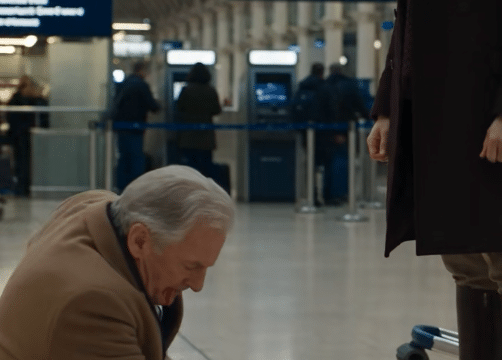
He was seventy-one, silver-haired, and dressed in a black tuxedo with a small military pin on his lapel. He had spent decades around men who used authority to protect others—and men who used it to protect their own egos.
He had watched Richard’s outburst with growing disbelief.
But when Margaret turned her face toward the light, Thomas stopped moving.
The woman’s expression was older than the room’s memories. Her eyes, despite the pain, held a composure he had not seen in decades.
And suddenly, he was no longer looking at a stranger.
He was looking at a name he had once believed he would never hear again.
Act III
Thomas Whitaker rose to his feet.
He did not hurry toward Margaret. He did not shout at Richard or demand that someone explain what had happened. His attention remained fixed on the woman beside the chair, as though he were afraid that one wrong movement might make the recognition disappear.
Margaret noticed him looking.
She offered no greeting. No signal. Nothing that might confirm what he suspected.
She simply steadied herself against the chair and began to rise.
The movement cost her. She paused halfway, drawing a guarded breath through the pain in her stomach. Her injured palm trembled slightly, but she refused to let her grandson see her collapse again.
Thomas’s face had changed.
The years had taken some of the strength from his posture, but they had not erased the memory of the officers he had served beside. He remembered briefings in rooms where nobody spoke casually about the people whose decisions had brought soldiers home alive.
He remembered a woman whose name had once traveled through military circles without needing to be printed on a banner.
A woman whose reputation had never depended on a polished uniform or a collection of medals.
Richard noticed the older officer standing.
“What?” he demanded, turning toward him. “Do you have something to say?”
Thomas barely seemed to hear him.
He took one careful step closer, looking at Margaret’s face as the truth settled into place.
Then he spoke two words.
“Black Eagle?”
The nickname seemed to travel farther than his voice.
At the nearest table, an elderly veteran straightened. Another retired officer turned sharply from his conversation. A man who had been reaching for his water glass stopped with his hand suspended above it.
Nobody explained anything.
They did not need to.
The reaction itself changed the atmosphere.
A moment earlier, Richard had commanded the room through intimidation. Now, the people around him were looking past his uniform, past his medals, past the authority he had been so determined to display.
They were looking at Margaret.
Richard frowned.
“What’s that supposed to mean?”
Thomas did not answer him.
His eyes remained on the woman in the stained navy dress. He looked almost reverent, but there was sorrow beneath it, too—a recognition tied to something more significant than rank or reputation.
Margaret had not asked for the attention. She had not announced who she was. She had not used her past to shield herself from what Richard had done.
She had stood between a child and an angry man, answered him calmly, and refused to lie about a harmless accident.
That was all.
And somehow, it had been enough to awaken a memory that an entire generation of military personnel had carried.
Richard glanced around the ballroom.
The silence was no longer the silence he had created. It had become something he could not control.
He saw the older veterans watching Margaret with expressions that made his stomach tighten. He saw Thomas standing rigidly, as if the name he had spoken deserved more respect than anything on the Colonel’s uniform.
Richard’s confidence began to fracture.
But instead of asking who Margaret was, he chose the one response that had always served him when he felt threatened.
He mocked what he did not understand.
Act IV
“That ridiculous name means nothing here.”
Richard delivered the line with a dismissive laugh, but it came out thinner than he intended.
He straightened his uniform and glanced toward the watching guests, trying to reclaim the room through sheer force of habit. The medals on his chest flashed beneath the lights. His insignia remained visible. His rank had not changed.
Yet none of those things seemed to help him now.
Thomas Whitaker stared at him in disbelief.
For a moment, the retired colonel looked as though he might answer with a dozen stories. He might have described the operations that had made Black Eagle legendary, or the terrible decisions that had demanded courage without guarantees.
Instead, he remained silent.
The story belonged to Margaret, not him.
She had finally managed to stand upright. One hand rested lightly against the chair, while the other stayed close to her abdomen. The front of her dress was stained with wine, her cheek was visibly swollen, and the faint blood at the corner of her mouth had not disappeared.
She looked at Richard.
“It used to mean everybody came home.”
Her voice was quiet.
There was no pride in it. No attempt to impress the guests or punish the man who had hurt her. If anything, the words carried a weariness that seemed to reach far beyond the ballroom.
Richard’s expression shifted.
He had expected a boast. A claim of superior rank. Some dramatic declaration that would give him something to challenge.
Instead, Margaret had spoken about other people coming home.
Thomas lowered his head slightly, remembering.
Years earlier, during a devastating operation, Margaret had earned the nickname Black Eagle among the people who served with her. It had not come from a publicity campaign or a carefully managed career. It had emerged from a moment when fear, confusion, and danger had stripped away every comfortable distinction between senior and junior, celebrated and forgotten.
When the situation turned catastrophic, Margaret had stayed focused on getting her people out.
She had gone back when others believed there was no safe reason to return. She had helped bring frightened, injured personnel through a situation that could easily have ended in a list of names no family wanted to receive.
The story had traveled through units and generations, changing in small details as stories often do. But the central truth had remained.
Margaret Hale had been the officer who refused to leave people behind.
And for those who had served in that era, Black Eagle had come to mean more than one woman’s courage. It had become a reminder that leadership was measured by the people who survived your decisions, not by the insignia on your shoulders.
Richard stared at Margaret.
He had spent the evening treating rank as a weapon. He had assumed that anyone who did not display visible status must be beneath him, and that a public display of force could make his assumptions look like truth.
Now the woman he had humiliated stood before him with the bearing of someone who had carried responsibilities he could barely imagine.
He began to remember the stories.
Not all at once. First, a fragment from an old briefing. Then a photograph he had seen during a professional course, accompanied by a name spoken with unmistakable respect. Then a remark from a senior officer who had warned younger commanders never to confuse quietness with weakness.
Black Eagle.
Richard looked again at the stained dress, the injured cheek, and the hand guarding Margaret’s stomach.
The pieces came together.
His daughter had gone pale. She was no longer looking at the broken glass or the wine on the floor. She was looking at her father as though she had just discovered a stranger standing inside his uniform.
Richard tried to speak, but no words came.
Around them, the veterans remained silent. Nobody cheered. Nobody mocked him. Their stillness was more devastating than applause could have been.
Margaret did not move toward him.
She did not demand an apology, threaten his career, or remind him that she had once held authority he could only dream of possessing. She simply stood her ground, refusing to let the worst moment of the evening become the defining fact of her life.
Richard had wanted everyone to see a woman who could be pushed aside.
Instead, he was beginning to see the person he had failed to recognize—and the kind of leadership he had just disgraced himself by violating.
Only one question remained.
Could he accept what he now knew, or would he continue pretending the truth was beneath him?
Act V
Thomas Whitaker remained beside the table, his eyes never leaving Margaret for long.
He remembered her before retirement, when her name had carried the weight of difficult decisions and the lives entrusted to her. He remembered the people who had spoken of her with gratitude rather than fear.
Most of all, he remembered that she had never needed a room to fall silent in order to prove who she was.
Richard had built his authority around the opposite idea.
He believed that respect could be extracted through intimidation, that rank made ordinary rules optional, and that a person who looked unimportant could be treated as though their dignity had no value.
His mistake had not been failing to recognize Black Eagle.
His mistake had been believing that Margaret needed to be someone famous before she deserved to be treated like a human being.
The room seemed to understand that distinction before he did.
His daughter stepped away from him, her expression stricken. She looked toward Margaret, then at the broken glass on the floor, then back at her father.
She had told him it was fine.
It had been fine.
A child had accidentally bumped a suitcase. Nothing had been damaged. Nobody had been threatened. Her father had transformed an ordinary inconvenience into a public act of cruelty because someone had dared to answer him calmly.
Now she could not look at him without seeing the distance between the officer he pretended to be and the man he had chosen to become.
Margaret noticed her expression.
For a moment, the older woman’s gaze softened. The young woman was not responsible for her father’s actions, and Margaret would not make her carry them.
She turned her attention back to Thomas.
The retired colonel gave her a small, respectful nod. There were questions he could have asked, memories he could have raised, and old names he could have spoken. But Margaret’s breathing was still guarded, and the swelling in her cheek was becoming more pronounced.
The first obligation was not nostalgia.
It was her safety.
At last, Thomas turned toward the staff near the ballroom entrance and signaled for assistance. The violence was over; only then did people begin to move. One guest stepped aside to clear the path, while another quietly guided the grandson away from the broken glass.
No one struck Richard. No one needed to.
The room had witnessed what he had done, and the consequences would not be settled by another act of humiliation. The incident could be documented, witnesses could provide statements, and the appropriate military authorities could determine what followed. His rank would not erase the facts, and Margaret’s reputation would not need to substitute for evidence.
Richard stood motionless as the people around him began attending to the aftermath.
He looked at Margaret once more.
She was not smiling. She did not look triumphant. Her dress was ruined, her face hurt, and her hand still rested near the place where his kick had struck her.
She had every reason to hate him.
But she did not give him the satisfaction of seeing her reduced to hatred.
For years, Richard had assumed that the most powerful person in any room was the one who could make everyone else afraid to speak. Tonight, he had learned how fragile that kind of power could be.
A single remembered name had exposed the emptiness beneath it.
Thomas Whitaker’s voice had not been loud. The nickname had not been a threat. No one had needed to explain the legend in detail or list Margaret’s achievements for the room to understand that Richard had badly misjudged the woman before him.
Black Eagle had once meant that people came home.
Now, standing in a ballroom full of veterans and families, Margaret carried another truth just as quietly: the people who deserve respect do not always announce themselves, and the people who demand it most loudly may be the least worthy of it.
Richard’s mouth opened.
The title, the uniform, and the medals that had seemed so important only minutes earlier suddenly offered him no protection from the one thing he could not command.
The truth.
His face drained of color. His eyes fixed on Margaret, and the last of his arrogance gave way to disbelief.
“Black Eagle… you?”