Act I
“Don’t touch my map.”
Major Daniel Mercer’s voice cut through the field command post as if the entire operation belonged to him personally. Around the folding tables, officers and enlisted personnel worked over tactical overlays, checked radio frequencies, and tracked moving units on digital screens. Outside the tent, generators rumbled beside a row of communication vehicles, but inside, every conversation seemed to stop when Mercer raised his voice.
The woman standing across from him did not step back.
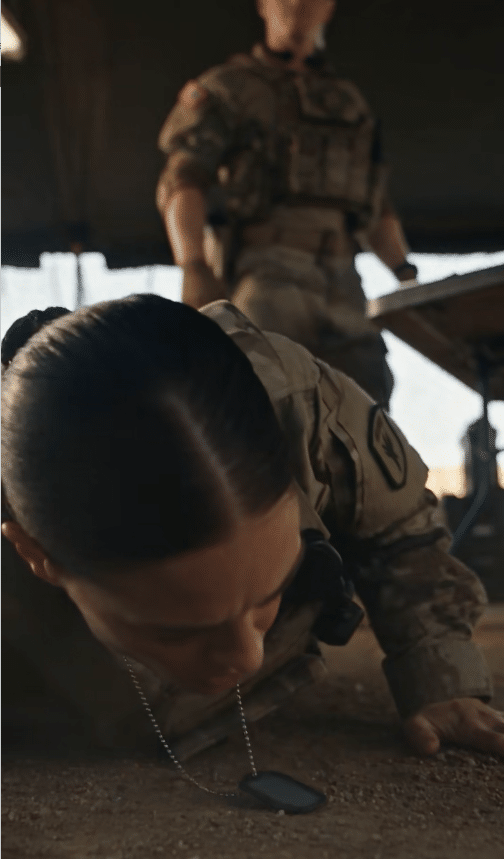
She was thirty-three, dressed in an ordinary OCP field uniform, her black hair pulled into a tight practical bun. Her tactical vest concealed most of her rank insignia, and nothing about her appearance invited special attention. To Mercer, she looked like another subordinate who had mistaken access to a command post for permission to challenge him.
She glanced down at the route he had just marked on the tactical map.
“Then stop marking the wrong route.”
The words were quiet, clipped, and impossible to misunderstand.
Mercer stared at her. He had spent the morning directing personnel, correcting junior officers, and making certain everyone knew whose plan they were following. His route had already been entered into the operational overlay, and several teams were preparing to move according to it.
The woman had noticed something those around him either had not seen or had been too cautious to mention. The proposed route cut through a vulnerable stretch of terrain where the unit could lose communications coverage and expose its flank.
She had corrected the mistake without raising her voice. That was what enraged him most.
In Mercer’s mind, a challenge delivered calmly was still a challenge. Worse, it was a challenge in front of witnesses.
He looked around the tent, taking inventory of the personnel who had turned toward them. A young communications specialist lowered his headset slightly. An officer near the radio console stopped writing. At the far end of the table, Chief Warrant Officer Robert Harlan, fifty-four, watched the exchange with the stillness of a man who had learned that the first person to speak in a tense command post was not always the person who understood what was happening.
Mercer noticed the attention.
He hated it.
The woman’s gaze remained on the map, not on the Major’s face. She was studying the terrain markings, the communications gaps, and the distance between the proposed route and the safer corridor that should have been used.
She was giving him one final opportunity to correct the error without making a spectacle of himself.
Mercer interpreted her restraint as defiance.
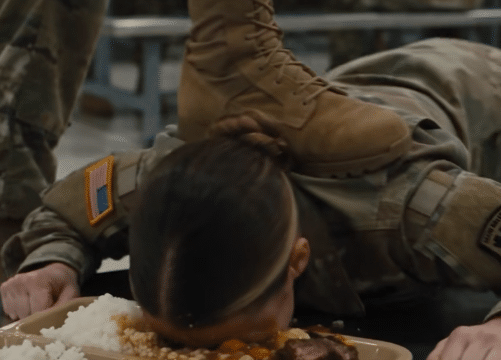
He pulled off one tactical glove. Wet mud clung to its surface from the churned ground outside the tent. Then, without warning, he flung the muddy glove directly into her face.
The impact left a smear across her cheek and brow.
She blinked once, more surprised by the deliberate humiliation than by the mud itself. Before she could straighten, Mercer struck her hard across one cheek with an open hand.
The crack echoed against the command post walls.
Her head turned with the blow. A red mark spread rapidly across her cheek, and a thin trace of blood appeared at the corner of her mouth. The personnel nearest the map table recoiled, but nobody moved toward her.
Mercer did not give her time to recover.
He took a driving step forward and kicked her hard in the stomach.
Her breath vanished. She folded forward, her hands moving instinctively toward her abdomen as her knees gave way. She fell onto the dirt floor inside the tent, catching herself on one hand before her shoulder struck the ground.
For a moment, the only sound was the low mechanical rumble outside and the uneven breath she struggled to draw.
She remained conscious.
And even with pain tightening her face, she did not beg.
Mercer stood over her, his chest rising with anger, as though the violence had settled a dispute that his own mistake had started.
“You’re nothing in my command post.”
Nobody answered.
But as the woman shifted slightly on the dirt, something beneath her collar slipped free.
A small black metal tag swung into view.
And the Chief Warrant Officer saw the words engraved on it.
What he recognized was not merely a call sign. It was a name the military had already buried.
Act II
Chief Warrant Officer Robert Harlan had spent nearly three decades around military operations, long enough to understand that the most dangerous person in a command post was not always the loudest or the highest-ranking officer.
Sometimes it was the person who noticed what everyone else had overlooked.
Harlan had watched Mercer build his reputation through confidence, relentless self-promotion, and an instinct for finding people who were reluctant to contradict him. The Major knew how to command a room when everyone agreed with him. He was less skilled when someone presented evidence that he was wrong.
The woman had done exactly that.
And now she was on the floor, one hand braced against the dirt, breathing through the pain of the kick. Her cheek was swollen and red, and mud streaked the side of her face. Yet her eyes remained alert, moving briefly toward the tactical map she had tried to correct.
She was still thinking about the route.
That detail unsettled Harlan almost as much as the tag.
He had seen people respond to humiliation with anger, fear, tears, or frantic attempts to defend themselves. The woman showed none of those reactions. Pain was visible in the guarded movement of her torso, but her expression remained controlled.
She seemed less concerned with what Mercer had done to her than with what he might do next.
The black tag had slipped farther out from beneath her collar.
Harlan could now read the engraving clearly.
VIPER ACTUAL.
His fingers tightened around the map tool he was holding.
For a second, the years seemed to fall away. He remembered an operational briefing from long ago, the kind of briefing that was never discussed casually and was never repeated outside the people who had been cleared to hear it.
There had been a name attached to a mission that had gone catastrophically wrong. A call sign associated with a commander whose judgment under pressure had saved people when the operation collapsed. Someone who had kept a damaged team moving after communications failed, who had made decisions in minutes that other people would spend years studying.
Then the mission had ended in disaster.
The reports had been incomplete. Communications had gone silent. The people who returned could not establish what had happened to everyone who had been separated during the final phase. Eventually, the call sign disappeared from operational use.
VIPER ACTUAL was retired.
The official explanation had been simple enough to repeat and difficult enough to accept: its bearer was believed dead.
Harlan had never forgotten the call sign because he had never forgotten the people who had spoken of its bearer. They had not described a legend. They had described a soldier who kept working when everyone else was running out of options.
There had been no public ceremony that could capture the truth of it. No parade could explain what it meant to make a decision with incomplete information while other people’s lives depended on getting it right.
The name had become something people spoke about carefully, if they spoke about it at all.
And now it was hanging from the neck of a woman Mercer had just kicked to the floor.
Harlan stared at her face, searching for a resemblance to the person in his memory. Time could change a face. So could exhaustion, injuries, and the years spent working in places where comfort was never guaranteed.
But the tag was unmistakable.
He looked again at the woman’s steady eyes.
She was not trying to draw attention to the engraving. She had not pulled it out deliberately or used it to threaten Mercer. The tag had emerged because he had knocked her down.
That made the sight of it worse.
The woman had walked into this command post without demanding recognition. She had examined a map, identified a dangerous error, and corrected it. When Mercer answered her professional judgment with violence, she had endured the assault without surrendering her composure.
If Harlan’s suspicion was correct, Mercer had just assaulted someone whose identity carried a history he could not begin to understand.
Harlan felt his stomach tighten.
He had to warn him.
But the Major was already looking for another way to humiliate her.
And Mercer had no idea how close he was to making his worst mistake permanent.
Act III
Mercer followed Harlan’s gaze toward the black tag.
For the first time since the confrontation began, the Major’s expression shifted. His eyes narrowed as he tried to make sense of the reaction around him. He had expected the room to settle after the assault, the way it usually did when he made it clear that a disagreement was over.
Instead, nobody seemed certain what to do.
One soldier stood motionless beside the communications equipment. A staff officer had stopped halfway through closing a folder. Another man looked from Harlan to the woman on the floor, then quickly away, as though eye contact might force him to acknowledge something he was not prepared to understand.
Mercer mistook the silence for judgment.
He wanted it to end.
Harlan stepped closer, but he did not approach the woman. His eyes remained fixed on the tag, and the usual professional neutrality in his face had been replaced by something unmistakable.
Alarm.
“Major… that call-sign was retired.”
He spoke quietly, but every word carried across the table.
Mercer turned toward him.
The warning should have been enough to make him stop. Harlan was not a junior officer prone to rumors, and he was not a man who confused old stories with current orders. His reputation had been built on precision, discretion, and an ability to distinguish useful intelligence from noise.
If Harlan said a call sign had been retired, he meant that it had been removed for a reason.
But Mercer had spent too much of his career treating uncertainty as a threat to his authority. He could not accept that a piece of metal hanging from a subordinate’s neck might have more power in that room than his own rank.
He looked down at the tag again.
The engraving seemed almost absurd to him. A dramatic name on a black piece of metal. A relic from a story he had never considered important.
He forced a sneer.
“Then it belongs in the trash.”
The words came out with the mocking confidence he had used moments earlier. Yet the effect was different now. No one laughed. Nobody joined in. Even the personnel who had previously watched Mercer’s every movement with practiced attentiveness seemed unwilling to share his contempt.
Harlan did not argue.
He simply looked at the woman.
She was slowly drawing a deeper breath, protecting her abdomen with one arm while keeping the other hand against the dirt. Her cheek was visibly swollen. A faint trace of blood remained at the corner of her mouth, but her gaze had not lowered.
She could have tried to explain herself.
She could have demanded that Mercer be punished. She could have shouted her rank, recited her assignments, or used the call sign as a weapon against him.
Instead, she looked at him with a calm so complete that it seemed to strip the room of every excuse he had made for himself.
“It was retired because they thought I was dead.”
Her voice was quiet.
There was no pride in it. No theatrical emphasis, no attempt to make the statement sound like a threat. She delivered the words as a fact she had carried for years, a fact that required no embellishment.
Mercer’s sneer stopped halfway across his face.
For a moment, his mind seemed to reject the sentence. He glanced at Harlan, expecting the Chief Warrant Officer to dismiss it, to explain that the woman was borrowing an old call sign, or to insist that the tag meant something different from what it appeared to mean.
Harlan did none of those things.
His expression had changed from alarm to stunned recognition. His posture had straightened, not in response to an order, but in the instinctive way a veteran reacts when confronted with something he believed he would never see again.
The woman did not move to stand over Mercer. She did not even attempt to rise immediately. She remained where she was, breathing carefully through the pain, while the truth settled into the room around her.
The Major had wanted to prove that she was insignificant.
Instead, he had forced her to reveal the smallest possible piece of a history that had been deliberately left behind.
And that tiny piece was enough to change the meaning of everything that had happened.
Act IV
The command post did not erupt into chaos.
It became quieter.
That was what Mercer noticed first. The generators outside continued to rumble. Radios still crackled. Somewhere beyond the tent, a vehicle door closed, followed by the faint sound of boots crossing packed ground.
But inside, the familiar rhythm of his command post had broken.
People were no longer watching him to see what he wanted them to do. They were watching him because they had begun to understand what he had done.
Mercer looked at the woman again.
He tried to reconcile the person on the dirt floor with the call sign engraved on the tag. The ordinary field uniform. The concealed rank. The lack of any demand for special treatment. Her insistence that the route was wrong. Her refusal to react when he raised his voice.
Those details had seemed like evidence of insignificance when he first saw her.
Now they seemed to point toward something else.
She had not needed to announce herself to know the map was wrong. She had not needed to raise her voice to make her assessment clear. And she had not needed to threaten him when he became violent.
Her restraint had not been weakness.
It had been a choice.
Mercer had spent the confrontation believing that authority was something he could establish through force. If someone challenged him, he could embarrass them. If embarrassment failed, he could make an example of them. He had mistaken the fear of his subordinates for respect and their silence for agreement.
The woman had not played by those rules because she had never accepted them.
Harlan remained still, but his attention was fixed on her with unmistakable seriousness. He had no need to explain the history of VIPER ACTUAL to the room. The reaction on his face told Mercer that the call sign was not a costume, a joke, or an invented identity.
It belonged to a past that had outlasted its official records.
Mercer’s eyes moved from Harlan to the tag, then back to the woman.
He wanted to ask questions, but every question that came to mind exposed another weakness in his position. Who was she? Why had no one told him? Why was she in his command post without a visible rank? Why had she been examining his route?
Most importantly, why had she allowed him to continue believing he was in control?
The answer to the last question was already there, in the way she had spoken before he struck her.
She had given him a chance to listen.
He had chosen violence instead.
The woman shifted her weight carefully, lifting her head enough to look toward the tactical table. Her breathing remained guarded, and pain tightened the muscles around her mouth. She did not pretend the kick had not hurt her.
But she also did not look defeated.
The tag rested against the front of her uniform, exposed now, no longer hidden beneath the collar. Its black surface seemed ordinary, almost unremarkable. Only the words engraved on it had changed the atmosphere of the entire tent.
Mercer could no longer dismiss it without dismissing Harlan’s judgment, the history behind the call sign, and the growing realization that he had acted on almost no information at all.
He had struck first and thought afterward.
That was the opposite of the discipline he was supposed to represent.
The tactical map still lay open on the table. The incorrect route remained marked across the terrain, an obvious line drawn with the certainty of someone who had never expected to be challenged. The safer corridor the woman had indicated was still visible beside it.
No one had changed the map.
No one needed to.
The error was there for everyone to see.
And for the first time, Mercer understood that the problem was no longer simply the route, the confrontation, or even the violence.
It was the fact that everyone in the room had witnessed him choose pride over judgment.
He looked at the woman, searching her face for anger, satisfaction, or some sign that she intended to use the moment against him.
He found none.
Her expression was cold, steady, and controlled.
That made the fear beginning to rise inside him far harder to dismiss.
Act V
Mercer had always imagined that the moment his authority failed would be loud.
He expected an argument, a direct challenge, perhaps a confrontation in which someone openly refused an order. In his mind, a loss of control would arrive as a visible struggle, something he could push back against with a sharper command or a stronger show of force.
He had never imagined it could happen in silence.
The Chief Warrant Officer stood beside the table, his attention still fixed on the woman. The other personnel remained in place, watching without intervening, their earlier uncertainty giving way to a grave awareness that the situation had crossed a line no rank could erase.
The woman slowly drew herself into a more upright position. She kept one hand near her abdomen and took a careful breath before lifting her chin. The pain was real, and so was the swelling on her cheek.
But she did not ask Mercer to help her.
She did not ask Harlan to speak for her.
She simply met the Major’s eyes.
For the first time, Mercer seemed to notice how little she had said throughout the confrontation. She had corrected his map. She had endured his humiliation. She had been struck, kicked, and left on the dirt floor in front of his personnel.
Then she had delivered one sentence.
That sentence had done more damage to his confidence than anything he could have imagined.
They thought I was dead.
Mercer’s gaze dropped briefly to the tag again. He no longer saw a piece of metal that belonged in the trash. He saw the remains of a history he did not know, attached to a person he had judged before making the slightest effort to understand her.
Harlan’s warning echoed in his mind.
That call-sign was retired.
There were details Harlan had not explained, names he had not spoken, and events that the woman had not offered to recount. But the absence of an explanation only made the implication more powerful. This was not a story Mercer could dismiss with a joke or a louder voice.
The person he had treated as insignificant was connected to a call sign that experienced personnel believed should no longer exist.
And she had not used that history to protect herself from him.
She had entered his command post, found a mistake, and tried to correct it.
Mercer’s jaw tightened. He looked as though he wanted to recover the expression he had worn before the assault, the easy contempt that had allowed him to believe he could control everyone around him.
It would not return.
The witnesses had seen the mud thrown into her face. They had heard the slap. They had watched him drive his boot into her stomach and stand over her while she struggled to breathe.
They had also seen what happened when the tag emerged.
No order could make those memories disappear. No display of rank could force the room to believe that he had acted with judgment. And no insult could turn the woman back into the harmless subordinate he had imagined when she first touched the map.
The tactical overlay remained open between them, its lines marking a route that had never been safe simply because a Major had chosen it.
Mercer had thought the map was his.
He had thought the room was his.
He had thought the woman on the floor was nobody.
Now he was staring at a call sign he had never expected to encounter, carried by someone who had been presumed dead and who had just survived his attempt to humiliate her.
His lips parted.
The certainty drained from his face. His eyes widened, and the muscles around his mouth tightened as the pieces finally connected. Whatever authority he had believed he possessed a few minutes earlier, it could not shield him from the truth of what he had done.
He looked at her as if seeing her for the first time.
And in a voice stripped of every trace of his earlier arrogance, he whispered the only words he could manage.
“You’re Viper Actual…?”