Act I
“Then skip lunch again.”
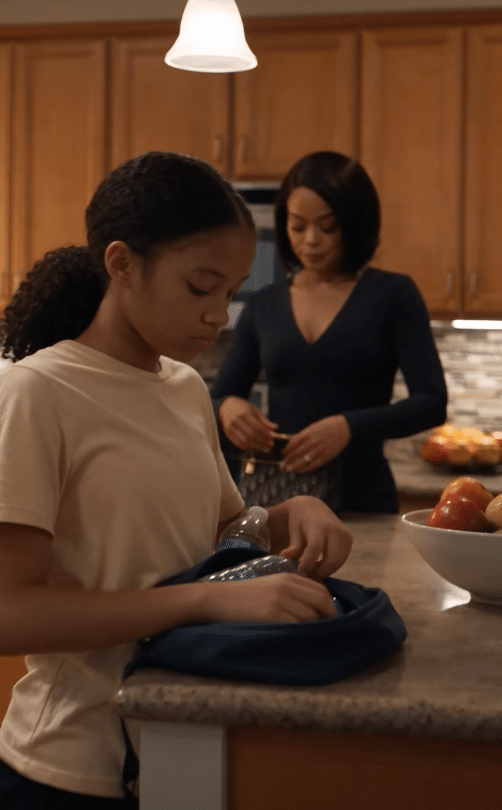
Nia stood in the kitchen before school, holding open a lunch bag that contained nothing but a bottle of water. Her cream school polo was neatly tucked in, and her curly black hair was tied into a low ponytail. The school bus would arrive soon, but she still had nothing to eat.
She looked at her stepmother, who was slipping a cash envelope into her purse.
“My lunch account is empty again.”
Her stepmother barely glanced at the bag.
“Then skip lunch again.”
Nia lowered her eyes to the empty lunch compartment. She wasn’t asking for anything extravagant. She wasn’t asking for extra spending money or a special treat. She wanted to understand why the money her father left for her school lunches kept disappearing before it reached her account.
Her stepmother adjusted her purse, the envelope hidden inside.
Nia had seen the label before: Nia lunch.
She knew her father left the money every Monday. She knew the routine because he had explained it to her himself, making sure she would have enough to eat during the school week.
Yet every time she checked her lunch account, the balance was empty.
The same thing had happened the previous week.
And the week before that.
Nia took a breath, trying to keep her voice steady. She was tired of asking the same question and being treated as though the problem were somehow her fault.
Then she pointed toward the note her father had attached to the envelope.
“Dad leaves money every Monday.”
Her stepmother’s expression cooled.
“That money pays for this house.”
The answer came as if it settled everything.
But Nia stared at the envelope disappearing into the purse and understood that the money hadn’t simply gone missing.
Someone had been making a choice about what she was allowed to have.
And just as her stepmother prepared to end the conversation, the one person who could verify the truth returned to the kitchen.
Act II
Nia’s father, Marcus, had established the lunch-money routine for a reason.
He knew school days were long. He knew Nia was growing, studying, and trying to manage more responsibilities as she got older. He wanted one ordinary part of her day to be dependable: when lunchtime came, she would have money in her account and something to eat.
Every Monday, he left cash in a labeled envelope.
The arrangement was simple enough that it shouldn’t have needed supervision. The money was designated for Nia’s lunches, and the envelope made that purpose clear.
But over time, the routine had become a source of quiet anxiety for Nia.
She would check her account, discover there was no balance, and try to work out what had happened. When she asked her stepmother, she received explanations that made her feel as if she had done something wrong.
Maybe she had spent the money.
Maybe she hadn’t paid attention.
Maybe there was no money left because the household had other needs.
Each explanation left Nia with the same problem: she was expected to go to school without knowing whether she could buy lunch.
She had begun packing her bag around that uncertainty. Some mornings, she hoped the account would have been funded overnight. Other mornings, she prepared herself for another empty balance.
Today, she had brought only water.
Her stepmother stood beside the counter, smoothing her dress and arranging her belongings as though the conversation had been no more significant than a reminder about chores. The labeled envelope was now inside her purse.
Nia looked at it one last time.
Then Marcus returned to the kitchen.
He had come back for his keys, moving quickly because the morning was already underway. But as he entered, he heard the last part of the exchange.
His gaze moved from Nia’s empty lunch bag to his wife’s purse.
He stopped.
“I leave cash only for Nia’s lunches.”
His wife turned toward him immediately.
The coldness in her expression gave way to a more accommodating look, the kind she often adopted when Marcus entered a room. She seemed ready to make the problem sound ordinary, something that could be resolved by explaining Nia’s supposed mistakes.
“She spends it at school.”
Marcus looked at Nia.
The girl remained still, her lunch bag open on the counter. She didn’t interrupt her stepmother or argue about what she had spent. She didn’t need to. Her father had said the money was for lunch, and the empty account was right in front of them.
Marcus’s expression tightened.
He had not left that money for household bills. He had not intended it as a contribution to general expenses. He had labeled the envelopes precisely because he wanted the purpose to be unmistakable.
His wife was claiming that Nia had spent the money.
But Nia’s account was empty again.
Marcus looked toward the envelope in her purse.
Before he could ask to see it, Ava appeared with a handful of cafeteria receipts.
She had been paying attention to the pattern, too.
And what she had brought would make it much harder to blame Nia.
Act III
Ava placed the receipts on the counter.
Her long natural curls fell around her shoulders as she sorted the papers, looking from the dates to the information printed on them. She was thirteen, old enough to recognize that something didn’t add up and uncomfortable enough with her mother’s behavior to stop pretending she hadn’t noticed.
The receipts showed a clear pattern.
Nia’s cafeteria account had not been funded for a month.
Not one missed transaction.
Not a single forgotten Monday.
An entire month.
Ava turned the papers toward Marcus.
“Her account got nothing.”
Marcus picked up the receipts and examined them one by one. The dates matched the weeks he had been leaving money for Nia. The account history did not support his wife’s explanation that Nia had spent the funds at school.
If Nia had been using the lunch money in the way her stepmother claimed, the account should have shown the corresponding activity.
Instead, it showed that the money had never reached the account.
Marcus looked at his wife.
She shifted her purse higher on her shoulder.
For the first time, her explanation seemed to have run out of room. She had claimed that Nia spent the money, but the receipts showed no deposits for the period in question. The cash envelopes had been placed in her care, yet the account remained empty.
Nia watched her father study the records.
She had been trying to explain the same problem for weeks. Each time, she had been met with another reason why she should accept it. Now Ava had brought the receipts, and the information was visible to everyone.
Still, the receipts answered only part of the question.
They showed what had not happened.
They did not show where the money had gone.
Caleb, who had been quietly observing the adults, stepped toward the counter. He was ten, with short neat curls and a black hoodie. In his hands was a device displaying the kitchen camera history.
He had noticed the Monday-morning pattern before.
The camera had recorded the kitchen at different times, and Caleb had gone back through the clips to compare them. He advanced through the dates, stopping at the same part of each morning.
His mother entered the kitchen.
She took the labeled envelope.
She placed it in her purse.
Then she left.
The movement repeated across the weeks.
Caleb raised his eyes toward Marcus.
“She takes it every week.”
The room fell quiet.
Nia looked at the screen. Ava’s receipts had shown that her account wasn’t receiving the money. Caleb’s recordings now showed what happened to the envelopes before the account could be funded.
Marcus watched the clips again.
Monday after Monday, the money intended for Nia’s lunches had been taken from the kitchen and carried away.
The evidence did not show what every dollar had ultimately been spent on. But it established the pattern that mattered: the money had been entrusted for a specific purpose, and the person responsible for handling it had repeatedly removed it instead of making sure Nia could use it for lunch.
Marcus lowered the device.
His wife said nothing.
Nia stood beside the empty lunch bag, looking at the bottle of water inside it. She had not been careless with the money. She had not spent it at school. She had been asking why the account was empty because she knew she was supposed to have money there.
Now the reason was visible.
And Marcus was beginning to understand that this had not been a single bad morning.
It had happened every week for an entire month.
Act IV
Marcus placed Caleb’s device beside the receipts.
Then he reached for the notes he had attached to the weekly envelopes.
There were four of them.
Each note was marked for Nia’s lunches. Each one represented another Monday when Marcus had set aside money specifically so his daughter would have something to eat during the school week.
He arranged them across the counter.
One.
Two.
Three.
Four.
The dates aligned with the receipts Ava had brought and the clips Caleb had found. The records formed a timeline that no longer depended on anyone’s memory or explanation.
Marcus stared at the notes.
He remembered leaving the cash. He remembered writing the labels. He had believed the arrangement was working because he had taken the time to make the purpose clear.
All the while, Nia’s account had remained empty.
His wife stood beside the counter, her hand gripping the strap of her purse. The envelope she had taken that morning was still inside it.
She looked at the papers, then toward the camera history on Caleb’s device.
There was no obvious way to dismiss the evidence as a mistake. The dates were there. The receipts were there. The footage showed the envelopes being removed.
And Nia had been arriving at school without lunch money.
Marcus looked at his daughter.
The realization was more painful than a simple accounting error. For four weeks, he had believed he was providing for Nia in one small but important way. He had trusted that the money he left would reach the purpose he had assigned to it.
Instead, Nia had been forced to face an empty account repeatedly, then listen as her stepmother blamed her for the situation.
She had tried to explain it.
She had pointed to the labeled envelopes.
She had reminded her stepmother that her father left money every Monday.
And she had been told that the money paid for the house.
Marcus’s eyes returned to the notes.
He could now see the pattern across the whole month, not just the latest morning. The first missing deposit had not been an isolated oversight. The next one had not been a coincidence. Each week had repeated the same sequence until Nia’s empty account became routine.
That was what made the kitchen feel different now.
The envelope in his wife’s purse was no longer just cash. It was part of a pattern that had continued while Nia was left to explain why she had nothing in her lunch account.
Ava stood beside the receipts, her expression heavy with discomfort. Caleb’s device remained open to the repeated clips. Neither child needed to accuse their mother; the records showed what had happened.
Nia’s lunch bag sat open on the counter.
Inside was only water.
Marcus looked at it, then at the four notes lined up in front of him. His wife seemed to sense that he was finally seeing the full extent of the situation. She tightened her grip on her purse and took a small step backward.
Marcus lifted his eyes to her.
His face had lost the uncertainty with which he had entered the kitchen.
He was no longer asking why the account was empty.
He was looking at four weeks of evidence.
Act V
Marcus kept the four weekly notes lined up across the counter.
Beside them lay Ava’s cafeteria receipts and Caleb’s record of the kitchen camera footage. Each piece of evidence supported the others. The money had been designated for Nia’s lunches. The account had received nothing for a month. The envelopes had repeatedly been taken by her stepmother.
And that morning, Nia had once again packed only a bottle of water.
Marcus looked at his daughter, who stood quietly in her cream school polo. She had not raised her voice. She had not exaggerated what had happened. She had simply kept asking about the money that was supposed to reach her lunch account.
Now he understood why her questions had never led to a solution.
His wife held her purse tightly, her polished expression beginning to collapse under the weight of the records. The same woman who had casually told Nia to skip lunch was now standing in front of the labeled envelopes, the receipts, and the footage that showed the repeated pattern.
Ava watched in silence.
Caleb lowered the device.
The kitchen was still filled with the ordinary sounds of a school morning: the faint hum of the refrigerator, the movement of papers on the counter, the approaching pressure of time before the bus arrived.
But the routine had been exposed for what it was.
Nia had not been forgetting to manage her money.
She had not been spending the lunch funds without explanation.
For four weeks, the money her father left for her had been taken before it could reach the purpose he intended. And when she tried to understand why she had no lunch balance, she had been told to go without.
Marcus looked once more at the four notes.
Then he faced his wife.
“You let her go hungry for a month?”
The question hung between them.
His wife stared at him, one hand still gripping her purse. Her lips parted, but no answer came. The confident explanation she had offered at the start of the morning had disappeared, leaving only the evidence she could no longer deny.
Marcus waited.
Nia stood beside the empty lunch bag, the water bottle still inside.
The bus was due soon.
Nothing had been resolved. No apology had been offered, and no consequence had been announced. The money’s full destination remained unknown, and the immediate question of Nia’s lunch still sat unanswered on the counter.
But Marcus finally understood that this was not one missed payment.
It was a pattern that had lasted for weeks.
His wife remained speechless, exposed by the four notes she had never expected him to put together.
Hard cut.