Act I
“Signatures are my problem.”
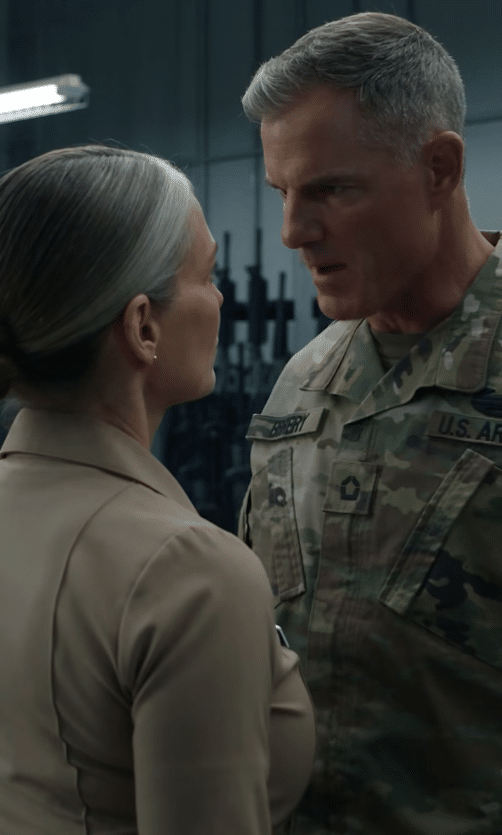
Colonel Richard Vance slammed a stack of equipment inspection forms onto the metal bench, staring down the woman who had dared to question his authority. Around them, soldiers stood frozen beneath the cold fluorescent lights of the armory inspection bay, surrounded by locked weapon cages, steel equipment racks, and crates waiting for approval.
The woman wore an ordinary olive utility shirt, OCP trousers, and tan boots. Her ash-blond hair was tied neatly at the back of her neck, and nothing about her uniform suggested a rank that demanded attention. But her eyes never dropped.
“Not when soldiers take the blame for yours.”
For a moment, the only sound was the faint hum of the overhead lights.
Vance’s jaw tightened.
He was forty-five, immaculate in his combat uniform, with close-cropped salt-and-pepper hair and black gloves that made every movement look deliberate. He had spent years learning how to make people uncomfortable without raising his voice. A glance from him could silence a room. A signature from him could end a soldier’s career.
And now, in front of his own personnel, a woman he considered an administrative nobody had questioned the one thing he refused to let anyone challenge: his paperwork.
He grabbed a glass of water from the inspection bench.
Before anyone could react, he threw the water into her face.
The glass crashed against the concrete, shattering across the floor. The woman barely had time to blink before Vance struck her hard across the cheek.
A sharp sound echoed through the bay.
Her head snapped to the side. Redness spread across her cheek, and a faint trace of blood appeared at the corner of her mouth. She staggered, trying to steady herself against the edge of the bench, but Vance stepped forward and drove a kick into her stomach.
She folded around the impact, stumbled backward, and fell beside the inspection table. One knee scraped against the concrete.
Nobody moved.
A young soldier’s hands clenched at his sides. Another stared at the floor, unable to look at what was happening. Several others watched with the rigid stillness of people who understood exactly how dangerous it could be to challenge a colonel.
Vance straightened his uniform.
“Paper-pushers don’t challenge command.”
The woman struggled to catch her breath. One hand pressed against her stomach, but she refused to beg. Even with her cheek swelling and pain tightening her expression, she looked up at him with an unsettling calm.
Vance mistook that calm for defeat.
He had no idea that something had just slipped from her inner pocket.
And the man standing near the equipment cages had already seen it.
Act II
The silver object skidded across the concrete, spinning once before coming to rest beside a marked equipment crate.
It was small enough to disappear beneath a boot. Its surface was polished but unadorned, with no visible serial number, no engraved name, and none of the conventional markings that would make an ordinary military identification badge recognizable.
Chief Warrant Officer Daniel Mercer noticed it first.
At fifty-five, Mercer had served long enough to recognize the difference between an unusual object and a dangerous one. His short silver hair framed a face weathered by years of field assignments, and his instincts had been sharpened by experiences he rarely discussed with younger soldiers.
He looked down.
Then he stopped breathing for a second.
The badge lay in plain sight, catching the fluorescent light.
Mercer had seen one like it before.
Not in a routine inspection. Not at a promotion ceremony. Not in any office where decorations and credentials were displayed for visitors.
He had seen it years earlier during a closed briefing, when a senior officer had explained that certain investigations required identities and authorities to remain concealed until the evidence was secured. The people involved did not advertise their presence. They did not wear conspicuous insignia. And the objects associated with their assignments were never supposed to circulate casually.
Most importantly, those objects were not supposed to have serial numbers.
Mercer had been told only what he needed to know. The details had remained sealed, and the warning had been unmistakable: if an unnumbered silver badge appeared during an investigation, nobody was to interfere with its holder or attempt to take possession of it.
The badge was not a decoration.
It was a signal.
Mercer slowly raised his eyes toward the woman on the floor.
She was breathing through the pain, one hand still pressed against her abdomen. Her expression had not changed in the way Mercer expected from someone who had just been assaulted by a superior officer.
She wasn’t looking for help.
She was watching Vance.
And suddenly, Mercer understood why.
The woman had not entered the armory wearing visible rank. She had not announced an inspection team or demanded that soldiers stand at attention. She had walked into the facility looking like someone whose presence could be ignored.
That had made her dangerous to a man like Vance.
People who believed they were being watched behaved differently. They checked their forms twice, chose their words carefully, and hid their mistakes behind layers of procedure.
But people who believed nobody important was watching?
They revealed themselves.
Vance had just revealed himself in front of an entire room of witnesses.
Mercer felt the blood drain from his face.
The colonel was already turning toward the fallen woman, preparing to deliver another insult.
Mercer knew he had only seconds to stop him from making the situation worse.
“Colonel… don’t touch that badge.”
Act III
Vance turned sharply toward Mercer.
For the first time since the confrontation began, someone had spoken to him as though his authority had limits.
His gaze moved from the warrant officer to the silver object on the floor. Then he looked back at the man who had spent years following orders without publicly questioning him.
“What?”
Mercer didn’t answer.
His eyes remained fixed on the badge.
The silence was more disturbing than an accusation. Mercer had never been a dramatic man. He did not exaggerate, spread rumors, or interrupt senior officers without a reason. If anything, he was known for the opposite: careful speech, measured judgment, and an almost stubborn refusal to speculate.
Yet now he looked as though he had recognized the first warning sign of a disaster already in motion.
Vance followed his gaze again.
The badge looked ordinary.
That was what irritated him most.
No number. No name. No rank. No official engraving that he could point to and use to reassert control over the room.
He gave a short, contemptuous laugh.
“It doesn’t even have a number.”
He said it loudly enough for the surrounding soldiers to hear, hoping ridicule would restore the balance he had lost.
But nobody laughed with him.
Mercer remained motionless. The soldiers beside the equipment racks watched the colonel with an unfamiliar expression. Their fear had not disappeared, but something had changed beneath it.
They were no longer certain that Vance was the most powerful person in the room.
The woman slowly lifted her head.
Her injured cheek was red and swollen. Her breathing remained guarded after the kick, and a faint abrasion marked the knee that had struck the concrete. But she made no effort to hide the pain or transform it into a performance.
She simply looked at the colonel.
“That’s why you should be worried.”
The words were quiet.
They did not sound like a threat. There was no raised voice, no dramatic declaration, and no attempt to impress the soldiers who had witnessed the assault.
That made them worse.
Vance’s smile remained on his face for a fraction of a second too long.
Then it began to disappear.
He looked at Mercer again, searching for some sign that the warrant officer had misunderstood the object. A nervous smile. An embarrassed shrug. Anything that would turn the warning into a mistake.
Mercer gave him nothing.
Instead, the older officer stood a little straighter.
His expression had changed from surprise to something closer to recognition and respect. It was the kind of expression Vance had seen reserved for officers whose names carried weight long before they entered a room.
The colonel looked back at the woman.
She was still wearing the same plain field uniform. No visible rank had appeared on her shoulders. No one had rushed through the doors to announce a distinguished visitor.
Nothing about her outward appearance had changed.
Only the way the people around her looked at her.
And Vance was beginning to understand that he had made the most dangerous mistake of his career.
He had judged her by what she was willing to display.
He had never considered what she might be deliberately concealing.
Act IV
For several seconds, nobody spoke.
The fluorescent lights hummed overhead, and somewhere beyond the locked cages, a metal door closed with a distant clang. The ordinary sounds of the armory seemed strangely loud now that every person inside it was waiting to see what the colonel would do next.
Vance’s eyes moved between Mercer and the woman.
He had built his authority around a simple belief: rank determined who could question him, and anyone without visible rank could be dismissed.
That belief had worked for years.
He had used it to pressure junior soldiers into signing equipment forms they had not properly checked. He had told them the paperwork was his responsibility, then reminded them that their signatures would be the ones attached to any discrepancy.
When someone hesitated, he invoked command.
When someone objected, he invoked discipline.
And when someone threatened to expose a problem, he made sure the cost of speaking up seemed greater than the cost of staying silent.
The woman had challenged that system with a single sentence.
Now he was looking at the evidence of a mistake he could not intimidate away.
The unnumbered badge remained on the floor between them.
Vance could have stepped back. He could have ordered the room secured, called for medical assistance, and allowed the proper authorities to determine what had happened.
Instead, he stood rigidly in place, trying to calculate which response would allow him to retain the most control.
That hesitation told Mercer everything he needed to know.
The warrant officer had spent decades around men who confused obedience with loyalty. He had watched competent soldiers accept punishment for failures they had not caused because a superior had convinced them that resistance was futile.
He had also watched those same soldiers lose faith in an entire command when they realized the people responsible for protecting them were more interested in protecting themselves.
Vance had crossed that line in front of witnesses.
The assault was no longer something he could reduce to a disagreement over inspection forms. Too many people had seen the water thrown into the woman’s face. Too many had heard the glass shatter. Too many had watched him strike her, kick her, and stand over her while she struggled to breathe.
And now Mercer had recognized the badge.
Whatever its full significance, the colonel could not make that recognition disappear.
His expression tightened as he studied the woman’s face. He seemed to be searching for a familiar name, a memory, or some detail that might explain why an experienced warrant officer had suddenly become afraid to move.
But she offered no explanation.
She did not reveal her rank.
She did not tell him how long she had been observing the armory or how much of his conduct she had already documented. She did not need to.
The most unsettling possibility was that the confrontation had given her precisely what she needed.
Vance had been so certain of his authority that he had stopped pretending to be professional.
He had exposed himself without being tricked, threatened, or provoked into some elaborate trap.
He had done it because he believed the person in front of him was powerless.
Mercer’s gaze flicked toward the colonel’s hands, then returned to the woman’s face.
He remained silent, but his posture carried a message Vance could no longer ignore.
Do not make another mistake.
The colonel swallowed.
His black-gloved hands, which had seemed so steady moments earlier, now looked awkward at his sides. He glanced toward the soldiers along the inspection benches, perhaps expecting them to return to their familiar silence.
They did not move to rescue him.
Some stared at the fallen glass. Others watched the woman. One young soldier who had been looking at the floor finally raised his eyes.
It was a small gesture.
But Vance noticed.
For the first time, he was no longer certain that the room belonged to him.
And the woman he had treated as an insignificant paper-pusher was still looking at him as though the real inspection had only just begun.
Act V
The change in Vance was almost invisible at first.
His shoulders remained squared, and his uniform was still immaculate. He had not suddenly become a different man. The same colonel who had thrown the water and delivered the kick was still standing in the same place.
But the confidence behind his expression had vanished.
He looked at Mercer again.
The warrant officer did not explain the badge. He did not reveal the woman’s identity or recite a list of credentials. His silence was deliberate, shaped by the knowledge that some information was not his to disclose.
Vance turned back toward the woman.
She was pushing herself upright beside the inspection bench, moving carefully because every breath hurt. She accepted neither his attention nor his fear as an apology. Her gaze remained level, and her composure made the red mark on her cheek seem more damning than any accusation she could have spoken.
The colonel’s eyes dropped to the silver badge.
An object without a serial number should have been meaningless to him.
That had been his argument.
Now he was beginning to wonder whether the absence of a number was exactly what made it significant.
He had spent years trusting visible authority: insignia, signatures, stamped forms, names at the bottom of official documents. He knew how to challenge a missing signature, question a discrepancy, or demand that someone prove they had the right to give him an order.
But he did not know how to challenge a warning he could not fully understand.
Mercer did.
That was what frightened him.
The warrant officer’s reaction had not been theatrical. It had been immediate, involuntary, and unmistakable. He had recognized something that Vance could not recognize, and whatever he had seen had changed the entire meaning of the confrontation.
The woman finally shifted her weight and stood.
She did not rush. She did not make a show of overcoming the pain. One hand remained near her abdomen as she steadied herself, and her injured knee made her movement cautious.
Still, she stood without asking anyone’s permission.
Vance stared at her, searching for the arrogance he had expected to find in someone challenging his command. He found none. There was no satisfaction in her face, no smile suggesting that she had engineered the assault, and no visible desire to humiliate him in return.
There was only a calm certainty that he had mistaken restraint for weakness.
He had believed that because she had not displayed her rank, she had none worth respecting.
He had believed that because she had asked questions about equipment, she could be dismissed as an administrator.
And he had believed that because the soldiers around him were afraid to intervene, they would always remain afraid to speak.
Now every assumption was collapsing at once.
The room seemed smaller. The fluorescent lights seemed harsher. The broken glass on the concrete looked like the physical remains of a moment he could never take back.
Vance’s mouth opened, but no explanation came.
He looked at the badge again.
Then at Mercer.
Then at the woman.
The colonel who had been so eager to remind everyone that signatures were his problem now looked as though he had finally realized that some problems could not be signed away.
His voice emerged as a fragment, stripped of its earlier contempt.
“No number…?”
The camera held on his face.
For the first time, Colonel Vance looked genuinely afraid.
And in the silence that followed, every soldier in the armory understood that the most important question was no longer whether the woman had the authority to challenge him.
It was how long she had known what he was doing—and what would happen now that he had given her one more reason to act.
The silver badge remained on the concrete between them, small and unnumbered.
Vance had dismissed it because he could not understand it.
That was the mistake he would remember long after the inspection bay emptied.
He had mistaken the absence of visible power for the absence of power itself.
And the woman he had tried to break had never needed to raise her voice to prove him wrong.
Reveal her identity and authorityReduce repeated power-shift reflections