The ballroom of the Halston Crown was glowing with the kind of luxury most people only ever saw in magazines.
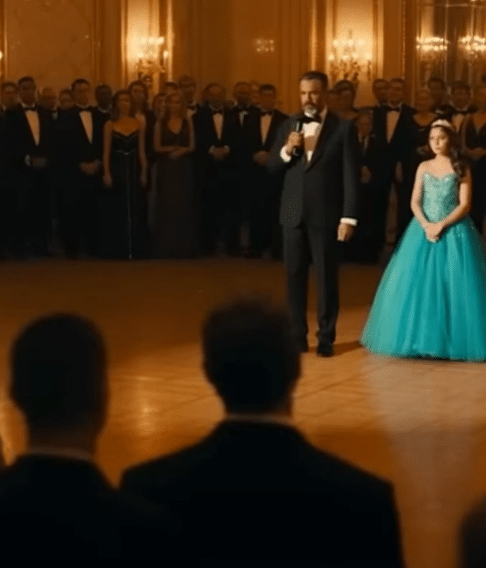
Crystal chandeliers hung like frozen stars from a ceiling painted in gold leaf. Tall arrangements of white orchids framed the edges of the stage. Waiters in immaculate uniforms drifted through the crowd with silver trays, while a soft string ensemble played something elegant and sad in the corner. The room was full of important people—investors, doctors, politicians, charity patrons, and wealthy friends of the family—all dressed in tuxedos, diamonds, silk, and satin.
It should have felt like a celebration.
Instead, the entire evening was weighted by grief.
At the center of the ballroom, on a raised stage beneath a wash of warm light, stood Adrian Vale in a black tuxedo with a microphone in his hand. He was a man used to command, the kind who rarely showed weakness in public. His name carried influence in banking, real estate, and philanthropy. His presence alone could silence a room.
But tonight, he looked like a father before anything else.
Next to him stood his daughter, Lila.
She wore a layered sea-green evening gown that shimmered softly whenever she moved. Her dark hair was pinned neatly back with tiny crystal clips. To anyone seeing her from a distance, she looked like a princess from a storybook gala.
But up close, there was a stillness about her that broke the heart.
She did not smile.
She did not wave.
She did not speak.
Her fingers were clasped tightly in front of her, and her eyes remained lowered as if the room were too loud, too bright, too full of hope she could no longer carry.
Adrian inhaled slowly, lifting the microphone closer.
“My daughter can’t speak,” he said.
The words rolled out over the ballroom and settled into the silence.
Every conversation stopped.
Even the musicians lowered their bows.
The room had known something serious was coming. That much had been obvious from the tone of the invitations, from the unusual gathering, from the rumors whispered before the event began. But hearing it spoken so plainly changed everything.
Adrian looked at Lila, then back at the crowd.
“If anyone can make her speak again,” he continued, his voice tightening just enough to show the pain beneath it, “I’ll give them one million dollars.”
A quiet shock passed through the guests.
One million dollars.
In a room full of wealth, it was still enough money to make people straighten in place and look more carefully at the man on stage. But the promise itself was not what moved them. It was the desperation behind it. This was not a stunt. Not a publicity trick. Not a dramatic charity announcement.
This was a father running out of answers.
Three years earlier, Lila had spoken constantly. She used to sing around the house, ask endless questions, interrupt dinners with wild ideas, and laugh so loudly that even the staff would smile from the next room. Then came the accident—a violent car crash on a rain-slick road that had taken her mother and left Lila physically unharmed but emotionally shattered. After the funeral, she had stopped speaking altogether.
Doctors called it selective mutism brought on by trauma.
Psychologists tried.
Specialists tried.
Private clinics in Switzerland, New York, and Tokyo tried.
Nothing had worked.
She had not said a single word since she was eight years old.
And now, at eleven, she stood under the chandeliers while the most powerful people her father knew watched in helpless silence.
Near the back of the crowd, a few guests lowered their eyes. A woman in diamonds dabbed at the corner of one eye. A renowned child therapist shifted her jaw as if she already knew she could offer nothing new. Even those who came partly out of curiosity now felt the uncomfortable weight of being inside someone else’s heartbreak.
Adrian lowered the microphone slightly, as if the promise had taken more out of him than he expected.
Then a voice came from the crowd.
“I can make her speak again.”
It was not loud.
But it cut through the silence so cleanly that everyone turned at once.
At first, most people assumed it must have come from one of the specialists or invited guests.
Then the crowd parted.
And through the line of tuxedos, gowns, and startled faces stepped a boy in a hoodie.
He was Black, perhaps twelve years old, wearing dark jeans, worn sneakers, and a simple charcoal sweatshirt with the hood down. He had no place, at least by the room’s cruel visual logic, in a ballroom like this. No tailored jacket, no polished shoes, no family name whispered with recognition as he moved. Yet none of that seemed to matter to him.
He walked forward with calm certainty.
Not arrogance.
Not bravado.
Certainty.
He stopped below the stage and looked up at Adrian as if nothing in the room—none of the chandeliers, none of the money, none of the judgment—had the power to shake him.
“I can make her speak again,” he repeated.
The reaction was immediate.
Confusion first.
Then disbelief.
Then the quiet sting of offense that wealthy people often feel when someone they do not expect dares to speak with confidence.
Adrian frowned.
He had spent years hearing false hope dressed up as expertise. Alternative healers. Celebrity therapists. Spiritual consultants. Performance doctors. Desperate parents are easy targets, and he had learned to distrust anyone who sounded too sure.
But this?
This was a child.
A child in a hoodie, standing beneath a million-dollar chandelier, telling him he could succeed where the world’s best had failed.
The muscles in Adrian’s jaw tightened.
Lila looked up for the first time.
Her eyes moved to the boy.
Something in her expression shifted—not recognition exactly, but attention. Real attention. More than she had given anyone in weeks.
Adrian did not notice that.
He only saw the risk of being made a fool in front of everyone.
“Get out of here,” he snapped.
The words hit the ballroom like a slap.
“This is not a child’s game.”
A few guests glanced away in discomfort. Others stared harder. A man near the bar folded his arms as though relieved someone had restored order. A woman in silver whispered something to the person beside her. The room had already begun deciding what this moment was supposed to mean: a grieving father interrupted by an audacious stranger.
But the boy did not move.
That was the first thing that changed the energy.
He didn’t flinch.
Didn’t argue.
Didn’t plead.
He just stood there, looking up at Adrian with a steadiness that felt far older than his age.
A tear slid down Lila’s cheek.
The camera of the room—every eye, every breath—shifted to her.
It was a small tear, but devastating. Because she still showed so little. Most days she held herself like glass, untouched on the surface, breaking somewhere deeper where no one could reach. The sight of that single tear meant something inside her had stirred.
Adrian saw it then and hesitated.
Only for a beat.
But enough for the boy to speak again.
“I’m not playing,” he said quietly.
The confidence in his voice had changed. It was softer now. Sadder. Honest in a way that made it harder to dismiss.
Adrian stared at him. “Then what are you doing here?”
The boy looked at Lila instead of answering immediately.
“When my little sister stopped talking,” he said, “people kept trying to make her speak.”
That shifted the room again.
No one had expected that.
Not a claim of magic.
Not a trick.
A memory.
A real one.
The boy kept his eyes on Lila.
“They brought toys. Doctors. Questions. Pressure. Everyone wanted her voice back so badly they forgot she was still there, even without it.”
The ballroom was silent in a completely different way now.
Adrian’s anger loosened, replaced by confusion.
The boy took one step closer to the stage.
“My sister didn’t need someone to force the words out,” he said. “She needed someone to sit with her where the words were hiding.”
Lila’s fingers tightened against the fabric of her dress.
Something about the sentence touched a place in her no specialist had reached.
Adrian lowered the microphone.
He was no longer in control of the room, and he knew it.
“What happened to your sister?” he asked.
The boy was quiet for a second.
Then he said, “She spoke again after seven months.”
A few guests visibly relaxed, as though hope had suddenly become more dangerous because it sounded believable.
“How?” Adrian asked.
This time, the boy finally looked at him.
“I stopped asking her to talk.”
The sentence landed with astonishing weight.
He went on before anyone could interrupt.
“I used to sit with her every afternoon on our apartment stairs. I’d bring chalk or comic books or crackers or just silence. Some days she’d draw. Some days she’d cry. Some days she’d get mad and throw things. I never told her it was time. I never asked for proof. I just stayed.”
Lila’s face had gone very still.
Not empty.
Listening.
The boy’s voice remained calm.
“One day she whispered that she hated everyone saying she was broken.”
A woman in the crowd covered her mouth.
The boy swallowed and continued. “Then she said she was scared that if she talked, everybody would expect her to be okay.”
No one in the ballroom moved.
Because now they understood that the silence on stage was not just a symptom. It was a shelter.
A place Lila had gone because the world outside it demanded too much pain too quickly.
The boy looked back up at her.
“I think she knows everyone here wants her voice,” he said. “But maybe nobody asked what her silence is protecting.”
That sentence struck Adrian harder than anything else that night.
Not because it was cruel.
Because it was true.
He had hired experts, built plans, created opportunities, offered money, assembled rooms full of resources—and in all of it, maybe he had still been treating Lila’s voice like the thing that needed to return, instead of treating Lila herself like the person who needed to feel safe.
The boy took another step forward.
“If you want, I won’t try to make her speak,” he said. “I’ll just talk to her.”
Adrian looked at his daughter.
For the first time in months, she was not looking through people.
She was looking at one.
Slowly, Adrian stepped back from the microphone.
The room seemed to exhale all at once.
The boy approached the stage. One of the event coordinators instinctively moved to stop him, but Adrian lifted a hand. Not now.
The boy climbed the short steps and stopped a few feet from Lila.
He did not smile too broadly. Did not crouch dramatically. Did not perform gentleness for the audience.
He simply stood near enough to be present and far enough to let her choose.
“My name is Micah,” he said.
Lila blinked.
“My sister liked sea animals when she stopped talking,” he continued. “I learned all of them just to tell her weird facts. Did you know octopuses collect shiny things for no reason?”
A few people in the crowd almost laughed through their tears.
Micah kept going, still casual, still light.
“And sea otters hold hands when they sleep so they don’t drift away. Which is actually kind of smart, because people drift too.”
Lila’s mouth trembled.
Not with words.
With feeling.
Micah glanced toward the sea-green layers of her dress. “Your dress looks like the ocean, by the way. If I were a fish, I’d trust it.”
For one impossible second, the entire ballroom leaned toward her.
Lila’s lips parted.
No sound came out.
Micah didn’t rush to fill the silence.
That was what made the next moment possible.
He waited.
Just waited.
The kind of waiting that asks for nothing and leaves the door open.
Another tear slipped down her cheek.
Then, barely above a breath, she said, “My mom liked the ocean.”
The room shattered into stunned silence.
Not loud surprise.
Not applause.
No one wanted to break the moment and risk losing it.
Adrian’s face collapsed.
The microphone slipped lower in his hand as tears filled his eyes. It was not the money, not the promise, not the public miracle that undid him.
It was hearing his daughter’s voice after three years and realizing the first sentence she had carried all that time was not random.
It was memory.
Love.
Grief that had finally found a safe place to breathe.
Micah nodded gently, as though this was the most natural thing in the world.
“What was her favorite part?” he asked.
Lila’s chest rose shakily.
“The waves,” she whispered.
This time, the room could not contain itself.
A sob broke from somewhere in the crowd. The woman in diamonds began crying openly. Even the hardened investors near the front lowered their heads, overwhelmed by the intimacy of what they had just witnessed.
Adrian dropped to one knee beside his daughter, not to take over the moment, but to meet her where she was.
“Lila,” he said, his voice breaking, “you don’t have to do anything else tonight.”
She turned to him.
And for the first time in years, she answered.
“I know.”
That was when the ballroom erupted—not chaotically, but with the kind of emotional release people feel when they have been holding their breath for far too long. Tears, gasps, hands over mouths, stunned laughter through crying. The musicians stood frozen. Even the servers near the back were wiping their eyes.
Adrian rose slowly and looked at Micah as though seeing him clearly only now.
“You did it,” he said.
Micah shook his head.
“No,” he replied. “She did.”
That answer told Adrian everything he needed to know about the boy standing before him.
This was not a child trying to win a million dollars.
This was a child who understood pain from the inside and recognized it in someone else.
Adrian looked out across the ballroom, at the specialists, the donors, the powerful guests, the polished world he had assembled around his daughter’s silence.
Then he looked back at Micah.
“What do you want?” he asked.
Micah’s answer came without hesitation.
“A music room at my school,” he said. “And counseling for kids who can’t afford it.”
That broke whatever restraint the room had left.
Because of course that was his answer.
Not a car.
Not cash.
Not fame.
A place for other children to be heard before they disappeared into silence.
By the end of the night, Adrian pledged not one million to Micah personally, but five million dollars to create trauma support and arts therapy centers in schools across the city—starting with Micah’s. He asked Micah and his family to help shape the program.
But that was only the public outcome.
The private truth was even more powerful.
Lila did not become endlessly talkative overnight. She did not suddenly transform into the child she had been before tragedy. Healing did not happen like that. But something had opened. A door. A trust. A breath.
And all because one boy in a hoodie walked into a room full of wealthy adults, refused to be frightened by their disbelief, and understood what none of them had fully understood before:
sometimes the way back to a voice is not through pressure, money, or power.
Sometimes it begins with someone who knows how to sit beside silence until it no longer feels lonely.