Act I
The question broke his father before the doctors could.
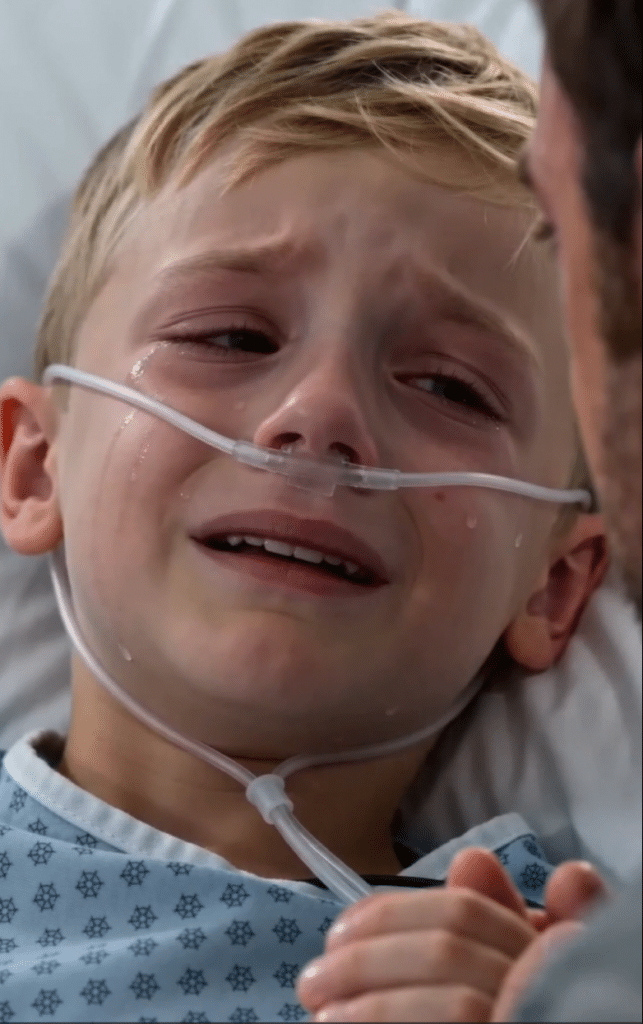
“Dad,” Noah whispered, “are we going home to die?”
Caleb gripped the edge of the hospital bed so hard his knuckles turned white.
His son lay beneath a thin blanket, pale and small, an oxygen tube resting beneath his nose. The monitor beside him beeped steadily, indifferent to the way a six-year-old child had just said the words no child should ever have to understand.
Caleb tried to answer.
Nothing came out.
His work boots were still dusty from the construction site. His gray jacket smelled faintly of sawdust and rain. On the chair by the door, his white hard hat sat beside a folder of medical bills he could not pay.
The treatment existed.
That was the cruelty.
It existed in another state, in another hospital, behind another number Caleb’s insurance would not cover.
He leaned over Noah and pressed a shaking kiss to his forehead.
“I’m sorry,” Caleb whispered.
Then the door burst open.
A woman in a tan trench coat stood there, breathing hard, her auburn hair damp from the rain outside. She looked expensive, powerful, and completely out of place in the cold hospital room.
Her eyes landed on Caleb.
“It’s you.”
Caleb blinked through exhaustion.
“I’m sorry?”
The woman stepped closer, tears shining in her eyes.
“You saved my son.”
The nurses froze.
Caleb stared at her, confused.
Then she looked at Noah.
Her face changed.
“Let me save yours.”
Act II
Caleb did not recognize her at first.
He had been living in survival mode for too long. Hospital hallways. Work shifts. Insurance calls. Nights spent sleeping upright beside Noah’s bed because he was afraid his son would wake up scared.
There had been no room in his mind for anything else.
But the woman remembered him.
Her name was Vivienne Hartwell.
Six months earlier, Caleb had been working on a bridge renovation when a car spun out during a storm and crashed through a temporary barrier. Inside was a teenage boy, trapped and unconscious while water rose around the wreck.
Caleb had not waited for emergency crews.
He had climbed down.
He had broken the window with a steel tool, cut the boy free, and carried him up through freezing rain while everyone shouted that the structure was unsafe.
By the time reporters arrived, Caleb was gone.
He had a second shift.
He never gave his name.
He never knew the boy survived.
Vivienne did.
Her son, Julian, lived because a stranger in work boots had risked everything and disappeared before she could thank him.
For months, she had searched.
Security footage. Construction permits. News clips. Subcontractor lists.
And now, by chance or fate, one of her private doctors had seen Caleb’s name attached to Noah’s case.
Vivienne looked at Caleb with a kind of certainty money could not buy.
“I have been looking for you,” she said. “And I am not leaving until your son gets a chance.”
Caleb’s eyes filled, but he shook his head.
“You don’t understand. The hospital already said—”
“I understand exactly what they said.”
Vivienne turned to the doctor holding the yellow folder.
“Call Boston. Call the specialist. Tell them the Hartwell Foundation is covering transport, treatment, and every related cost.”
The room went silent.
Caleb grabbed the bed rail, suddenly unsteady.
Noah blinked up at her.
“Am I going home?”
Vivienne softened.
“No, sweetheart,” she said. “You’re going to get better.”
Act III
Hope did not arrive like sunshine.
It arrived with phone calls, signatures, and people moving faster than they had moved all week.
Within an hour, Noah’s records were transferred. Within two, an air medical team was being arranged. By nightfall, Caleb was holding a printed treatment plan he had been told was impossible that same morning.
He stared at the pages like they might vanish.
Vivienne stood beside him quietly.
“Why?” he asked.
She looked through the glass at Noah, who had finally fallen asleep.
“Because when my son was dying in that car, you didn’t ask whether he was rich. You didn’t ask what we could do for you. You just saved him.”
Caleb swallowed hard.
“I didn’t do it for this.”
“I know,” she said. “That’s why I’m doing it.”
But there was one more truth.
Vivienne had not only come with money.
She had come with influence.
The hospital administrator who had delayed Noah’s referral suddenly found the missing paperwork. The insurance company that had denied the claim agreed to emergency review. The charity board that had ignored Caleb’s application reopened it within minutes of receiving Vivienne’s call.
Caleb realized then that poverty had not only made him helpless.
It had made people comfortable saying no.
Vivienne made them uncomfortable.
And for Noah, that changed everything.
Act IV
The transfer happened before dawn.
Caleb rode beside Noah, one hand resting gently on the blanket, afraid to let go even for a second.
Noah was weak, but awake.
“Dad?”
“Yeah, buddy?”
“Is the lady an angel?”
Caleb looked across the ambulance where Vivienne sat speaking quietly with the medical team.
“No,” he whispered. “She’s someone who remembered.”
At the new hospital, specialists moved with urgency. Tests were repeated. Options were explained. Caleb signed forms with trembling hands while Vivienne’s foundation handled everything that had once stood between his son and life.
Days became weeks.
There were hard mornings.
There were fevers, setbacks, long waits outside procedure rooms, and nights when Caleb stood in the hallway and cried where Noah could not see him.
But there was also progress.
Noah’s color returned slowly. His voice grew stronger. One afternoon, he asked for pancakes. Another day, he laughed at a cartoon so loudly a nurse peeked in smiling.
Caleb nearly broke down at the sound.
Vivienne visited often, never making herself the hero. Sometimes she brought Julian, the boy Caleb had saved.
The first time Julian met Noah, he stood awkwardly by the bed and said, “Your dad saved my life.”
Noah looked at Caleb with wide eyes.
“He did?”
Caleb rubbed the back of his neck.
“Something like that.”
Julian smiled.
“So my mom saved yours back.”
For the first time in months, Caleb laughed.
Act V
Noah came home in spring.
Not to die.
To live.
The apartment was small, but Vivienne’s foundation had quietly made it warm, safe, and ready. A new bed. Clean air filters. A fridge full of food. Follow-up care scheduled for months.
Caleb stood in the doorway carrying Noah, unable to speak.
On the kitchen table was a card.
For the man who saved my son before he knew his name.
Caleb pressed the card to his chest and closed his eyes.
Months later, he returned to the construction site.
This time, there was a plaque near the bridge.
Not with his name alone.
With both boys’ names.
Julian Hartwell and Noah Mercer.
Two lives connected by one storm, one act of courage, and one debt repaid with grace.
Vivienne stood beside Caleb at the dedication.
“You gave me my son back,” she said.
Caleb watched Noah laughing nearby, thin but stronger, alive beneath the bright open sky.
“No,” he said softly. “You gave me mine.”
Vivienne smiled.
And for once, Caleb did not feel like a poor father begging the world for mercy.
He felt like what he had always been.
A man who had saved a life.
And finally, someone had saved his.