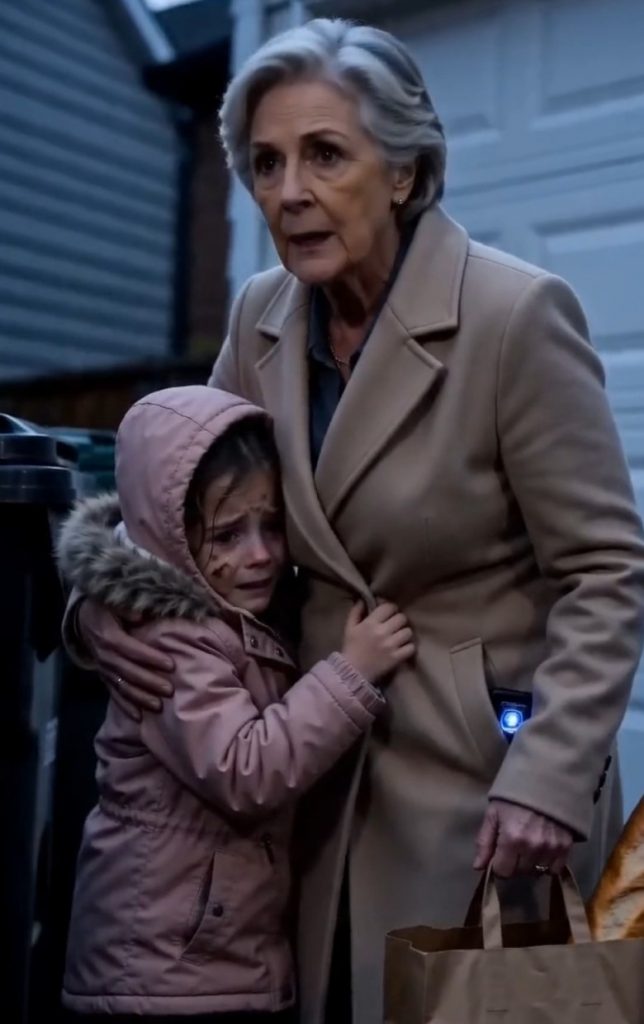
Act I
The alley was almost dark when Evelyn Mercer heard the sound.
At first, she thought it was a cat.
A small, broken noise came from somewhere near the trash bins, half-buried beneath the hush of evening traffic and the soft patter of rain dripping from roof gutters. The narrow passage between the brick house and the white garage door smelled of wet leaves, cold concrete, and old garbage.
Evelyn stopped walking.
Her left hand tightened around the brown paper grocery bag. The baguette inside tilted against her wrist.
“Sweetheart?” she called softly. “Are you alright?”
Nothing answered.
Then a trash bin shifted.
Evelyn stepped closer, careful not to move too quickly. She was sixty-eight, but age had not made her careless. If anything, it had taught her that fear often hid in corners most people walked past.
Between two dark green bins, a little girl was curled against the wall.
She was maybe seven or eight. Her pink hooded parka was streaked with dirt, the fur around her collar damp from rain. Her messy hair stuck to her cheeks. Her eyes were wide and shining in the dim light, fixed on Evelyn like she was trying to decide whether grown-ups were still safe.
Evelyn crouched, ignoring the cold wetness soaking through the hem of her beige trench coat.
“Oh, honey,” she whispered. “What happened?”
The child’s chin trembled.
“Please,” she said, barely louder than the rain. “He followed me.”
Evelyn did not look around right away.
That was the first rule.
When a frightened child told you danger was near, you did not make a show of searching for it. You did not panic. You did not give the danger the pleasure of knowing it had been seen.
You made yourself calm enough to become a wall.
“It’s okay,” Evelyn said.
She reached out with her right hand, slow and open, and touched the girl’s shoulder. The child flinched, then leaned into the contact as if her body had been waiting for permission to stop holding itself together.
“Stay close to me.”
Evelyn helped her stand and guided her behind her coat. The little girl grabbed the wool with both hands and pressed her face into Evelyn’s back.
A footstep sounded at the far end of the alley.
Then another.
Evelyn straightened.
A man emerged from the shadow between the garage and the fence, hands in his hoodie pockets, dark cargo pants dragging at the wet concrete. He had a beard, a calm face, and the steady confidence of someone used to being believed before he was questioned.
He smiled as if he had just found something misplaced.
“Ma’am,” he said, “I think you have my niece.”
The girl’s fingers dug into Evelyn’s coat.
“No!” she screamed. “He’s lying!”
The sound tore through the alley.
The man’s smile tightened.
Evelyn did not move backward. She did not raise her voice. She simply stood between him and the trembling child, grocery bag in one hand, shoulders squared against the fading light.
Her left coat pocket gaped slightly.
Inside it, a small dark blue object showed at the edge.
The man’s eyes flicked toward it.
For the first time, his expression changed.
And Evelyn realized he had just recognized the one thing he had hoped she would never have.
Act II
Evelyn Mercer had spent thirty-one years learning how liars stood.
Some leaned too close. Some smiled too often. Some played offended before anyone accused them. The clever ones stayed soft. They kept their voices low, their hands visible, their faces wounded by misunderstanding.
The man in the alley was clever.
That made him dangerous.
“My sister’s been looking everywhere,” he said, taking one slow step forward. “She runs off sometimes. She gets confused.”
The little girl shook violently behind Evelyn.
“No,” she sobbed. “I don’t know him.”
Evelyn kept her eyes on the man.
“What’s her name?”
He did not hesitate long, but he hesitated.
Evelyn caught it.
“Madison,” he said.
The child behind her whispered, “That’s not my name.”
The man exhaled like Evelyn was the one making this difficult.
“Ma’am, I appreciate you helping, but she’s upset. I need to take her home.”
Evelyn’s face remained still.
“Then you won’t mind waiting while I call her mother.”
His jaw moved once.
There it was.
The crack beneath the polish.
Evelyn Mercer had once been Detective Evelyn Mercer, head of a missing children unit in a city that liked to pretend evil only happened in other neighborhoods. For three decades, she had sat with mothers under fluorescent lights, walked school routes with patrol teams, watched security footage until her eyes burned, and knocked on doors no parent should ever have to imagine.
She had retired five years ago.
At least, that was what the department paperwork said.
In truth, she never learned how to stop listening.
She still volunteered twice a week at a child advocacy center downtown. She still trained young officers on victim interviewing. She still carried, in the left pocket of whatever coat she wore, a blue leather badge holder with her retired shield, her current advocate credential, and a small panic transmitter linked to a police response app.
Her daughter called it paranoia.
Evelyn called it experience.
That evening, she had only meant to buy bread, soup, and pears from the corner market. Her grandson was coming over after soccer practice. She had planned to complain about his muddy cleats, feed him too much, and pretend not to notice when he took the last chocolate biscuit.
Then she heard the child crying behind the bins.
Now the bread was forgotten.
The man tilted his head.
“Look,” he said, lowering his voice. “She’s a kid. She’s scared. You’re making it worse.”
Evelyn felt the little girl press closer.
“What is her mother’s name?” Evelyn asked.
The man gave a short laugh.
“You don’t need to interrogate me.”
“Yes,” Evelyn said. “I do.”
His eyes hardened.
Rain slid from the edge of the garage roof and struck the concrete in a steady rhythm.
The alley seemed to shrink around them.
At the far end, a car passed without slowing. Its headlights swept briefly across the man’s face, revealing the irritation he had been trying to hide.
The girl whispered into Evelyn’s coat, “He was outside my school.”
Evelyn’s breath did not change, but something inside her went cold.
“What school?” she asked softly.
The child hesitated, then whispered the name.
Evelyn knew it.
Three blocks away.
Dismissal had been less than an hour ago.
The man took another step.
“That’s enough,” he said.
Evelyn’s left hand moved toward her pocket.
The grocery bag rustled.
The blue leather edge became more visible.
“Don’t,” the man said.
It was quiet. Almost polite.
But it was not a request.
Evelyn looked at him, and for a moment she was not an elderly woman in a wet alley with a bag of groceries.
She was every door he had thought would stay closed.
Every witness he assumed would look away.
Every woman he mistook for harmless because her hair had turned gray.
“Stay where you are,” she said.
The man smiled again, but this time it did not reach even halfway to his eyes.
And behind Evelyn, the little girl whispered a name that changed everything.
“Please,” she said. “I want my mom. I want Rachel.”
Evelyn went still.
Rachel.
Not because the name was unusual.
Because Evelyn had heard it that morning.
Act III
Rachel Voss had been at the child advocacy center at 10:17 a.m.
Evelyn remembered the time because she had checked the clock when the young mother walked in, pale and shaking, carrying a folder against her chest like it was the only thing keeping her upright.
Rachel had not come to report a stranger.
She had come to report her ex-husband.
His name was Daniel Rusk. Early thirties. Bearded. Dark hoodie in the security footage from the school parking lot. History of ignoring custody restrictions. Charming when watched. Cruel when private.
Evelyn had sat across from Rachel in the small blue interview room while rain tapped the window.
“He keeps saying she belongs with his family,” Rachel had said. “But he doesn’t want custody. He wants control.”
Her daughter’s name was Lily.
Seven years old.
Pink parka.
Messy hair.
Loved drawing moons in the corner of every piece of paper.
Evelyn had told Rachel to call police immediately if she saw Daniel near the school. She had helped her fill out an emergency safety update. She had watched Rachel leave with a number written on a card and fear written all over her face.
Now that fear was hiding behind Evelyn in an alley.
And Daniel Rusk was standing ten feet away, pretending to be an uncle.
Evelyn slid her thumb over the panic transmitter in her pocket and pressed once.
No sound came from it.
No light.
Just a silent signal moving through the city.
Daniel’s eyes narrowed.
“What did you just do?”
Evelyn pulled the blue badge holder from her coat and let it fall open in her palm.
The shield caught the last gray light of dusk.
“Former Detective Mercer,” she said. “Missing Children. Current child advocate. And you are not her uncle.”
Daniel’s face went blank.
The performance ended so completely that the alley seemed to lose heat.
Lily peeked around Evelyn’s coat, saw the badge, and burst into fresh tears. Not from fear this time. From the shock of being believed.
Daniel lifted both hands slightly.
“Okay,” he said. “This is a misunderstanding.”
“No,” Evelyn replied. “A misunderstanding is when someone takes the wrong umbrella. You followed a child from school after her mother filed a safety report this morning.”
His eyes flickered.
There was another crack.
Bigger.
“You don’t know what you’re talking about.”
“I know her name is Lily Voss,” Evelyn said. “I know her mother is Rachel. I know there is an active custody restriction. I know you lied twice in under a minute.”
Daniel’s hands slowly lowered.
The old alley held its breath.
Evelyn could feel Lily trembling against her spine. She wanted to turn around, wrap both arms around the child, and tell her it was over.
But it was not over.
Danger often grew louder when exposed.
Daniel looked past Evelyn toward the street, calculating distance, witnesses, escape. The nearest porch light flickered across the brick wall. Somewhere a dog barked from inside a house.
“You should mind your own business,” he said.
Evelyn almost smiled.
Men like him always said that when their control slipped.
“My business,” she said, “has been frightened children for most of my life.”
He took one step back.
Then his gaze dropped to the grocery bag.
Evelyn saw the decision forming before he moved.
He lunged.
Not at Lily.
At the phone he thought Evelyn was reaching for.
But Evelyn had not survived three decades in her work by being slow when it mattered.
She swung the grocery bag hard against his forearm. The baguette snapped inside with a dry crack, pears thudding into the wet concrete. Daniel cursed and stumbled sideways.
“Run to the light,” Evelyn told Lily.
The child did not move.
“Lily,” Evelyn said, sharper now, “front porch. Yellow house. Go.”
Lily bolted.
Daniel twisted toward her.
Evelyn stepped into his path and drove the heel of her sensible shoe down on his foot with every ounce of force she had left from a younger life.
He shouted.
The sound bounced off brick.
At the far end of the alley, a porch door opened.
A man’s voice called, “Hey! What’s going on?”
Daniel froze.
Sirens wailed in the distance.
Not close enough yet.
But close enough to be heard.
Evelyn lifted her chin.
“You can run,” she said. “But every second you spend running proves the child was right.”
Daniel stared at her with open hatred.
Then he turned and disappeared into the shadows behind the garage.
For one terrible second, Evelyn thought he had escaped.
Then a police cruiser screamed around the corner.
And from the yellow house porch, Lily cried out the words Evelyn had been waiting to hear.
“My mom! That’s my mom!”
Act IV
Rachel Voss came running through the rain barefoot.
She must have left her car in the middle of the street. One door hung open behind her, headlights cutting through the mist. Her hair was loose, her face white with terror, and when Lily launched herself from the porch, Rachel dropped to her knees so hard Evelyn winced.
The mother and daughter collided under the porch light.
Rachel wrapped both arms around Lily and made a sound Evelyn had heard too many times in too many precinct hallways. The sound of a parent receiving back the whole world.
“You’re here,” Rachel kept saying. “You’re here. You’re here.”
Lily sobbed into her mother’s shoulder.
“He said you weren’t coming.”
Rachel squeezed her tighter.
“I will always come.”
Evelyn stood in the alley with rain on her face and her broken groceries around her feet.
A young officer approached her, hand on his radio.
“Ma’am, are you the one who triggered the alert?”
Evelyn held up the blue badge holder.
His posture changed immediately.
“Detective Mercer?”
“Retired,” she said.
“Yes, ma’am.”
“Suspect fled behind the white garage. Male, early thirties, dark gray hoodie, dark cargo pants. He may cut through the rear service lane.”
The officer repeated it into his radio and ran.
More cruisers arrived. Lights flashed red and blue across the wet brick, turning the alley into a storm of color.
Rachel looked up from the porch.
Her eyes found Evelyn.
Recognition struck her face.
“You,” she whispered.
Evelyn walked toward her slowly.
Rachel held Lily close, as if even gratitude could wait behind protection.
“You told me to trust the plan,” Rachel said, voice breaking. “You told me to call if he came near her.”
“I’m sorry he got that close.”
Rachel shook her head fiercely.
“You found her.”
Evelyn looked at Lily, who was still clutching her mother with both hands.
“No,” Evelyn said. “She found a place to hide. That kept her safe until help came.”
Lily turned her tear-streaked face toward Evelyn.
“You believed me,” she whispered.
The words landed deeper than the child knew.
Evelyn crouched in front of her, ignoring the ache in her knees.
“I did.”
“Grown-ups don’t always.”
Evelyn’s throat tightened.
“No,” she said. “They don’t. But they should.”
A shout came from the far end of the block.
Then another.
Two officers appeared from behind the garage with Daniel Rusk between them, his hands cuffed behind his back, his hoodie dark with rain. His calm was gone. His face was red, twisted with humiliation and fury.
Rachel went rigid.
Lily buried her face in her mother’s coat.
Daniel looked at them, then at Evelyn.
“This is my family,” he snapped. “You had no right.”
Evelyn stood.
The porch light caught the badge in her hand.
“Family doesn’t hunt children in alleys.”
His expression faltered as neighbors began gathering behind windows and doors. Phones appeared. Curtains shifted. The quiet street he had counted on was no longer quiet.
Rachel rose, Lily in her arms.
For months, Evelyn later learned, Daniel had made her feel small in offices, in court waiting rooms, in school pickup lines. He had spoken softly to professionals and viciously in private. He had called her unstable. Overprotective. Bitter.
Now everyone saw him.
Not as the misunderstood father he pretended to be.
As the man a child had run from.
A detective on scene approached Rachel carefully.
“Mrs. Voss, we’ll need to take your statement, but your daughter can be transported somewhere safe first.”
Rachel nodded, unable to stop crying.
Daniel laughed bitterly.
“You think this is over?” he called. “You think a crying kid and some old woman can ruin me?”
Evelyn turned toward him.
“No,” she said. “You ruined yourself when you assumed fear would keep everyone silent.”
The words hit harder because they were quiet.
Daniel looked away first.
That was when Lily lifted her head.
Small, shaking, still wrapped around her mother’s neck, she pointed at him.
“He told me if I screamed, no one would believe me.”
Every adult on the sidewalk went still.
Rachel closed her eyes.
Evelyn felt the old anger rise in her chest. Not wild. Not reckless. The disciplined anger that had carried her through years of cases where children were asked to be braver than the people meant to protect them.
The detective beside Rachel spoke into his recorder.
“Statement noted.”
Daniel stopped struggling.
Because he understood then.
The alley had witnesses now.
The child had a voice.
And the woman he dismissed as harmless had opened the door he could not close again.
Act V
By nine that night, the alley was empty except for rainwater, fallen leaves, and the remains of Evelyn’s groceries.
The baguette lay broken beside the bins. One pear had rolled under a parked car. The brown paper bag had torn down the middle, its edges dark and soft from the wet concrete.
Evelyn stood over it and sighed.
“That was dinner,” she muttered.
A young officer hurried over.
“Ma’am, please don’t worry about that. We can have someone—”
“I’m allowed to mourn good bread,” Evelyn said.
He blinked, then laughed despite himself.
It was the first gentle sound the alley had heard all evening.
At the advocacy center, Rachel and Lily were placed in a protected family room with warm blankets, hot chocolate, and a counselor Lily had met once before. Rachel refused to let her daughter out of arm’s reach. No one asked her to.
Daniel Rusk was booked before midnight.
The case did not vanish into paperwork the way he had expected. The school cameras showed him watching the side gate. A neighbor’s doorbell camera caught his car circling the block. Rachel’s safety report from that morning established the warning. Evelyn’s silent alert gave the timeline.
And Lily’s voice mattered.
That mattered most of all.
Two weeks later, Evelyn returned to the same corner market.
The cashier, who had heard some version of the story from half the neighborhood, refused to let her pay for bread.
Evelyn argued.
The cashier won.
She stepped outside with another paper bag and found Rachel waiting near the curb, Lily beside her in a purple coat this time, both hands wrapped around a small envelope.
Lily looked better. Not healed. Children did not simply bounce back from terror because adults wanted the world to feel fair again. But her eyes were brighter. Her hair was brushed into two uneven braids. On one sleeve, someone had sewn a tiny moon patch.
“Hi, Miss Evelyn,” she said.
Evelyn smiled.
“Hello, Lily.”
Rachel’s eyes filled before she spoke.
“We wanted to give you something.”
Lily stepped forward and handed Evelyn the envelope.
Inside was a drawing.
It showed an alley, but not the way Evelyn remembered it. In Lily’s picture, the garage was white, the bins were green, and the sky was dark blue. Evelyn stood in the center wearing her beige coat, much taller than any real person could be. Behind her was a small girl in pink.
In Evelyn’s hand, the blue badge shone like a star.
At the bottom, in careful child handwriting, Lily had written:
She was not scared of him.
Evelyn pressed her lips together.
For a moment, she was back in every room where she had wished the ending could be different. Every case that had arrived too late. Every child she had searched for in the cold mathematics of maps and clocks. Every parent she had held while hope grew thinner.
But this time, the child was standing in front of her.
Alive.
Safe.
Waiting for her reaction.
Evelyn crouched, slower than she had in the alley but with the same careful attention.
“I was scared,” she said.
Lily’s brow furrowed.
“You were?”
“Oh, yes.”
“But you didn’t look scared.”
Evelyn touched the edge of the drawing.
“That’s not the same thing.”
Lily thought about that.
Then she nodded, as if filing the lesson somewhere important.
Rachel reached for Evelyn’s hand.
“I don’t know how to thank you.”
“You already did,” Evelyn said, looking at Lily.
The court moved quickly after that. Not perfectly, because courts rarely do. But this time, the paper trail was clear, the witnesses were many, and the old habit of smoothing dangerous men into polite language finally failed.
Daniel’s access to Lily was suspended. Criminal charges moved forward. Rachel and Lily relocated with help from the advocacy center, not far enough to vanish, but far enough to breathe.
Evelyn still walked that alley sometimes.
Not because she enjoyed remembering.
Because some places needed to be reclaimed.
By winter, the brick wall had been cleaned. The bins were moved closer to the street. A motion light was installed above the garage door, bright enough to flood the whole passage when anyone stepped inside.
The yellow house family put a small planter near their porch.
In spring, it filled with marigolds.
One afternoon months later, Evelyn received another drawing in the mail.
This one showed a girl in a purple coat walking into a school building while her mother waved from the gate. The sun was huge and yellow. In the corner of the page, almost hidden behind a tree, was a tiny woman in a beige coat holding a grocery bag.
On the back, Lily had written:
I screamed and someone heard me.
Evelyn kept both drawings in her study.
She did not frame her badge. She did not display old commendations. She had never cared much for plaques or ceremonies or polished words from people who forgot the cases as soon as the speeches ended.
But she framed Lily’s drawings.
The blue badge in one.
The yellow sun in the other.
Because that was the real work.
Not catching villains in dramatic alleys. Not standing tall because you were fearless.
The real work was making sure a child learned that her fear was not proof of weakness.
It was a signal.
It was a voice.
It was something worthy of being heard.
And sometimes, on a cold evening when the light dropped too quickly and the city began to blur at the edges, Evelyn would pass the mouth of that alley and pause.
She would see again the girl between the bins.
The man stepping from shadow.
The small blue badge in her hand.
And she would remember the moment the whole night turned.
Not when the sirens came.
Not when Daniel was caught.
But when a terrified child said, “He’s lying,” and an old woman believed her before the world demanded proof.