Act I
The watch hit the bottom of the gold trash bin with a sound too small for the room it broke.
It was not a dramatic crash. Not a shattering. Just one dull, metallic click against the white plastic liner, swallowed almost immediately by the soft music drifting through the jewelry boutique.
But the elderly woman in the wheelchair heard it like a door closing.
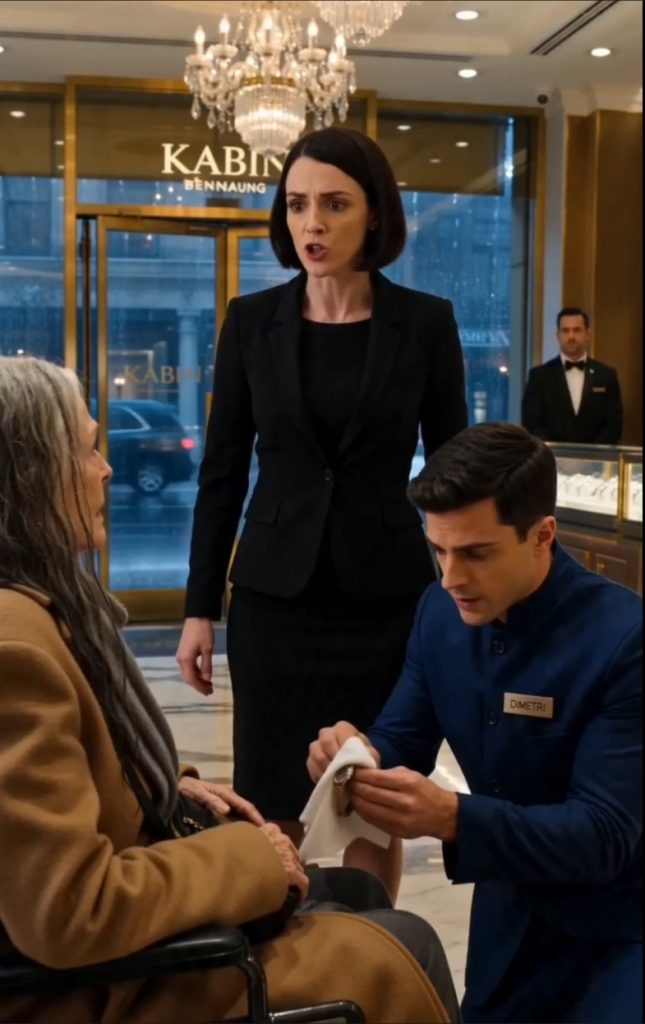
She sat before the glass counter in a damp brown wool coat, her gray hair still wet from the rain outside. A small black purse rested in her lap. Her hands, thin and trembling, hovered in the air where the watch had been only seconds earlier.
Across from her, the young clerk in the black blazer looked disgusted.
“We don’t repair junk,” she said.
The word hung beneath the chandeliers.
Junk.
In that room, everything was arranged to look eternal. Marble floors polished until they reflected the gold trim. Crystal chandeliers glittering overhead. Velvet trays holding diamond rings behind spotless glass. The name KABIN gleamed above one wall, and BENNAONG shone in gold letters near the private consultation salon.
Outside, rain blurred the city street beyond the glass doors.
Inside, the warmth felt suddenly cruel.
The elderly woman looked at the trash bin, then back at the clerk.
“That watch is not junk,” she said softly.
The clerk folded her arms.
“Madam, this boutique handles high-value pieces. Modern pieces. Certified pieces. We cannot waste time on something you found in a drawer.”
A man in a royal blue high-collar uniform froze near the opposite display case.
His name tag read DIMITRI.
He had seen the whole thing.
For a second, he looked at the clerk. Then at the woman. Then at the gold trash bin sitting on the marble like an insult dressed as decor.
He walked over without asking permission.
The clerk snapped, “Dimitri.”
He ignored her.
He reached into the bin, carefully pulled out the old watch, and wiped it with a white cloth he took from his pocket. Then he knelt beside the woman’s wheelchair, lowering himself until she did not have to look up to be seen.
The clerk’s face hardened.
“You’ll lose your job for this.”
Dimitri held the watch gently in his palm.
“It matters to her,” he said.
The old woman stared at him, and something in her eyes changed. Not surprise exactly. Recognition.
As if, after all these years, she had finally heard the language this house was built to speak.
Then she opened her purse and reached for a brown envelope.
And the entire boutique was about to learn what the clerk had thrown away.
Act II
Her name was Madeleine Kabin, though no one in the boutique knew it.
Not the clerk.
Not the security guard near the door.
Not even Dimitri, who had spent the last eight months studying the company’s history during late train rides home because he believed places had souls, and employees should know whose soul they were serving.
To him, she was simply an elderly customer who had come in from the rain.
That had been enough.
Madeleine had not entered the boutique through the private salon, though she could have. She had not called ahead. She had not asked for the director. She had not worn the sapphire brooch that would have made every manager in the building sweat through their shirt.
She arrived in a wheelchair pushed by no assistant, wearing an old coat that smelled faintly of rain and lavender soap.
At the door, the security guard hesitated before pressing the entrance button. He glanced at the wheelchair, then at the wet hem of her coat, then at the marble floors.
Dimitri saw the hesitation and crossed the room.
“Welcome to Kabin Bennaong, madam,” he said. “Please come in out of the rain.”
She looked up at him.
“Thank you, young man.”
Her voice was quiet, but not weak.
That was the first thing Dimitri noticed.
The second was the way her eyes moved around the boutique. She did not look at the diamonds the way most people did. She did not lean toward glitter. She looked at the wood trim, the spacing between counters, the curve of the staircase leading to the private rooms, the old founder’s portrait placed beneath a wash of warm light.
Like someone returning to a house she had helped build.
The clerk, Clara Voss, noticed her too.
Clara had perfected the boutique smile: bright for clients in tailored coats, soft for wealthy husbands, reverent for women wearing old family stones. But when Madeleine approached the counter and placed the vintage watch on the velvet mat, Clara’s smile thinned.
The watch was simple compared to the pieces around it.
A round silver case. A worn crown. A faded leather strap. Tiny scratches along the metal cover from decades of use. The kind of object that carried time honestly instead of hiding it behind diamonds.
“My husband wore this here,” Madeleine said. “Many years ago.”
Clara barely looked at it.
“Do you have authentication papers?”
Madeleine paused.
“I have a letter.”
Clara exhaled through her nose.
“Madam, without documentation, there is very little we can do. We are not a pawn shop.”
Dimitri, arranging pearl earrings nearby, felt his jaw tighten.
Madeleine nodded slowly.
“I am not trying to sell it.”
“Then what do you want?”
“I want it opened and cleaned. It stopped ticking last winter.”
Clara’s eyes flicked toward the woman’s coat again. Toward the purse. Toward the wheelchair. Her conclusion arrived before kindness did.
“We don’t repair junk.”
Then she snatched the watch from the counter and threw it into the trash.
The boutique went still.
A tuxedoed employee in the background looked down immediately, choosing safety over decency. The security guard pretended to study the rain. Clara lifted her chin as if she had protected the brand from contamination.
Dimitri felt something hot rise in his chest.
He had grown up five blocks from the old factory where Kabin watches were first assembled. His grandfather had been a polisher there for thirty-two years. In Dimitri’s childhood home, there was one framed photograph of his grandfather standing beside the founder, both men in rolled sleeves, both smiling as if work could be sacred when done with care.
Dimitri had joined the boutique not because he loved luxury.
He joined because he believed the brand once meant something more than price.
So he retrieved the watch.
And when he knelt beside Madeleine, the room changed in a way no one understood yet.
Act III
Madeleine watched Dimitri wipe the watch with the seriousness of a priest handling a relic.
His hands were careful, not because the watch looked expensive, but because he had already decided it deserved care. That distinction mattered to her more than he could know.
“What is your name?” she asked.
“Dimitri, madam.”
“Dimitri,” she repeated, as though placing the name somewhere important.
Clara stepped closer, heels clicking against the patterned marble.
“Stand up,” she said. “You are embarrassing the boutique.”
Dimitri did not stand.
“No,” Madeleine said quietly. “He is honoring it.”
Clara blinked, offended by the calm.
“Madam, you do not understand where you are.”
For the first time, Madeleine smiled.
It was small.
Tired.
Devastating.
“Oh, I understand exactly where I am.”
She opened the brown envelope on her lap. The paper inside was old but carefully protected. First came a typed letter, yellowed at the folds. Then a black-and-white photograph.
Dimitri saw the photograph before Clara did.
A man in a suit stood in front of an early version of the same boutique counter. Younger, but unmistakably distinguished. His hair was neatly combed, his posture formal, his eyes alive with the confidence of a man building something from nothing.
On his wrist was the watch.
The same silver case.
The same worn shape.
The same piece Clara had called junk.
Madeleine held the photo between two fingers and looked down at it with a tenderness that made the chandeliers feel dim.
“My husband wore this here,” she said again. “On the morning the first boutique opened.”
Dimitri’s breath caught.
Behind the counter, Clara’s expression shifted from impatience to irritation, then to uncertainty.
She leaned closer.
Her eyes moved from the photograph to the wall.
There, beneath the gold KABIN lettering, hung a large portrait of the founder. The same strong jaw. The same watchful eyes. The same man from the photograph, painted larger than life and framed as heritage for clients who never wondered who had dusted the frame.
Clara’s mouth opened.
She looked back at the photograph.
Then at the portrait.
Then at the woman in the wheelchair.
“That’s the founder,” she whispered.
Madeleine closed her fingers around the photograph.
“And I am his wife.”
No one moved.
Even the rain beyond the glass doors seemed to soften.
Clara’s face drained of color.
The tuxedoed employee finally looked up. The security guard turned fully from the entrance. Somewhere behind the private salon doors, a manager’s voice faded mid-sentence as if the building itself had inhaled.
Dimitri remained on one knee, the old watch still resting in his cloth-covered hand.
Founder’s wife.
Not a poor woman wasting their time.
Not an inconvenience.
Not someone to be measured by damp hair and an old coat.
Madeleine Kabin looked at Clara, and her voice, though quiet, carried across every gold surface in the room.
“My husband built this company repairing watches for dockworkers, teachers, widows, and men who saved for five years to buy one good thing. He used to say a luxury object is not valuable because it is expensive. It is valuable because someone has trusted it with memory.”
Clara swallowed.
“I didn’t know.”
Madeleine’s gaze dropped briefly to the trash bin.
“No,” she said. “You did not ask.”
Act IV
The boutique manager arrived too late to rescue anyone.
His name was Laurent, a thin man with silver-rimmed glasses and the nervous grace of someone who had survived by pleasing the powerful before they finished speaking. He came out of the private consultation room smiling, then saw Madeleine and stopped so abruptly that the smile vanished from his face.
“Madame Kabin.”
The title landed like a gavel.
Clara gripped the edge of the counter.
Dimitri looked up, stunned.
Laurent crossed the marble floor quickly, then bent at the waist with a respect Clara had never seen him give anyone.
“We were not informed you would be visiting today.”
Madeleine’s expression did not change.
“That was the purpose of the visit.”
Laurent’s eyes flicked toward the trash bin, the watch in Dimitri’s hand, Clara’s pale face, and he understood enough to become afraid.
“Madame, if there has been a misunderstanding—”
“There has not,” Madeleine said.
Two words.
Clean as a cut.
She took the watch gently from Dimitri and turned it over in her hands. The metal cover was scratched. The hinge was stiff. But her thumb found the small groove by instinct.
“My husband, Henri, carried this through every year of the company’s beginning,” she said. “When we could not afford a sign, this watch sat in the window beside handwritten repair cards. When the first investor mocked him for polishing old watches instead of chasing diamonds, Henri told him, ‘The rich buy shine. The loyal return for care.’”
Dimitri lowered his eyes.
His grandfather had repeated that line.
The loyal return for care.
It was written in old employee manuals, carved into company lore, quoted in anniversary brochures no one in the modern boutique bothered to read.
Madeleine looked at Clara.
“I came today because tomorrow is the founder’s anniversary. The board requested I lend this watch for the exhibition upstairs.”
Laurent closed his eyes briefly.
The exhibition.
The private event.
The brand’s most important heritage evening in years.
Clara’s lips parted, but no words came out.
Madeleine continued.
“I decided to bring it through the public counter instead. My husband always said the soul of a house is revealed by how it treats someone who appears to have nothing to offer.”
The silence deepened.
Clara’s humiliation was no longer private. Two clients near the bridal display had stopped pretending not to listen. A jeweler from the back room stood frozen in the hallway. The tuxedoed employee who had ignored everything earlier now looked like he wished he had vanished when kindness was still possible.
Laurent turned to Clara.
“Is it true?” he asked softly. “You threw Madame Kabin’s watch into the trash?”
Clara’s face tightened.
“I was following brand standards.”
Madeleine’s eyes sharpened.
“No. You were protecting your idea of wealth from the sight of age.”
Clara flinched.
Dimitri finally stood, still holding the cloth in both hands.
“She asked for a cleaning,” he said. “Nothing more.”
Laurent looked at him.
“And you retrieved it?”
“Yes, sir.”
“After being told not to?”
Dimitri glanced at Clara, then back at Madeleine.
“Yes, sir.”
Clara seized the moment.
“He disobeyed a senior associate in front of a client.”
Madeleine let out a soft breath.
“A client,” she repeated. “Only now?”
Clara looked down.
The old woman placed the watch on the glass counter. Then she laid the photograph beside it, followed by the typed letter.
Dimitri saw the signature at the bottom.
Henri Kabin.
Madeleine touched the page.
“This is the letter my husband wrote the night before he died. He asked that, after my passing, the family shares be transferred only if the board could prove the company still remembered why it began.”
Laurent went very still.
Clara looked up sharply.
Madeleine did not raise her voice.
“I have not passed, Mr. Laurent. And after this morning, I am no longer sure the board deserves what it expects.”
The boutique manager’s face went gray.
Because the old woman in the damp coat was not merely a widow.
She was the last living guardian of the founder’s controlling legacy trust.
And the watch Clara had thrown away was the key piece in a decision worth more than every diamond in the room.
Act V
Clara began to apologize.
Not immediately from remorse.
First from fear.
“Madame Kabin, I am deeply sorry if my tone seemed—”
Madeleine lifted one hand.
Clara stopped.
“If?”
The word was quiet, but it exposed everything.
Clara’s eyes filled, though no one knew whether from shame or panic. For the first time since Madeleine entered, she looked young. Not polished. Not superior. Just a frightened employee who had mistaken cruelty for professionalism because cruelty sometimes wears a blazer and calls itself standards.
Madeleine did not destroy her.
That would have been easy.
Instead, she asked one question.
“When you saw me, what did you think I was worth?”
Clara’s mouth trembled.
No answer could save her.
Laurent removed his glasses and rubbed the bridge of his nose. “Clara, go to my office.”
She looked at him.
“Now?”
“Now.”
Clara walked away slowly, heels no longer sharp against the marble. Near the staircase, she paused once as if hoping someone might call her back.
No one did.
Madeleine watched her go without triumph.
Dimitri understood then that she had not come to humiliate anyone. She had come hoping not to be disappointed.
That made the disappointment worse.
Laurent turned back to Madeleine.
“Madame, I assure you this does not reflect the values of the house.”
Madeleine looked around the boutique.
The chandeliers. The roses. The guarded cases. The gold letters. The employees staring at the floor after learning that kindness had been the safest career move all along.
“Values are not what a company hangs on a wall,” she said. “They are what remains when no one important seems to be watching.”
Laurent lowered his head.
“Yes, Madame.”
Madeleine looked at Dimitri.
“Would you take me to the watchmaker’s room?”
Dimitri straightened.
“Of course.”
He guided her wheelchair carefully across the patterned marble, moving slowly enough that she could see the portrait as they passed. Henri Kabin looked down from the wall, painted in the prime of his life, his eyes full of impossible confidence.
Madeleine stopped beneath it.
For a moment, she was no longer the old woman in the wheelchair.
She was a young bride standing beside a rented counter while her husband promised that one day, people would come from all over the world to buy what his hands had made.
“They forgot your hands, Henri,” she whispered.
Dimitri heard but pretended not to.
That was another kind of respect.
The watchmaker’s room smelled of oil, metal, and cedar. It was quieter than the boutique floor, humbler too. No chandeliers. No champagne. Just lamps, tools, magnifiers, and the delicate patience of work that could not be rushed.
Dimitri placed the watch on a leather pad.
The senior watchmaker, called from the back, examined it with widening eyes.
“This is the first anniversary piece,” he murmured.
Madeleine nodded.
“Can it tick again?”
The watchmaker looked offended by the possibility that it might not.
“Yes, Madame. But it must be done carefully.”
“Then carefully,” she said.
Dimitri stayed beside her while the watchmaker opened the case.
Inside, time had left its dust but not its defeat. The mechanism was old, stubborn, and beautifully made. Henri’s initials were engraved beneath the cover, almost hidden near the hinge.
H.K.
Madeleine touched them once.
“I used to hear it at night,” she said softly. “When he came home late and thought I was sleeping. Tick, tick, tick. I knew he was beside me before he spoke.”
Dimitri looked down.
“My grandfather worked in the first polishing room,” he said.
Madeleine turned to him.
“What was his name?”
“Anton Sokolov.”
Her face changed.
“Anton had the best hands in the building.”
Dimitri stared at her.
“You remember him?”
“Your grandfather saved the first royal order,” she said. “Henri scratched the case the night before delivery. Anton stayed until sunrise.”
Dimitri laughed once, softly, in disbelief.
“My grandmother told that story. I thought she made it grander than it was.”
“Oh, she probably did,” Madeleine said. “But not by much.”
For the first time that morning, she smiled without sadness.
The watchmaker began the restoration while the boutique outside rearranged itself around the shock. Clara’s desk was cleared before lunch. Laurent called the board. The heritage exhibition was delayed by one hour, then transformed entirely.
By evening, Madeleine returned to the main floor.
This time, every employee stood.
She hated that a little.
Respect that arrives after power is revealed always carries an aftertaste.
But Dimitri did not stand because she was powerful. He had already knelt when he thought she was no one.
That was why, during the founder’s anniversary event the next night, Madeleine asked him to bring the watch forward.
The boutique was filled with elite clients, board members, journalists, and jewelers flown in from three countries. Champagne moved through the room on silver trays. Cameras flashed beneath the chandeliers.
Madeleine sat beside the portrait of Henri, the restored watch in her hands.
When the room quieted, she snapped the metal cover shut.
The sound was small.
This time, everyone heard it.
“My husband founded this house because he believed time was the most intimate luxury,” she said. “Not diamonds. Not gold. Time. The minutes we spend earning trust. The years we spend keeping promises. The seconds in which we decide whether a stranger deserves dignity.”
No one breathed too loudly.
“Yesterday, this watch was thrown away in this boutique.”
A ripple moved through the guests.
Madeleine continued.
“It was retrieved by an employee who did not know my name, my history, or my power. He only knew that it mattered to me.”
She looked at Dimitri.
“Come here.”
Dimitri stepped forward, face pale with emotion.
Madeleine placed the watch in his hands.
“The Heritage Repair Program will reopen under your supervision,” she said. “Every customer who enters with a memory will be treated as if that memory belongs to the founder himself.”
Dimitri’s eyes shone.
“I don’t know what to say.”
Madeleine smiled.
“Say you will remember.”
He closed his fingers carefully around the watch.
“I will remember.”
Months later, the boutique changed in ways some clients noticed and others did not.
A small desk appeared near the entrance, not for high jewelry appointments, but for repairs. Old watches. Bent clasps. Tarnished lockets. Wedding bands worn thin by fifty years of ordinary love.
Above it hung a simple line in gold letters.
The loyal return for care.
Dimitri saw it every morning.
Clara never returned to the floor. Whether she learned from what happened, no one could say. Some lessons cannot be measured from the outside.
Madeleine visited once a month after that, never through the private entrance. Sometimes she wore pearls. Sometimes the same brown coat. Sometimes she simply sat near the repair desk and watched people place their memories into careful hands.
One rainy afternoon, a young woman came in with a cracked silver bracelet that had belonged to her mother.
She apologized before anyone spoke.
“I know it probably isn’t worth much.”
Dimitri looked at the bracelet, then at her.
“Who told you worth begins with price?”
The young woman blinked.
Madeleine, seated nearby in her wheelchair, lowered her eyes and smiled.
The chandeliers glowed warmly above them. Rain streaked the glass doors. Diamonds glittered in their cases, beautiful and cold, while an old watch ticked softly beneath the founder’s portrait.
Not loudly.
It did not need to.
Some things prove their value simply by continuing.