Act I
At first, everyone on the bus thought the dog was lost.
He came out of the desert like a streak of gold, bursting from the brush beside the highway as the sun bled orange across the horizon. The bus was moving fast, its white frame cutting through the empty road, engine roaring too loudly for a vehicle that size.
And still, somehow, the Golden Retriever kept up.
His fur whipped in the wind. His ears flattened against his head. His paws struck the asphalt in a frantic rhythm as he sprinted straight in front of the bus, barking with a desperation no one inside could ignore.
In seat 12A, Martin Hale leaned forward and gripped the seat in front of him.
“What does this dog want?” he shouted. “Is there something wrong with the bus?”
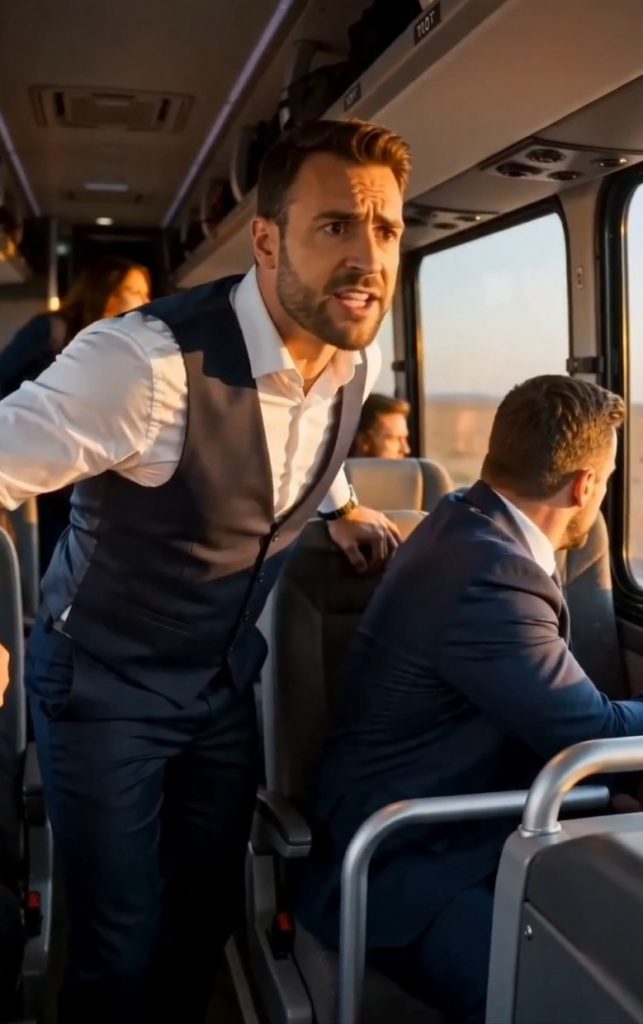
Across the aisle, a man in a navy suit pressed his face closer to the window. Behind him, a young woman in a brown coat covered her mouth, her eyes wide as the dog dropped back toward the front wheel.
The dog was no longer running ahead.
He was running beside the right side of the bus.
Dangerously close.
Too close.
His head snapped toward the spinning wheel, and his barking changed. It was sharper now, higher, almost frantic. He lunged near the side panel, then swerved away before the tire could catch him.
The passengers began to murmur.
“Why won’t the driver stop?”
“Is that dog hurt?”
“He’s going to get killed.”
Martin turned toward the front.
“Driver!” he yelled. “Pull over!”
The driver, a broad-shouldered man named Carl Briggs, did not answer. His hands stayed locked at ten and two. His eyes remained fixed on the desert road ahead, but his jaw tightened.
The dog surged forward again, placing himself directly in front of the bus.
Carl hit the horn.
The blast shook the cabin.
But the dog did not move.
He looked back through the windshield, mouth open, tongue flashing, barking as if every second mattered.
The bus swerved slightly.
A woman screamed.
Martin stood halfway from his seat. “Stop the bus!”
Carl shouted over his shoulder, “Sit down!”
The command landed with a force that made several passengers freeze. But Martin did not sit. Something about the driver’s voice was wrong.
It was not fear.
It was anger.
The kind of anger a man feels when someone ruins a plan.
Outside, the Golden Retriever dropped back to the front wheel again. This time his body nearly brushed the metal rim, and the sunset flashed across something beneath the bus.
A spark.
Small.
Brief.
But Martin saw it.
So did the man in the navy suit.
Their eyes met across the aisle.
The dog had not been chasing the bus.
He had been chasing the danger underneath it.
And the person behind the wheel already knew.
Act II
The bus had left Phoenix two hours late.
That was the first thing Martin would remember later. Not the dog. Not the sunset. Not the sound of panic rising around him like heat from the highway.
The delay.
They had been told it was a paperwork issue. Then a driver change. Then a maintenance check. Ordinary excuses, delivered in the flat voice of a woman behind a charter desk who refused to make eye contact.
The passengers were not tourists.
That was the second thing Martin would remember.
They were witnesses, auditors, attorneys, and former employees traveling to a federal hearing in Nevada. The hearing concerned Silver Ridge Energy, a company powerful enough to own half the desert and arrogant enough to believe it owned the people living in it.
For years, Silver Ridge had run private transport for workers, inspectors, and officials across the region. Quiet buses. Empty highways. No reporters. No questions.
Martin had once been their safety consultant.
He had also been the first man they tried to silence.
Six months earlier, he found inspection logs that did not match reality. Brake replacements signed off but never performed. Engine warnings deleted. Driver complaints buried. A technician’s report about “critical front assembly instability” vanished from the system the day after it was filed.
The technician’s name was Owen Reyes.
Owen had worked at a desert service depot called Mile 87, a lonely maintenance stop on the highway where buses refueled, cooled down, and rolled out again before dawn.
Owen was careful. Too careful to make enemies by accident.
Then he disappeared.
Silver Ridge said he quit.
His wife said he would never leave their son without goodbye.
His dog waited outside the depot gate for three days.
The dog’s name was Ranger.
Martin had seen him once before, months ago, sitting beside Owen’s truck with a red bandana around his neck and dust on his golden fur. Owen had laughed when Ranger nudged a wrench with his nose.
“He thinks he’s part of the crew,” Owen said.
Martin remembered smiling.
Now, staring through the bus window at the same dog risking his life on the highway, Martin did not smile at all.
Because Ranger was not lost.
Ranger knew this bus.
He knew its sound. Its smell. Its wrongness.
Across the aisle, the man in the navy suit leaned toward Martin.
“I’m Marcus Bell,” he said quickly. “Accident reconstruction. I’m supposed to testify tomorrow.”
Martin nodded once. “Then tell me I didn’t just see sparks under the front right side.”
Marcus’s face was pale.
“You did.”
The young woman behind him spoke for the first time.
“My father worked at Mile 87.”
Martin turned.
She swallowed hard. “I’m Elena Reyes. Owen Reyes was my father.”
For a moment, the roar of the bus seemed to fade.
Martin looked from Elena to the dog outside.
Ranger had fallen back again, barking toward the undercarriage, then sprinting ahead as if begging them to follow his urgency.
Elena’s eyes were wet, but her voice hardened.
“He only does that when something’s burning.”
Marcus looked toward the front.
“The driver has to stop.”
“He won’t,” Martin said.
“How do you know?”
Martin watched Carl’s shoulders.
Because Carl had ignored the dog.
Because Carl had ignored the sparks.
Because Carl’s knuckles were white on the wheel, not with panic, but determination.
And because ten minutes before Ranger appeared, Martin had seen the driver slide his phone into his pocket after reading one message.
Keep moving.
No stops.
Act III
The bus began to vibrate harder.
Not the normal shudder of tires on desert asphalt. This was deeper, uneven, pulsing through the floor in waves. Overhead lights flickered once. Someone near the back began praying under their breath.
Ranger barked again.
Three sharp bursts.
Then he veered left, forcing Carl to slow for half a second.
Carl cursed and jerked the wheel.
Elena cried out as the dog stumbled, recovered, and kept running.
“He’s trying to slow us down,” she said.
Marcus moved into the aisle. “Driver, pull over now.”
Carl did not turn. “Return to your seat.”
“The front assembly is overheating.”
“I said sit down.”
Martin stood beside Marcus.
The two men looked very different. Martin, white shirt and dark vest, looked like he belonged in a conference room. Marcus, in his navy suit, looked like he belonged in court. But fear had stripped both of them down to the same simple truth.
If they did nothing, the bus might not make the next ten miles.
At the front, Carl reached for the radio.
Martin saw his hand tremble.
Not enough for the passengers to notice.
Enough for Martin.
“Who told you not to stop?” Martin asked.
Carl’s head snapped slightly.
There it was.
A crack.
Elena pushed into the aisle behind them. “My father filed the report on this bus, didn’t he?”
Carl said nothing.
“He found something,” she continued, her voice rising. “That’s why he disappeared.”
“Miss, sit down,” Carl said.
“Look at me.”
He didn’t.
That was answer enough.
The bus lurched.
A metallic scream tore from beneath the right side.
The cabin erupted.
Passengers grabbed armrests. Someone’s bag fell from the overhead rack. The young woman in the brown coat cried out as the floor bucked beneath her feet.
Outside, Ranger darted ahead again.
But this time he did something different.
He turned off the road.
Straight toward a narrow emergency turnout half-hidden by dust and scrub.
He ran into it, stopped, spun around, and barked at the bus with every ounce of strength in his body.
Marcus stared.
“He’s showing us where to stop.”
Martin looked through the windshield.
The turnout was small. Rough gravel. A rusted call box. Maybe enough room for the bus if Carl began braking now.
Beyond it, the road sloped downhill into a long desert grade with no shoulder and a sharp curve at the bottom.
If they missed the turnout, they would be trapped on the descent.
Martin lunged forward.
Carl shouted, “Don’t!”
But Martin had already grabbed the pole beside the driver’s seat.
“You stop this bus,” he said.
Carl’s eyes flashed. “You don’t know what you’re doing.”
Marcus stepped beside him. “Actually, I do. And if that wheel fails on the grade, everyone here is in danger.”
For the first time, Carl looked scared.
Not for them.
For himself.
Elena saw it and whispered, “What did they promise you?”
Carl’s face twisted.
Then his phone buzzed again.
It sat in the cup holder.
The screen lit up.
Martin saw the message before Carl could hide it.
Make sure none of them arrive.
The bus went silent in a way that was louder than screaming.
Carl reached for the phone.
Martin got there first.
And in that instant, the driver stopped pretending.
Act IV
Carl slammed his elbow backward, knocking Martin against the fare box.
Marcus grabbed the wheel with one hand as the bus drifted toward the center line. Passengers screamed. Elena braced herself between two seats, refusing to fall.
Outside, Ranger barked like mad from the turnout, his golden body framed by the dying sun.
Carl fought for control of the wheel.
Marcus shouted, “Brake! Brake now!”
Carl snarled, “The brakes won’t hold!”
That was the truth he had been hiding.
Martin struggled upright, one hand still clutching Carl’s phone. On the screen were messages stretching back hours. Instructions. Payment confirmation. Route details. A photo of the passenger manifest.
Every witness.
Every name.
Every seat.
Elena saw her father’s name in one message preview.
Reyes problem handled. Daughter on board.
Her face changed.
Whatever fear had been there burned away into something colder.
“My father didn’t leave,” she said.
Carl looked at her in the rearview mirror.
And that glance told her everything.
Marcus forced the gear selector downward.
The engine roared.
The whole bus shuddered.
“Everybody hold on!” he shouted.
Carl tried to shove him away, but Martin locked an arm around the driver’s shoulder and pulled him back from the wheel. Not enough to throw him. Enough to break his control.
Marcus steered toward the turnout.
The bus groaned.
The front right side screamed again, metal grinding against metal. The smell of heat and rubber flooded the cabin. Passengers ducked low, gripping seats, each other, anything solid.
Ranger did not move from the turnout.
He stood in the exact place they needed to aim for, barking, barking, barking.
“Move, dog!” Martin yelled, though Ranger could not hear him.
At the last second, Ranger sprang aside.
The bus left the asphalt.
Gravel exploded beneath the tires.
The passengers were thrown forward against seat belts and armrests. The bus fishtailed, tilted, corrected, then tore through scrub before Marcus dragged it into a grinding stop yards from the old call box.
Silence hit first.
Then sobbing.
Then the tick of overheated metal.
Martin’s hands were shaking so badly he nearly dropped the phone.
Elena stumbled toward the door.
Outside, Ranger stood in the dust, chest heaving, tongue out, fur glowing copper in the last light. His paws were dirty. His body trembled from exhaustion. But his eyes were fixed on the bus door.
The door hissed open.
Elena stepped down.
For one suspended second, the dog stared at her.
Then Ranger ran to her and buried his head against her coat.
Elena dropped to her knees in the dirt and wrapped both arms around him.
“You found him, didn’t you?” she whispered. “You knew.”
Ranger whined softly.
Behind them, Marcus and Martin climbed out with several passengers. They saw the damage immediately.
The front right wheel was leaning at an angle it should never have held. One of the mounting points had nearly separated. A dark burn mark scarred the metal housing. Another few minutes, and the wheel could have failed completely on the downhill grade.
Marcus crouched, his face grim.
“This wasn’t neglect.”
Martin looked at him.
Marcus touched the loosened assembly, then the cut sensor line hanging beneath it.
“This was tampered with.”
Elena stood slowly.
Ranger pressed against her leg.
From inside the bus, Carl shouted that they had no proof.
Then Martin held up the phone.
“No,” he said. “We have plenty.”
A highway patrol car arrived twenty minutes later.
Then another.
Then federal agents.
By then the sun had disappeared, and the desert was no longer gold. It was black and cold and full of flashing red and blue lights.
Carl was taken away without a speech.
The passengers watched him go in stunned silence.
But Elena was not watching Carl.
She was watching Ranger.
The dog had wandered to the edge of the turnout and stood facing the desert beyond the highway. He stared toward the old Mile 87 depot, somewhere out there in the dark.
As if waiting for someone who would never walk back.
Act V
The hearing did not begin the next morning.
It began two days later, under heavier security and with every news camera in Nevada pointed at the courthouse steps.
Silver Ridge Energy called it an isolated criminal act.
Nobody believed them for long.
Carl’s phone led investigators to a chain of private contractors. The contractors led to executives. The executives led to deleted maintenance reports, hidden payments, and a sealed internal memo marked urgent.
At the center of it all was Owen Reyes.
Elena’s father had not been a man who quit.
He had been a man who found the truth under the wrong bus and refused to look away.
His final report showed that several company vehicles were being kept on the road despite critical safety failures. One bus in particular had been flagged as dangerous.
The same white coach bus that later carried the witnesses.
The same bus Ranger chased through the desert.
Owen had tried to take the records public. Before he could, he vanished from the company system. His badge deactivated. His email wiped. His resignation forged.
But Owen had trained Ranger too well.
Every evening, at Mile 87, Owen had made the dog follow a simple command during maintenance checks.
Find the hot wheel.
Ranger learned by smell, by sound, by the faint changes humans missed. Overheated brakes. Leaking fluid. Burning rubber. Metal under stress.
To the company, he was just a dog left behind at a depot.
To Owen, he had been a partner.
And on that evening in the desert, Ranger had recognized the sound of the bus his owner feared most.
He had chased it until the humans finally listened.
Elena testified on the third day.
She wore the brown coat from the bus, even though Celia from the victim support office told her she did not have to. Elena said she wanted the jury to see her as she had been that night.
Scared.
Angry.
Alive because a dog refused to give up.
Martin testified after her. Marcus testified for nearly four hours, explaining the damage, the sabotage, the point on the road where the wheel would likely have failed, and the turnout Ranger had led them to before the grade.
Then prosecutors played the roadside footage from a passenger’s phone.
The courtroom watched Ranger sprint beside the bus, barking toward the wheel, then racing ahead into the turnout as the sun burned red behind him.
Nobody laughed.
Nobody called it coincidence.
Even the judge removed his glasses and looked down for a moment when the video ended.
Silver Ridge fell slowly, then all at once.
Executives resigned. Charges followed. Families of former workers came forward. Old reports reopened. The Mile 87 depot, once abandoned under dust and silence, became evidence.
And Owen Reyes finally became what he had always deserved to be.
Not a missing employee.
Not a company problem.
A whistleblower.
A father.
A man who tried to save people.
Weeks after the trial, Elena returned to Mile 87.
Martin came with her. So did Marcus. They did not plan it that way, but grief and gratitude have a way of gathering people in the same place.
The depot looked smaller in daylight.
A rusted sign. A cracked lot. A service bay with one door half-bent from years of desert wind.
Ranger jumped out of Elena’s truck before she could stop him.
He ran straight to the old garage door and sat there.
No barking this time.
No panic.
Just waiting.
Elena walked up behind him and placed a hand on his head.
“I know,” she said.
Inside the garage, investigators had found Owen’s hidden backup drive taped beneath a workbench. It held the files that made the case impossible to bury. It also held photos.
Owen and Elena at Christmas.
Owen asleep in a chair with Ranger’s head on his knee.
Owen standing beside the white bus, frowning at the front right wheel.
On the back of one printed photo, Owen had written three words.
Trust the dog.
Elena had read those words so many times the ink seemed burned into her heart.
Now she knelt beside Ranger outside the depot and clipped a new tag to his collar.
Not a company tag.
Not a lost dog tag.
A home tag.
Ranger Reyes.
Martin watched from a few feet away, his hands in his pockets, his eyes wet but steady.
“He saved all of us,” he said.
Elena looked toward the highway.
In the distance, cars moved like tiny sparks through the desert heat.
“No,” she said softly. “He finished what my father started.”
The wind crossed the empty road.
Ranger lifted his head.
For a second, his body went still, ears forward, eyes fixed on something beyond the highway. Elena followed his gaze but saw only dust and sunset.
Then Ranger relaxed.
He leaned into her side.
The desert was quiet now.
No roaring engine. No screaming metal. No passengers gripping their seats as the world tilted beneath them.
Just a daughter, a dog, and the long road where the truth had almost died.
Elena stood and opened the truck door.
Ranger climbed in, circled once, and lay down in the passenger seat like he had done it all his life.
Before Elena started the engine, she looked one last time at Mile 87.
For years, that place had been where her father disappeared.
Now it was where he had spoken.
Through records.
Through courage.
Through the dog who remembered what humans tried to erase.
And as Elena drove away from the depot, Ranger rested his head against the window, watching the desert road unwind ahead of them.
This time, he did not have to chase anyone.
This time, the people had finally followed.