Act I
The dog knew before anyone else did.
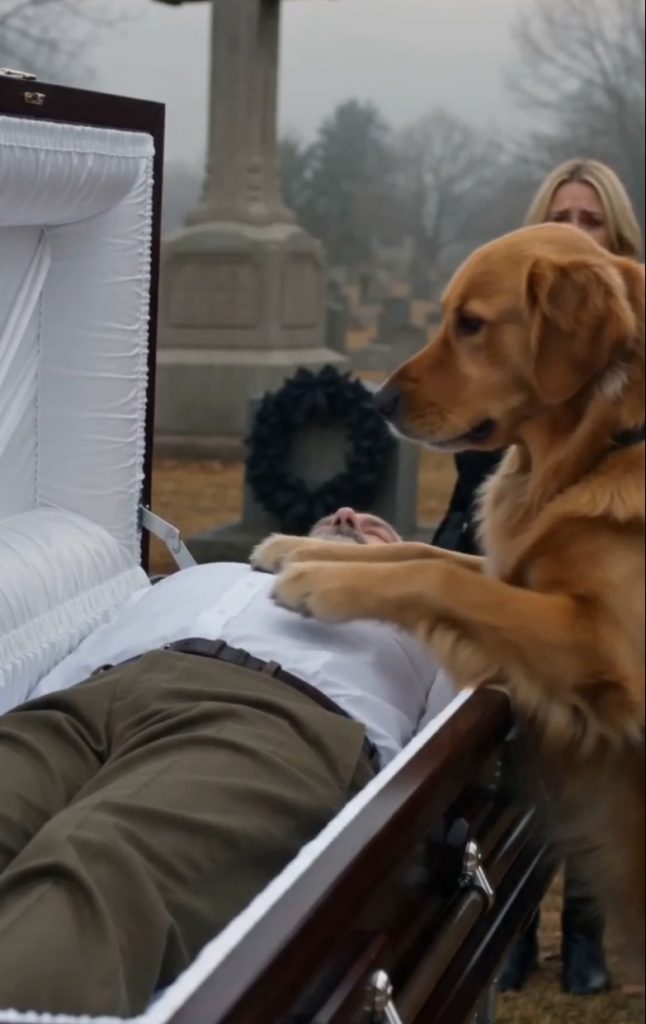
He stood on his hind legs beside the dark wooden casket, his golden fur trembling in the winter wind, his front paws hooked over the polished rim as if the whole world depended on him staying there.
Inside the casket lay Walter Grayson.
Seventy-two years old. Gray beard. White hair. White dress shirt buttoned neatly beneath his chin. Olive trousers pressed so sharply they looked chosen by someone who cared more about appearances than grief.
His eyes were closed.
His hands were folded.
He looked peaceful in the way funeral homes teach the dead to look peaceful.
But Duke did not believe it.
The Golden Retriever lowered his head to Walter’s chest at first, pressing his snout against the white shirt as though listening for something too faint for human ears. The mourners behind the casket watched in silence, unsure whether to cry or step away.
Then Duke pushed himself upright.
His right paw landed on Walter’s upper chest.
His left paw pressed lower, against his abdomen.
And he began to push.
Once.
Twice.
Again.
Hard enough that Walter’s shirt shifted beneath the dog’s paws.
A blonde woman in a black coat clapped a hand over her mouth. The man beside her, wearing a black leather jacket, stared without blinking. Another mourner in a dark pea coat took half a step forward, then stopped, as if the sight had frozen his courage inside him.
The cemetery stretched around them in muted winter colors. Brown grass. Leafless trees. A stone cross dark against a sky smeared gray and orange. Wind moved between the gravestones like it was whispering names.
Duke barked.
Not a lonely bark.
Not the broken sound of a pet grieving at a grave.
It was sharp. Repeated. Urgent.
A warning.
Father Michael Voss approached from the side of the casket, his black cassock snapping slightly in the wind. His jaw was tight, his hands lifted in a calming but commanding gesture.
“Somebody take the dog away!” he called.
Duke’s head whipped toward him.
The bark that followed was so fierce that the priest stopped mid-step.
“Duke,” the blonde woman whispered through her fingers. “Please…”
But Duke ignored her. He turned back to Walter and pressed again, rhythmic and desperate, his paws thumping against the old man’s shirt.
Father Michael’s patience thinned.
“This is not appropriate,” he said. “The animal is distressed.”
The man in the leather jacket finally moved. “Then get him off.”
But no one did.
Because Duke was not just distressed.
He was working.
His breathing grew heavy. His eyes glistened, dark and wet, but his focus never broke. He barked at the priest, pushed against Walter, barked again, then pressed his head to the old man’s chest as though pleading with him to answer.
Father Michael stepped closer despite himself.
“What is wrong with him?” he breathed.
Then he looked down into the casket.
And for the first time that afternoon, the priest’s face changed from irritation to horror.
Because Duke had not been trying to say goodbye.
He had been trying to stop a burial.
Act II
Walter Grayson had not always been a lonely old man in a casket.
Once, he had been the kind of man the entire town waved to.
He owned Grayson Hardware for thirty-eight years, the last brick storefront on Maple Street that still gave kids free peppermint candies from a glass jar near the register. He sharpened lawn mower blades, fixed broken porch lamps, lent tools to people who never returned them, and pretended not to notice when a struggling customer came up short.
His wife, Eleanor, used to call him “impossible.”
But she smiled when she said it.
After Eleanor died, the store became too quiet. Walter sold it, closed the second floor apartment, and moved into the small house near the cemetery where he could see the church steeple from his kitchen window.
That was when Duke entered his life.
The dog had been found outside the old fire station during a rainstorm, soaked, underfed, and still wagging his tail at everyone who passed. Walter came to donate blankets, saw the dog sitting with one paw lifted like he was asking politely to belong somewhere, and left with muddy paw prints on his passenger seat.
From then on, Duke went everywhere Walter did.
To the post office. To the diner. To the church picnic. To the cemetery every Sunday, where Walter sat beside Eleanor’s grave and told her everything she had missed.
Duke always lay between Walter’s boots.
People thought it was loyalty.
It was more than that.
Duke knew Walter’s body the way some people know weather. He knew when the old man’s breathing changed. He knew when his balance shifted. He knew when Walter’s heart, weakened by years of quiet trouble he refused to dramatize, began to flutter out of rhythm.
Three times, Duke saved him.
Once by barking until a neighbor came over.
Once by knocking the phone from the table into Walter’s lap.
Once by refusing to let Walter stand up from his chair until the ambulance arrived.
Walter laughed about it afterward.
“Dog’s bossier than my wife ever was,” he told everyone.
But there were people who did not find Duke charming.
Caleb Grayson, Walter’s nephew, hated the dog.
Caleb was the man in the black leather jacket now standing behind the casket. He had moved back into town six months earlier, claiming he wanted to help his uncle. He brought groceries. Paid bills. Spoke loudly to doctors. Answered questions no one had asked him.
Walter let him stay in the guest room for a while.
Then came the arguments.
The neighbors heard them through closed windows.
Caleb wanted power of attorney.
Walter said no.
Caleb wanted to sell the house.
Walter said Eleanor had planted every rosebush in that yard, and he would leave it only when God carried him out.
Caleb wanted Duke sent away.
Walter laughed in his face.
“Son,” Walter told him, “that dog has more right to my house than you do.”
Two weeks later, Walter changed his will.
Only three people knew.
Walter.
His attorney.
And the blonde woman standing at the funeral with red-rimmed eyes and one hand still pressed to her mouth.
Her name was Claire Bennett.
She was not family by blood, but Walter had called her “my girl” since she was nine years old and came into the hardware store with skinned knees and questions about everything. Her mother had worked for Walter. After Claire’s parents died, Walter and Eleanor became the closest thing to grandparents she had left.
Claire had begged Walter not to let Caleb move in.
Walter had waved her off.
“I’ve handled tougher men than Caleb,” he said.
But one night, Claire arrived with soup and found Duke locked in the shed.
The dog had scratched the inside of the door until his paws were raw with dirt and splinters. Walter was asleep in his recliner, too deeply asleep, his medication bottles lined up on the side table in an order Claire did not recognize.
Caleb said Walter was tired.
Claire said she was calling a doctor.
Caleb smiled.
“Always so dramatic.”
The next morning, Walter was declared dead.
And before Claire could understand how, Caleb had arranged the funeral for the following day.
Too fast.
Too clean.
Too controlled.
Claire tried to object, but Caleb told everyone grief had made her unreasonable.
Then Duke arrived at the cemetery.
And everything Caleb had buried began clawing its way back up.
Act III
Father Michael saw it only because Duke pushed Walter’s shirt crooked.
A tiny movement.
So faint that, at first, the priest thought the wind had shifted the fabric. But the casket lining was still. The flowers were still. Even the mourners had gone silent.
Only Walter’s throat moved.
Barely.
Father Michael leaned closer.
His breath stopped.
“Call an ambulance,” he said.
No one moved.
The words were too impossible.
Claire lowered her hand from her mouth. “What?”
The priest turned sharply. “Call an ambulance now!”
Caleb stepped forward. “Father, he’s dead.”
Father Michael looked at him with a severity no one had ever heard from the mild priest.
“I said call.”
Duke barked again, as if agreeing.
The man in the dark pea coat, Walter’s old neighbor Sam Rourke, fumbled his phone out of his pocket and dialed. Claire rushed to the casket, but Duke blocked her for one half-second until he recognized her voice.
“Duke, sweetheart, let me see.”
The dog moved just enough.
Claire touched Walter’s wrist with trembling fingers.
Nothing.
Then something.
Maybe.
She pressed harder, tears blurring her vision. “I can’t tell. I can’t tell.”
Father Michael stripped off his outer vestment and folded it under Walter’s shoulders, trying to keep him positioned safely without moving him too much. His face had gone pale, but his hands were steady now.
Caleb’s voice rose. “This is insane. You’re all embarrassing yourselves.”
Claire looked at him.
Really looked.
And in his anger, she saw what she had missed before.
Not grief.
Not shock.
Fear.
The ambulance came screaming through the cemetery gates seven minutes later.
Those seven minutes felt longer than the funeral itself.
Duke never left the casket.
He stopped pressing only when the paramedics arrived, and even then, he stayed beside Walter’s head, whining softly as they checked for signs no one at a funeral should still be checking for.
One paramedic looked at the other.
Then both moved faster.
Claire heard words she did not understand. Low pulse. Shallow respiration. Possible medication suppression. Hypothermic state. Transport now.
Caleb backed away.
Sam noticed.
So did Father Michael.
When the paramedics lifted Walter from the casket, Duke tried to follow. Claire grabbed his collar gently, but the dog pulled so hard she nearly stumbled.
“Let him come,” one paramedic said.
Dogs were not allowed in ambulances.
Everyone knew that.
But nobody argued.
Not after what they had seen.
Duke jumped in beside Walter as if he had been waiting for permission from the only people in the cemetery who finally understood him.
Claire climbed into the front seat.
Through the windshield, she saw Caleb standing near the abandoned casket, his leather jacket dark against the winter grass.
His face was empty now.
Not stunned.
Calculating.
And as the ambulance pulled away from the cemetery, Claire realized the funeral had not been the end of Walter’s story.
It had been Caleb’s final attempt to make sure no one heard the rest of it.
Act IV
Walter woke up thirty-six hours later.
Not fully.
Not dramatically.
There was no sudden gasp, no perfect sentence, no miracle that made doctors abandon science and fall to their knees. His eyes opened slowly in a hospital room filled with machines, dim light, and the soft sound of Duke sleeping beneath the bed.
Claire was holding Walter’s hand when his fingers moved.
She nearly dropped the paper cup in her lap.
“Walter?”
His eyelids fluttered.
Duke was awake instantly.
The dog rose, placed his front paws gently on the edge of the bed, and gave one low, trembling whine.
Walter’s eyes shifted toward him.
His lips moved.
No sound came out.
Claire leaned closer, crying before she could stop herself.
“It’s okay,” she whispered. “You’re safe. Duke found you. He wouldn’t let them bury you.”
A tear slipped from the corner of Walter’s eye.
Later, the doctors explained it in careful language.
Walter had not been dead at the cemetery. His body had been pushed into a state that made him appear far closer to death than he was. His pulse had been dangerously faint. His breathing almost impossible to detect without proper equipment. His age, heart condition, and the cold had made everything worse.
But the question was not only how it happened.
The question was who needed it to happen quickly.
A hospital blood test raised suspicion. A review of his medication made it worse. The dosage in his system did not match the prescription. Someone had been giving him more than his doctor ordered.
Then Claire told the police about the shed.
About Duke being locked away.
About Walter’s bottles being rearranged.
About the rushed funeral.
Father Michael gave a statement too. Sam did the same. The funeral home director admitted Caleb had insisted on no delays, no additional viewing, no second doctor, no complications.
“He said Mr. Grayson wanted it simple,” the director explained.
Walter, weak but aware, gave the final piece.
Two days after waking, he asked for paper.
His hand shook too badly to write more than a few words at a time, so Claire held the pad while he formed the letters slowly.
Caleb.
Pills.
Will.
Duke cried.
Those four lines were enough to open the door.
The police searched Walter’s house.
They found medication hidden behind the water heater. They found Duke’s torn fur caught in the shed latch. They found papers in Caleb’s duffel bag: unsigned property transfer forms, a copy of Walter’s old will, and a handwritten list of accounts.
Most damning of all, they found the new will in Walter’s desk drawer, ripped but not destroyed.
Caleb had not inherited the house.
He had not inherited the savings.
Walter had left the house to Claire, with instructions that Duke remain there for life. The rest of his estate was to support a local senior care fund and a rescue shelter for older dogs.
Caleb got nothing.
Nothing except a paragraph Walter had added at the end.
To my nephew Caleb, I leave the chance to become better than the man he has chosen to be.
Caleb had read that line.
And decided Walter would never read anything again.
He was arrested two nights later at a motel outside the county line.
When the officers brought him in, he claimed Claire had manipulated everything. He called Duke a confused animal. He called Walter senile. He called the priest theatrical.
But no one believed him now.
Not the police.
Not the town.
Not Father Michael, who stood in the hospital hallway with his collar slightly crooked and the haunted look of a man who had nearly blessed a living man into the ground.
When Walter was strong enough, the priest came to apologize.
Walter listened from his bed, thin and tired, Duke’s head resting against his leg.
Father Michael’s voice broke.
“I thought the dog was grieving.”
Walter’s mouth curved faintly.
“He was,” Walter whispered. “Just not for the reason you thought.”
Act V
Walter did not return to the cemetery for three months.
By then, winter had loosened its grip on the town. The brown grass showed thin green shoots. The trees were still bare, but the air had changed. Softer. Less cruel.
Claire drove him there in her old station wagon.
Duke sat in the back seat with his head between the front seats, watching Walter the entire time as if the old man might vanish if he blinked too long.
Walter had lost weight. His steps were slower. One side of his face still drooped slightly when he was tired. But his hand, when it rested on Duke’s head, was steady.
They did not go to the place where the casket had stood.
Not right away.
First, Walter went to Eleanor’s grave.
Claire stayed a few steps behind, giving him the dignity of privacy. Duke walked beside him, close enough that his shoulder brushed Walter’s leg.
Walter lowered himself carefully onto the bench beside the stone cross.
For a long time, he said nothing.
Then he looked at the name carved into the stone.
“Well, Ellie,” he murmured, “I was nearly early.”
The wind moved through the cemetery.
Duke settled at his feet.
Walter smiled, but the smile did not last. His eyes filled, and he pressed his fingers to his mouth the way people do when grief returns too suddenly to be contained.
Claire looked away, tears in her own eyes.
She had almost lost him.
Not to age.
Not to illness.
To greed wearing the mask of family.
Caleb’s trial came later that spring. He pleaded guilty before Walter had to testify in full. The evidence was too clear, the witnesses too many, and the story too strange for the town ever to forget.
People repeated it in diners, churches, grocery lines, and front porches.
The dog who would not let them bury his master.
Some made it sound like a miracle.
Walter never corrected them.
But he knew the truth was even more powerful than magic.
Duke had paid attention.
When others trusted paperwork, Duke trusted breath.
When others saw a body in a casket, Duke saw the man who had fed him, walked him, spoken to him, and loved him back to life after the world had abandoned him.
When the priest demanded someone take him away, Duke refused.
That was not a miracle.
That was love doing its job.
The house changed after Walter returned.
Claire moved into the spare room, not because Walter asked, but because she refused to let him recover alone. Duke resumed his old patrols, moving from bedroom to kitchen to front window with grave importance.
Father Michael visited every Friday.
At first, the visits were awkward. He brought soup. Walter complained it needed salt. Duke sniffed the priest’s shoes suspiciously for nearly a month.
Eventually, Father Michael earned forgiveness.
Mostly.
One afternoon, he found Walter on the porch, Duke asleep across his feet.
“I’ve changed the funeral policy,” the priest said.
Walter raised an eyebrow.
“For the parish,” Father Michael clarified. “No rushed burials without proper confirmation. No exceptions.”
Walter looked down at Duke.
The dog opened one eye.
“Good,” Walter said.
The priest nodded solemnly. “And I may have added a line about listening when animals behave strangely.”
Walter chuckled, then coughed, then chuckled again.
By summer, the town placed a small bench near Eleanor’s grave. Not a memorial to Walter, who loudly objected to being memorialized while still alive, but a quiet gift from the people who had nearly lost him.
The plaque was simple.
For those who stay when love tells them to.
On the first clear evening after it was installed, Walter sat there with Claire on one side and Duke on the other.
The cemetery looked different in warm light.
Less like an ending.
More like a place where stories paused, waiting to be understood.
Walter rested one hand on Duke’s back.
“You caused quite a scene, old boy,” he said.
Duke thumped his tail once against the grass.
Claire laughed softly. “He saved your life.”
Walter looked at the dog.
Duke looked back with calm brown eyes, as if all of it had been obvious from the beginning.
“Yes,” Walter whispered. “He did.”
Across the cemetery, the place where the casket had stood was empty now. No cart. No white silk lining. No mourners frozen in disbelief. No priest holding up his hands, no nephew pretending grief, no winter sky pressing down over everyone.
Just grass.
Just wind.
Just the memory of a dog who had known that farewell had come too soon.
Walter leaned back against the bench, tired but alive, and closed his eyes in the evening sun.
Duke immediately lifted his head.
Watching.
Listening.
Guarding.
Because some promises are never spoken.
Some are made in quiet kitchens, on lonely porches, beside hospital beds, and in cemeteries where everyone else has given up.
Duke had made his promise the day Walter brought him home from the rain.
And when the world tried to take his master away before his time, Duke kept it.