Act I
The mud did not want to let go.
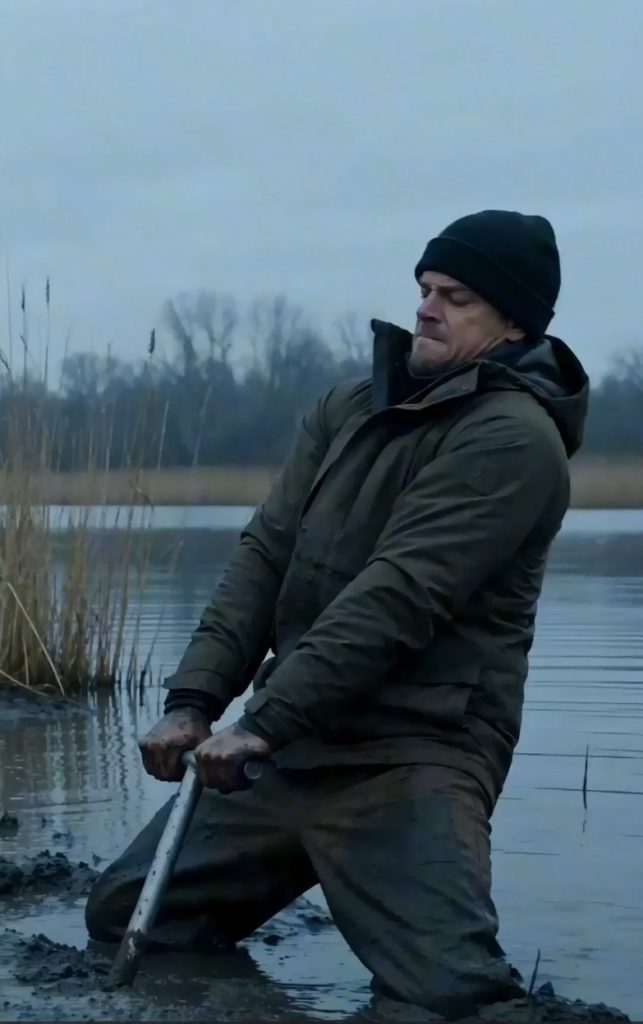
It held the metal rod with a wet, stubborn grip, sucking at Elias Rowe’s boots every time he shifted his weight. Cold water seeped through the knees of his trousers. Rain clung to his black beanie, slid down the lines of his weathered face, and dripped from his jaw into the gray riverbank below.
Still, he pulled.
“Hnngh…”
The sound came out of him low and rough, half grunt, half prayer.
Behind him, the river stretched wide and silent beneath the overcast sky. Bare trees leaned along the far bank like witnesses too tired to speak. Reeds shivered in the wind. The whole place looked abandoned by the world.
That was why Elias had come.
Blackmere River had always hidden things.
Coins. Rusted tools. War buttons. Broken bottles. Once, a silver locket with no photograph inside. Most people saw trash and mud. Elias saw memory.
But this was different.
The hook at the end of his T-handle rod had caught on something deep, something heavy, something that shifted beneath the surface like it had been sleeping there for longer than any man had a right to disturb.
He braced one boot behind him.
The mud swallowed it up to the ankle.
“Come on,” he breathed.
He pulled again.
The rod flexed.
A thick suction sound rose from the muck, slow and obscene, as if the riverbank were opening its mouth.
Elias’s hands slipped on the handle, slick with grime. He tightened his grip until his fingers burned. His shoulders locked. His jaw clenched. He leaned back with everything he had.
“Yah! Hrrgh!”
The mud released with a violent pop.
A dark shape broke the surface.
At first, Elias thought it was a tree root.
Then more of it rose.
Long. Curved. Heavy.
Mud poured from hollow openings in thick ribbons. Water streamed down ridges and into the shallow puddles around his boots. The object turned slightly against the hook, and the gray daylight caught the shape of it.
Two empty sockets.
A long snout.
A row of jagged, ancient-looking edges beneath the muck.
Elias stopped breathing.
The thing in the mud looked like a skull.
Not human. Not livestock. Not anything that belonged to the fields, rivers, or forests of the present world.
It looked older than the river itself.
For a moment, the only sound was wind crossing the bank and mud dripping from the relic into the water below.
Elias stared down at it, both hands still frozen around the rod.
“Oh…” he whispered. “Oh my God.”
His knees almost gave.
Because beneath the slime, just above one hollow eye, he saw a mark carved into the stone-dark surface.
Three short lines crossing a circle.
Elias knew that mark.
He had seen it in his father’s notebooks twenty-seven years ago.
Act II
Everyone in Harrow County knew about Martin Rowe’s obsession.
They talked about it in diners, hardware stores, bait shops, and church parking lots with the kind of pity that always sounded a little too close to mockery.
Poor Martin.
Brilliant man, once.
Then the river got into his head.
Elias had been twelve when his father first took him to Blackmere at low tide. He remembered the cold, the smell of wet reeds, the way his father crouched in the mud with a small brush in his hand, cleaning dirt from a dark shard of bone.
“This river was not always a river,” Martin had said.
Elias, shivering in an oversized coat, had frowned. “What was it?”
His father smiled like he had been waiting years for someone to ask.
“A road,” he said. “A graveyard. A sea floor. A battlefield. Depends how far back you’re willing to look.”
Martin Rowe taught paleontology at a small college until funding dried up and the department decided fossils did not attract enough donors. After that, he taught high school science, repaired bicycles on weekends, and spent every spare hour walking the Blackmere banks.
He believed something rare was buried beneath the river mud.
Not just bones.
A species.
A missing link in the county’s ancient history, a prehistoric predator that should not have been this far inland. He called it the Blackmere skull, though he had only fragments then. A tooth. Part of a jaw. A curved piece of bone with a strange ridge across it.
The experts laughed.
The county museum refused to authenticate the samples.
A wealthy developer named Warren Vale dismissed Martin publicly at a town meeting, calling him “a schoolteacher with mud on his boots and fantasy in his head.”
Everyone laughed that night.
Elias remembered because he had been sitting in the back row.
He also remembered his father standing at the microphone, cheeks red, eyes bright with humiliation, and saying only one thing.
“The river keeps records whether men believe in them or not.”
Two months later, Martin disappeared.
The official story was simple.
He went out alone after a storm, slipped on the bank, and was taken by the river.
His coat was found near the reeds. His truck was parked by the old ferry road. One of his field notebooks lay open on the passenger seat, pages warped by rain.
But Elias never believed it.
Not fully.
His father knew the river too well. He knew where the mud gave way, where the current undercut the bank, where the water looked still but pulled hard beneath the surface.
And one thing had always bothered Elias.
The last page of the notebook had been torn out.
His mother told him to let it go.
Grief had already hollowed her out. Every time Elias asked questions, her face closed like a door. By the time he was eighteen, she had sold the house and moved inland, away from the river, away from the whispers, away from every person who called Martin brilliant before calling him unstable.
Elias stayed.
Not because he was brave.
Because leaving would have felt like helping the river finish what it started.
He became what people expected him to become: the son of the mad fossil man, grown into another muddy fool with a hook, a beanie, and too many maps folded in his pockets.
He worked construction when he could. Repaired docks. Cleared storm damage. Took odd jobs from people who smiled to his face and joked behind his back that he was still chasing Daddy’s monster.
He let them.
Because sometimes the only way to survive humiliation is to turn it into fuel.
Every winter, when the water dropped low and the banks exposed their dark layers, Elias returned to Blackmere. He searched where his father had searched. He marked old finds. He learned the river’s moods until he could feel hidden shelves of stone beneath his boots.
Then, three nights earlier, a storm tore through Harrow County.
The river rose fast.
By morning, half the eastern bank had collapsed.
That was when Elias found the first sign.
A piece of blackened fossil bone jutting from the mud.
And beside it, scratched into a flat stone, three short lines crossing a circle.
His father’s mark.
The same symbol Martin used in his notebooks when he believed a site was too important to trust to memory.
Elias had returned before dawn with rope, a probe rod, and a stubbornness that felt almost inherited.
Now the thing his father had chased for half his life was rising from the mud at his feet.
But as the last clump slid from the skull’s empty socket, Elias saw something that should not have been there.
Metal.
Act III
At first, Elias thought it was part of his hook.
He crouched in the mud, breath shaking, and wiped the relic with the sleeve of his jacket. The skull-like object was larger than he had expected, nearly the length of his arm, dense and dark beneath the layers of silt.
But set inside one hollow opening, wedged deep behind a ridge of stone, was a small rusted cylinder.
Not ancient.
Not fossilized.
Human-made.
Elias’s pulse hammered in his throat.
He dug carefully with two muddy fingers, afraid of damaging the relic, afraid of what he might find, afraid of finding nothing at all. The cylinder resisted, then shifted loose with a gritty scrape.
It was a field canister.
The kind surveyors used decades ago to protect paper from rain.
Elias knew because his father had owned three of them.
One was still in a shoebox under Elias’s bed.
His hands started trembling.
“No,” he whispered.
The canister was sealed with wax, darkened by time and river mud. On the side, barely visible beneath grime, someone had scratched two letters.
M.R.
Elias sat back hard in the mud.
The cold went through him.
For a moment, he was twelve again, standing beside his father in the reeds while Martin laughed and told him the river was a library if you knew how to read mud.
Elias wiped the canister against his jacket and twisted the cap.
It would not open.
He tried again, harder.
The seal cracked.
Inside was a roll of oilskin wrapped around folded pages.
The paper was damp at the edges but intact.
Elias unfolded it with the care of a man handling a heartbeat.
His father’s handwriting stared back at him.
If this reaches anyone, it means I was right.
Elias’s breath left him.
The river wind moved over the pages, threatening to take them. He hunched over, shielding them with his body.
The first page described the skull.
Its size. Its ridges. Its impossible age. Its location under the eastern bank near the old ferry road.
The second page listed names.
Warren Vale.
Harrow Development Authority.
Blackmere Museum Board.
County Survey Office.
Elias read faster, heart pounding harder with every line.
His father had not been dismissed because he was wrong.
He had been silenced because he was right.
The eastern bank, the very stretch of mud where Elias knelt, had once been scheduled for excavation before Vale’s luxury riverfront project. Martin had argued that construction should stop until the site could be studied. He had sent samples to the museum. He had photographed the skull after finding part of it exposed during a previous flood.
Then the samples vanished.
The museum denied receiving them.
The survey maps were altered.
The development permits moved forward.
According to Martin’s notes, Vale’s company planned to dredge the bank and bury whatever was found beneath concrete before anyone with authority could interfere.
The last page was shorter.
The handwriting was rougher, as if written quickly.
I am going back tonight. I marked the skull and sealed these notes inside the cavity. If they take my work, the river may still keep this. Elias, if you ever read this, do not let them make a joke of the truth.
Elias pressed the page to his chest.
He did not cry right away.
The shock was too large for tears.
Then he heard an engine.
He lifted his head.
A black utility vehicle rolled slowly along the old ferry road above the bank.
No logo on the side.
No reason to be there.
It stopped near Elias’s truck.
The driver’s door opened.
And a man in a tan coat stepped out, holding a phone to his ear, staring down at the mud where Elias knelt beside the skull.
Elias recognized him even after all these years.
Warren Vale was older now.
But his smile had not changed.
Act IV
“Elias Rowe,” Vale called from the bank. “You look exactly like your father.”
Elias folded the papers fast and shoved them inside his jacket.
The skull lay half-exposed in the mud between them, too large to hide, too important to abandon.
Vale began descending the slope with the careful confidence of a man who believed every place belonged to him if he arrived expensive enough. His boots sank into the mud, and irritation flashed across his face.
Two younger men followed him.
Not workers.
Not archaeologists.
Security.
Elias stood slowly, gripping the metal rod in one hand.
“What are you doing here?”
Vale smiled.
“I could ask you the same thing.”
“This is public riverbank.”
“Public things still require permits when one starts removing material of potential scientific value.”
Elias almost laughed.
The sound came out bitter.
“Now you care about scientific value?”
Vale’s eyes moved to the skull.
For one second, his expression slipped.
Not much.
But enough.
Fear.
Then calculation.
“My God,” Vale said softly. “He really found it.”
The words confirmed everything.
Elias’s fingers tightened around the rod.
“You knew.”
Vale looked back at him.
“Your father was a passionate man. Passion makes people careless.”
The wind seemed to stop.
Elias stepped forward.
“What happened to him?”
One of the security men shifted.
Vale lifted a hand to stop him.
“No one harmed your father,” Vale said. “He went where he shouldn’t have gone, in weather no sensible man would enter. Men like Martin write their own tragedies.”
Elias stared at him.
The answer was polished, practiced, and empty.
A rich man’s version of a locked door.
“Move away from the object,” Vale said.
“No.”
Vale sighed.
“Elias, think carefully. You have no credentials. No preservation equipment. No legal claim. If you damage that specimen, whatever it is, you will be remembered as the man who destroyed the very discovery his father chased.”
The cruelty of it was almost elegant.
Use the truth as a weapon.
Make him afraid of his own hands.
For a moment, Elias looked down at the skull. Mud still clung to its hollow sockets. Water dripped steadily from its long snout. It looked less like a monster now than a witness dragged into daylight after waiting a lifetime.
His father had hidden the notes inside it.
His father had trusted the river.
And somehow, impossibly, the river had delivered them to his son.
Elias reached into his jacket.
Vale’s eyes sharpened.
But Elias did not pull out a weapon.
He pulled out his phone.
The screen was cracked. Mud streaked the case. The signal was weak but alive.
“You’re being recorded,” Elias said.
Vale’s face hardened.
Elias raised the phone higher.
“And livestreamed.”
That was a lie.
At first.
But then, from the top of the bank, another voice called out.
“He’s not lying.”
A woman stood beside Elias’s truck with a camera raised to her face.
Dr. Naomi Price.
Harrow University’s last remaining geologist, and the only academic in the county who had never mocked Martin Rowe’s work. Elias had sent her one message at dawn with a blurry photo of the exposed bone.
Found something. My father’s mark. Blackmere east bank. Come fast.
She had come.
Behind her were two students, a county ranger, and a local reporter Elias vaguely recognized from flood coverage.
Vale looked up at them.
For the first time, he did not seem in control of the room.
Because there was no room.
Only mud, gray sky, cold river air, and the truth lying between them like a skull with open eyes.
Dr. Price climbed down the bank slowly, never taking her gaze off the relic.
When she reached it, she crouched and forgot to breathe.
“Elias,” she whispered. “Do you know what this is?”
His throat tightened.
“My father did.”
She looked up at him then, and something in her expression softened.
“Then your father may have found one of the most important inland fossil specimens in the region.”
The reporter’s camera clicked.
Vale turned sharply.
“No photographs until provenance is established.”
Dr. Price stood.
“Provenance?” she repeated. “The man’s father documented the site nearly three decades ago.”
Vale’s smile returned, thinner now.
“Allegedly.”
Elias took out the oilskin pages.
The wind tugged at them, but this time he did not hide them.
“Not allegedly,” he said.
And he handed his father’s final words to Dr. Price.
Act V
By sunset, the riverbank was no longer empty.
Floodlights stood on the old ferry road. Tarps shielded the skull from the worst of the wind. Dr. Price’s team worked carefully around the site, photographing every angle, mapping the mud layers, speaking in low voices that carried both urgency and awe.
No one called it treasure anymore.
Treasure was too small a word.
Treasure belonged to coins and gold and things men wanted to own.
This was evidence.
Of ancient life.
Of buried history.
Of a dead man’s reputation waiting beneath mud for nearly thirty years.
Elias stood apart from the activity, his hands wrapped around a paper cup of coffee someone had given him. He had not taken more than one sip. Mud had dried on his jacket, his trousers, his face. His shoulders ached from the pull, but he barely felt it.
He watched Dr. Price place his father’s notes into a protective sleeve.
For most of his life, Elias had imagined vindication as something loud.
An apology shouted across a town hall. Warren Vale exposed in front of cameras. Museum officials forced to admit they had laughed because it was easier than listening.
But the real thing was quieter.
It was Dr. Price touching Martin Rowe’s handwriting like it mattered.
It was a student whispering, “He was right,” without knowing Elias could hear.
It was the reporter asking how to spell Martin’s name.
Not “local eccentric.”
Not “amateur fossil hunter.”
Martin Rowe.
Science teacher. Field researcher. The man who found Blackmere first.
Warren Vale left before dark with two officers from the county ranger’s office asking him questions he clearly did not enjoy. He was not dragged away. There was no dramatic arrest in the mud.
Men like him rarely fell all at once.
But the first crack had opened.
The museum records would be reviewed. The old permits would be pulled. The altered survey maps would be compared against Martin’s notes. People who had spent decades benefiting from silence would soon learn how heavy paper could become when truth was written on it.
Dr. Price found Elias near the waterline.
“You should go home,” she said gently. “You’re freezing.”
Elias looked at the river.
For years, he had hated it.
He had blamed it for swallowing his father, for keeping its secrets, for reflecting the same gray sky year after year while his family broke around an unanswered question.
Now he did not know what he felt.
“It kept him,” Elias said.
Dr. Price followed his gaze.
“Yes,” she said. “In a way, it did.”
Elias reached into his jacket and took out the final page of his father’s note. Dr. Price had made a copy and returned the original to him, sealed in a clear sleeve.
He read the last line again.
Elias, if you ever read this, do not let them make a joke of the truth.
The words blurred.
This time, the tears came.
Not loud. Not dramatic. Just a quiet breaking in the cold, with the river moving softly behind him and the ancient skull resting under lights nearby.
Dr. Price stepped away to give him privacy.
Elias folded over the note, one muddy hand pressed against his mouth, and cried for the father he had lost, the boy who had not been believed, and the man he had become by refusing to leave the river alone.
A week later, the story reached every major paper in the state.
The Blackmere skull was described as a once-in-a-generation fossil discovery. Martin Rowe’s old field notes were authenticated. His photographs, long denied by the museum, were found in a mislabeled archive box after an internal review that no one at the museum seemed eager to explain.
Warren Vale’s riverfront project was suspended indefinitely.
At the high school where Martin once taught, the science wing was renamed in his honor.
Elias attended the ceremony in the same dark green jacket, cleaned as best as it could be, though one streak of river mud remained near the cuff. He had meant to scrub it out.
Then he decided not to.
The auditorium was full.
People who had mocked his father now spoke of him carefully, as if respect could be retroactively applied if one used the right tone. Elias listened without smiling. Some apologies arrived too late to warm anything, but they still had to be heard.
When his turn came, he walked to the microphone.
For a moment, he saw his father standing in the back of the room in an old raincoat, mud on his boots, eyes bright with impossible certainty.
Elias unfolded one page.
“My father once told me the river keeps records whether men believe in them or not,” he said.
The room went still.
“He was laughed at for that. Dismissed for it. Punished for refusing to trade truth for comfort.”
His voice tightened, but he did not stop.
“I spent most of my life thinking I was searching for proof that he was right. But I understand now that I was also searching for permission to stop being ashamed of believing him.”
He looked out at the crowd.
No one laughed.
No one whispered.
“So let this wing carry his name,” Elias said. “Not because he found something ancient, but because he taught us that truth can be buried, mocked, denied, and forgotten by almost everyone.”
He paused.
“But not destroyed.”
Months later, Elias returned to Blackmere alone.
The bank had been marked and protected now. The skull had been moved to a university lab, where experts cleaned it grain by grain. Its hollow eyes no longer stared from the mud, but Elias could still see the place where it had emerged.
The reeds whispered in the wind.
The river moved quietly under the gray sky.
Elias crouched at the water’s edge and placed his palm against the cold mud.
For the first time in twenty-seven years, the riverbank did not feel like a grave.
It felt like an answer.
And somewhere beneath the dark water, beneath the silt and stone and sleeping records of the earth, Elias imagined his father smiling.
The river had kept its secret.
Then, when the world was finally ready to listen, it had given it back.