Act I
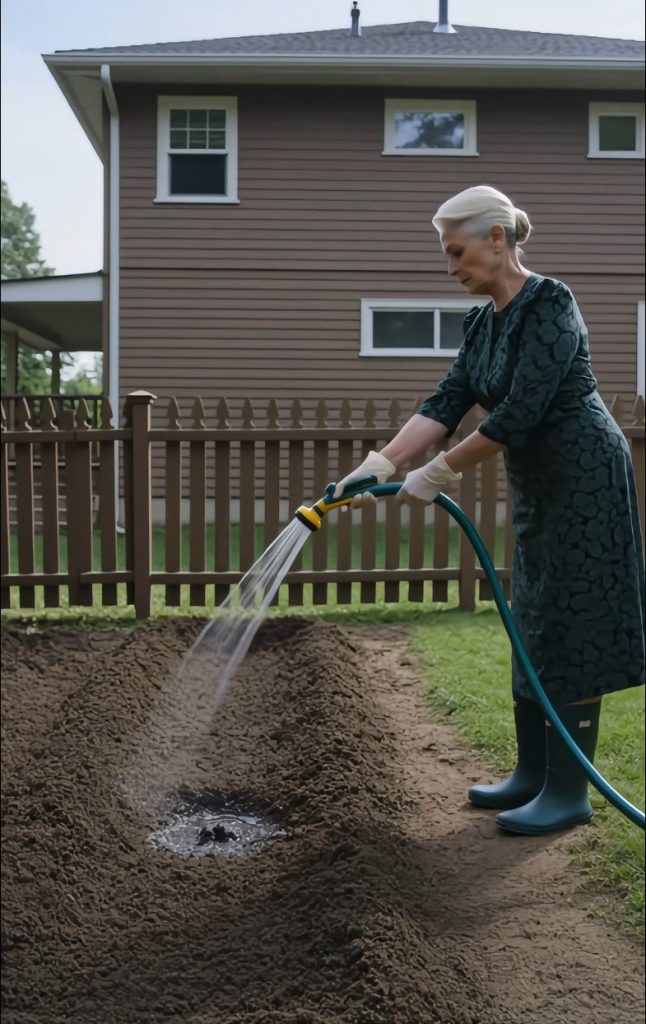
Every afternoon at 4:17, Mrs. Eleanor Whitcomb watered the same patch of dirt.
Not the whole garden.
Not the rose bushes along the fence.
Not the neat row of empty wooden stakes waiting for tomatoes.
Only one dark, muddy circle near the center of the freshly tilled bed.
She stood there in her green dress with pink roses printed across the fabric, white gloves wrapped around the yellow nozzle of the hose, and rubber boots planted in the soft earth like she was guarding a secret.
The water hissed steadily.
The soil darkened.
And behind the fence, five neighbors watched.
They had been watching for six days.
At first, they made jokes about it. Eleanor was old. Widows had routines. Maybe she forgot she had already watered it. Maybe she was trying to drown weeds before they could grow.
But by the third day, the jokes changed into whispers.
By the fifth, someone said the word suspicious.
By the sixth, they were gathered shoulder to shoulder behind the weathered picket fence, peering over the top boards like jurors waiting for a confession.
“Why does she water that exact spot every single day?” Linda Holloway whispered.
No one answered.
Eleanor heard her.
She did not turn around right away.
She kept the stream steady, letting the water fall in a silver arc onto the black center of the bed. Tiny puddles gathered, shivering under the gray afternoon sky.
Then, slowly, Eleanor looked over her shoulder.
Her face was calm.
Too calm, Linda thought.
The old woman’s white hair was pinned into a careful bun. Her mouth was set in a line that revealed nothing. She looked at the neighbors not with surprise, but with the quiet exhaustion of someone who had expected cruelty to arrive eventually and was only disappointed it had come so quickly.
Linda straightened, pretending she had not been leaning.
Beside her, Gary Shaw folded his arms. “Afternoon, Eleanor.”
Eleanor looked at him.
Then at Linda.
Then at the others.
She said nothing.
The hose kept running.
That silence made them bold.
“You know,” Linda called, her voice sweeter now that she had an audience, “people are starting to wonder what you’re doing back there.”
Eleanor turned back to the soil.
“I’m watering my garden.”
Gary snorted. “That’s not a garden. That’s one hole.”
The others laughed softly.
Eleanor’s gloved hand tightened around the nozzle.
The spray lowered, gentler now, almost tender.
From the fence, all they could see was mud.
Dark, soaked, secretive mud.
But Eleanor saw something else.
She saw the smallest disturbance at the center of it.
A green point, no taller than a fingernail, pushing its way into the world.
And she knew that if the neighbors understood what it was, they would not laugh.
They would want to own the story.
Or worse, destroy it.
So Eleanor stood between them and the mud, guarding the only thing in that yard that still knew how to live.
Act II
Before the garden became a mystery, it had been a marriage.
Eleanor and Henry Whitcomb bought the brown-sided house in 1978, back when the neighborhood was all young trees, chain-link fences, and families who borrowed sugar without texting first.
Henry built the picket fence himself.
Badly.
The posts leaned by the second winter, and Eleanor teased him about it for forty years. He always said the fence had character. She always said character was what men called mistakes when they didn’t want to fix them.
But the garden was never a mistake.
That garden fed them through layoffs, recessions, illnesses, and the terrible summer when their son Daniel came home from the hospital thinner than his own shadow. Tomatoes, squash, beans, carrots, herbs, strawberries near the back step. Henry grew everything with the patience of a man who believed soil told the truth if you listened long enough.
Eleanor did the watering.
Every afternoon, same time.
Henry said plants appreciated punctuality.
Eleanor said plants appreciated water and did not own watches.
They were happy in the ordinary way people fail to appreciate until ordinary disappears.
Daniel was their only child.
A bright, serious boy who collected leaves between book pages and once cried because Henry cut down a dead lilac bush without giving him time to say goodbye. He grew into a quiet young man with his father’s hands and his mother’s stubbornness.
He studied forestry.
He moved west.
He sent postcards from mountains and national parks, each one covered in careful handwriting and pressed leaves taped to the back.
Then, at twenty-seven, he was gone.
A hiking accident, the ranger told them.
A sudden storm.
A trail washed out.
No long goodbye. No final conversation. Just a phone call that split Eleanor’s life into before and after.
Henry stopped planting for almost a year.
Then one spring, he carried a small paper envelope into the yard and stood in the garden with tears in his eyes.
Inside were seeds.
Daniel had mailed them two weeks before he died, from a grove of old American chestnut hybrids he had been helping restore. His note was still folded in the envelope.
Dad, plant one for me. If it takes, I want to come home as shade.
Henry planted three seeds.
None survived.
He planted two more.
Nothing.
For years, he tried.
The winters were wrong. The soil was too wet. The squirrels found them. The seedlings weakened. Each failure hurt quietly, but Henry never threw the envelope away.
When he died the previous winter, Eleanor found it in the top drawer of his workbench.
One seed remained.
Beside it was a note in Henry’s handwriting.
Ellie, if you find this, don’t let them tell you it’s too late.
That was why she tore up the old garden bed herself in March, even though her knees burned and her hands cramped inside the gloves.
That was why she knelt in the cold soil and planted the final seed.
That was why every afternoon, at 4:17, she stood with the hose and watered the same exact spot.
It was not habit.
It was not madness.
It was Henry’s last request.
Daniel’s last gift.
And the only living bridge between every version of Eleanor’s life that grief had not managed to take.
But to the neighbors behind the fence, it looked like something else.
Because suspicion is easier than tenderness.
And people who cannot understand devotion often rename it danger.
Act III
The first complaint came the next morning.
Eleanor found the notice taped to her front door, protected from the drizzle inside a plastic sleeve.
Neighborhood Residential Association
Informal Property Concern
Unusual Yard Disturbance
She read it twice.
Then once more, slower.
The letter said multiple residents had observed “repeated, concentrated watering of a dug area” and expressed concern about drainage, odor, and possible unauthorized burial of organic matter.
Eleanor laughed once.
Not because it was funny.
Because if she did not laugh, something inside her would break.
Unauthorized burial.
As if grief needed a permit.
As if a seed could be charged with trespassing.
She folded the letter and put it on the kitchen table beside Henry’s old mug. The house was quiet around her. Too quiet. The kind of quiet that presses against the walls after the last person who shared your memories is gone.
At 4:17, she went outside anyway.
The neighbors were already waiting.
Linda stood at the fence with Gary, the Peterson brothers, and a woman named Marcy who had moved in only three months earlier but spoke about the neighborhood like she had invented it.
Eleanor turned on the hose.
Linda cleared her throat. “We don’t want trouble, Eleanor.”
“Then stop looking for it.”
Gary frowned. “People have a right to know what’s happening next door.”
Eleanor aimed the water at the muddy patch. “Not everything next door belongs to you.”
That shut them up for three seconds.
Then Marcy said, “My children play near this fence.”
Eleanor looked at the empty yard behind them. Marcy had no children.
No one corrected her.
That was how small mobs work.
They borrow fear from whoever offers it first.
The water struck the soil, soft and steady. Eleanor noticed the tiny green point had risen higher overnight. Two folded leaves pressed together like hands in prayer.
Her chest tightened.
She wanted to smile.
She did not dare.
Linda saw the flicker in her face.
“What’s in there?” she asked.
Eleanor said nothing.
Gary leaned forward. “If it’s nothing, you won’t mind if someone checks.”
The hose lowered.
For the first time, Eleanor turned fully toward them.
“You will not put one foot in my garden.”
Gary’s eyebrows rose. He had expected embarrassment, maybe confusion, maybe the trembling defensiveness of an old woman caught doing something strange.
He had not expected iron.
Linda’s mouth tightened. “You don’t have to be hostile.”
“I am not hostile,” Eleanor said. “I am clear.”
Behind them, a car door shut.
A man in a navy rain jacket walked up the driveway carrying a clipboard. He was young, maybe thirty, with official shoes and the tired expression of someone paid to turn neighborly malice into procedure.
“Mrs. Whitcomb?” he called.
The neighbors straightened.
Eleanor turned slowly.
“Yes.”
“I’m Aaron Pike, with the residential association. We received a complaint.”
“Only one?”
His eyes flicked toward the fence.
He understood more than he wanted to.
“I’m required to inspect the reported area.”
Eleanor’s heart began to pound.
The tiny sprout stood in the wet soil behind her, fragile enough that one careless shoe could erase everything.
Aaron took a step toward the garden.
Eleanor moved in front of him.
“No,” she said.
The neighbors leaned closer.
The whole backyard seemed to shrink around that one word.
Act IV
Aaron Pike did not want to be there.
That became obvious the longer he stood in the yard with his clipboard dampening in the mist. He looked at the garden, then at Eleanor, then at the fence full of faces pretending not to enjoy the scene.
“Mrs. Whitcomb,” he said carefully, “I’m not here to upset you.”
“You are standing in my yard because five adults had nothing better to do than gossip about mud.”
Behind the fence, Gary muttered, “That’s not fair.”
Eleanor did not look at him. “It is precise.”
Aaron pressed his lips together, fighting something that might have been a smile.
Then Linda spoke.
“She’s been acting strange since Henry died.”
That did it.
The air changed.
Eleanor turned her head, slowly.
Linda seemed to realize she had stepped onto sacred ground, but pride pushed her forward.
“We’re concerned,” she added quickly. “For her. For the property. For the neighborhood.”
Eleanor’s voice stayed quiet.
“Do not use my husband’s name to decorate your cruelty.”
No one laughed then.
Aaron lowered his clipboard.
“Mrs. Whitcomb,” he said, softer now. “Can you tell me what you’re growing?”
Eleanor’s first instinct was no.
No, because the seed was private.
No, because Daniel’s handwriting was not neighborhood business.
No, because Henry’s last note belonged to her and the kitchen table and the silence after midnight, not to Linda Holloway’s hungry eyes over a fence.
But the sprout trembled under the light fall of water.
And Eleanor suddenly understood that hiding it had made it vulnerable in a different way.
Secrets are safe only until other people decide they are weapons.
She turned off the hose.
The yard fell into a deep, startling quiet.
Even the birds seemed to pause.
Eleanor stepped carefully into the garden bed, boots sinking slightly into the dark earth. She bent with effort, one hand on her knee, and brushed a bit of wet soil away from the center.
“There,” she said.
Aaron followed her gaze.
So did the neighbors.
At first, no one spoke.
The thing they had feared, mocked, reported, and judged was barely visible.
A sprout.
One tiny green sprout standing upright in the mud, delicate and absurdly brave.
Linda blinked. “That’s it?”
Eleanor stood slowly.
“No,” she said. “That is not it.”
She walked to the back steps and picked up a small tin box she had left beneath the covered porch. Her hands shook as she opened it, but she did not hide them.
Inside were two notes and a faded postcard.
She handed the first note to Aaron.
He read it silently.
His face changed.
Then he read the postcard.
Daniel’s last message.
Dad, plant one for me. If it takes, I want to come home as shade.
Aaron swallowed.
The fence grew very still.
Eleanor looked at Linda now. At Gary. At Marcy. At all of them.
“My son mailed those seeds before he died,” she said. “My husband spent years trying to grow one. He failed every time, and every spring he tried again.”
Her voice caught, but she held it.
“When Henry died, I found one seed left. One. So I planted it.”
Linda’s face had gone pale.
Eleanor looked back at the sprout.
“I water that exact spot every day because it is alive. Because after burying my son and my husband, I wanted one thing in this yard that was not a grave.”
No one moved.
The words settled over the garden, heavier than rain.
Aaron closed the tin box gently and handed it back to her.
“There will be no inspection,” he said.
Gary looked down.
Marcy folded her arms, then unfolded them, suddenly unsure what to do with her hands.
Linda’s eyes shone, but Eleanor did not need her tears. Not yet.
Apologies made too quickly are often only discomfort looking for an exit.
Eleanor picked up the hose again.
The spray returned, soft and careful.
The neighbors watched the water fall around the sprout.
This time, none of them whispered.
Act V
The next afternoon, Eleanor came outside at 4:17 and found the fence empty.
For a moment, she stood very still.
Then she saw the small paper bag resting on the garden gate.
Inside was a packet of plant markers, a pair of new gardening gloves, and a note written in Linda Holloway’s neat, nervous handwriting.
I am sorry. I should have asked kindly or stayed quiet. I would like to help protect it, if you will allow me.
Eleanor read it once.
Then she placed it on the porch rail.
She did not forgive Linda immediately.
Forgiveness, in Eleanor’s experience, was like gardening. People liked to talk about blooms, but most of the work happened unseen, underground, in dark places where roots either took or did not.
Still, she kept the gloves.
A week later, Aaron Pike returned without a clipboard.
He brought a small wire guard to protect the sprout from rabbits and careless feet. He installed it himself, kneeling in the soil while Eleanor stood nearby pretending not to supervise.
“Too close,” she said.
He adjusted it.
“Still crooked.”
He adjusted it again.
She nodded once. “Better.”
He smiled.
By the end of the month, the neighbors had stopped calling it “that spot.”
They called it Daniel’s tree.
Linda asked permission before stepping into the yard. Gary repaired the leaning fence post Henry had refused to fix for decades. Marcy, who did not have children but did have loneliness she had disguised as judgment, began bringing Eleanor muffins on Thursdays.
Some were terrible.
Eleanor ate them anyway.
Spring warmed slowly.
The tiny sprout unfolded into leaves, then more leaves, each one a green insistence that the past did not have to end where sorrow left it. Eleanor kept watering at 4:17, but now she watered the whole bed too. Tomatoes returned. Basil. Marigolds along the edges because Henry had believed they discouraged pests, though Eleanor suspected he mostly liked the color.
One evening in early summer, Linda stopped by while Eleanor was kneeling beside the young chestnut sapling.
“I found something,” Linda said.
Eleanor looked up.
Linda held out an old photograph.
It had been taken years before, at a neighborhood picnic. Henry stood near the garden fence in a straw hat, one hand on Daniel’s shoulder. Daniel could not have been more than twelve. Eleanor stood beside them laughing at something outside the frame.
The three of them looked sunlit.
Careless.
Whole.
“I almost threw it away,” Linda said. “I’m glad I didn’t.”
Eleanor took the photograph.
For a moment, the yard blurred.
Then she pressed the picture to her chest.
“Thank you,” she whispered.
Linda nodded, crying openly now.
This time, Eleanor allowed it.
Not because tears fixed anything.
Because sometimes they meant a person had finally stopped watching from the fence and stepped into the truth.
Years would pass before the sapling became shade.
Eleanor knew she might not live to sit beneath it.
That thought no longer frightened her the way it once had.
Henry had planted for futures he could not guarantee. Daniel had mailed seeds from a forest he would never see restored. Love, she was learning, had always been an act of faith performed by people who might not get to witness the result.
So she made arrangements.
Not with the residential association.
With Aaron, who promised the tree would be protected.
With Linda, who promised to water it if Eleanor ever could not.
With the neighborhood children, who were finally real after new families moved in, and who learned that the small fenced sapling was not to be kicked, climbed, snapped, or used as a sword-fighting post.
One little boy asked her why the tree mattered so much.
Eleanor considered giving him the simple answer.
It was my son’s.
It was my husband’s.
It is mine.
Instead, she looked at the bright young leaves trembling in the breeze.
“Because someone loved it before it was big enough to prove it deserved loving,” she said.
The boy seemed to think about that very seriously.
Then he nodded, as if this made perfect sense.
That autumn, Eleanor placed Henry’s old garden chair near the bed. She sat there in a sweater, the tin box on her lap, watching yellow leaves drift from the older trees beyond the fence.
The chestnut sapling was still small.
Still fragile.
But alive.
The same neighbors who had once leaned over the fence to accuse her now waved from the sidewalk. Some looked embarrassed when they passed. Some looked grateful. Eleanor accepted both. Shame could become useful if it taught people to become gentle.
At 4:17, she stood and took up the hose.
The water flowed in a soft arc, catching the pale afternoon light before falling around the roots.
She thought of Henry’s hands.
Daniel’s postcards.
The final seed.
The mud everyone mistook for a secret.
Perhaps it had been a secret after all.
Not the dark kind people wanted.
The sacred kind.
The kind that waits beneath ordinary soil, asking only for patience, protection, and someone stubborn enough to keep showing up.
Eleanor lowered the hose.
At the center of the garden, the little tree stood bright against the dark earth.
She smiled then, small and private.
Behind her, the fence no longer felt like a wall.
And in the soft sound of water touching soil, Eleanor could almost hear Henry laughing, Daniel calling from the yard, and life answering them both in green.