Act I
The rope was too big for his shoulders.
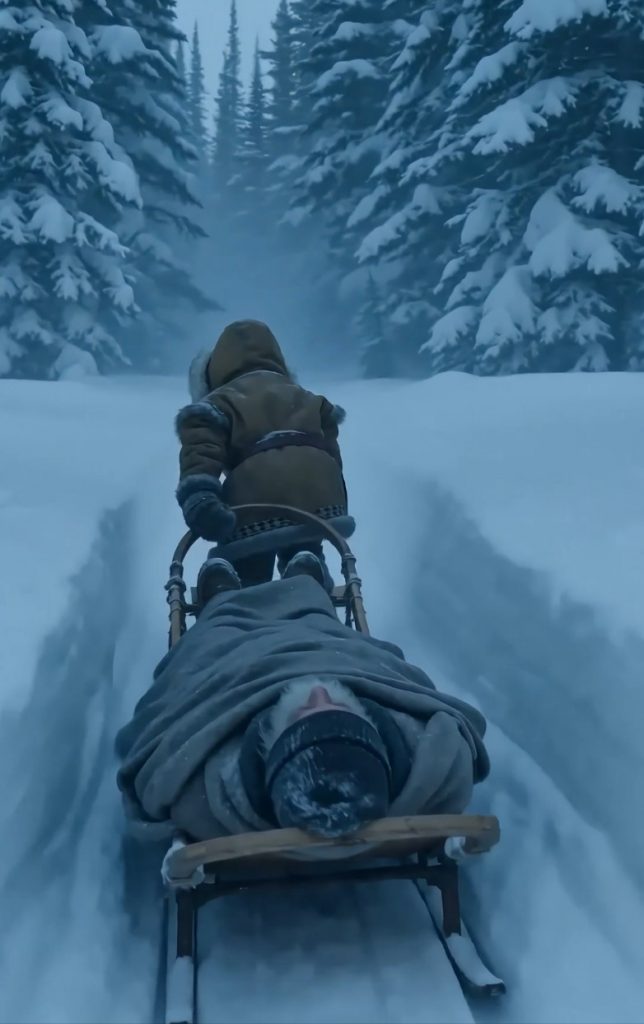
It crossed Owen Mercer’s small chest like it belonged on a grown man, biting into his brown parka every time he leaned forward. His boots sank deep into the snow. His breath came in sharp white bursts. His cheeks were red from the cold, and snowflakes clung to his lashes until blinking hurt.
Behind him, the wooden sled scraped over the frozen trail.
On it lay his grandfather, wrapped in a gray wool blanket, beard frosted white, eyes closed beneath a dark knit cap.
“Grandpa,” Owen shouted into the storm.
The wind tore the word apart.
The old man did not answer.
Owen pulled harder.
The pine trees rose on both sides like black walls, their branches heavy with snow. The path ahead had nearly vanished. Every step filled behind him as if the forest wanted to erase proof that anyone had passed through at all.
The sled hit a buried root and jolted.
His grandfather moaned.
Owen twisted in the harness, panic flashing across his face. “Grandpa!”
Arthur Mercer’s eyes opened just a little. They were glassy, unfocused, already drifting somewhere far away from the boy fighting the storm in front of him.
Owen stumbled back to him, still tangled in the rope.
“Wake up right now!” he cried. “You promised you’d stay awake!”
Arthur’s lips moved, but no sound came out.
Owen grabbed the blanket and tucked it tighter around his grandfather’s shoulders with mittened hands. He had watched Arthur do it for injured hikers a hundred times. Keep them covered. Keep them talking. Keep moving unless shelter is closer than help.
But Owen was nine.
He was nine years old, and the man who knew the forest better than anyone was lying on a sled, barely breathing.
The wind screamed through the pines.
Somewhere under the blanket, Arthur’s hand remained closed in a fist.
Owen noticed it again.
Even unconscious, his grandfather would not let go of the folded yellow paper he had nearly died retrieving.
The paper everyone said did not exist.
Act II
Arthur Mercer had raised Owen on rules.
Not school rules or table manners, though he cared about those too. Forest rules.
Never step on ice you haven’t tested. Never ignore birds going quiet. Never trust a trail just because it used to be there. And if snow starts falling sideways, find shelter before pride turns you into a story people tell later.
Owen knew them all.
He knew how to read moss, how to split kindling, how to listen for water under snow. He knew the whistle signals Arthur kept on a hook by the door. Three blasts for help. Two for location. One for answer me, you stubborn old goat.
That last one was not official.
His mother had invented it.
Before the sickness took her, Clara Mercer used to say Arthur had been born half pine tree. Strong, stubborn, rooted too deep to move. After Owen’s father died overseas, she brought her son back to the old ranger cabin where she had grown up, and Arthur took them both in without one question.
For three years, the cabin was home.
Then Clara died, and adults with folders began speaking about Owen like he was a box that needed the correct address.
Arthur was too old, they said.
The cabin was too remote.
The winters were too dangerous.
Owen needed stability.
That word followed him everywhere.
Stability.
It came from caseworkers, lawyers, teachers, even his uncle Martin, who arrived after Clara’s funeral wearing a black coat and a soft voice Owen did not trust.
Martin was Clara’s older half brother. He lived in the city, had a clean house, a quiet wife, and no children. He told everyone he wanted what was best for Owen.
But Owen had seen him in Arthur’s study, opening drawers.
He had heard him on the phone saying, “Once the old man is declared unfit, the land can be sold.”
The land.
That was what Martin wanted.
Two hundred acres of old pine forest, the ranger cabin, the creek, the ridge where Clara’s ashes had been scattered at sunrise.
Arthur fought him.
He went to court in a pressed flannel shirt, hands shaking only slightly, and said Clara had left instructions. She wanted Owen with him. She had written it down before her final surgery.
But the document was missing.
Martin said grief had confused Arthur.
The judge delayed the decision once.
Then twice.
The third hearing was set for Monday morning.
If Arthur could not produce the paper by then, Owen would be taken to the city with Martin while the court “reviewed permanent options.”
On Saturday night, Arthur remembered the fire tower.
It came to him suddenly as he stared at Clara’s old map above the kitchen table.
“She hid copies,” he whispered.
Owen looked up from his homework.
Arthur’s face had gone pale. “Your mother hated filing cabinets. She kept important things where no one sensible would look.”
The old North Ridge fire tower had been closed for years, but Clara had used it as a writing place when she was young. Arthur found the key in a coffee tin behind the stove, exactly where she used to hide spare change.
They left before dawn Sunday.
Just a quick trip, Arthur said.
Up the trail by snowmobile, retrieve the lockbox, back before the storm line hit.
But storms do not care about promises.
By noon, the wind shifted.
By one, the snowmobile died two miles from the cabin.
By two, Arthur had found the lockbox in the fire tower, opened it with frozen fingers, and taken out Clara’s signed guardianship letter.
By three, he collapsed beside the trail.
Owen remembered the emergency sled strapped to the tower wall.
Arthur had shown him once.
“For supplies,” he had said. “Or people, if the forest gets mean.”
Now the forest had gotten mean.
And Owen was pulling the only family he had left through it.
Act III
At first, Owen thought the cabin was close.
Everything looked close in a storm until it wasn’t.
The pines repeated themselves. The trail markers vanished under ice. Wind drove snow into his face so hard he had to look down at his boots and trust the memory of the path more than his eyes.
Arthur had taught him that too.
“When you can’t see far, see small,” he used to say. “One safe step. Then another.”
So Owen took one step.
Then another.
The sled scraped behind him with a sound that made his teeth hurt.
“Grandpa,” he called again. “Tell me something.”
Arthur’s eyes fluttered.
“Owen?”
“I’m here.”
“Leave the sled.”
Owen stopped.
“No.”
“Too heavy.”
“No.”
“Go to the cabin. Bring help.”
Owen’s face twisted with anger and fear. “You said Mercers don’t leave people in snow.”
Arthur tried to breathe deeply and failed.
“Owen…”
“No,” the boy said, louder this time. “You don’t get to teach me all the rules and then break them.”
The old man’s mouth moved into the faintest shadow of a smile.
Then his eyes closed again.
Owen screamed his name until his throat burned.
Nothing.
He wanted to sit down beside him.
Just for a minute.
Just long enough to cry.
But another rule rose in his mind, sharp as Arthur’s voice.
Snow makes tired people lie.
Lie down, and the forest keeps you.
Owen turned forward again.
The rope pulled tight.
His knees shook. His boots slid. His whole body leaned into the harness, too small against the weight of the sled and the storm and the folded paper in Arthur’s fist.
Then he saw something blue through the trees.
A trail marker.
Not the main trail.
The rescue trail.
Owen’s heart jumped.
Arthur had painted those marks years ago, blue stripes on pine trunks leading toward the old ranger supply hut. The hut had a stove, dry matches, and an emergency radio if the batteries had not died.
The cabin was farther.
The hut was possible.
Owen turned the sled.
The new path was worse.
Narrower. Steeper. Buried under drifts. Twice the sled tipped, and Owen had to throw his whole body against it to keep Arthur from sliding into the snow. Once, he lost a mitten and had to dig for it with fingers already going numb.
Still, he followed the blue marks.
One safe step.
Then another.
Behind him, Arthur’s fist finally opened.
The yellow paper slipped from his hand and blew across the snow.
Owen saw it.
He lunged.
The harness yanked him back, dropping him to his knees. The paper skittered toward a drift, tumbling end over end in the wind.
“No!”
He clawed forward, dragging the sled with him, one mitten stretched out until his fingertips caught the edge.
He grabbed it and shoved it inside his coat.
For one second, he stayed on his knees, sobbing into the storm.
Not because of the cold.
Because he understood now.
His grandfather had not gone into the blizzard for land.
He had gone because that paper was the last sentence Owen’s mother had left behind.
And Arthur had been willing to die before letting anyone erase it.
Act IV
The ranger hut appeared like a ghost.
Low roof. Snow-buried steps. One small window crusted white with ice.
Owen almost missed it.
Scout, the old carved wooden bear beside the door, was covered to the ears in snow. Arthur had carved it when Clara was little, and Owen had always thought it looked friendly.
Now it looked like a miracle.
He dragged the sled the last twenty feet and collapsed against the door.
It did not open.
Snow had packed hard around the bottom.
Owen kicked it. Then shoved it. Then threw his shoulder into the wood with a cry so raw it frightened him.
The door gave an inch.
Then another.
He squeezed inside, grabbed the shovel from the wall, and dug until he could pull the sled through the doorway.
Arthur’s breathing was quieter now.
Too quiet.
Owen found the emergency blankets first. Then the matches. His hands shook so badly he broke two before the third caught. The little stove coughed, smoked, then finally accepted the flame.
Heat began as an idea.
Then a promise.
Owen wrapped Arthur in the silver emergency blanket and fed twigs into the stove the way he had been taught. He wanted to call out, to celebrate, to tell his grandfather they had made it.
But Arthur did not wake.
The radio sat on the shelf beside a dusty first-aid kit.
Owen turned the knob.
Static.
He turned it again.
Nothing.
His chest tightened.
“Come on,” he whispered. “Please.”
A burst of sound cracked through the speaker.
Then static again.
Owen grabbed the microphone.
“This is Owen Mercer,” he said, voice shaking. “I’m at the North Ridge ranger hut. My grandpa is sick. Please help us.”
Only static answered.
He pressed the button again.
“My grandpa is Arthur Mercer. He was a ranger. He needs help. Please.”
A voice came through, broken and distant.
“Repeat… location…”
Owen nearly dropped the mic.
“North Ridge ranger hut!” he shouted. “Blue trail! Near the old fire tower!”
Static.
Then the voice again.
“Stay… shelter… help coming…”
Owen started crying so hard he could barely answer.
“Okay.”
Outside, the storm howled around the hut.
Inside, the stove glowed.
Owen crawled beside the sled and took Arthur’s hand. It was cold, but not gone.
“You hear that?” he whispered. “Help’s coming. So you have to stay.”
Arthur did not open his eyes.
Owen pulled the yellow paper from his coat and unfolded it near the stove’s light.
His mother’s handwriting filled the page.
If I cannot raise Owen, I want him with my father, Arthur Mercer. He is home to me, and he will be home to my son.
Owen read it again.
Then again.
He pressed it to his chest and looked at his grandfather.
“You were right,” he said. “Mom did say.”
Lights flashed outside the window.
Not firelight.
Red.
Blue.
Moving through the snow.
Owen stood too fast and nearly fell.
He opened the door just as rescuers reached the hut, faces wrapped in scarves, headlamps cutting through the storm. At the front was a woman in a state rescue jacket, breathing hard, eyes wide when she saw the boy.
“Owen?”
He nodded.
Then he pointed behind him.
“My grandpa kept the paper safe,” he said.
The rescuer looked past him to Arthur on the sled.
Her voice softened.
“No, sweetheart,” she said. “You kept him safe.”
Act V
Arthur Mercer woke up in a hospital room three days later.
The first thing he saw was Owen asleep in a chair beside the bed, still wearing the same brown parka because he had refused to go home without him.
The second thing he saw was Martin standing near the doorway with a lawyer.
That made Arthur try to sit up.
A nurse stopped him.
“Easy,” she said. “You’re not fighting anyone today.”
Arthur’s eyes moved to Martin.
Martin smiled the sad, polished smile he used in court.
“Dad,” he said, though Arthur had never been his father, “we’ve all been worried.”
Owen woke at the sound of his voice.
His body went rigid.
Arthur noticed.
So did the woman standing at the foot of the bed.
Judge Elena Morris.
She had come in person after hearing how the guardianship letter had been found. Beside her stood the rescue captain, the caseworker, and a sheriff’s deputy holding a folder that looked much thicker than it had any right to be.
Martin’s smile faded.
The judge looked at Owen.
“I understand you carried something through the storm.”
Owen reached into the pocket of the parka.
The letter was now sealed in a plastic evidence sleeve, wrinkled but readable. He handed it over with both hands.
Judge Morris read it quietly.
Arthur watched her face.
Martin spoke quickly. “Your Honor, with respect, a letter from a deceased parent doesn’t override the broader concerns about Mr. Mercer’s age and capacity.”
The rescue captain turned slowly.
“This boy dragged a grown man through a blizzard using survival skills Arthur Mercer taught him. If that’s incapacity, I’d like to see what competence looks like.”
The nurse hid a smile.
The judge did not.
She looked at the caseworker.
“And the allegations regarding Mr. Mercer’s property?”
The deputy opened the folder.
That was where Martin’s true trouble began.
During the search for Owen and Arthur, state police had reviewed the court filings. The land sale documents Martin had prepared were dated before any custody decision had been made. His petition to become Owen’s guardian listed the forest property as an asset to be “liquidated for the child’s benefit.”
But no account had ever been opened for Owen.
No plan existed.
Only a buyer.
A logging company connected to Martin’s business partner.
Owen did not understand all of it then.
He only understood that Martin stopped smiling.
Two weeks later, the court made its decision.
Not in a grand courtroom full of reporters. Just a small hearing room with wooden chairs, a tired clerk, and Owen sitting between Arthur and the rescue captain because the judge said heroes could choose where they sat.
Arthur remained Owen’s guardian.
The land was placed into protected trust until Owen was grown.
Martin was removed from all proceedings and later investigated for fraud.
When the judge asked Owen if he understood the decision, he nodded.
Then he asked, “Does Grandpa still get to teach me snow rules?”
Arthur made a sound that was halfway between a laugh and a sob.
The judge smiled.
“I believe that would be wise.”
Winter did not end right away.
It lingered, as winters do in the north, pressing against windows, piling snow on the cabin roof, turning the pines white and silent. Arthur came home with a cane, strict instructions, and a new respect for the fact that nine-year-old boys could become very bossy after saving someone’s life.
“You need soup,” Owen told him the first night.
“I need coffee.”
“The doctor said soup.”
“The doctor isn’t here.”
Owen crossed his arms.
Arthur ate soup.
The rescue sled was hung on the cabin wall in spring.
Arthur wanted to store it properly in the shed, but Owen refused. He said it belonged where they could see it.
So Arthur cleaned the runners, sanded the worn wood, and mounted it above the fireplace. Beneath it, Owen taped a copy of Clara’s letter.
Not the original.
That stayed safe in a courthouse file.
This copy was for the cabin.
For them.
Sometimes Owen still woke in the night hearing wind. On those nights, he padded into the main room and found Arthur already awake in his chair, fire glowing low, blanket over his knees.
Neither of them said much.
Owen would climb into the chair beside him, too big for it now but not too old, and Arthur would rest one arm around his shoulders.
“Storm’s outside,” Arthur would say.
Owen would nod.
“Not in here.”
Years later, people in town would tell the story of the boy who dragged his grandfather through the blizzard. They would make the path longer, the storm worse, the child smaller, because stories grow in the telling.
Owen never corrected them.
But he knew the truth.
He had not felt brave.
He had felt terrified. Exhausted. Angry. Cold beyond anything he had words for.
He had wanted to stop a hundred times.
He simply hadn’t.
That was what Arthur told him bravery was.
Not the absence of fear.
A rope across your chest.
A sled behind you.
One safe step.
Then another.
And love heavy enough to pull through the storm.