Act I
The suitcase hit every porch step on the way down.
Thud.
Scrape.
Thud.
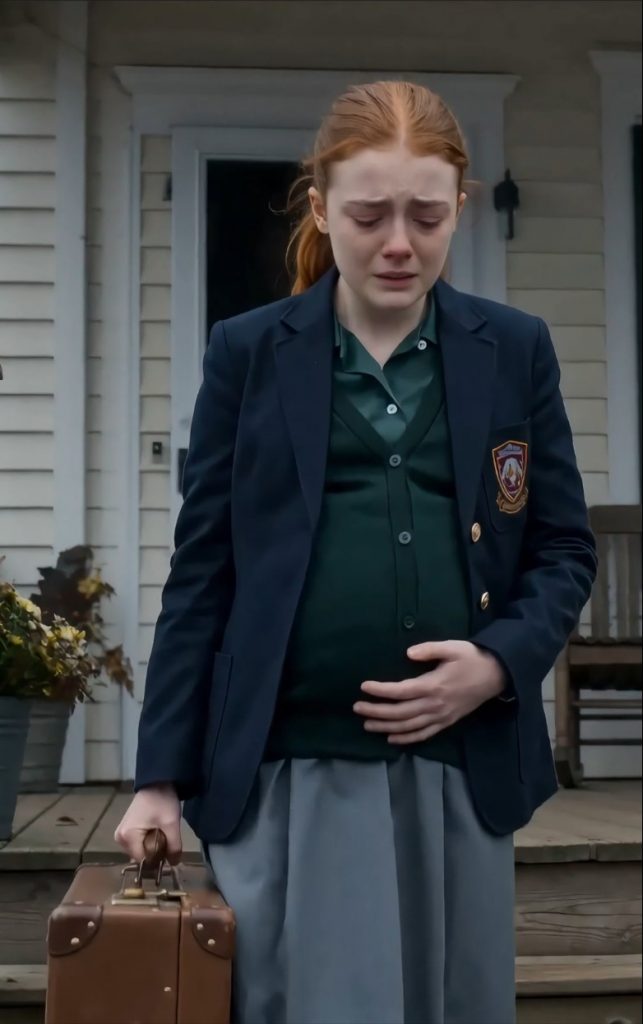
Clara Whitaker tried to lift it higher, but her fingers were numb from the cold and her wrist ached beneath the weight. She was only seventeen, still wearing her navy school blazer, gray pleated skirt, and black knee-high socks, like she had been sent home from class instead of thrown out of her life.
Her left hand stayed pressed over her belly.
Behind her, the white house stood quiet and perfect among the bare trees.
Perfect from the road.
Perfect for neighbors.
Perfect for Christmas cards, parent association meetings, and the kind of family photographs where everyone smiled because the camera demanded it.
But the front door was open now, and perfection had teeth.
“Leave right now,” her mother shouted from the porch, “and don’t you dare come back.”
Clara stopped at the bottom step.
The fog curled around the yard, softening the trees, swallowing the road, making the whole world look like it had already turned away from her.
Her mother, Vivian, stood in a gray wool coat with her red hair pinned neatly behind her ears. Her blue eyes were bright with rage, but not grief. Not fear. Not even shock anymore.
She had already decided what Clara was.
A stain.
A problem.
A story to bury before it reached the school board.
Clara looked past her mother to the doorway.
Her father stood there.
Charles Whitaker, history teacher, church trustee, respected man, admired man. His brown blazer was buttoned, his maroon sweater vest smooth beneath it, as if he had dressed formally for the moment he would abandon his daughter.
“You have brought nothing but disgrace to our family,” he said.
He did not raise his voice.
That made it worse.
Clara’s throat tightened. “Dad…”
His face did not soften.
For one terrible second, she thought he might. She thought the word Dad might still mean something strong enough to reach him.
But he only looked at the suitcase in her hand.
“Go,” he said.
The wind moved through the leafless trees.
Clara’s breath trembled out of her.
She wanted to ask where. She wanted to ask how. She wanted to ask why the people who had taught her to look both ways before crossing the street could send her into the fog with no plan, no coat warm enough for the night, and a baby moving quietly beneath her palm.
But she had learned something in that house.
Some questions were only another way to beg.
And she was done begging people who had already shut the door inside their hearts.
So Clara turned.
The suitcase dragged over wet leaves as she walked down the path. Her shoes tapped softly against the pavement. Behind her, her mother said something else, but the fog took the words before they reached her.
Then the door closed.
Clara did not look back.
She walked until the house disappeared behind the gray curtain of mist.
And then, two blocks away, the suitcase snapped open.
Clothes spilled onto the cold road.
Uniform shirts.
A sweater.
A hairbrush.
A folded photograph she had never seen before.
And beneath all of it, sewn into the torn brown lining, was a sealed envelope with one sentence written in her grandmother’s handwriting.
For Clara, when they finally show you who they are.
Act II
Clara had always known her family loved appearances.
She just had not understood they loved appearances more than her.
In the Whitaker house, curtains were opened at exactly eight every morning. The porch was swept even when no one had visited. Her mother kept fresh flowers in the dining room, not because she liked flowers, but because people might stop by.
Her father believed dignity was a performance.
Stand straight.
Speak clearly.
Do not embarrass your mother.
Do not argue in public.
Do not let people know what hurts.
Clara tried.
For years, she tried so hard she almost disappeared into obedience.
She made honor roll. She played violin at school concerts. She volunteered at church luncheons. She smiled beside her parents in photographs and listened as adults told Vivian and Charles what a lovely daughter they had raised.
Lovely meant quiet.
Lovely meant manageable.
Lovely meant useful.
Then Clara fell in love with a boy named Miles Bennett, and for the first time in her life, she felt seen instead of displayed.
Miles was not rich. His mother worked nights at the hospital cafeteria, and his father had been gone since he was little. He wore secondhand jackets, fixed bikes for extra money, and laughed with his whole face.
Vivian called him unsuitable.
Charles called him a distraction.
Clara called him safe.
When she found out she was pregnant, Miles was the first person she told.
He did not run.
He cried, then held her hand, then said, “We’ll figure it out. I don’t know how, but I’m not leaving.”
That was the last time Clara saw him alone.
Two days later, Miles stopped answering her messages.
A week later, her father told her Miles’s family had decided it was best if he stayed away.
Vivian said, “Boys like that don’t stay.”
Clara believed them because believing the alternative was too painful.
She did not know Charles had gone to Miles’s house.
She did not know he had threatened to report Miles for harassment if he contacted her again.
She did not know Vivian had taken Clara’s phone while she slept, blocked his number, deleted his messages, and told herself it was protection.
Protection of what?
Not Clara.
The family name.
The baby became harder to hide.
At school, whispers followed her. Teachers looked at her belly and then looked away too quickly. The nurse called home after Clara nearly fainted during assembly.
That was the day Vivian packed the suitcase.
Not carefully.
Angrily.
She pulled drawers open, threw clothes inside, and spoke in short, sharp sentences.
“You made your choice.”
“You knew better.”
“You will not ruin your father’s position.”
Clara stood in the hallway, one hand on the wall, trying to understand how a home could turn into a place where every familiar object became a witness against her.
The suitcase belonged to her grandmother Ruth.
Ruth Whitaker had died the previous winter, quietly, in the back bedroom with Clara holding her hand. She had been the only person in that house who asked Clara what she wanted before telling her what she should do.
Before she died, Ruth had said something strange.
“Someday, if you have to leave, take the brown suitcase.”
Clara thought it was grief talking.
Now she sat on the side of the road with damp leaves clinging to her socks, holding the envelope Ruth had hidden in the lining.
Her hands shook as she opened it.
Inside was a letter.
A key.
A bank card.
And a photograph of her father as a teenager, standing beside a girl with red hair and a swollen belly.
Clara stared.
The girl was her mother.
Sixteen years old.
Pregnant.
And smiling with the same fear Clara now carried in her own face.
The lie was bigger than Clara’s pregnancy.
It had been living in the house long before she was born.
Act III
The letter began with an apology.
Not the kind people give to make themselves feel better.
A real one.
My Clara,
If you are reading this, it means your parents have done what I was afraid they might do. I am sorry I did not protect you sooner. I told myself silence kept peace in the family. It did not. It only taught them that cruelty could go unanswered.
Clara pressed a hand to her mouth.
Cars passed through the fog without stopping.
She kept reading.
Ruth wrote about Vivian.
How Vivian had become pregnant at sixteen.
How her own parents had wanted to send her away.
How Charles had married her quickly, not out of romance, but because Ruth insisted the family would not punish a frightened girl for needing help.
Clara’s breath caught.
Her parents had not been older and wiser.
They had once stood exactly where she stood.
Afraid.
Young.
Dependent on mercy.
And now they had denied her the mercy that had saved them.
But the letter did not stop there.
Ruth wrote about the house.
The white house with the porch and the leafless trees did not belong to Charles.
It never had.
Ruth had left it in a trust years earlier. Vivian and Charles were allowed to live there only as long as Clara remained safe, supported, and educated under their care.
If they forced Clara out, neglected her medical needs, or tried to control her inheritance, the trust would transfer authority to Ruth’s attorney.
The key in the envelope opened a small apartment above a bookshop downtown.
Paid for.
Quiet.
Safe.
The bank card held emergency funds in Clara’s name.
There was a phone number at the bottom.
Marianne Bell, attorney. Call her before you call anyone else.
Clara read the final paragraph through tears.
Your parents will tell you disgrace is something you carry. They are wrong. Disgrace is what people do when love costs them their image and they choose the image. You are not ruined. You are not alone. Go to the bookshop. I left the light on for you.
A sound broke out of Clara then.
Half sob.
Half laugh.
Because somewhere in the fog, beneath all the rejection, her grandmother had built a door.
Clara gathered her clothes back into the suitcase with shaking hands. The old latch would not close properly, so she tied it shut with the scarf Ruth had packed years ago.
Then she started walking again.
Not toward nowhere.
Toward an address.
The bookshop sat on Maple Street between a closed florist and a bakery with steamed windows. The sign above the door read Bell & Briar Used Books in faded gold letters.
A light glowed in the apartment above.
Clara stood beneath it, soaked from mist, exhausted, one hand on her belly and the other around the key.
Before she could climb the stairs, the shop door opened.
A woman in her sixties stepped out wearing a long cardigan and wire-rimmed glasses.
She looked at Clara.
Then at the suitcase.
Then at the envelope in her hand.
“Oh, sweetheart,” she whispered. “Ruth said you might come.”
And for the first time that day, Clara was not told to leave.
She was brought inside.
Act IV
Marianne Bell did not ask Clara to explain everything before giving her a blanket.
That alone made Clara cry.
She sat in the back room of the bookshop with a mug of warm tea between both hands while Marianne called a doctor, then a legal assistant, then someone named Mrs. Bennett.
Clara looked up sharply at the name.
“Miles’s mother?” she asked.
Marianne paused.
“Yes.”
Clara’s heart started beating harder. “Why?”
“Because Ruth left instructions,” Marianne said carefully. “And because Miles has been trying to reach you for months.”
The mug nearly slipped from Clara’s hands.
“No,” she whispered. “He left.”
Marianne’s eyes softened in a way that made the truth hurt before it arrived.
“He didn’t.”
The door opened twenty minutes later.
Miles came in first, hair damp from the fog, face pale and wild with fear. His mother was behind him in her hospital cafeteria uniform, breathing hard as if she had run from work.
The moment Miles saw Clara, he stopped.
Not because of her belly.
Not because of shame.
Because he looked like he had found someone he thought had been taken from him.
“Clara,” he said.
Her name broke in his mouth.
She stood too quickly, one hand gripping the table.
“You stopped answering.”
He shook his head. “Your number blocked me. Your dad came to my house. He said if I contacted you, he’d make sure my mom lost her job. He said you wanted nothing to do with me.”
Clara’s face crumpled.
“I thought you left.”
“I never left.”
The sentence struck the room like a bell.
Miles stepped forward slowly, giving her space, letting her choose.
That was how she knew.
He was not there to claim her.
He was there to stand with her.
Clara reached for him, and he caught her carefully, both of them crying into each other’s shoulders while Marianne looked away to give them what privacy the little room allowed.
But the night was not done with them.
At nine-thirty, Charles and Vivian Whitaker arrived at the bookshop.
Charles knocked like a man used to doors opening.
When Marianne did not move fast enough, he knocked again.
Harder.
Clara stood behind the counter, Miles beside her, his mother near the stairs. The suitcase rested at Clara’s feet like evidence.
Marianne opened the door.
Charles looked past her immediately.
“Clara,” he said. “You are coming home.”
Vivian stepped into the light behind him, her face tight with fury disguised as concern.
“You’ve caused enough trouble,” she said.
Something in Clara went very still.
Only hours earlier, those words would have folded her.
Now she had Ruth’s letter in her pocket.
Miles’s hand near hers.
Marianne at the door.
And the truth beneath her feet.
“No,” Clara said.
Her father stared at her.
Vivian blinked, stunned by the simple refusal.
Marianne stepped forward with a folder. “Mr. and Mrs. Whitaker, we need to discuss the trust.”
Charles’s expression changed.
There it was.
Fear.
Not for Clara.
For the house.
For the money.
For the life he had mistaken as his.
Vivian’s eyes darted to the suitcase. “You had no right to open that.”
Clara almost laughed.
“My suitcase?”
“Your grandmother was confused,” Charles said quickly. “She was old. She had no idea what she was signing.”
Marianne’s voice cooled. “Ruth Whitaker signed those documents in full capacity, with witnesses and medical certification. And tonight, by forcing Clara out while pregnant and without safe housing, you triggered the protection clause.”
Vivian’s face drained of color.
Clara looked from one parent to the other.
“So that’s why you came,” she said softly. “Not because you were worried.”
Her father opened his mouth.
No words came.
“You came because Grandma made sure you’d lose something if you threw me away.”
That truth was uglier than the fog.
Charles stepped toward her. “You are a child. You don’t understand family.”
Clara’s voice shook, but it did not break.
“I understand that Grandma gave you mercy when Mom was pregnant with me.”
Vivian flinched as if struck.
Clara pulled out the photograph.
The old one.
Vivian at sixteen, pregnant, standing beside Charles.
“I understand that you were saved by the compassion you refused to give me.”
The room went silent.
Miles looked at the photo, then at Clara, stunned.
Marianne did not speak.
She did not need to.
Vivian’s eyes filled, but Clara could no longer tell if the tears came from shame or anger.
Charles reached for the photo.
Clara pulled it back.
“No,” she said. “This is mine now.”
For the first time in her life, her parents had nothing that could make her hand it over.
Act V
The legal process did not feel like victory at first.
It felt like exhaustion with paperwork.
There were emergency filings, medical appointments, school meetings, and calls from people who suddenly wanted to “hear both sides.” Charles tried to frame everything as a family misunderstanding. Vivian told relatives Clara had run away and fallen into the influence of outsiders.
But Ruth’s trust was clear.
The letter was clear.
The witnesses were clear.
And when Marianne submitted a copy of the photograph along with documentation of Vivian’s own teenage pregnancy and Ruth’s support, the story Charles and Vivian had built around moral authority began to collapse.
People did not like hypocrisy when it became visible.
The school suspended Charles pending investigation after Miles’s mother filed a complaint about his threats. Vivian resigned from the board of the church women’s committee before anyone could ask her to.
The white house was placed under trust supervision.
Charles and Vivian were ordered to leave within thirty days.
Clara did not attend the hearing where that decision was made. She stayed above the bookshop, sitting by the window with her grandmother’s scarf around her shoulders, watching rain slide down the glass.
Miles sat on the floor nearby, assembling a crib someone from the community had donated.
He was terrible at it.
The instructions were upside down.
Clara noticed and laughed for the first time in days.
He looked up, embarrassed. “I’m providing emotional support to the screws.”
She laughed harder.
Then cried.
Then laughed again.
That became the shape of healing.
Nothing clean.
Nothing simple.
Just grief and relief arriving in the same breath.
Weeks passed. The apartment above the bookshop became home in small ways. A kettle on the stove. Schoolbooks on the table. Baby clothes folded in a drawer that used to hold old receipts.
Clara returned to school with her head down at first.
Then a little higher.
Some students whispered. Some stared. One girl slipped a note into her locker that said, My sister was pregnant senior year. She’s in college now. You’re not alone.
Clara kept the note inside Ruth’s envelope.
Miles walked her home most afternoons, but only after asking if she wanted him to. That mattered. Choice mattered now in ways she had never understood before.
One evening, near the end of winter, Clara returned to the white house.
Not to move in.
Not yet.
She stood at the edge of the yard while volunteers carried boxes inside. Marianne had helped convert the house into what Ruth had always dreamed it could become: a protected residence for young mothers finishing school, women needing safety, and families beginning again after rejection.
The porch had been repaired.
The front door repainted.
The mailbox still said WHITAKER, but beneath it someone had added a small brass plaque.
Ruth House
Clara climbed the steps slowly.
The same steps.
The same wood.
The same place where her suitcase had thudded beside her as her parents told her she was disgrace.
This time, no one shouted.
Marianne stood in the doorway with a set of keys.
Miles waited at the bottom of the steps, giving her the moment.
Clara placed her hand over her belly.
The baby moved.
A small flutter beneath her palm.
She closed her eyes.
“You made it back,” Marianne said gently.
Clara looked at the open door.
“No,” she said. “I made it somewhere new.”
Inside, the house no longer smelled like furniture polish and rules. It smelled like paint, clean blankets, soup warming in the kitchen, and books from the shop downstairs waiting to be shelved in the front room.
The formal dining room had become a study space.
The guest room had become a nursery.
Her grandmother’s old bedroom had a chair by the window and a framed copy of Ruth’s final sentence on the wall.
Do not beg people to love you safely. Go where safety is already waiting.
Clara stood in front of it until her eyes blurred.
Her parents had wanted the fog to swallow her.
They had imagined shame would make her small enough to disappear.
But they had forgotten Ruth.
They had forgotten that love, real love, plans ahead. It hides keys in envelopes. It tucks protection into suitcase linings. It tells the truth even after death.
Months later, when Clara’s daughter was born, she named her Ruth.
Vivian sent flowers.
No note.
Clara did not throw them away.
She placed them in the kitchen, not as forgiveness, but as proof that she could decide what entered her home and what did not.
Charles sent nothing.
That hurt less than she expected.
On the first warm day of spring, Clara sat on the porch of Ruth House with baby Ruth asleep against her chest. Miles sat beside her with two mugs of tea. Down the road, the fog was gone, replaced by pale sunlight and trees beginning to bud.
The suitcase sat near the door.
Empty now.
Repaired.
Clara kept it there for the girls who arrived with plastic bags, backpacks, cardboard boxes, or nothing at all. She wanted them to see it before they heard the rules.
Not the old rules.
The new ones.
You are not disgrace.
You are not too late.
You are not what they called you when they were afraid of the truth.
The road beyond the house still curved into the woods.
Clara watched it quietly, remembering the night she walked away believing she had been abandoned by everyone.
She knew better now.
Sometimes the people who throw you out think they are ending your story.
But sometimes, hidden in the very thing they force you to carry, someone who loved you has already written the next chapter.