Act I
Buddy sat exactly where he had been told.
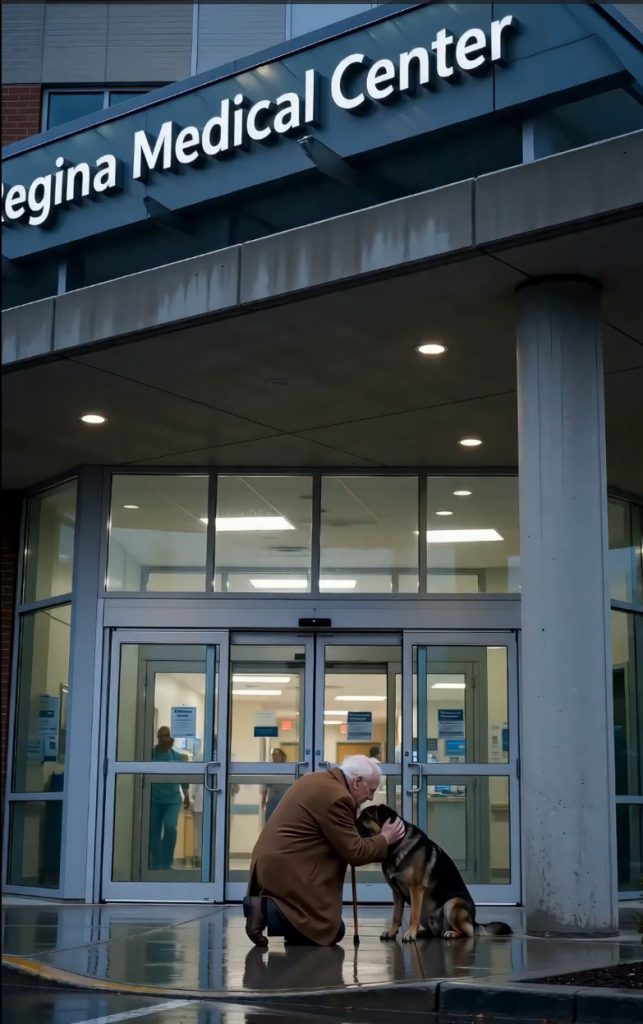
The rain began as a mist, soft enough to disappear on the concrete, then slowly became a steady gray curtain over the hospital entrance. Water gathered on the glass doors of Regina Medical Center. It slid in crooked lines down the panels, blurring the bright lobby inside into streaks of white and blue.
Still, Buddy did not move.
He was a large German Shepherd, black and tan with a graying muzzle, soaked now from ears to paws. Rain clung to the fur around his eyes and dripped from his chin. His collar tag shifted faintly whenever he lifted his head toward the sliding doors.
Every time they opened, he straightened.
Every time a nurse, visitor, doctor, or patient came out who was not the old man, his ears lowered just a little.
But he stayed.
Because Walter Reed had told him to.
Two hours earlier, Walter had knelt beside him on the pavement with the slow, painful effort of a man whose body had become too fragile for ordinary movements. He wore a long brown wool coat, dark trousers, and the same wedding ring he had never taken off since his wife died eleven years before.
His wooden cane rested beside him.
His trembling hands cupped Buddy’s face.
The dog leaned forward, pressing his forehead against Walter’s.
“Wait for me,” Walter whispered.
His voice was raspy, but gentle.
“I’ll be right back.”
Buddy had stared into his eyes as if committing the command to memory.
Then Walter stood, using the cane to push himself upright. He turned toward the automatic doors, each step slow, each tap of the cane echoing against the concrete.
Buddy watched him disappear into the bright hospital lobby.
The doors closed.
The dog sat down.
He did not understand heart monitors, test results, or the way nurses speak softly when the news is bad. He did not understand why Walter had hidden his cough behind a handkerchief for weeks, or why the old man had whispered to a framed photograph that morning, “Not yet, Anna. Not until I make this right.”
Buddy understood only one thing.
Walter had said wait.
So he waited.
The sky darkened.
The pavement turned slick.
Visitors passed around him with umbrellas. Some smiled sadly. One man offered him a piece of sandwich. A young woman tried to coax him under the overhang.
Buddy ignored them all.
Then the doors opened again.
This time, a nurse in light blue scrubs stepped out into the rain.
Her shoes made soft wet sounds on the pavement. A dark stethoscope rested around her neck, and her badge swung against her chest as she walked toward him.
She stopped a few feet away.
“Buddy,” she said softly.
The dog lifted his head.
The nurse’s face was kind.
That made it worse.
“Come with me.”
Buddy looked past her.
Through the glass.
Toward the place where Walter had vanished.
He did not stand.
The nurse’s eyes filled, though she tried to hide it.
Buddy’s breath trembled once. Rain ran down his face, but the wetness gathering at the corners of his eyes was different.
He knew.
Somehow, before any human said it clearly, he knew the man who had promised to come back could not walk through those doors alone.
And behind the nurse, inside the hospital lobby, Walter Reed’s cane stood propped against an empty chair.
Act II
Walter Reed had not always walked with a cane.
For most of his life, he had been the man other people leaned on.
He built porches, repaired fences, fixed engines, patched roofs, carried groceries for widows, and shoveled snow from the church steps before anyone arrived to ask. In the neighborhood, children called him Mr. Walter. Dogs pulled toward him on leashes. Strangers trusted him within minutes.
His wife, Anna, used to say he had hands made for mending.
Then she got sick.
For two years, Walter learned the geography of hospitals. Elevators. Oncology wings. Waiting rooms with vending machines that buzzed all night. He learned which nurses liked strong coffee, which doctors avoided eye contact, which family members fell apart quietly in parking lots.
Anna died in November, during the first snow.
After the funeral, the house became too silent.
Walter stopped fixing things unless someone else asked. The garden went wild. The porch swing stayed covered. He still wore his wedding ring and still set two coffee cups on the counter some mornings before remembering.
Buddy came into his life six months later.
A retired service dog no one wanted because he was “too bonded” and “too serious.” Walter found him at a rescue shelter, sitting in the back of the kennel, watching visitors come and go with tired brown eyes.
The volunteer said, “He’s loyal, but he needs someone patient.”
Walter had laughed softly.
“So do I.”
Buddy went home with him that day.
At first, they simply existed near each other. Walter made breakfast. Buddy watched. Walter sat on the porch. Buddy lay beside the steps. Walter cried once in the kitchen while holding Anna’s mug. Buddy placed his head against Walter’s knee and did not move until the old man’s breathing steadied.
After that, they belonged to each other.
Every morning, Walter walked Buddy down Maple Street, past the bakery, the pharmacy, and the little post office where everyone knew them. When Walter’s joints worsened, Buddy slowed his pace. When Walter stumbled, Buddy braced. When Walter forgot his cane by the door, Buddy barked until he turned back for it.
But Walter was keeping secrets.
He had been receiving letters from Regina Medical Center for weeks. Test results. Follow-ups. Urgent reminders. He hid them in the drawer beneath the phone, then moved them when Buddy began nudging at the drawer as if scent alone could expose fear.
The diagnosis was not sudden.
It was the kind of news that creeps in quietly, then fills the whole room.
Walter did not tell his daughter, Emily.
That was the worst mistake he made.
Emily lived three states away and had not visited in nearly two years. Not because she did not love him. Because love had become tangled with old hurt.
After Anna died, Walter and Emily fought over everything.
The house.
The medical bills.
Anna’s jewelry.
The fact that Emily wanted him to move closer to her and Walter refused to leave the home where her mother’s voice still seemed to linger in the walls.
The fight ended with Emily crying in the driveway and Walter saying, “I’m not helpless.”
She said, “No, Dad. You’re just alone and too proud to admit it.”
Then she left.
They spoke less after that.
Buddy watched Walter sit beside the phone many evenings, hand resting on the receiver, not dialing.
The morning he went to the hospital, Walter finally made one call.
Not to Emily.
To a lawyer.
Then he put on his brown coat, picked up his cane, and told Buddy they were going for a ride.
Buddy followed happily.
He did not know Walter had spent the night signing papers.
He did not know the old man had written one letter to his daughter and another to the hospital.
He did not know that when Walter knelt outside Regina Medical Center and whispered, “I’ll be right back,” it was both a promise and a prayer.
Because Walter had one last thing to fix.
And this time, his hands might not be strong enough to do it alone.
Act III
Nurse Clara Evans had seen loyalty before.
She had seen husbands sleep upright in plastic chairs for three nights straight. She had seen sisters argue with doctors until someone explained the plan in plain English. She had seen children press drawings against hospital windows because infection rules kept them from visiting.
But she had never seen anything like Buddy.
For three hours, the German Shepherd sat outside the entrance in the rain.
Security asked if they should call animal control.
Clara said no.
The dog was not causing trouble. He was not wandering. He was not lost.
He was waiting.
She had first noticed him when Walter Reed checked in at the front desk.
The old man’s breathing was strained, though he tried to hide it. His hand shook as he signed the form. He looked once over his shoulder toward the glass doors, where Buddy sat outside like a soldier holding position.
“Is that your dog?” Clara asked.
Walter smiled.
“My best friend.”
“We can have someone bring him inside if he’s a service animal.”
Walter hesitated.
Then he shook his head. “He’ll wait. He’s good at that.”
Clara did not like the way he said it.
As if the dog had spent a life waiting for people who did not return.
Walter collapsed forty minutes later in Imaging.
Not violently. Not dramatically. He simply reached for a wall that was too far away and went down before anyone could catch him properly.
The hospital moved around him with practiced urgency.
Oxygen.
Monitors.
Questions he could barely answer.
Emergency contacts.
That was where Clara found the first crack in the story.
Walter had listed his daughter, Emily Reed, but beneath her number he had written, in shaky handwriting:
Please call only after speaking with Buddy’s new guardian.
Clara stared at the line.
Buddy’s new guardian?
In Walter’s coat pocket, they found a sealed envelope addressed to her.
Not to Emily.
To the nurse who helps Buddy.
Clara should have waited.
She knew that.
But hospital rules were built for paperwork, not rain-soaked dogs holding vigil beyond sliding doors.
She opened it in the staff room with trembling hands.
Inside was a short letter.
If you are reading this, I did not walk out when I meant to. My dog is outside. His name is Buddy. He waits when I ask him to, and I fear he will wait until his body gives out if someone does not tell him otherwise. Please bring him in. Please let him know I did not abandon him.
Clara covered her mouth.
There was more.
My daughter Emily is his rightful person now, though she does not know it yet. She loved dogs as a girl. She loved me too, before grief made us both foolish. In the side pocket of Buddy’s collar is a key to my house and a note for her. Tell her I am sorry. Tell her she was right. I was proud when I should have been honest.
Clara read the final line twice.
If Buddy refuses to leave the doors, say Anna’s name. He knows that means home.
Clara folded the letter carefully.
Then the doctor came in.
His face told her what no one had to say yet.
Walter Reed was alive.
But barely.
And if his daughter was going to hear his voice again, someone had to reach her fast.
Clara called Emily Reed.
The number rang six times.
Then a woman answered, guarded and tired.
“Hello?”
“Emily Reed?”
“Yes.”
“My name is Clara Evans. I’m a nurse at Regina Medical Center. I’m calling about your father.”
Silence.
Then the sound of a chair scraping.
“What happened?”
Clara looked through the staff room window toward the entrance.
Buddy still sat in the rain.
“He’s very ill,” she said. “And there’s something else you need to know.”
Before she could explain, Buddy suddenly stood.
His ears lifted.
His eyes locked through the glass.
Inside the lobby, an orderly was wheeling Walter past on a hospital bed toward the emergency elevator.
Buddy saw him.
And broke his command for the first time.
Act IV
The bark echoed through the entrance like a cry.
Buddy lunged toward the glass doors just as they began to close. His paws skidded on the wet pavement. His shoulder hit the sensor bar. The doors opened again, and before security could stop him, he rushed inside.
“Buddy!” Clara called.
The German Shepherd ran across the lobby, water flying from his coat, nails clicking against the polished floor. Visitors gasped and stepped back, but he did not turn toward them.
He ran straight to Walter.
The orderly stopped the bed.
Walter lay pale against the pillow, oxygen tubing beneath his nose, eyes closed. His cane was gone. His coat was gone. He looked smaller without them, stripped of all the little things that made him seem sturdy.
Buddy placed his front paws carefully on the lower edge of the bed and whined.
Walter’s eyelids fluttered.
“Sir?” Clara whispered.
Walter’s hand shifted weakly against the blanket.
Buddy pressed his wet muzzle beneath it.
For one fragile second, Walter opened his eyes.
“Buddy,” he breathed.
The dog went still.
Everyone in the lobby did too.
Walter’s fingers touched the dog’s head, barely moving.
“I came back,” he whispered.
Clara had to turn away.
The doctor beside her cleared his throat softly. “We have to move him.”
“I know,” Clara said.
But she did not move Buddy yet.
Walter looked past the dog, searching.
“My daughter?”
“She’s on her way,” Clara said.
His eyes closed with relief and pain.
“Tell her…”
His voice faded.
Clara leaned closer. “Tell her what?”
Walter swallowed.
“Tell her I kept the house too quiet.”
Then the elevator doors opened.
Buddy tried to follow.
Clara knelt beside him and took his collar gently.
He resisted once, not with aggression, but with heartbreak.
Then she whispered the name from the letter.
“Anna.”
Buddy stopped.
His head turned toward her.
Clara’s throat tightened. “Anna means home, doesn’t it?”
The dog stared at her, breathing hard.
Then, slowly, he lowered his paws from the bed.
The elevator doors closed between him and Walter.
Buddy stood in front of them long after they shut.
When Emily arrived four hours later, the rain had stopped, but the hospital windows were still streaked with water.
She came through the doors wearing a dark travel coat, hair pulled hastily back, face pale from the drive. Clara recognized her immediately, not from any photo, but from the way Buddy reacted.
He had been lying on a blanket near the waiting area, refusing food, refusing water, refusing every attempt to coax him farther inside.
Then Emily stepped through the doors.
Buddy lifted his head.
Emily froze.
“Oh,” she whispered.
She had not seen Buddy in person before. Only in blurry photos Walter had once texted her after adopting him.
Buddy stood slowly.
He walked to her without barking.
Emily dropped to her knees in the middle of the lobby.
The dog pressed his head into her chest.
And Emily, who had promised herself she would stay composed, wrapped both arms around him and sobbed into his wet fur.
“I’m sorry,” she whispered.
Buddy leaned harder against her.
Clara stood nearby with Walter’s letter in her hand.
She did not interrupt until Emily looked up.
“Your father wanted you to have this.”
Emily took the envelope.
Her hands shook as she opened it.
Whatever Walter had written inside changed her face line by line.
Anger.
Grief.
Regret.
Love.
By the time she reached the end, she was crying silently.
“He thought I didn’t want him,” she said.
Clara sat beside her.
“He thought he was protecting you from watching him get weaker.”
Emily looked toward the elevator.
“He always thought silence was protection.”
Buddy rested his chin on her knee.
Emily’s fingers moved through his fur.
Then a doctor appeared at the end of the hall.
“Ms. Reed?”
Emily stood too fast.
Buddy stood with her.
The doctor’s voice was gentle, serious, and careful.
“Your father is asking for both of you.”
The words almost broke her.
Both of you.
Not just Emily.
Not just Buddy.
The family Walter thought he had lost was being called into the room together.
Act V
Walter Reed did not survive the night.
But he did not die alone.
Emily sat on one side of the bed, holding his hand. Buddy lay on the other side, head resting against the blanket, eyes fixed on the old man’s face.
For nearly an hour, Walter drifted in and out.
Sometimes he knew where he was.
Sometimes he thought he was back home.
Once, he turned his head slightly and whispered, “Anna, the porch light’s still on.”
Emily covered her mouth, but Buddy only lifted his ears, recognizing the name that meant home.
Near midnight, Walter woke clearly.
His eyes found Emily first.
“I should have called.”
She squeezed his hand. “I should have come.”
“No.” His voice was barely there. “I was the father.”
“You were also grieving.”
He looked at her then, really looked, as if seeing not the daughter who had argued in the driveway, but the child he once carried to bed after she fell asleep on the couch.
“I made the house a shrine,” he whispered. “Not a home.”
Emily cried softly. “We can fix it.”
Walter’s eyes moved to Buddy.
The dog leaned closer, nose against his wrist.
Walter’s fingers brushed the fur between his ears.
“You’ll take him?”
Emily nodded, unable to speak.
“Don’t let him wait in the rain.”
“I won’t.”
Walter seemed to settle after that.
Not healed.
Not safe.
But peaceful in the only way left to him.
His final breath came quietly, with Emily’s hand around his and Buddy’s head beneath his palm.
The monitor changed.
The room filled with the soft, terrible stillness that follows goodbye.
Buddy did not understand the machine.
He understood the hand that no longer moved.
He raised his head and gave one low whine.
Emily bent over him, and together they mourned the man who had loved them both imperfectly, stubbornly, completely.
Three days later, Emily took Buddy home.
Walter’s house stood at the end of a narrow street lined with old maples. The porch light was on, just as he had left it. The garden was overgrown. A newspaper sat damp near the steps. The wind chimes Anna had loved clicked softly in the breeze.
Buddy stepped from the car and stood very still.
Emily opened the gate.
He walked up the path slowly, nose low, taking in every scent Walter had left behind.
At the door, Emily used the key Clara had found in Buddy’s collar.
Inside, the house smelled like dust, cedar, old books, and her father’s coffee.
Emily stood in the hallway and began to cry before she made it three steps.
Buddy leaned against her leg.
For weeks, grief lived in the house like weather.
Emily sorted papers. Called lawyers. Cleaned the kitchen. Found unpaid bills, old photographs, hospital letters, and sticky notes Walter had written to himself in shaky handwriting.
Buy Buddy food.
Call Emily Sunday.
Fix porch hinge.
Tell her about Anna’s quilt.
That last one undid her.
The quilt was in the cedar chest at the foot of Walter’s bed. Beside it was another letter, addressed to Emily in Anna’s handwriting.
Her mother had written it years earlier, before the illness became too cruel.
In it, Anna asked Emily to forgive her father for the ways grief would make him difficult.
“He will hold on too tightly to things,” Anna wrote. “Not because things matter more than you. Because he will not know where to put all the love when I am gone.”
Emily read that line with Buddy’s head in her lap.
Then she finally understood.
Her father had not loved the house instead of her.
He had been hiding inside the place where love still had a shape.
Spring came quietly.
Emily stayed longer than she meant to.
First a week.
Then a month.
Then she stopped calling it temporary.
She worked remotely from Walter’s old study, where Buddy slept beneath the desk. She repaired the porch hinge. She replanted Anna’s garden with lavender and white roses. She took Buddy on the same morning route Walter had walked, past the bakery, the pharmacy, and the post office.
People stopped them often.
They told stories.
Walter fixing a porch after a storm.
Walter paying for a neighbor’s medication.
Walter bringing Buddy into the hardware store and pretending not to notice when the dog stole biscuits from the counter jar.
Emily collected those stories like pieces of a man she had not fully lost.
One rainy afternoon, six months after the hospital, she drove Buddy back to Regina Medical Center.
Not because she wanted to relive the worst night.
Because Buddy still stiffened whenever rain hit the windshield.
He still watched doors too long.
He still waited sometimes at the front gate, ears forward, as if part of him remained on that wet pavement under hospital lights.
Emily parked near the entrance.
Buddy stepped out slowly.
The glass doors slid open and shut. Nurses passed. Visitors hurried under umbrellas. The concrete was wet, reflecting the cold glow inside.
Buddy walked to the exact spot where Walter had told him to wait.
Then he sat.
Emily crouched beside him, rain speckling her coat.
“He came back to you,” she whispered. “Not the way you wanted. But he did.”
Buddy looked at the doors.
For a long moment, neither moved.
Then Clara Evans came outside.
She was off shift, wearing a raincoat over her scrubs, but Buddy recognized her. His ears lifted, and his tail moved once.
Clara smiled sadly. “Hi, Buddy.”
Emily stood and hugged her.
They had become something like family, because some nights connect strangers permanently.
Clara knelt and touched Buddy’s damp head.
“You ready to go home?” she asked.
Buddy looked once more at the doors.
Then he stood.
Not quickly.
Not forgetting.
But choosing.
Emily clipped the leash to his collar, and together they walked back through the rain.
Behind them, the hospital doors opened and closed, opened and closed, swallowing and releasing strangers into the bright lobby.
But Buddy did not turn back again.
Walter had asked him to wait.
And he had.
Faithfully.
Bravely.
Until love found the courage to tell him the command was over.
Now home was not the old man walking through the doors with his cane.
Home was the daughter who finally came.
Home was the porch light still burning.
Home was the promise Walter kept in the only way he could, leaving Buddy not with silence, not with rain, not with an empty entrance, but with someone who would never again let him wait alone.