Act I
The German Shepherd found the spot before the humans did.
He lunged so hard in his black harness that the elderly man nearly fell forward into the snow. His paws tore at the white crust, claws scraping through ice, breath bursting in frantic clouds as he barked at one place beneath a frost-coated bush.
“Over there!” the old man shouted. “Please, hurry!”
Officer Hannah Reed was already running.
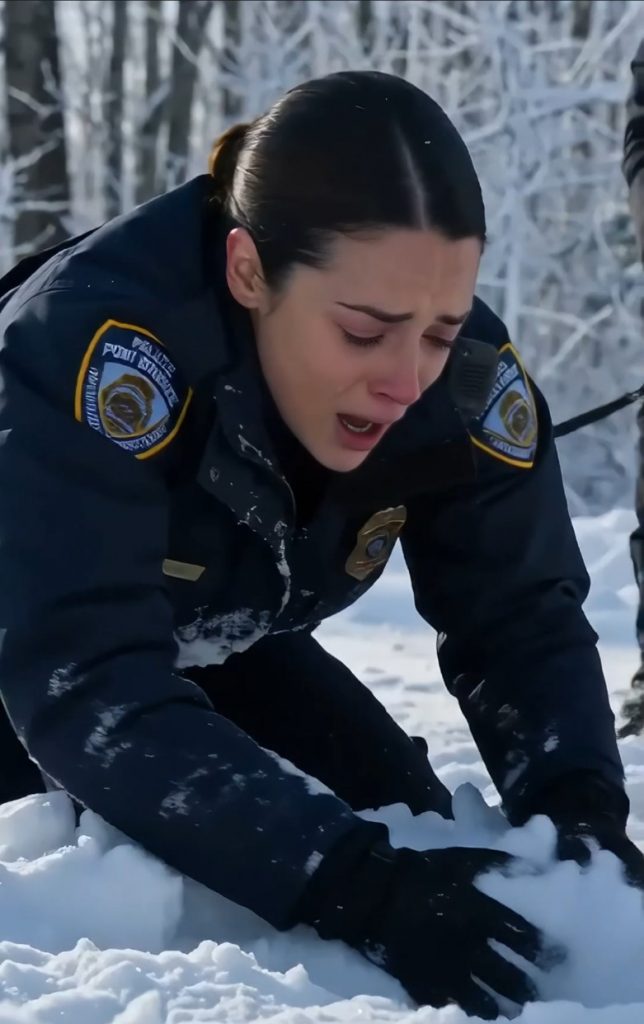
Her boots sank into the snow. Her dark blue uniform was soaked at the knees. Her face was red from cold, and tears had frozen in the corners of her eyes before she could wipe them away.
Behind her, the police SUV sat with every door open, lights flashing blue against the white forest.
The dog barked again.
Sharp. Desperate. Certain.
Hannah dropped to her knees beside him and began digging with both hands.
Snow flew behind her in wet clumps. Her gloves filled with ice. She did not stop. She could not stop.
The old man pointed with trembling hands. “He’s got the scent. He’s got it!”
Hannah’s breath came in broken bursts.
For eighteen hours, the whole county had been searching for a missing seven-year-old boy named Caleb Reed.
Her son.
He had vanished after school during the first heavy snow of the season. One minute, he had been walking across the little park behind the library. The next, there was only his backpack in the snow and a line of footprints disappearing toward the trees.
People said children wander.
Hannah knew Caleb did not.
He was afraid of the woods after dark. He never crossed the creek alone. He always called her if he was late, even when he knew she was on duty.
Something had taken him from the path.
Now the dog was digging like the earth itself was hiding a secret.
Hannah clawed deeper.
Her fingers struck fabric.
She froze.
A red mitten.
Small.
Soaked through.
Caleb’s.
The world narrowed to that bright scrap of color against the snow.
“No,” Hannah whispered.
The dog stopped barking and began to whine.
Hannah dug harder, sobbing now.
“No, no, please God. No.”
Then, beneath the snow and frozen leaves, something tapped once from below.
Act II
Caleb had lost the other red mitten three winters ago.
Hannah remembered because he cried for half an hour even though she promised to buy him new ones. He said they were “fast mittens” because his grandmother had sewn a little lightning bolt on each cuff.
Only one remained now.
He wore it everywhere.
To school. To the grocery store. To bed once, when the heater broke and he decided being dramatic was a survival skill.
That mitten in the snow was not just evidence.
It was Caleb’s hand in hers. Caleb’s laugh in the kitchen. Caleb falling asleep with a library book open across his chest. Caleb asking why police officers helped strangers but still forgot to buy orange juice.
Hannah had been on duty when he disappeared.
That was the part that kept cutting her open.
She had promised to pick him up from the library program by four. A crash on the north road kept her out until four-thirty. Her mother was supposed to get him instead, but traffic stalled behind a snowplow. Caleb waited by the library doors like he had been told.
Then he was gone.
The search began before sunset.
By midnight, volunteers were combing ditches with flashlights. By dawn, divers checked the creek even though the ice was thin and Hannah screamed that Caleb would never go there. By morning, the news vans arrived, careful faces and cold cameras pointed at her grief.
The first real lead came from Walter Pike.
He was seventy-eight, a retired forest warden who lived in a small cabin beyond the park trail. People called him difficult. Some called him confused. He wore old wool coats, argued with town officials about trail maintenance, and trusted dogs more than he trusted men with clipboards.
He had called the station at 5:12 p.m.
A boy in a red mitten, he said. Running near the old service road. A dark figure behind him. Snow too thick to see more.
The dispatcher marked it as uncertain.
An officer went out, saw nothing, and moved the search back toward town.
But Walter did not stop.
He took his German Shepherd, Ranger, into the woods after midnight. Ranger had been a search dog once, before age and a torn ligament retired him. He was slower now. Gray around the muzzle. But his nose still knew the difference between a lost trail and a lie.
At sunrise, Walter appeared at the police command post, half-frozen and furious.
“You’re searching the wrong side,” he said.
No one wanted to listen.
Hannah did.
Not because Walter was convincing.
Because Ranger would not stop pulling toward the trees.
Now, in the bright cruel light of winter, Hannah knelt where Ranger had led them and stared at Caleb’s mitten in her hand.
The tapping came again.
Faint.
Hollow.
Not from the snow.
From underneath it.
Walter grabbed her shoulder. “There’s a culvert.”
Hannah looked up.
“What?”
“Old drainage tunnel,” he said, voice shaking. “Under the service road. They covered the entrance years ago.”
Ranger barked into the hole.
Hannah’s heart slammed against her ribs.
Caleb was not buried in the snow.
He was beneath it.
And he was alive.
Act III
The rescue turned frantic.
Hannah shouted into her radio until her voice cracked. Fire department. Medics. Excavation tools. Now.
Then she went back to digging because waiting felt impossible.
Ranger worked beside her, pawing carefully at the same spot, stopping whenever the snow shifted too much. Walter dropped to his knees too, old hands bare in the cold, scooping away ice and branches.
The first firefighter reached them seven minutes later.
Then another.
Then the whole forest seemed to fill with voices, tools, breath, and urgency.
“Clear the top layer!”
“Watch the collapse!”
“Get a thermal blanket ready!”
Hannah was pulled back twice.
Both times, she returned.
Finally, one firefighter lifted a sheet of frozen plywood hidden beneath the snow. Under it was a narrow concrete opening, half-blocked with ice and brush.
Ranger shoved his muzzle toward the gap and whined.
A child’s voice answered.
So small Hannah almost didn’t believe it.
“Mom?”
Hannah made a sound that frightened everyone around her.
“I’m here!” she cried, pressing herself to the frozen ground. “Caleb, I’m here!”
He coughed weakly from inside the tunnel. “It’s dark.”
“I know, baby. Don’t move. We’re getting you out.”
“I hid.”
Hannah’s body went still.
Walter turned toward her.
“You hid from who?” Hannah asked, forcing every word to stay gentle.
Caleb was quiet.
Then, barely audible, he whispered, “Mr. Dale.”
The name passed through the rescue team like a crack through ice.
Evan Dale was the assistant director of the library program.
He had helped organize the search.
He had handed Hannah coffee at midnight and told her they would find her son.
Hannah’s hands closed around the snow.
Ranger growled.
The firefighters widened the opening with careful tools. Minutes stretched into years. Snow slid. Concrete scraped. Someone warned Hannah to step back, but she could not take her eyes off the dark gap.
Then a small hand appeared.
Bare, trembling, reaching toward the light.
Hannah caught it.
“I’ve got you,” she sobbed. “I’ve got you.”
They pulled Caleb out wrapped in cold, fear, and a torn blue coat. He was shaking so badly he could barely speak. His lips were pale. One foot was missing a boot. But he was breathing.
Alive.
Hannah folded around him on the snow, holding him while medics wrapped them both in thermal blankets. Caleb clung to her collar with his bare fingers.
“Ranger found me,” he whispered.
The old dog pressed his nose against Caleb’s cheek.
The boy smiled for half a second, then started crying again.
Hannah looked over his head at Walter.
The old man was sitting back in the snow, breathless, tears shining in his white beard.
“You were right,” she said.
Walter shook his head and touched Ranger’s harness.
“He was.”
Act IV
Evan Dale was arrested before nightfall.
Not in a dramatic chase.
Not with a confession.
He was found at the library, standing beside the children’s craft table, calmly answering questions from a detective while acting concerned.
Then Hannah’s radio crackled.
Caleb had named him.
Everything changed.
The detectives searched his office and found Caleb’s missing boot hidden beneath a trash bag in a supply closet. They found security footage he had claimed was broken. They found messages to an unknown number saying, He saw me take the envelope.
The envelope turned out to be the reason Caleb ran.
He had seen Mr. Dale remove something from the director’s locked cabinet after the library program ended. Caleb thought it was a game at first. Then Dale saw him watching.
Caleb fled out the back door.
Dale followed.
In the storm, Caleb reached the service road and saw the old culvert entrance partly open beneath a snow-covered board. Small enough for a child. Too narrow for an adult in a heavy coat.
He crawled inside.
Dale could not reach him.
So he covered the opening.
He did not plan for Ranger.
The envelope Dale stole contained financial records from the library’s children’s fund. Donations meant for winter coats, school lunches, book grants, and emergency family aid had been quietly redirected for more than a year.
The director had begun to suspect him.
Dale wanted the records before the board meeting.
Caleb was simply in the wrong hallway at the wrong time.
That was what people would say later.
Hannah hated that phrase.
Wrong place. Wrong time.
As if evil were weather.
As if Caleb had wandered into danger instead of danger choosing to chase a child into the snow.
At the hospital, Caleb slept under warm blankets while Hannah sat beside him and watched his chest rise and fall. She had refused to change out of her wet uniform until a nurse threatened to have another officer physically remove her jacket.
Walter sat in the hallway with Ranger at his feet.
The dog would not leave.
When Hannah finally stepped out, Walter tried to stand.
She stopped him.
“You saved my son.”
Walter looked uncomfortable with gratitude. “I made them late by being old and stubborn.”
“You made them look in the right place.”
He looked down at Ranger.
“Your boy saved himself too,” he said. “Smart enough to hide. Strong enough to tap when he heard us.”
Hannah pressed a hand to her mouth.
For eighteen hours, she had imagined endings no parent should have to imagine. Now her son was alive on the other side of a hospital door, and the relief was so enormous it hurt.
Walter reached into his coat pocket and pulled out the red mitten.
A nurse had dried it as best she could.
“Thought he’d want it back,” he said.
Hannah took it carefully.
The little lightning bolt was still there.
Bent.
Dirty.
But still stitched to the cuff.
Act V
Caleb came home four days later.
The town lined the street with blue ribbons, stuffed dogs, and hand-painted signs. Hannah hated the attention at first. Then she saw Caleb staring out the car window, watching people wave like the world was trying to apologize.
He lifted one hand.
A small wave.
The whole street seemed to exhale.
Ranger was waiting on the porch.
Walter stood beside him, leaning on a cane, pretending he had not arrived two hours early.
The moment Caleb stepped out of the car, Ranger rose.
The boy walked slowly, still weak, still wrapped in a coat too big for him. When he reached the dog, he dropped both arms around Ranger’s neck.
Ranger closed his eyes.
No cameras caught the sound Hannah made.
She was grateful for that.
Life did not return to normal.
Normal was gone.
It became something new.
Caleb slept with a night-light shaped like a moon. He kept both mittens under his pillow even after Hannah bought him three new pairs. He did not want to go back to the library for a long time, and no one made him.
Hannah took leave from work.
For two weeks, she barely let him out of her sight. Then slowly, with counseling, patience, and Walter’s blunt wisdom, she learned that watching Caleb breathe was not the same as helping him live.
Ranger helped most.
Every afternoon, Walter brought him over. Caleb brushed the old dog’s coat, fed him pieces of toast, and told him things he did not yet want to tell adults.
One day, Hannah found Caleb on the porch with Ranger’s head in his lap.
“I was scared in the tunnel,” Caleb said.
Hannah stayed by the door, silent.
Caleb rubbed Ranger’s ear. “But I remembered Mom said police dogs find people.”
Ranger thumped his tail once.
“So I waited for a dog.”
Hannah turned away before he could see her cry.
The investigation into Evan Dale widened. The stolen funds led to other records, other signatures, other adults who had looked away because the library was beloved and beloved places are sometimes trusted too easily.
Dale went to prison.
The children’s fund was restored.
The library reopened under a new director with glass panels in every program room door and strict sign-out rules that no one complained about anymore.
At the entrance, they hung a framed photo of Ranger.
Under it, a small plaque read:
RANGER
Retired Search K9
Found What Others Missed
Walter grumbled that Ranger could not read and therefore did not care.
But he stood in front of the plaque for a long time.
Spring arrived late that year.
When the snow finally melted in the forest, Hannah took Caleb back to the old service road. Not to force bravery. Not to erase fear. Only because Caleb asked.
Walter came too.
Ranger walked between them, slower now, but still proud in his black harness.
The culvert had been sealed permanently. A safety marker stood beside it, bright orange against the wet brown earth. Birds moved in the trees. Water dripped from branches. The place looked smaller without snow.
Caleb held Hannah’s hand.
“That’s where I was,” he said.
“Yes.”
“And that’s where Ranger dug?”
“Yes.”
He looked at the old dog.
Ranger sniffed the ground, then sneezed.
Caleb smiled.
For a while, they stood in quiet.
Then Caleb pulled the red mitten from his pocket.
Hannah frowned gently. “You brought it?”
He nodded.
“I don’t want to keep it under my pillow anymore.”
He walked to the marker and tied the mitten around the post by its cuff. The little lightning bolt faced outward.
Walter cleared his throat.
“That’s a good place for it.”
Caleb stepped back.
“I want it to show where I came out.”
Hannah knelt beside him.
“You came out because you were brave.”
Caleb shook his head.
“I was scared.”
Walter gave a soft grunt. “Those two things don’t cancel each other.”
Ranger leaned against Caleb’s side.
The boy leaned back.
And Hannah understood something then that grief and fear had kept from her.
The forest would always hold the memory of what happened.
But it would also hold the rescue.
The barking.
The digging.
The old man refusing to be dismissed.
The boy tapping in the dark.
The moment a mother heard her child’s voice rise from beneath the snow and the whole world became possible again.
Months later, when people asked Caleb about the day he was found, he did not talk about the tunnel first.
He talked about Ranger.
“He knew,” Caleb would say. “He knew I was there.”
And maybe that was the truest part of the story.
In a world full of adults who doubted, delayed, lied, and looked in the wrong direction, an old German Shepherd put his nose to the snow and refused to move until someone listened.
Sometimes hope does not arrive gently.
Sometimes it barks until the forest answers.
Sometimes it claws through ice.
Sometimes it drags everyone back to the one place they were afraid to look.
And sometimes, beneath all that cold silence, a child is still waiting to be found.