Act I
The coffee pitcher hit the floor like a warning shot.
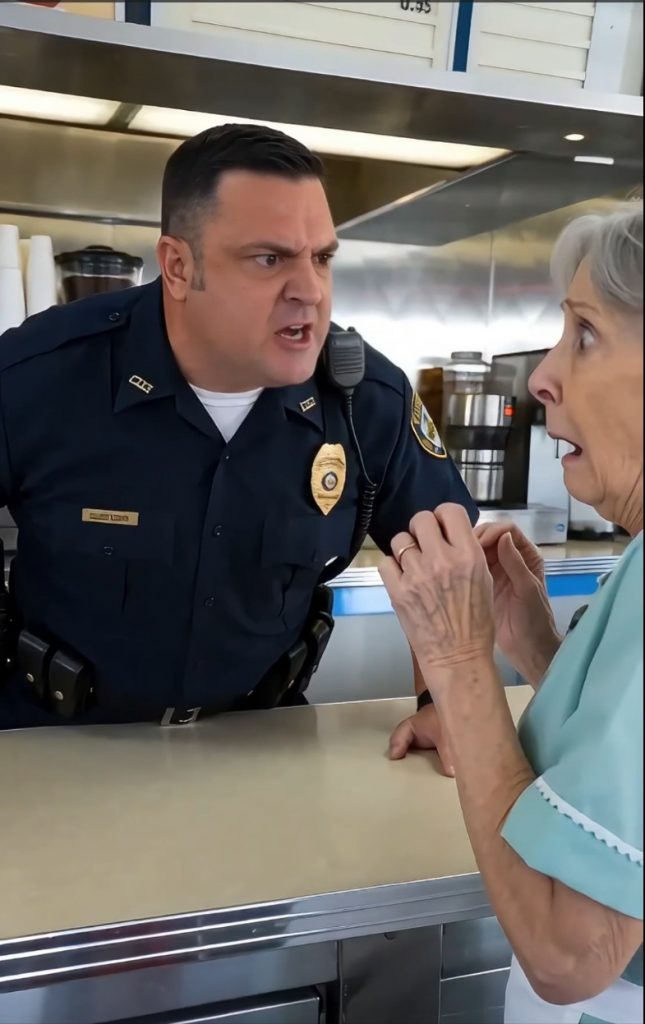
Glass burst across the white tile. Hot coffee splashed beneath the counter, spreading in a dark puddle at the elderly waitress’s shoes. The whole diner froze under the cold buzz of fluorescent lights.
Officer Colbert Coulson leaned over the counter with his badge shining on his chest and his hand still extended from the shove.
“Nobody cares what you think, sweetheart!”
Mabel Reeves flinched like the words had struck her harder than the glass.
She was seventy-one, though she would have said seventy if anyone asked. Her gray hair was pinned beneath a small green cap that matched her diner uniform, and her white apron had a coffee stain near the pocket from a rush-hour spill she had not had time to wipe off.
Her hands rose instinctively toward her chest.
“I only said you couldn’t speak to the girl that way,” she whispered.
The officer’s eyes narrowed.
The “girl” was a teenage hostess crying quietly near the kitchen doors after Coulson had called her useless for bringing him the wrong pie. No one else had said anything. Not the cook. Not the customers in the booths. Not the two men at the counter pretending to stare into their coffee.
Only Mabel.
And now the glass lay broken at her feet.
Coulson straightened, breathing hard through his nose. His name tag caught the light.
COLBERT COULSON.
He turned slightly toward the booth area, daring anyone to challenge him.
That was when the man in the red booth moved.
He had been sitting alone near the window, broad shoulders filling the space, bald head lowered over a half-finished cup of coffee. His black leather vest creaked as he shifted. The patches on it were worn but clear.
KICKERS.
EST. 1982.
His tattooed hands rested on the tabletop.
He looked at the broken glass.
Then at Mabel.
Then at the officer.
Coulson saw him watching and walked toward him with slow, heavy steps, one hand hovering near his duty belt.
The biker did not move at first.
He waited until Coulson was close enough to feel tall.
Then he stood.
The booth seat groaned under his weight. He rose slowly, unfolding to his full height, gray-streaked beard catching the diner light, eyes calm and hard.
Coulson’s stride faltered.
The biker looked down at him and spoke in a voice low enough to make the room lean in.
“Looks like you picked the wrong place, pal.”
Mabel’s breath caught.
Because she knew that voice.
And Coulson had no idea the man he was threatening had once made a promise in that very booth.
Act II
Gnouc’s Diner had survived three recessions, two fires, one flood, and every bad idea city planners could throw at it.
It sat on the corner of Harper and 9th, wedged between a dry cleaner and a pawn shop, glowing late into the night with its blue trim, red leather booths, and stubborn neon sign. Nobody agreed on how to pronounce the name anymore. The original owner had been a Frenchman named Luc Gnouc, but truckers called it “Gino’s,” teenagers called it “the booth place,” and Mabel simply called it home.
She had worked there for forty-three years.
She started when her husband, Eddie, was still alive and their son was still small enough to sleep in a flour sack under the prep table during late shifts. Back then, the diner fed cops, construction crews, nurses, bikers, runaways, and anyone else who had five dollars or enough pride to offer dishwashing instead.
Mabel never liked turning people away.
Eddie used to say it would bankrupt them.
Then he would slide an extra plate under the heat lamp and pretend it was a mistake.
Their son, Danny, grew up between the booths. He learned to read from the menu. Learned to count change from the register. Learned that a man in leather could be gentler than a man in a suit, and that a badge did not make someone decent unless the person underneath was decent first.
Then Danny got sick.
It was sudden. A fever that became something worse. A hospital bill that became a mountain. Mabel and Eddie sold their little house to keep up. Eddie died before the debt did.
Danny lived.
Barely.
But survival changed him. At sixteen, angry at the world and tired of being the reason his mother was broke, he ran.
Mabel searched bus stations, shelters, police desks, and alleys until her own body gave out. Months passed. Then years. Danny became a ghost she set a place for every Christmas.
The diner stayed open because grief needed work.
That was where the KICKERS came in.
They were not the kind of motorcycle club people whispered about in fear. Not really. They were mechanics, veterans, warehouse men, widowers, and stubborn old troublemakers who raised money for burned-out families and escorted frightened witnesses to court.
In the late eighties, they started meeting at Gnouc’s after rides.
Mabel fed them cheap. They fixed her roof after the flood. She patched their jackets when seams split. They called her Ma, and she pretended to hate it.
One of them had been a young biker named Silas Boone.
Back then, Silas was all rage and bone, fresh out of a bad home and already halfway to becoming a man people crossed the street to avoid. Mabel caught him stealing a loaf of bread from the kitchen one rainy night.
She did not call the police.
She sat him in Booth Six and gave him stew.
“You can be hungry,” she told him, “but you don’t get to become cruel.”
Silas never forgot it.
Years later, when he became president of the KICKERS, he made the diner their unofficial home. Every December, they held a toy drive there. Every summer, a memorial ride. Every time Mabel needed something fixed, painted, repaired, or carried, five motorcycles appeared before she finished the sentence.
But lately, the diner had become harder to protect.
The neighborhood was changing. Developers wanted the whole block. The pawn shop had already sold. The dry cleaner was considering. Gnouc’s lease was up in three months, and the building’s new owner had made it clear that a shiny brunch place could pay twice the rent.
Then Officer Coulson began showing up.
At first, he ate free meals and called them “community support.” Then he parked his cruiser out front for hours, scaring customers away. Then he told Mabel that “old places attract old problems.”
She knew what he meant.
The regulars. The bikers. The unhoused men she fed coffee during winter mornings. The teenage workers who needed patience more than lectures.
Mabel had finally told him no that afternoon.
No more free meals. No more shouting at staff. No more using his badge like a weapon in a place built to feed people.
And now the pitcher was shattered.
But Silas Boone had been in Booth Six.
And he still owed Mabel for the night she refused to let him become cruel.
Act III
Coulson tried to smile.
It was the wrong choice.
A smile can look confident on a decent man. On Coulson, it looked like calculation.
“You got something to say?” he asked.
Silas did not look away. “I already said it.”
Coulson’s hand drifted toward his belt again.
The diner held its breath.
Mabel stepped forward despite the glass. “Please don’t.”
Silas lifted one hand slightly, not toward Coulson, but toward her.
“It’s all right, Ma.”
The word hit the room.
Ma.
Coulson’s eyes flicked between them. “That old woman bothering you people now?”
Silas’s face did not change, but everyone close enough saw his jaw tighten.
“The only person bothering anyone is you.”
Coulson laughed. “Careful. You don’t know who you’re talking to.”
A voice came from the counter.
“Yeah, he does.”
It was Lou, the cook, still holding the towel he had frozen with when the pitcher broke. He was a quiet man, not built for confrontation, but his eyes were fixed on the officer now.
Coulson turned. “Stay out of this.”
Lou swallowed, then pointed toward the ceiling corner.
“Camera got everything.”
Coulson went still.
Only for half a second.
But Silas saw it.
So did Mabel.
The officer’s confidence shifted, not enough to disappear, but enough to show the machinery underneath. He was not just angry. He was afraid of evidence.
He moved suddenly toward the counter.
Silas stepped into his path.
The biker did not touch him.
He did not have to.
Coulson stopped inches away from him.
“You blocking a police officer?”
“No,” Silas said. “I’m blocking a bully.”
A customer in the booth near the window raised her phone. Another did the same. Then another. The diner, which had spent the first terrible seconds silent, began to wake up.
Mabel saw it happen.
Courage moving table to table.
Small at first.
Then contagious.
The teenage hostess wiped her face and stepped beside Lou. “He made me delete a video last week.”
Coulson’s head snapped toward her. “You better watch what you say.”
Silas took one step closer.
Coulson stopped talking.
The girl’s voice trembled, but she kept going. “He yelled at a man outside. Said he’d arrest him for loitering unless he left the block. The man was waiting for a bus.”
Another customer, a nurse in blue scrubs, spoke up. “He threatened my husband over a parking spot.”
A trucker at the counter set down his mug. “Saw him take cash from a tow driver behind here.”
Coulson’s face darkened. “You people have no idea what you’re accusing me of.”
Mabel finally found her voice.
“Yes,” she said softly. “We do.”
Everyone looked at her.
She held the counter with one hand, careful not to step on glass.
“You’ve been coming here for months,” she said. “Taking what you want. Scaring my staff. Telling me the city would shut this place down if I didn’t cooperate.”
Coulson’s nostrils flared.
Mabel’s voice shook, but it did not break.
“You told me people like me don’t know when to quit.”
Silas turned his head slightly.
That was the sentence that did it.
Because everyone in the KICKERS knew what Gnouc’s meant to Mabel.
And one of them was already outside making a call.
Act IV
The first motorcycles arrived before internal affairs did.
Three at first, then six, their engines rolling low outside the diner windows. They did not rush inside. They did not surround the officer. They simply parked along the curb like a wall of chrome and leather, facing the glass front where Coulson now stood under fluorescent light with every eye on him.
Silas heard them.
So did Coulson.
The officer forced a laugh. “This supposed to scare me?”
“No,” Silas said. “They’re witnesses.”
Coulson’s radio crackled.
He ignored it.
Then the diner door opened.
A woman in a dark suit stepped inside, raincoat over one arm though it was not raining. Two uniformed officers followed her, but their faces were not friendly toward Coulson.
The woman held up a badge.
“Detective Marla Haines. Internal Affairs.”
Coulson’s expression hardened. “This is a misunderstanding.”
Detective Haines looked at the shattered glass, the coffee on the floor, the shaking waitress, the phones still recording, and the large biker standing between Coulson and everyone else.
“Doesn’t look like one.”
Coulson lowered his voice. “Marla, come on.”
Her face went cold.
“Do not use my first name.”
Silence settled again.
Haines turned to Mabel. “Mrs. Reeves?”
Mabel nodded.
“We received your complaint last week. We were on our way to speak with you when Mr. Boone called and said the situation had escalated.”
Mabel blinked.
Silas looked at her gently. “You didn’t think I’d let you file that alone, did you?”
Her eyes filled.
Coulson pointed at Silas. “He’s interfering with law enforcement.”
Haines glanced at him. “Mr. Boone is the reason we have three sworn statements, two videos, and a copy of your alleged threats to the property owner.”
Coulson’s face changed.
That was the hidden piece.
The property owner.
The developer trying to push Gnouc’s out had not been working alone. Coulson had been pressuring Mabel under the table, making the diner feel unsafe enough to close, cheap enough to buy, quiet enough to erase.
Silas had suspected it for weeks.
The KICKERS had watched. Recorded. Asked questions. Found tow drivers, street vendors, and small business owners with stories that sounded too similar to ignore.
Coulson had made one mistake.
He thought people who served coffee, fixed bikes, cooked hash browns, and rode old motorcycles did not know how to build a case.
Detective Haines stepped closer.
“Officer Coulson, surrender your badge and duty weapon.”
His hand moved instinctively toward his belt.
The two uniformed officers behind Haines tensed.
Silas did not move.
He only said, quietly, “Don’t make Mabel watch you do something stupid.”
Coulson looked at him.
Then at the phones.
Then at Mabel.
For a second, all the swagger drained out of him, and what remained was smaller, uglier, and afraid.
He unclipped the badge.
The sound of metal leaving cloth was almost too soft to hear.
Mabel heard it anyway.
So did everyone who had ever been made to feel powerless by a man wearing one.
Act V
Lou swept up the glass after Coulson was taken outside.
Mabel tried to help.
No one let her.
The teenage hostess guided her to Booth Six and brought her tea with too much sugar because that was how Mabel made it for everyone else when they were shaken.
Silas sat across from her.
For a while, neither of them spoke.
Outside, the motorcycles remained lined along the curb. Inside, the diner slowly remembered how to breathe. A fork clinked. Someone sniffed. The coffee machine hissed as Lou started a fresh pot.
Mabel stared at her hands.
“They’ll close us anyway,” she said.
Silas leaned back. “No, they won’t.”
“You don’t know that.”
“I do.”
She looked at him.
He reached into his vest and pulled out an envelope, folded once.
Mabel frowned. “What is that?”
“Insurance.”
She did not take it.
He slid it across the table.
Inside were documents. Lease agreements. Purchase papers. A letter from the building owner. A transfer notice.
Mabel read the first page.
Then read it again.
Her eyes widened.
“Silas.”
“The club bought the building last month.”
Her hand flew to her mouth.
He shrugged, suddenly looking almost embarrassed. “Technically, a nonprofit we started bought it. Community kitchen, youth training space, meeting hall. Diner stays. Rent stays what it was in 1998.”
Mabel’s face crumpled.
“You should have told me.”
“You would’ve argued.”
“I absolutely would have.”
“That’s why I didn’t.”
She laughed through tears, then covered her face.
Silas’s voice softened.
“You fed me when I was nobody. Let me return the favor.”
Mabel shook her head. “You were never nobody.”
That hit him harder than he expected.
For a moment, the big man with the gray beard looked like the hungry teenager in Booth Six again, caught between shame and salvation over a bowl of stew.
The investigation into Coulson grew quickly.
Once the badge came off, people talked.
Diner workers. Street vendors. Tow drivers. An elderly man Coulson had threatened outside the pharmacy. A young mother whose brother had been stopped three times in one month until she paid a “fine” that never reached any court.
The developer denied everything.
Then the texts came out.
By winter, Coulson was no longer an officer. By spring, he was facing charges. The developer lost two city contracts and quietly left town after discovering that small businesses, when organized by angry waitresses and old bikers, could become very loud.
Gnouc’s changed too.
Not its heart.
Just its reach.
The back room became a training kitchen for teenagers who needed jobs and second chances. The counter added a small sign near the register:
PAY WHAT YOU CAN BREAKFAST, 6–8 A.M.
NO QUESTIONS. NO SHAME.
Mabel claimed it was too generous.
Then she was the one who made extra biscuits every morning.
The KICKERS fixed the neon sign. Lou painted the back hallway. The hostess Coulson had humiliated became assistant manager after proving she could run a Saturday rush better than any adult in the building.
And Booth Six got a brass plaque.
Not Silas’s idea.
Mabel’s.
It read:
FOR ANYONE WHO NEEDS A PLACE TO START OVER.
Silas pretended the plaque annoyed him.
He sat there every Friday anyway.
Months later, after Coulson’s first court hearing, Mabel found herself alone in the diner after closing. The chairs were up. The counter had been wiped down. The new coffee pitcher gleamed near the machine, sturdy and unbroken.
She stood where the old one had shattered.
For a moment, she could still hear it.
The crash.
The shout.
The silence that followed.
Then the booth creak.
The leather vest.
The calm voice that had cut through fear.
Looks like you picked the wrong place, pal.
Mabel turned off the overhead lights one row at a time, leaving only the neon glow in the windows. Outside, Silas waited by his motorcycle, arms folded, watching the street like he always had.
She stepped out and locked the door.
“You don’t have to walk me to my car,” she said.
“I know.”
“You’re going to anyway?”
“Yes, ma’am.”
She smiled.
They crossed the sidewalk slowly.
At the curb, she paused and looked back at the diner.
Bright trim. Red booths. Old sign. New purpose.
Still standing.
“You know,” she said, “Eddie would’ve liked this.”
Silas looked at the glowing windows.
“Yeah?”
“He would’ve said you overpaid.”
Silas laughed.
“He’d be right.”
Mabel touched his arm.
“He would’ve been proud too.”
The big man looked away quickly, blinking against something he would blame on the wind even though there was no wind at all.
Inside Gnouc’s, the new coffee pitcher waited for morning.
So did the booths, the grill, the sugar jars, the old jukebox, and the sign promising breakfast without shame.
The place had been bullied, threatened, underestimated, and nearly erased.
But cruelty had misread it.
It saw an old waitress and thought fragile.
It saw bikers and thought trouble.
It saw a diner and thought property.
It never understood that some places are held together by more than leases and walls.
Some places are held together by every person who was fed there when they had nowhere else to go.
And when one of those places is attacked, the people it saved remember.
They stand up.
They step forward.
And they make sure the wrong man learns exactly where he is.