Act I
The classroom went silent before the papers hit the floor.
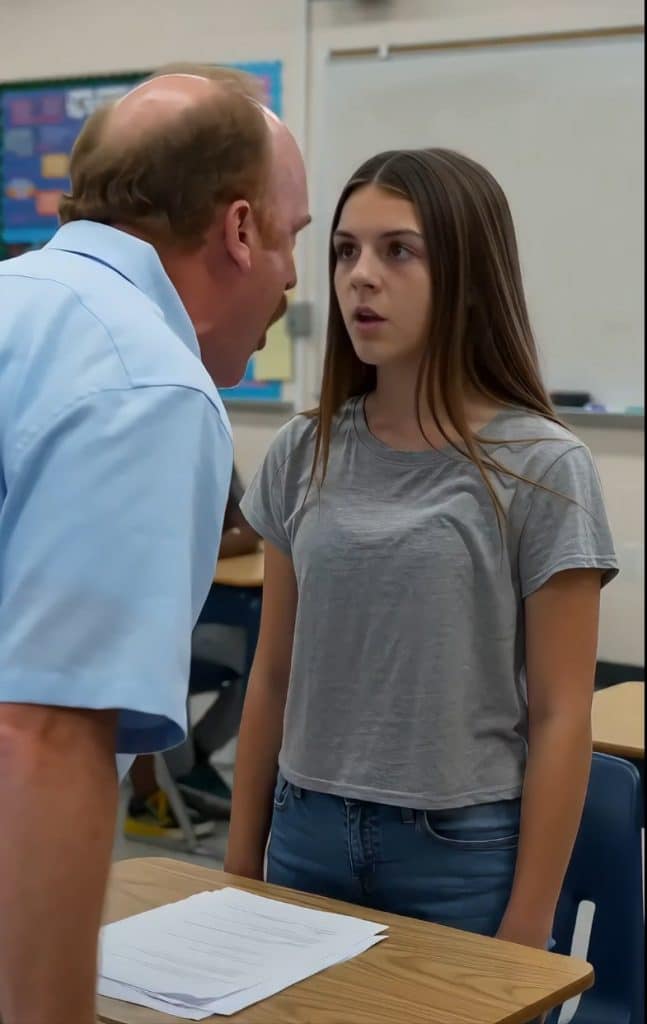
Mr. Grayson had already been shouting for almost a minute, but the sound of the pages sliding off Emma Carter’s desk was what made everyone understand this was no longer a lesson.
It was a warning.
White sheets scattered across the gray tile beside her chair. One page spun under the front leg of the desk. Another landed face-up near Emma’s sneakers, the bold black heading visible to half the room.
Westbridge High Internal Review — 2009.
Mr. Grayson stood over her, breathing hard.
His light blue shirt was wrinkled under the arms, his mustache twitching with anger, his face red from the kind of rage adults pretend is authority.
“Wait,” he snapped. “You want to correct me?”
Emma stood beside her desk with her hands at her sides.
She was seventeen, wearing a plain gray T-shirt and jeans, her long brown hair falling straight over her shoulders. Nothing about her looked threatening. Nothing except the fact that she would not sit down.
Mr. Grayson leaned closer.
“Huh? You think you know better? Sit down now.”
The class did not move.
Twenty-four teenagers sat frozen beneath the fluorescent lights, their notebooks open, pens abandoned, eyes darting between the teacher and the girl who had finally said no.
Emma’s voice came out steady.
“No. I’m not sitting.”
A chair creaked somewhere in the back.
Someone’s phone was half-raised beneath a desk.
Mr. Grayson saw it and pointed toward the class. “Put that away.”
Then he turned back to Emma.
“You have no idea who you’re talking to.”
That was when his hand dropped to the papers on her desk.
The same papers she had brought in a blue folder that morning. The same papers she had protected through first period, through lunch, through the walk down the hall while other students whispered that she was really going to do it.
He snatched the stack.
For one second, Emma’s eyes widened.
Then he slammed it back down so hard the front pages shot across the desk and spilled to the floor.
Paper scraped wood.
Pages slapped tile.
The class inhaled as one.
Emma lowered her eyes to the scattered documents.
Then she looked back up at him.
Her mouth did not tremble.
Her voice cut through the room, calm and clear.
“And you have no right to throw things at me.”
Mr. Grayson froze.
Because everyone heard it.
Because someone had recorded it.
And because those papers on the floor were not homework.
They were proof that the most feared teacher at Westbridge High had built his career on a lie.
Act II
For nine years, Thomas Grayson had been the teacher students warned each other about.
Not because he was strict.
Strict teachers could still be fair.
Mr. Grayson was different.
He had a way of making students feel small in front of witnesses. He circled desks slowly when someone gave a wrong answer. He repeated mistakes out loud for the whole class to hear. He called silence “proof of laziness” and questions “attitude.”
Parents loved him at first.
He was organized. He sent long emails. He spoke at school board meetings about discipline, standards, and how teenagers today needed consequences more than comfort.
The principal called him “old-school.”
Students called him something else.
Not in writing.
Never where adults could see.
Emma Carter had spent three years avoiding his attention.
She did her work. Sat near the middle. Answered only when called on. She learned that invisibility was safer than being right.
But Emma had a reason for taking his history elective senior year.
Her mother.
Rachel Carter had been a student at Westbridge High in 2009. Brilliant, quiet, and poor enough that teachers called her “promising” in the same tone they used for “unfortunate.”
Rachel was supposed to graduate at the top of her class.
Instead, she left school two months before graduation after being accused of stealing final exam materials from the faculty office.
The accusation ruined her.
Her scholarship disappeared. College disappeared. People who once praised her stopped meeting her eyes in grocery aisles. Rachel spent years working double shifts, raising Emma alone, carrying a disgrace she never deserved but could never disprove.
She died when Emma was fourteen.
A winter illness that became pneumonia too quickly.
After the funeral, Emma found a box under her mother’s bed.
Inside were report cards, scholarship letters, a photograph of Rachel in a graduation gown she never got to wear, and one folded note.
I didn’t steal anything. But no one believed me.
Emma read it until the creases tore.
For years, that was all she had.
Then, in August of senior year, the school announced Mr. Grayson would be teaching a new unit called Integrity and Consequences: Lessons from Westbridge History.
The first case study was her mother.
He did not name Rachel at first.
He called her “a student from 2009 who threw away a bright future by cheating.”
Emma sat in the second row and felt the room tilt.
Students glanced at her.
Some knew.
Most did not.
Mr. Grayson continued, voice heavy with moral satisfaction.
“She was caught because one teacher had the courage to protect academic honesty.”
Emma looked at the slide.
There was a scanned discipline memo.
Signed by Thomas Grayson.
In 2009, he had been a young assistant teacher trying to prove himself.
That night, Emma went to the public library and searched old school board archives until the librarian asked if she was all right.
The next week, she filed a records request.
Then another.
Then she contacted a retired secretary named Mrs. Alvarez, whose name appeared on old meeting minutes.
Mrs. Alvarez agreed to meet at a coffee shop.
She was seventy-two now, with sharp eyes and a memory that had waited too long to be useful.
“I always knew something was wrong,” she told Emma.
Then she gave her copies.
Not rumors.
Documents.
A missing access log.
An unsigned disciplinary addendum.
A staff memo showing that Mr. Grayson had been under review for losing exam materials days before Rachel was accused.
And one email, printed from an old backup server, in which Thomas Grayson wrote to the assistant principal:
If this gets traced to me, my career is finished. The Carter girl was in the hall after practice. Use that.
Emma stared at the sentence until the coffee went cold.
Her mother had not been careless.
She had been convenient.
And Thomas Grayson, now standing in front of her class as a moral authority, had used a teenager’s future to save his own.
Act III
Emma did not plan to confront him that day.
That was the part people misunderstood later.
They imagined bravery as something clean and premeditated, like walking into battle with music behind you.
But Emma had only meant to ask a question.
When Mr. Grayson put her mother’s case study on the whiteboard again, when he described “the damage one dishonest student can do to an institution,” something inside her refused to stay buried.
She raised her hand.
He looked annoyed before she spoke.
“Yes, Emma?”
The way he said her name told her he knew exactly whose daughter she was.
She stood.
The class shifted around her.
“Your timeline is wrong,” she said.
Mr. Grayson blinked. “Excuse me?”
“The exam materials were reported missing on March 12. My mother was accused on March 16. But the office access logs show she never entered the faculty wing that week.”
His face changed.
Just slightly.
Enough.
A hush moved through the class.
Mr. Grayson smiled, but it was thin. “Sit down.”
Emma opened the folder on her desk. “I have the records.”
“Emma.”
“I have the email too.”
His eyes went to the papers.
Then to the class.
Then to the phones.
That was when he lost control.
The shouting began.
He accused her of disrespect. Of disrupting class. Of making wild claims. He told her she was emotional, confused, and out of line.
She stayed standing.
The class watched the man who had humiliated students for years finally face someone who had brought receipts.
Then he threw the papers.
And Emma said the sentence that changed the room.
“And you have no right to throw things at me.”
The silence afterward was not empty.
It was full.
Full of recordings.
Full of witnesses.
Full of students realizing that authority could be wrong and still sound confident.
Mr. Grayson’s face tightened.
“Pick those up,” he said.
Emma did not move.
A boy named Malik stood from the back row.
“I’ll get them.”
Mr. Grayson whipped around. “Sit down.”
But Malik was already walking forward.
Then another student stood.
Then another.
Within seconds, half the class was out of their seats, gathering the pages from the floor and placing them carefully back on Emma’s desk.
No one spoke.
That made it worse for him.
There was no shouting to punish. No chaos to blame. Just students quietly refusing to let evidence stay scattered where he had thrown it.
The door opened.
Principal Voss stepped in, drawn by the noise or perhaps by the text someone had already sent.
“What is going on here?”
Mr. Grayson turned instantly.
“Emma Carter is making defamatory accusations in my classroom.”
Emma looked at the principal.
Then at the restored stack of papers.
Then at her classmates.
“No,” she said. “I’m finishing something my mother never got to finish.”
Act IV
By three o’clock, the video had reached every phone in the school.
By four, it had reached parents.
By six, it had reached the superintendent.
Mr. Grayson was placed on administrative leave the next morning.
The school used careful language.
Pending review.
Personnel matter.
Student safety.
Emma hated the careful language.
Her mother’s life had been destroyed by careful language.
Academic dishonesty.
Disciplinary action.
Withdrawal before graduation.
Words that sounded neat enough to hide cruelty.
But this time, people were watching.
Mrs. Alvarez came forward publicly. So did two former students who said Mr. Grayson had threatened them when they questioned grades. A retired assistant coach remembered Rachel Carter crying outside the office the day she was accused.
The old email was authenticated.
The access logs matched.
The final piece came from a sealed personnel file the district had never expected anyone to request. In 2009, Thomas Grayson had been quietly reprimanded for mishandling exam materials. Two weeks later, Rachel Carter was accused, and the issue disappeared.
At the school board hearing, Emma wore her mother’s old necklace beneath her gray blazer.
Mr. Grayson sat across the room with an attorney.
He did not look at her.
That bothered her more than if he had glared.
When she was called to speak, Emma unfolded a page with both hands.
Her voice shook at first.
Then steadied.
“My mother’s name was Rachel Carter,” she said. “She was not a case study. She was not a warning. She was not the dishonest student Mr. Grayson described to generations of students.”
The room was packed.
Students lined the walls. Parents stood in the back. Teachers sat with folded hands, some ashamed, some defensive, some quietly crying.
Emma continued.
“My mother lost her scholarship. She lost her graduation. She lost years of opportunity because an adult decided his future mattered more than hers.”
She looked at the board members.
“She spent the rest of her life being treated like a mistake she did not make.”
Mr. Grayson’s attorney shifted in his chair.
Emma turned toward him.
Not the lawyer.
The teacher.
“For years, you told students accountability builds character,” she said. “I hope you meant it.”
That was the moment he finally looked up.
His face was pale.
For the first time, Emma saw not power, not authority, not rage.
Fear.
The board voted unanimously to reopen Rachel Carter’s disciplinary record. The accusation was formally vacated. Her transcript was corrected. Her diploma, withheld for fifteen years, would be issued posthumously.
Then came the second vote.
Thomas Grayson’s employment was terminated.
The room did not erupt.
It exhaled.
Emma sat down before her legs gave out.
Malik, seated behind her, placed one hand gently on the back of her chair.
“You did it,” he whispered.
Emma stared at the table.
No.
She thought of her mother’s note.
I didn’t steal anything. But no one believed me.
Now they did.
That was not the same as getting her back.
But it was something.
It was the first clean breath after years of dust.
Act V
The diploma arrived in a dark blue folder two weeks later.
The school held a small ceremony in the auditorium.
Emma almost refused to attend.
She told herself it was too late. Her mother would never frame it. Never hold it. Never smile awkwardly while someone took a picture. Never know what it felt like to walk across the stage while people clapped for the truth instead of whispering about a lie.
But Mrs. Alvarez called her the night before.
“Your mother deserved a witness,” she said. “So do you.”
Emma went.
The auditorium was full, but quiet.
Principal Voss walked to the microphone and apologized publicly. Not perfectly. Not enough. But clearly.
Then he said Rachel Carter’s name.
For once, no one said it with shame attached.
Emma walked onstage and accepted the diploma on her mother’s behalf.
The folder felt heavier than paper.
It felt like all the years Rachel had carried alone.
When Emma turned toward the audience, students rose first.
Then parents.
Then teachers.
Applause filled the room slowly, then fully, until Emma had to look down because she could not hold all those faces at once.
In the front row, Mrs. Alvarez was crying openly.
Malik clapped with both hands above his head.
And near the back of the auditorium, several students from Mr. Grayson’s class stood together, the same students who had picked the papers off the floor without saying a word.
Afterward, Emma went alone to the cemetery.
The grass was damp from morning rain. Her mother’s headstone was small and simple.
Rachel Carter
Beloved Mother
1986–2021
Emma sat beside it and placed the diploma against the stone.
For a long time, she said nothing.
Then she whispered, “They know.”
Wind moved through the trees.
She wished there were a better ending than that.
A way for justice to rewind instead of merely arrive late.
But life did not give back stolen years. It did not return missed graduations or unopened college letters. It did not undo the nights Rachel had come home exhausted, smiling anyway because Emma needed dinner and homework help and a mother who did not collapse under the weight of what had been taken from her.
Justice was not magic.
It was repair.
Slow, imperfect, necessary repair.
Months later, Westbridge High changed.
Not completely.
No place changes completely just because one cruel man leaves.
But something shifted.
Teachers were required to document disciplinary claims with more than authority and volume. Students learned where to report misconduct. The school created an archive review committee for old cases involving withdrawals and discipline.
Emma joined it after graduation as a student representative.
The first time she walked back into a classroom to speak about student rights, her hands shook.
Then she saw a sophomore girl in the second row watching her with wide, anxious eyes.
Emma thought of her mother.
She thought of the papers on the floor.
She thought of the moment she had wanted to cry but spoke instead.
So she began.
“You are allowed to ask questions,” Emma told them. “You are allowed to be treated with respect. And when an adult has power over you, that power comes with responsibility.”
A teacher near the door nodded.
The sophomore girl wrote something down.
After the session, she came up to Emma.
“My teacher said I was making things up,” the girl whispered. “But I kept notes.”
Emma looked at her.
Then smiled softly.
“Good.”
That was how the story continued.
Not with one dramatic victory.
With evidence kept.
Questions asked.
Students believed.
Adults held accountable.
And a girl who had once stood beside a desk while a furious teacher threw her papers, now teaching others that dignity does not disappear just because someone tries to scatter it across the floor.
Years later, Emma kept one page from that day.
Not the email.
Not the board decision.
One ordinary sheet with a bent corner and a faint gray mark from where it had landed on the classroom tile.
She framed it beneath her mother’s diploma.
People sometimes asked why.
Emma always answered the same way.
“Because that was the day the lie fell apart.”
But privately, she knew it was more than that.
It was the day a room full of silent students saw papers thrown like they were worthless and decided, one by one, to pick them back up.
It was the day her mother’s name began returning to her.
Not as disgrace.
Not as rumor.
As truth.