Act I
The first thing that hit the counter was her breath.
Then her hands.
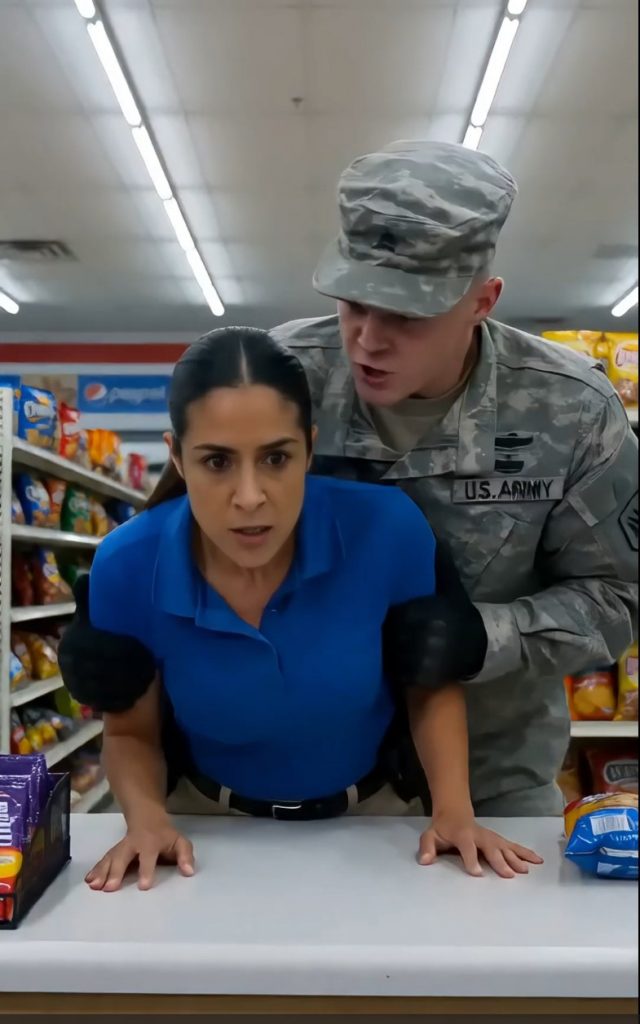
Nina Hale slammed forward against the checkout counter hard enough to make the candy display tremble. A row of gum packs slid sideways. The scanner beeped once by accident. Behind her, the man in camouflage leaned close, both black-gloved hands still raised from the shove.
“You think you’re tough, huh?” he barked.
The convenience store went silent.
Outside the glass doors, the night glowed under the white lights of the gas pumps. Four men and a woman stood near a parked pickup, frozen with drinks and snack bags in their hands, staring through the glass like they could not believe what they had just seen.
Inside, fluorescent lights buzzed overhead.
Chips. Cookies. Soda coolers. Lottery tickets. All the ordinary things of a gas station night suddenly looked too bright, too clean, too harmless for what was happening at the register.
Nina caught herself with both palms on the counter.
Her blue polo stretched across her shoulders. Her radio clipped at her waistband knocked against the edge of the register. For half a second, she looked like any young cashier caught off guard by a man twice as confident and far too used to being obeyed.
The soldier grabbed her arm.
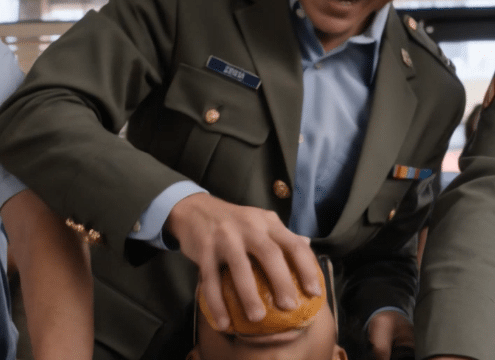
His uniform was crisp enough to look real. The patch on his chest read U.S. ARMY. The name tape above the pocket read FHEANY.
His face was twisted with rage.
“Answer me,” he snapped. “You think you can talk back to me?”
Nina looked up at him from the side.
Fear passed across her face.
Then something colder replaced it.
Not anger.
Recognition.
The soldier did not notice.
Men like him rarely noticed the exact second a woman stopped being afraid of them.
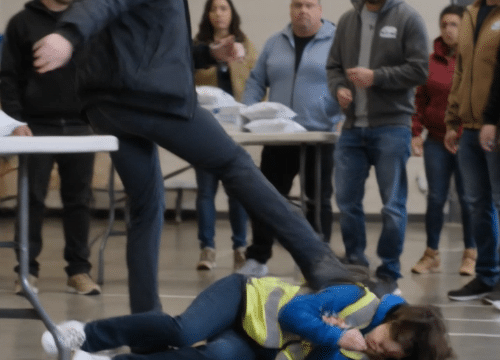
He shoved her again, driving her toward the glass exit. Nina stumbled through the doorway and hit the pavement outside, but she did not land the way he expected. She tucked, rolled over one shoulder, and came up with one hand on the ground, eyes already locked on him.
The onlookers gasped.
The soldier stepped out after her, smirking.
“Stay down.”
Nina rose slowly.
Her breathing was steady now.
Her hands came up, compact and controlled. Her feet shifted into balance under the gas station lights.
And for the first time, the man in the uniform seemed uncertain.
Because the cashier he had thrown outside was not looking at him like a victim anymore.
She was looking at him like evidence.
Act II
Nina Hale was not supposed to be working nights at a gas station.
At least, that was what people told her.
She had been top of her class once. Full scholarship. ROTC recommendation. A future that looked sharp and official on paper.
Then her father died, her mother’s health collapsed, and her younger brother, Aaron, came home from deployment a different person than the boy who had left.
So Nina stayed.
She dropped out for a year that became two. She took the late shift at the QuickMart because it paid extra, because her mother needed medication, because Aaron slept better when someone was awake in the house after midnight.
She learned to scan beer and microwave burritos while listening for panic calls from home.
She learned which truckers were kind, which teenagers were trouble, and which men walked in already looking for someone smaller to blame.
But before all of that, she had trained.
Not for sport.
Not for ego.
Her father had been a boxing coach before the illness took his lungs. He taught Nina footwork in their garage when she was twelve, with duct tape lines on the concrete and a kitchen timer on an old stool.
“Power is loud,” he used to say. “Balance is quiet.”
Aaron taught her the rest when he came home.
He hated talking about where he had been, but movement helped him breathe. So they trained together in the backyard at dawn, him correcting her stance, her making him laugh when he got too serious.
Then one night, Aaron vanished.
No goodbye. No note. Just his truck found behind a warehouse near the interstate, his phone smashed under the seat, his service jacket missing from his closet.
The police called it a voluntary disappearance.
Nina never believed that.
Aaron had left one thing behind: a photograph of three men outside a private security office.
One of them wore an Army uniform.
One had a name Nina could never forget.
Fheany.
She had spent months searching. Asking questions. Getting doors closed in her face. Every path led nowhere, or to people who suddenly stopped answering.
Then, two hours before the shove, the man walked into her store.
Same face.
Older than the photograph, but unmistakable.
The uniform made her stomach turn.
He bought nothing. He wandered the aisles, watching the exits. When Nina asked if he needed help, he smiled like he had been waiting for her to ask.
“You’re Aaron Hale’s sister,” he said.
The words froze her.
“What did you say?”
His smile widened. “Small world.”
Then he placed a folded receipt on the counter.
On the back, written in Aaron’s handwriting, were four words.
Don’t trust the uniform.
Nina looked up.
That was when he shoved her.
Not because she had insulted him.
Because she had recognized him.
Because whatever Aaron had found before he disappeared had finally walked into the light.
And now the man in the stolen honor of a uniform was standing outside the gas station, realizing too late that Nina Hale had been waiting two years for an answer.
Act III
He came at her fast.
Too fast for a man who thought she was helpless.
Nina moved off his line instead of backward. His hand cut through empty air. His boots scraped against the pavement.
The onlookers near the pumps scattered, but nobody left.
One man had his phone raised now.
Another shouted, “Call 911!”
The soldier swung again, wild with embarrassment.
Nina slipped inside his reach and struck once, clean and short, not to punish him but to stop him. He stumbled, shocked more than hurt, and tried to grab her uniform shirt.
She broke the grip and drove him back with a precision that made the gas station fall into stunned silence.
This was not panic.
This was discipline.
Every movement was compact. Every step had purpose. She never chased him. She never lost her balance. She made him waste energy, made his anger turn clumsy, made his confidence crack under the bright pump lights.
He tried to charge.
She dropped low, disrupted his stance, and forced him sideways. When he staggered, she followed with quick, controlled strikes that made him retreat instead of advance.
His expression changed.
First rage.
Then disbelief.
Then fear.
The man who had thrown her through a doorway was now backing away from a cashier in khaki pants and a blue polo, breathing hard while his own uniform became the ugliest thing about him.
“Who are you?” he gasped.
Nina did not answer.
Not yet.
He reached toward his belt.
Her eyes snapped to the movement.
Before he could pull anything free, she turned through one final kick that sent him crashing backward across the slick pavement near the pumps. He landed hard and stayed there, dazed, the fight gone out of him.
The onlookers stood with their mouths open.
Nina remained upright, hands still half-raised, chest rising and falling with controlled breaths.
Then the soldier’s jacket shifted.
A small black pouch spilled from inside his uniform.
Papers slid across the pavement.
One stopped near Nina’s shoe.
She looked down.
It was Aaron’s military ID.
Her brother’s face stared up at her from the wet concrete.
The world narrowed to that card.
Then, from the soldier on the ground, came a bitter laugh.
“You still don’t know where he is.”
Act IV
Nina picked up the ID with trembling fingers.
The police arrived six minutes later.
By then, the soldier had given up trying to stand. Two onlookers kept their distance but blocked the exit lane with a pickup. The woman from the pumps had wrapped her jacket around Nina’s shoulders, though Nina did not remember accepting it.
Officer Ramirez was the first inside the glow of the station lights.
He saw the uniform. The scattered papers. The cashier with a scraped elbow and a military ID in her hand. Then he saw the name tape.
His face changed.
“Fheany,” he said quietly.
Nina looked at him. “You know him?”
Ramirez crouched near the man on the ground and pulled the name tape loose.
It came off too easily.
Underneath was another name.
Not stitched.
Printed on an older uniform panel.
KELLER.
Ramirez swore under his breath.
The man on the pavement smiled through swollen pride. “Careful, officer.”
Ramirez ignored him and looked at Nina.
“This man is not active Army. He’s been using stolen uniforms and veteran credentials to move through restricted spaces. We’ve been looking for him for months.”
Nina’s fingers tightened around Aaron’s ID.
“My brother?”
Ramirez’s voice softened. “We had reason to believe Aaron Hale was helping us build the case.”
Nina’s knees almost weakened.
“Helping you?”
“He contacted our office under another name. Said a private security crew was recruiting former soldiers, then using their documents for illegal transport jobs. He disappeared before he could testify.”
Keller laughed again.
Nina turned toward him.
“Where is he?”
Keller looked up at her from the pavement, all his earlier arrogance reduced to spite.
“Ask your boyfriend with the badge.”
Ramirez stepped forward, but Nina lifted a hand.
Not to protect Keller.
To stop herself from becoming what he wanted.
She crouched just far enough to meet his eyes.
“You came here because Aaron left me something,” she said.
Keller’s smile flickered.
There it was.
The truth.
Nina stood and ran back inside.
The receipt.
It was still on the counter, half tucked beneath the register mat.
Don’t trust the uniform.
She turned it over, searching every inch. Nothing.
Then she remembered Aaron.
He never wrote the real message where people expected it.
She held the receipt under the scanner light.
Faint numbers appeared along the edge, written in pressure marks rather than ink.
A storage unit code.
Ramirez read it over her shoulder.
The unit was less than three miles away.
By midnight, police opened it.
Inside were boxes of stolen IDs, forged travel papers, burner phones, and a laptop wrapped in duct tape.
And at the very back, sitting on an overturned crate with zip ties around his wrists, was Aaron Hale.
Alive.
Thinner. Bruised. Furious.
But alive.
When he saw Nina, he tried to smile.
“Took you long enough,” he said.
She burst into tears before she reached him.
Act V
The story hit the news before sunrise.
The headline changed depending on the outlet.
Gas Station Cashier Stops Violent Impostor.
Missing Veteran Found After Convenience Store Attack.
Woman Fights Back After Being Assaulted by Man in Stolen Army Uniform.
Nina hated all of them.
They made it sound clean.
None of it was clean.
Her elbow hurt for days. Her ribs ached from hitting the pavement. She woke twice that week hearing the slap of her palms against the counter and the soldier’s voice in her ear.
But Aaron was home.
That made the pain easier to carry.
He spent three nights in the hospital, then two weeks refusing to rest in the exact way that made Nina threaten to duct tape him to the couch. Their mother cried every time she passed his bedroom door and saw him there.
Keller talked once the charges stacked high enough.
He gave names.
Private contractors. Corrupt warehouse managers. Two officials who had looked the other way while stolen military credentials moved through shipping routes and secure sites. Aaron had found the network by accident, then stayed inside long enough to gather proof.
Too long.
But not for nothing.
The storage unit evidence broke the case open.
The real Sergeant Fheany, whose name had been used, was cleared publicly. Other veterans whose identities had been stolen were notified. Keller’s uniform, once a weapon of intimidation, became evidence in a courtroom where nobody stood when he entered.
Nina testified.
She wore the same blue polo.
Not because she had to.
Because she wanted Keller to see it.
He would never understand that uniform did not make him powerful. Neither did gloves. Neither did shouting. Neither did shoving someone smaller through a door.
Power was not the costume.
Power was getting back up.
After the trial, people came to the QuickMart for weeks just to see her.
Some asked for selfies.
Some called her a hero.
One man said she should become a cop.
Another said she should teach self-defense.
Nina smiled politely and scanned their chips.
She knew what they meant.
But she also knew heroes still had bills, mothers who needed rides to appointments, and brothers who woke from nightmares at 3:17 every morning.
Life did not become cinematic after justice arrived.
It became ordinary again.
Blessedly ordinary.
Aaron fixed the loose cabinet door in the kitchen. Nina returned to night shifts. Their mother complained that both of them drank too much coffee. Officer Ramirez stopped by the store once a week, always pretending he only needed gum.
Three months later, Nina found an envelope taped beneath the counter at work.
For one frozen second, her heart stopped.
Then she recognized Aaron’s handwriting.
Inside was a photograph.
Their father in the old garage, holding boxing gloves.
Nina and Aaron as kids, standing beside him in terrible fighting stances, all elbows and attitude.
On the back, Aaron had written:
Balance is quiet. You proved him right.
Nina laughed.
Then cried behind the register while a customer in aisle three politely pretended not to notice.
That night, when her shift ended, she stepped outside into the gas station lights.
The pavement where she had fallen had been washed clean by rain. Cars moved along the highway. The store hummed behind her. Nothing about the place looked extraordinary.
But Nina knew better.
Some places keep the shape of what happened there.
She stood where Keller had shoved her.
Then where she had risen.
The glass doors reflected her face back at her: tired, serious, alive.
Aaron pulled up in his truck, leaning out the window.
“You coming or are you planning to intimidate the parking lot?”
Nina wiped her eyes quickly. “Shut up.”
He grinned.
She walked toward him, keys in hand, shoulders relaxed beneath the blue polo.
Behind her, the store lights buzzed on.
Ahead of her, her brother was waiting.
For two years, she had lived inside a question.
That night, the answer sat in an old truck with the heater running, complaining about hospital food and pretending not to cry when she climbed in.
Nina looked back once at the convenience store.
At the counter.
At the doors.
At the place where a man in a stolen uniform thought he had found someone easy to break.
He had been wrong.
He had not found weakness.
He had found a sister who remembered every lesson her father taught her, every warning her brother left behind, and every reason to stand up when the world expected her to stay down.