Act I
The baby had been crying for forty-seven minutes.
Sofia knew because she had counted every one.
At first, she told herself it was ordinary. Infants cried. Sometimes they cried because they were hungry, tired, cold, too warm, lonely, uncomfortable, or simply alive in a body too new to explain itself.
But this cry was different.
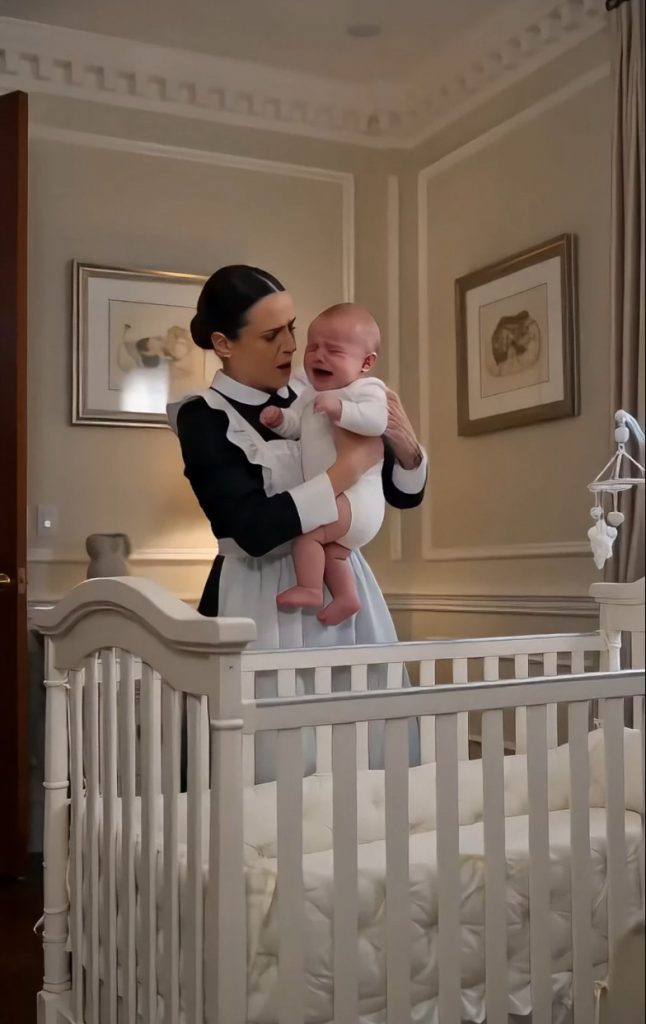
It came in sharp waves from the nursery at the end of the grand hallway, rising and breaking against the polished walls of the Whitmore mansion while the crystal chandelier glittered above as if nothing in the house could ever be wrong.
Sofia stood outside the nursery door, one hand on the frame.
Inside, baby Oliver lay in a white wooden crib surrounded by cream blankets, framed nursery prints, a gold-trimmed lamp, and more softness than most children ever knew.
And still, he screamed like something in that perfect room was hurting him.
Sofia pushed the door open.
Before she could take two steps, a voice cut through the hallway.
“Make it stop!”
Camille Whitmore stood halfway down the staircase in a gold silk robe, one hand gripping the banister. Diamonds flashed at her ears. Her dark hair fell in smooth waves over her shoulders, and her face was tightened not with worry, but irritation.
Sofia looked back at her.
“Mrs. Whitmore, I think something may be wrong.”
Camille’s eyes narrowed.
“What’s wrong is that I pay you to keep this house peaceful.”
The baby cried harder.
Sofia turned away and hurried into the nursery.
She lifted Oliver carefully, supporting his head against her shoulder. He was warm, trembling, his tiny fists clenched against her uniform. She bounced him gently, whispered to him, checked his blanket, his bottle, his diaper.
Nothing helped.
Then, as she adjusted the back of his white onesie, her fingers stopped.
Two red marks crossed the baby’s back.
Not scratches from tiny nails. Not the usual marks from fabric folds. These were broad, angry-looking impressions, like something had pressed against him again and again while he lay helpless in the crib.
Sofia’s breath caught.
“Oh, sweetheart,” she whispered.
Oliver sobbed against her neck.
Behind her, Camille’s voice floated from the hallway, colder now.
“Is he quiet yet?”
Sofia did not answer.
She laid Oliver safely in the padded bassinet beside the changing table and turned back to the crib. Her heart pounded as she pulled at the sheet. The bedding was pristine, expensive, tucked with perfect corners.
Too perfect.
She stripped the sheet back.
Then the mattress protector.
The elastic snapped softly under her trembling hands.
Beneath the white cover, the mattress was not clean.
A brownish-red stain spread across one corner, old but unmistakable against the pale fabric. Beside it, half tucked under the seam, was a folded piece of paper.
Sofia reached for it.
Her fingers shook as she unfolded the note.
Only one sentence was written inside.
This is not the first baby.
Act II
Sofia Marquez had worked in wealthy homes long enough to understand that luxury could hide almost anything.
It could hide loneliness behind marble floors. It could hide screaming matches behind soundproof theater rooms. It could hide unpaid staff behind charity galas and cruelty behind good manners.
But the Whitmore house had felt wrong from the first day.
Not obviously wrong.
No broken glass. No shouting in front of guests. No bruised staff whispering in corners.
Just a coldness beneath the beauty.
The nursery was too perfect. Camille was too distant. The household staff moved too quietly around the baby, as if speaking his name too loudly might summon consequences.
Sofia had been hired three weeks earlier after the previous nanny “left suddenly.” Camille said this with a little shrug over breakfast, as if nannies were flowers that wilted and needed replacing.
“She became emotional,” Camille said. “I cannot have emotional women around my son.”
Sofia had almost walked out that day.
Then Oliver cried from upstairs.
That sound changed everything.
He was four months old, small and serious-eyed, with a little crease between his brows that appeared whenever he studied someone’s face. The first time Sofia picked him up, he quieted instantly and grabbed the collar of her uniform with one tiny hand.
She stayed because of him.
Camille rarely held him.
She posed with him when photographers came. She kissed his forehead at charity luncheons. She called him “my miracle” when other society women visited with flowers and champagne.
But when no one watched, Camille treated Oliver like an object that had arrived late and inconveniently.
“Don’t let him wrinkle that blanket.”
“Don’t feed him in the blue room.”
“Don’t bring him downstairs when my friends are here.”
“Don’t let him cry where I can hear it.”
Sofia had worked for distant mothers before, but Camille’s distance felt sharper.
Fearful.
As if the baby carried a secret she could not bear to touch.
The staff knew something too.
The housekeeper, Mrs. Bell, avoided the nursery after sunset. The driver refused to speak about the west wing. The cook crossed herself whenever Camille’s mother-in-law visited and asked to see “the child.”
But no one explained.
They only said, “Be careful.”
Sofia had grown up in a different kind of house. Small apartment, loud kitchen, cousins everywhere, her mother singing while stirring soup, her father fixing broken things on the table because there was no garage.
When Sofia became a nanny, her mother told her, “People will trust you with their children, but sometimes the children will trust you first. Listen to them.”
So Sofia listened.
Oliver’s cry that night was not hunger.
It was warning.
Now she stood over the crib, the folded note in her hand, while the baby whimpered in the bassinet behind her.
This is not the first baby.
Sofia read it three times.
The handwriting was rushed, slanted hard across the paper. At the bottom, almost hidden by a smear of old ink, was another line.
Ask about Nathaniel.
The nursery door creaked.
Sofia turned.
Camille stood in the doorway.
Her silk robe gleamed under the soft lamp light, but her face had gone completely still.
“What are you holding?” she asked.
Sofia closed her fist around the note.
And for the first time since she entered the Whitmore house, Camille looked afraid.
Act III
Sofia slipped the note into her apron pocket before Camille could cross the room.
“Nothing,” she said.
It was a bad lie.
Camille knew it. Sofia knew it. Even Oliver, still hiccuping through tiny sobs, seemed to know the room had changed.
Camille stepped closer to the crib.
Her eyes moved to the stripped bedding, the exposed mattress, the stain.
For one second, something like panic broke through her polished face.
Then it vanished.
“You had no right to tear apart my nursery.”
“There are marks on Oliver’s back,” Sofia said.
Camille’s mouth tightened. “Babies mark easily.”
“Not like this.”
“You are a nanny, Miss Marquez. Not a doctor.”
“Then call one.”
Silence.
It was the wrong answer, and both women felt it.
Camille looked toward the bassinet, where Oliver had gone quiet except for small shivering breaths.
“No doctor,” she said.
Sofia’s stomach turned cold.
“Mrs. Whitmore—”
“I said no doctor.”
The command filled the nursery.
But Sofia was no longer listening like an employee.
She was listening like someone standing in front of a locked room with a child inside it.
“Who is Nathaniel?” she asked.
Camille’s face changed so quickly that Sofia almost stepped back.
Rage came first.
Then grief.
Then fear.
“You should leave,” Camille said softly.
“I’m not leaving Oliver.”
“He is my son.”
“Then act like it.”
The slap never came, but the room felt as if it had.
Camille straightened.
“You forget your place.”
“No,” Sofia said, voice trembling but firm. “I just remembered it.”
A sound came from the hallway.
A cane tapping against wood.
Both women turned.
Eleanor Whitmore, Camille’s mother-in-law, stood in the doorway.
She was seventy-five, silver-haired, draped in black cashmere, her face pale under the chandelier glow. Sofia had seen her only twice before. Both times, Camille had sent Oliver upstairs before Eleanor could hold him.
Now the older woman stared at the exposed mattress.
Her hand tightened on the head of her cane.
“Where did you find it?” Eleanor asked.
Camille spun toward her. “Go back to your room.”
Eleanor ignored her.
Her eyes stayed on Sofia.
“The note,” she said. “Where did you find it?”
Sofia pulled it slowly from her pocket.
Camille lunged.
Eleanor struck her cane against the floor.
“Enough.”
The word cracked through the nursery with an authority Camille had not expected.
Sofia handed the note to Eleanor.
The old woman opened it.
Her eyes filled before she finished the first line.
“Nathaniel,” she whispered.
The name fell into the room like a body into deep water.
Camille’s face hardened. “Don’t.”
Eleanor looked at her daughter-in-law with a grief so old it had become steel.
“You told me he was stillborn.”
Sofia’s breath caught.
Camille said nothing.
Eleanor’s voice shook.
“My grandson. My first grandson. You told us he never breathed.”
Camille looked away.
Sofia understood then that the stain in the crib was not just a stain.
The note was not just a warning.
Oliver’s cries had opened the door to a death the house had buried in silk and silence.
Act IV
The truth came out in pieces, because lies built over years do not collapse cleanly.
Nathaniel had been the first Whitmore heir.
Born three years before Oliver, after a pregnancy Camille had treated like a crown. The family celebrated him before he arrived. Newspapers printed announcements. The nursery was designed by a famous decorator. Eleanor ordered a silver rattle engraved with his initials.
Then, suddenly, Camille claimed the baby was gone.
A private medical tragedy. No visitors. No questions. No funeral the staff were allowed to attend.
Eleanor had begged to see him.
Camille refused.
Her husband, Julian Whitmore, was overseas finalizing a business merger when it happened. By the time he returned, Camille had already cremated what she said were the remains and locked the nursery.
The previous nanny, a young woman named Grace, had been the only person in the house that night.
She disappeared two days later.
“She left,” Camille said whenever anyone asked.
But Grace had not left quietly.
She had hidden the note under the mattress.
This is not the first baby.
Ask about Nathaniel.
Eleanor called Julian from the nursery with shaking hands.
For once, Camille could not stop her.
Within twenty minutes, the mansion filled with voices. Julian arrived still in his evening suit, hair windblown, face hollow when he saw his mother holding Oliver and Sofia standing beside the stripped crib.
“What happened?” he demanded.
Camille moved toward him. “Julian, she’s trying to manipulate your mother.”
But Julian was staring at the mattress.
Then at the note.
Then at Sofia.
“What marks?” he asked.
Sofia showed him gently, without exposing Oliver more than necessary. Julian’s face went gray.
“Call Dr. Patel,” he said.
Camille snapped, “No.”
Julian turned on her.
His voice was quiet.
That made it worse.
“Why not?”
Camille looked at the baby in Eleanor’s arms.
For the first time, she looked less like a woman protecting her status and more like a woman trapped under the wreckage of her own fear.
“He wouldn’t stop crying,” she whispered.
No one moved.
Camille pressed her fingers to her mouth.
“Nathaniel cried all night. Every night. I couldn’t sleep. I couldn’t think. Everyone kept saying I should be grateful. That he was perfect. That I was blessed.”
Eleanor’s face crumpled.
Camille continued, voice growing distant.
“I wasn’t made for it. The noise. The need. The way everyone looked at me like motherhood should have fixed whatever was wrong inside me.”
Julian took one step back, as if the woman before him had become a stranger.
“What happened to our son?”
Camille shook her head. “I didn’t mean—”
“What happened?”
She broke then.
Not beautifully. Not dramatically. Just a collapse of composure so complete that the wealth around her looked suddenly ridiculous.
Nathaniel had not been stillborn.
He had died in that nursery after repeated neglect and panic, while Grace begged Camille to call for help. Camille’s family physician had covered the truth to protect the Whitmore name. Grace was paid to disappear, but before she left, she hid the note for the next person who might listen.
Oliver had been born into the same room.
Placed in the same crib.
Under the same silence.
And that night, beneath the mattress protector, a small hard ridge from the old damaged mattress seam had pressed into his back, making him scream until someone finally investigated what everyone else had been trained not to see.
Sofia covered her mouth, horrified.
Eleanor held Oliver tighter.
Julian called the police himself.
Camille did not fight when they came.
She only looked once at the crib and whispered, “I thought if everything looked perfect, it would be different this time.”
Sofia looked at the white walls, the framed art, the silk curtains, the soft lamp.
Perfect.
That was the most dangerous lie in the room.
Act V
Oliver did not sleep in that nursery again.
Before midnight, he was taken to the hospital, where doctors confirmed he would recover physically with care and monitoring. The marks faded over time. The deeper wounds belonged to the adults who had failed him, and those would take longer to face.
Sofia stayed at the hospital until sunrise.
No one asked her to.
No one told her to go.
Julian sat in the hallway with his head in his hands while Eleanor rocked Oliver in a chair, humming a lullaby she had never been allowed to sing to Nathaniel.
When Sofia finally stepped out for coffee, Julian followed.
“Miss Marquez,” he said.
She turned.
He looked older than he had hours earlier.
“I don’t know how to thank you.”
Sofia’s eyes burned from exhaustion.
“Thank Grace,” she said. “She left the note.”
Julian looked down.
“And you found it.”
“No,” Sofia said softly. “Oliver did. He cried until someone listened.”
That sentence stayed with the family.
It appeared later in court, when prosecutors described how long the truth had been hidden beneath wealth, fear, and reputation. The doctor who falsified Nathaniel’s records was arrested. Grace, the former nanny, was found living under a different name in another state. She testified with trembling hands and a steady voice.
She had carried guilt for three years.
No one in the courtroom blamed her more than she blamed herself.
Camille’s trial became a public scandal, but Sofia hated that word. Scandal made it sound like gossip. Like ruined parties and newspaper columns. This was not scandal.
This was a child.
Two children.
One lost, one saved because a nanny refused to obey a woman who cared more about silence than crying.
Julian sold the mansion within the year.
He said it was because the house had too many memories, but Eleanor corrected him.
“No,” she said. “It has too many lies.”
They moved into a smaller home near the river, with wide windows, creaky floors, and a nursery painted pale yellow instead of white. Oliver’s crib was simple. New. Checked twice by Eleanor and three times by Sofia before anyone put him in it.
Sofia did not remain a maid.
Julian offered her money first. She refused most of it. Then he offered to pay for nursing school, after learning she had once given up that dream to help support her younger brothers.
That, she accepted.
“Not as a reward,” she told him.
Julian nodded. “As a correction.”
Sofia became a pediatric nurse five years later.
On the day she graduated, Eleanor sat in the front row with Oliver, now a bright-eyed little boy who whispered too loudly through the ceremony and clapped at the wrong time.
Afterward, he ran to Sofia and wrapped his arms around her legs.
“You help babies,” he said.
She knelt to his height.
“I try.”
He frowned, serious as only children can be. “You helped me when I was a baby.”
Sofia touched his cheek.
“Yes,” she said. “You helped me too.”
Eleanor watched them with tears in her eyes.
The old nursery was gone by then.
The mansion had been renovated by new owners who knew nothing about the crib, the note, or the child whose name had been erased from family conversation until one night another baby cried loudly enough to disturb the beautiful lie.
But Sofia kept a copy of Grace’s note.
Not the original. That belonged in evidence, then later in Oliver’s family archive beside Nathaniel’s corrected certificate and a photograph Julian finally placed on the mantel.
Sofia kept a handwritten copy in the back of her nursing journal.
This is not the first baby.
Ask about Nathaniel.
To others, it sounded like a warning.
To Sofia, it became a vow.
Listen before the powerful explain.
Look beneath what is polished.
Trust the cry that will not stop.
Years later, when a young trainee asked how Sofia always seemed to know when something was wrong, Sofia thought of the Whitmore nursery. The cream walls. The gold robe in the doorway. The mattress cover pulling back. The small note that turned a mansion inside out.
She did not tell the whole story.
Some stories belong first to the children who survived them.
She only said, “A baby can’t tell you the truth in words. So you learn to read everything else.”
Then she walked into the next room, where another child was crying.
Not every cry hid a secret.
Not every beautiful room concealed danger.
But Sofia had learned that compassion is not soft when it matters most. Sometimes it is quiet hands lifting a baby from a crib. Sometimes it is a young woman standing up to a wealthy mother in a mansion full of people paid not to hear.
And sometimes justice begins with one simple, trembling question in a nursery that was never as perfect as it looked.
What is this?