Act I
The boy stood outside the bakery window with his breath fogging the glass.
Inside, steam curled around trays of golden buns. Warm light spilled over wooden shelves stacked with bread, rolls, and soft white loaves dusted with flour. The whole shop smelled like butter, yeast, and safety.
Outside, Oliver Reed opened his hand.
Three coins sat in his dirty palm.
He counted them once.
Then again.
As if the number might change if he looked harder.
His stomach growled so loudly that he pressed one arm across it, embarrassed even though no one had heard. His shirt was torn near the collar. One of his shoes had a hole at the toe. Dirt smudged his cheek in a thin gray line.
Behind the counter, Mr. Thomas Bellamy turned a tray of fresh buns toward the window.
Oliver watched two of them roll slightly together.
Two.
That was all he needed.
Not a bag. Not a box. Not anything greedy.
Just two.
He pushed the coins into his pocket, swallowed hard, and stepped toward the bakery door.
The bell above it jingled when he rushed inside.
Thomas looked up.
For one second, Oliver froze in the warm air. The heat wrapped around him. His eyes flicked to the counter, to the buns, to the owner’s hands.
Then desperation moved before fear could stop it.
Oliver snatched two steamed buns from the tray, clutched them against his chest, and ran.
“Hey!” Thomas shouted. “Stop! Thief!”
The word chased Oliver harder than the man did.
Thief.
He burst through the door, nearly slipping on the front step. Behind him, Thomas grabbed a wooden broom from beside the counter and charged into the street, apron swinging, face red with anger.
Oliver did not look back.
He ran down the narrow sidewalk, past shuttered shops and cracked brick walls, the two buns pressed to his chest like they were something alive. His breath tore in and out of him. His legs burned. His heart hammered against his ribs.
Thomas followed, broom in hand, furious at first.
Then confused.
The boy was not running toward an alley.
He was not laughing.
He was not eating.
He was running toward the oldest house at the end of Willow Lane, the one with peeling paint, broken steps, and curtains that never opened.
Oliver shoved the door with his shoulder and disappeared inside.
Thomas slowed at the threshold.
The house smelled cold.
Not dirty exactly.
Just empty. Damp. Tired.
He stepped in, still gripping the broom, and followed the sound of a child crying.
At the end of a narrow hall, he found the bedroom.
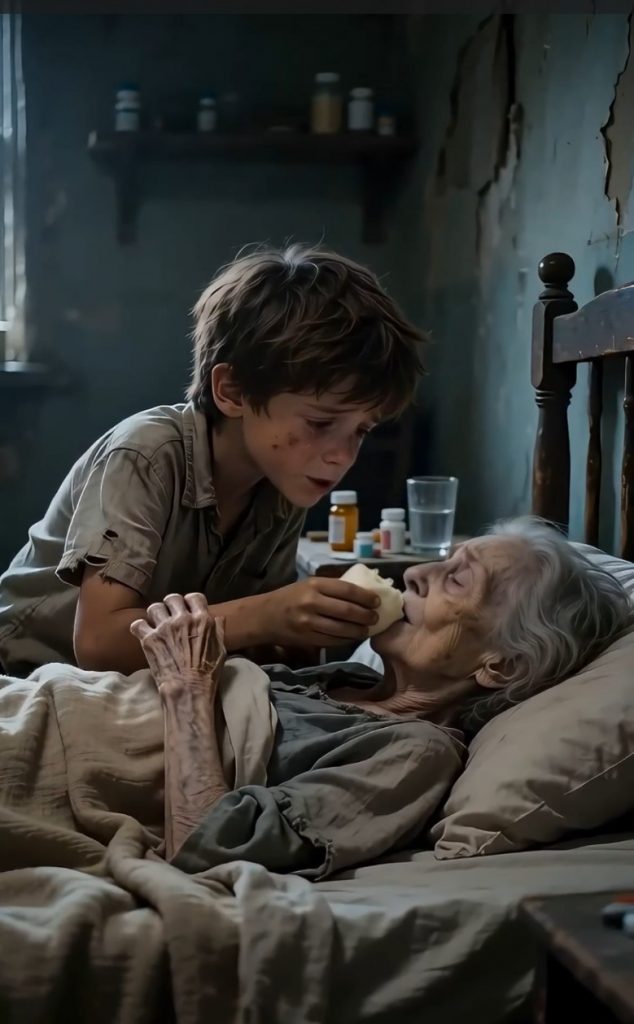
Oliver was on both knees beside a wooden bed.
An elderly woman lay beneath a thin beige blanket, her face pale and fragile against the pillow. Medicine bottles crowded the bedside table beside a glass of water. The wallpaper peeled in strips behind her head.
Oliver tore a small piece from one bun with trembling fingers.
“Eat, Grandma,” he whispered. “Please get better soon, okay?”
The old woman opened her eyes just enough to see him.
Oliver lifted the bread to her mouth as carefully as if it were medicine.
Thomas stopped in the doorway.
The broom lowered slowly in his hand.
The anger that had carried him there vanished so completely it left him hollow.
Because the boy had not stolen because he was careless.
He had stolen because someone he loved was starving.
And Thomas Bellamy suddenly understood he had chased a child all the way home for trying to keep the last family he had alive.
Act II
Oliver Reed had not always been hungry.
That was what made hunger cruel.
It did not arrive like a stranger. It moved into familiar rooms and changed them slowly.
First, breakfast became smaller. Then dinner became soup stretched with water. Then bread crusts were saved in a tin near the stove. Then Oliver began saying he was not hungry so his grandmother would eat more.
Evelyn Reed always knew when he lied.
She had raised him since he was four years old, after his mother left town for work and never found her way back in any permanent way. Evelyn never spoke badly of her daughter in front of him. She only said, “Some people get lost inside their own storms.”
So Oliver learned to live by the steady things.
His grandmother’s hands.
Her old songs.
The little kitchen table where she helped him with spelling.
The Sunday buns she bought from Bellamy’s Bakery when she had extra money, always splitting one in half and pretending she wanted the smaller piece.
Evelyn had worked most of her life cleaning rooms at the county hospital. She knew which nurses cried in supply closets and which patients had no visitors. She knew how to stretch a dollar, mend a cuff, soothe a fever, and make a child believe a cold room was an adventure if you called it camping.
But sickness had a way of stealing from people who already owned very little.
It started with a cough.
Then weakness.
Then missed shifts.
Then a doctor’s visit that led to another, and another, until the small table by her bed filled with orange bottles Oliver could not pronounce.
The rent fell behind.
The pantry emptied.
The neighbors helped when they could, but Willow Lane was full of people surviving close to the edge themselves. Everyone had kindness. Few had money.
That morning, Evelyn had tried to get up and make tea.
She nearly fell before reaching the door.
Oliver caught her with both arms, too small to hold her properly and too frightened to let go.
“I’m fine,” she told him.
“No, you’re not.”
Her eyes softened.
He hated that look.
The look adults gave children when they wanted to protect them from a truth already standing in the room.
There was no bread left.
No milk.
No rice.
Only water, medicine, and the three coins Oliver had found in the pocket of his school trousers.
Evelyn told him not to go out.
Oliver went anyway.
He had planned to buy the cheapest thing at the bakery. Maybe yesterday’s roll. Maybe a broken bun Thomas would not mind selling for less. But the line inside had been long, and when Oliver looked through the window, he saw the prices written on the chalkboard.
He did the math.
He was short.
Again.
Across the counter, Thomas Bellamy had been having his own bad morning.
The bakery looked warm from outside, but warmth did not pay flour bills. His rent had risen. His oven needed repairs. Two teenagers had stolen pastries the week before and laughed when he yelled after them. A delivery customer still owed him money. His knees hurt from waking at three every morning to knead dough alone.
Thomas was not a cruel man.
But tired men sometimes mistake exhaustion for righteousness.
When he saw Oliver snatch the buns, he did not see a child drowning.
He saw one more person taking from him.
So he grabbed the broom.
He shouted the word.
Thief.
And he ran.
Now, standing in the doorway of that ruined little bedroom, Thomas heard the word echo back at him and felt ashamed of every step he had taken.
Oliver still had not noticed him.
The boy was focused only on Evelyn.
“Just a little more,” he pleaded. “Please.”
Evelyn swallowed with effort, then turned her eyes toward the doorway.
She saw Thomas.
Oliver followed her gaze.
His face went white.
He dropped the remaining piece of bun into his lap and scrambled backward, shielding his grandmother with his body even though he was half Thomas’s size.
“I’m sorry,” Oliver cried. “Don’t take them. Please. I’ll pay you back. I promise. I’ll sweep. I’ll carry boxes. I’ll do anything.”
Thomas could not speak.
Then Evelyn lifted one trembling hand.
“Tommy Bellamy?”
The name struck him harder than the chase.
No one had called him Tommy in thirty years.
Act III
Thomas stepped into the room as if the floor had changed beneath him.
Evelyn Reed looked older than memory had allowed. Smaller. Frailer. Her gray hair lay thin against the pillow, and her breath came shallow and careful.
But her eyes were the same.
Soft, steady, knowing.
“Mrs. Reed?” he whispered.
Oliver looked between them, confused.
“You know him?”
Thomas lowered the broom until it rested against the wall.
“She knew me when I was your age.”
Evelyn’s mouth curved faintly.
“You stole apples.”
Thomas let out one broken laugh.
“I borrowed them.”
“You climbed my fence with a pillowcase.”
Oliver stared at the bakery owner.
Thomas looked down, embarrassed in a way he had not felt since childhood.
“I was hungry.”
The room went quiet.
That was the truth he had spent years forgetting.
Before Bellamy’s Bakery was his, before the apron, before the display window and the warm shelves, Thomas had been a boy with a father who drank too much and a mother who worked until her hands swelled. He remembered standing outside back doors, smelling dinners he could not afford. He remembered pretending he had already eaten.
And he remembered Evelyn Reed.
Back then, she lived in a small house with a vegetable garden. Whenever she caught him near the fence, she never shouted. She only opened the gate.
“If you’re going to steal,” she told him once, “steal sitting down at my kitchen table like a civilized person.”
She fed him soup.
Bread.
Apples cut into quarters.
She packed extra rolls in paper and told him to say they were leftovers if anyone asked.
Years later, when Thomas’s mother died and his father disappeared for three days, Evelyn was the one who sat with him on the porch until morning.
He had not seen her in years.
Life had moved on. The bakery consumed him. People became faces from memory, then names, then ghosts.
But Evelyn Reed had once fed him when he had nothing.
And he had just chased her grandson with a broom.
Thomas covered his mouth with one hand.
“I didn’t know,” he said.
Oliver’s voice shook.
“I tried to pay.”
“I know.”
“I only took two.”
“I know.”
“I wasn’t going to eat them.”
That undid Thomas completely.
He knelt on the floor, not caring that his apron touched the dust.
“I know,” he said again, softer this time.
Evelyn coughed weakly. Oliver turned to her at once, panic returning.
Thomas looked at the medicine bottles.
Some were nearly empty. Some had dates from weeks earlier. One prescription had a label with a warning that made his stomach tighten.
“When did she last see a doctor?” he asked.
Oliver looked down.
“I don’t know. She says doctors cost money if they keep finding things.”
Thomas stood.
The room seemed colder now.
Not because there was no heat, though there barely was.
Because poverty had been sitting here quietly, politely, waiting to be noticed, and everyone had walked past it.
Including him.
He took the remaining bun from Oliver’s lap, tore it into smaller pieces, and placed them on a clean saucer from the bedside table.
Then he looked at Oliver.
“Stay with her.”
The boy stiffened. “Are you calling the police?”
Thomas flinched.
“No.”
“Animal control?” Oliver asked, because fear makes children grab any punishment they have heard adults threaten.
“No,” Thomas said, his voice breaking. “I’m calling an ambulance.”
Evelyn tried to protest.
Thomas turned to her.
“You fed me when I was a boy, Mrs. Reed. You don’t get to tell me I can’t return two buns and a phone call.”
Her eyes filled.
Oliver stared at him as if kindness was more frightening than anger.
Thomas pulled out his phone with flour still dusting his fingers.
By the time emergency services answered, he already knew this was no longer about stolen bread.
It was about a debt he had forgotten he owed.
Act IV
The ambulance arrived twenty minutes later.
To Oliver, it felt like a parade of judgment.
Paramedics in dark uniforms entered the house carrying bags and equipment. A neighbor opened her door. A man from across the street stepped onto his porch. Someone whispered. Someone else crossed themselves.
Oliver stood beside the bed, both hands clenched.
Thomas stayed near him.
Not too close. Not pretending to be family. Just close enough that the boy knew he had not been abandoned to the consequences of asking for help.
Evelyn was too weak to argue for long.
The paramedics spoke gently. They checked her breathing, her pulse, her blood pressure. They asked about medications. Oliver answered what he could, his voice small and precise.
Thomas listened and felt a new kind of shame.
Not the sharp shame of chasing him.
The heavier shame of realizing how much responsibility a child had been carrying in silence.
When they lifted Evelyn onto the stretcher, Oliver grabbed her hand.
“I’m coming.”
A paramedic looked at Thomas.
“Are you family?”
Oliver froze.
Thomas saw the fear.
If no adult claimed him, where would he go?
“I’m a friend,” Thomas said. “I’ll follow. He rides with her.”
The paramedic nodded.
Oliver looked at Thomas like he had just opened a locked door.
At the hospital, Evelyn was admitted for severe dehydration, infection, and complications from untreated illness. The doctor spoke in careful terms, but Thomas understood enough.
She had waited too long.
Not because she did not care about living.
Because she was afraid the cost of surviving would bury the boy after she was gone.
Oliver sat in the waiting room holding a paper cup of water he did not drink.
Thomas brought him food from the cafeteria.
Oliver stared at the sandwich.
“I didn’t steal this?”
Thomas sat beside him.
“No.”
“Do I have to work for it?”
“No.”
Oliver hesitated.
“Then why?”
Thomas looked at the boy’s dirt-smudged face, his exhausted eyes, the way his hands still curled as if protecting invisible buns.
“Because someone should have fed you before you had to run.”
Oliver’s chin trembled.
He turned away, embarrassed, but Thomas saw the tears anyway.
That night, Thomas closed the bakery early.
He returned to Willow Lane with a box of bread, soup, milk, eggs, fruit, and every practical thing he could think of. He expected the house to feel empty without Evelyn and Oliver inside.
Instead, it felt accusing.
Peeling walls. Cold stove. Thin blankets. Notices tucked beneath a chipped bowl. A school paper with Oliver’s handwriting. A photograph of Evelyn years younger, standing beside a little boy Thomas recognized only after staring.
Himself.
He picked it up slowly.
In the photo, he was maybe nine, scrawny and suspicious, holding an apple in one hand. Evelyn stood beside him, smiling like feeding a hungry child was the most ordinary thing in the world.
Thomas sat on the edge of the bed and cried.
He cried for the boy he had been.
For the boy he had chased.
For Evelyn, who had spent her life giving away what little she had and ended up with almost nothing.
The next morning, he went to the bakery before dawn and baked more than he had planned.
By seven, the window was full.
By eight, a handwritten sign hung beside the door.
No child leaves hungry. Ask at the counter.
Customers read it with curiosity at first.
Then with silence.
Some paid extra.
Some looked away, ashamed by memories they did not want.
By noon, Thomas had started a basket near the register. Not charity, he decided. Charity sounded distant. This would be called Mrs. Reed’s Basket.
People could take bread from it. People could add to it. No questions. No speeches. No one made to feel small for needing what every body needs.
But Thomas knew bread alone would not fix Oliver’s world.
So he made calls.
To the hospital social worker.
To a school counselor.
To the landlord.
To a doctor who still owed the bakery three birthday cakes and, Thomas decided, several favors.
And when Oliver returned to the bakery three days later, eyes red from sleeping in a hospital chair, Thomas did not ask him to apologize again.
He handed him an apron.
Oliver stared at it.
“I thought I was banned.”
“You’re hired.”
The boy blinked.
“I’m ten.”
“Then you’re hired for ten-year-old work. Folding bags. Counting napkins. Sweeping. Eating lunch.”
Oliver looked suspicious.
“Eating lunch is work?”
“At this bakery, yes.”
For the first time since Thomas had met him, Oliver almost smiled.
But the real test came one week later, when Evelyn woke strong enough to ask where her grandson was.
Act V
Evelyn came home to a different house.
Not a perfect house.
The wallpaper still peeled. The floorboards still creaked. The winter air still slipped through the old window frame.
But the bed had clean sheets. The table had groceries. The medicine bottles were organized in a tray with labels Oliver could read. A small heater hummed in the corner, borrowed from Thomas until the landlord fixed what he had ignored for too long.
Oliver hovered over her like a tiny nurse with wild hair.
“Drink water.”
“I just did.”
“Doctor said more.”
“Doctor said many things.”
“Grandma.”
Evelyn sighed and took the cup.
Thomas stood in the doorway with a fresh bag of buns and pretended not to be watching with tears in his eyes.
When Evelyn saw him, she smiled.
“Tommy Bellamy, are you still stealing apples?”
“Only if the price is unfair.”
She laughed, then coughed, and Oliver immediately panicked.
“I’m all right,” she told him.
For the first time, he almost believed her.
Recovery took time.
Evelyn did not spring from bed because life had become kind. Illness does not vanish just because people finally care. There were appointments, bills, forms, hard days, frightening nights, and moments when Oliver woke from nightmares thinking he was still being chased.
But now they were not alone.
Thomas drove them to the clinic when he could. The school arranged support. A church group repaired the bedroom window. The landlord, after one visit from a city housing inspector Thomas had personally invited, discovered a sudden passion for maintenance.
At the bakery, Mrs. Reed’s Basket became part of the neighborhood.
At first, people were shy.
A mother came in with two children and asked whether the sign was real. Thomas said yes and looked away while she chose bread, because dignity sometimes needs privacy.
An old man left a dollar under the basket and took one roll.
A teenager in a school hoodie added three apples.
A nurse from the hospital bought a dozen buns every Friday and paid for twenty.
Oliver worked after school.
He folded bags with serious concentration. He swept the floor. He learned to weigh dough and count change. He ate lunch at the small table in the back, though for weeks he still asked before every bite.
“You don’t have to ask,” Thomas told him one afternoon.
Oliver looked down at his soup.
“I know.”
But knowing and trusting are not the same.
Thomas understood.
So he waited.
Spring came slowly.
Evelyn grew strong enough to sit in the bakery on Sunday mornings, wrapped in a blue cardigan, watching Oliver help behind the counter. Customers greeted her by name now. Some thanked her without fully knowing why. Others knew exactly.
One Sunday, Thomas placed a framed photograph on the wall behind the register.
Oliver noticed it first.
“Is that you?”
Thomas glanced up.
The photo showed Evelyn years ago, standing beside a hungry boy holding an apple.
“Yes.”
Oliver leaned closer.
“You looked scared.”
“I was.”
“Grandma fed you?”
Thomas nodded.
“She did.”
Oliver studied the photo in silence.
Then he looked at his grandmother.
“You never told me.”
Evelyn’s eyes softened.
“Kindness isn’t a story you tell so people praise you. It’s a seed you plant and hope grows somewhere.”
Thomas looked away.
Oliver thought about that for a long time.
Years later, he would remember those words more clearly than almost anything else.
He would remember the window fogged with steam. The coins in his palm. The chase. The broom. The moment he thought his whole life was about to collapse because he had taken two buns for the only person who loved him.
He would remember Thomas stopping in the doorway.
The anger leaving his face.
The world changing shape.
When Oliver turned sixteen, Thomas taught him how to make the steamed buns properly.
“Too much filling,” Thomas said.
Oliver grinned.
“No such thing.”
“When you own the bakery, you can ruin them however you want.”
Oliver stopped.
Thomas kept kneading like he had not said anything enormous.
“What?”
Thomas shrugged.
“I’m old.”
“You’re fifty-two.”
“That is practically ancient when you wake up at three.”
Oliver stared at him.
Thomas finally looked up.
“This place needs someone who remembers what hunger feels like without being ashamed of the people who walk in carrying it.”
Oliver swallowed hard.
In the corner, Evelyn sat in her favorite chair, pretending to read but clearly crying over the same paragraph for ten minutes.
Oliver looked from her to Thomas.
Then to Mrs. Reed’s Basket by the door, full of bread, apples, and small wrapped sandwiches.
He understood then.
The bakery had not simply fed him.
It had become proof that one terrible choice did not have to define a child forever.
Sometimes the world catches you stealing because it has failed to see you starving.
And sometimes, if mercy arrives before punishment, the story changes.
On the anniversary of the day Oliver stole the buns, Thomas placed two fresh steamed buns in a white paper bag and handed them to him.
Oliver smiled.
“Do I owe you?”
Thomas reached across the counter and gently closed Oliver’s fingers around the bag, just as if it were a gift too important to drop.
“No,” he said. “You keep them.”
Oliver carried the buns home to Evelyn.
She was waiting by the window, sunlight resting on her silver hair.
He broke one in half and gave her the bigger piece.
She noticed.
She always noticed.
“This time,” he said, smiling through the ache in his throat, “we can eat them slow.”
Evelyn took the bread and touched his cheek.
Outside, Willow Lane was still narrow. The old house still leaned slightly with age. The world was still unfair in a thousand ordinary ways.
But inside, there was warmth.
There was bread.
There was family.
And somewhere down the street, Bellamy’s Bakery glowed in the evening light, its window fogged with steam, its door open, and a basket near the counter waiting for anyone brave enough to walk in hungry.