Act I
The first thing Sarah heard was Oliver screaming.
Not the fussy cry he made when he dropped a toy. Not the tired cry that came before nap time. This was sharp, terrified, tearing through the storm like something had gone terribly wrong.
Sarah dropped the laundry basket in the mudroom and ran.
Rain slapped against the windows. Wind shoved at the back door so hard the frame rattled. The backyard beyond the glass was a blur of gray fence, black puddles, and branches whipping beneath a sky that looked ready to split open.
Then she saw them.
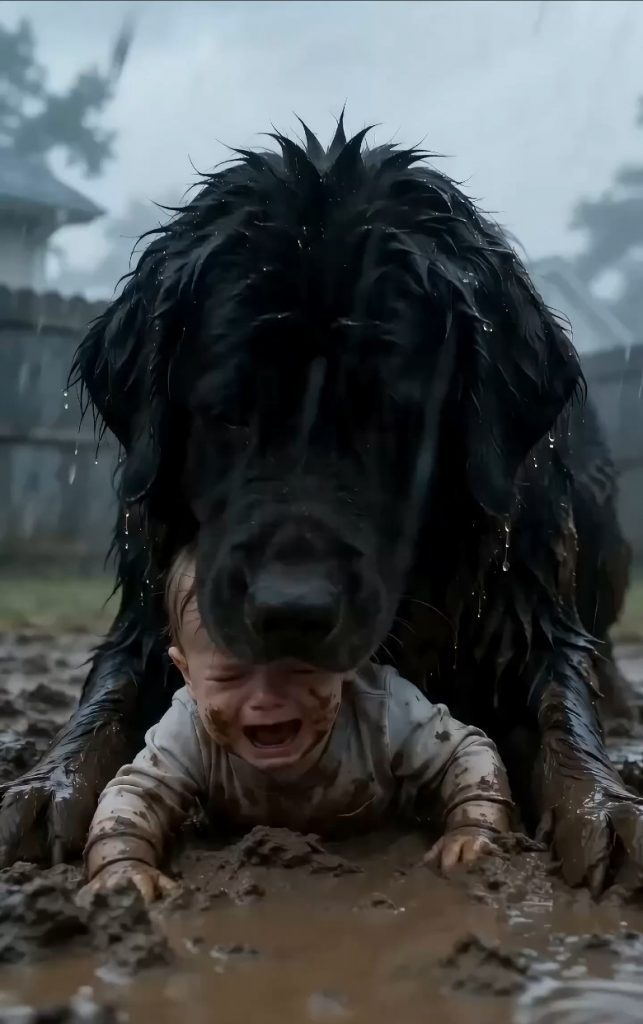
Oliver was down in the mud.
And Atlas was over him.
The massive black Newfoundland stood above the toddler like a soaked shadow, his long fur heavy with rain, his paws planted deep in the wet earth. His head was lowered near Oliver’s shoulder, his jaws gripping the back of the boy’s light shirt.
Sarah’s heart stopped.
“Oliver!”
She threw the door open and ran into the storm.
Mud swallowed her boots. Rain stung her face. Her gray hoodie clung to her arms as she stumbled across the yard, watching in horror as Atlas dragged her little boy across the ground.
Oliver wailed harder, his small hands curling uselessly against the mud.
To Sarah, it looked like a nightmare.
The dog she had raised, fed, defended, forgiven after every knocked-over chair and muddy paw print, had her son in his mouth.
“Atlas!” she screamed. “Get away from him!”
The dog did not let go.
He pulled again, forceful but steady, dragging Oliver several more feet through the slick grass and puddled dirt.
Something inside Sarah snapped.
She grabbed the nearest fallen stick from the mud, lunged forward, and swung at Atlas’s side with every ounce of panic in her body.
“OLIVER! GET AWAY!”
The dull impact landed.
Atlas released the shirt at once.
He staggered back, not snarling, not attacking, only huffing through the rain as if he still needed her to understand something.
Sarah threw the stick away and dropped to her knees, scooping Oliver into her arms. He clung to her neck, sobbing into her soaked sweatshirt, his face and clothes smeared with mud.
“It’s okay,” she gasped. “Mommy’s here. Mommy’s got you.”
Then the sky cracked.
A massive tree limb tore loose above the yard and came crashing down into the mud exactly where Oliver had been lying seconds before.
Sarah froze.
The branch hit with a heavy, sickening thud, exploding mud and water into the air.
For one breath, she could not move.
Then slowly, with Oliver trembling against her chest, she turned her head toward Atlas.
The dog stood in the rain, soaked and silent, staring back at her.
And Sarah realized she had struck the only one who had seen the danger coming.
Act II
Atlas had never been an easy dog.
He was too large for the house, too hairy for the furniture, too stubborn for anyone who thought dogs should be convenient. He shed black fur onto clean blankets, drank from the bathtub if someone left the door open, and once dragged an entire bag of potting soil through the kitchen because he apparently believed the floor needed “improvement.”
But he had been Michael’s dog first.
Michael had found him as a half-grown puppy outside a flooded roadside ditch three years earlier, soaked to the bone and shaking under a collapsed piece of fencing. Sarah still remembered her husband coming home in his firefighter jacket, holding the muddy animal against his chest like he had discovered treasure.
“We are not keeping that bear,” Sarah had said.
Michael grinned. “Good. He’s not a bear. He’s Atlas.”
Sarah had rolled her eyes.
Then Atlas looked at her with those enormous dark eyes, leaned his wet head against Michael’s shoulder, and sighed like he had finally arrived somewhere safe.
After that, the argument was already lost.
Atlas grew into the size of a small sofa. He followed Michael everywhere, from the garage to the backyard to the nursery they painted yellow when Sarah was pregnant with Oliver. Michael used to joke that Atlas considered himself head of security.
“Watch the little man,” Michael would say, pointing toward Oliver’s crib.
Atlas would lie down beside it.
When Oliver learned to crawl, Atlas moved slowly around him as if afraid the wind from his tail might knock him over. When Oliver learned to walk, he grabbed fistfuls of Atlas’s fur for balance, and the dog stood patiently, blinking through the indignity like a saint.
Michael loved that.
He loved everything loud and loyal.
Then, one winter night, a warehouse fire took him from them.
Sarah did not remember much after the knock on the door. Only the uniforms on the porch. The rain. The way Atlas began howling from the hallway before anyone said a word.
After Michael died, the house changed.
Oliver was too young to understand why Daddy stopped coming home, but Atlas understood enough to wait by the garage door every evening until darkness filled the windows.
Sarah understood too much.
Every room held Michael’s absence. His boots by the bench. His jacket in the closet. His mug in the cabinet. His dog pressing a giant head into her lap whenever she finally let herself cry.
At first, Atlas was the only thing keeping her from falling apart.
Then he became one more thing she was afraid she could not manage.
Single motherhood swallowed her whole. Bills arrived. Sleep vanished. The roof leaked. Oliver caught every cold that passed through daycare. Atlas needed food, grooming, vet visits, walks, baths, patience.
So much patience.
The week before the storm, Sarah had called a rescue organization.
She told herself she was only asking questions.
“He’s wonderful,” she said over the phone, standing in the pantry so Oliver would not hear. “He’s just… big. And I’m alone now.”
The woman on the other end was kind.
That somehow made it worse.
Sarah never completed the form.
But the thought had entered the house.
And Atlas seemed to know.
For days, he stayed closer to Oliver than usual. He slept outside his door. He followed him from room to room. When Sarah opened the back door that stormy afternoon to grab a fallen toy from the patio, Atlas pushed past her into the yard.
Oliver toddled after him.
Sarah saw them near the fence and called, “Two minutes!”
Two minutes.
That was all it took for the storm to turn.
Act III
The old maple tree had been a problem for months.
Michael had meant to cut the damaged branch down before winter, but the fire happened first. After that, Sarah stopped looking up at it.
The branch hung over the back corner of the yard, thick and dark, split near the base from some older storm. On dry days, it looked harmless enough. On windy days, it groaned.
The morning of the storm, a neighbor had texted.
That limb looks worse. Need help calling someone?
Sarah had read it while cleaning spilled cereal off the floor and trying to get Oliver’s shoes on.
She meant to reply.
She meant to do a lot of things.
By afternoon, the rain had soaked the ground into a brown, slippery mess. Water pooled in every low patch of the yard. The wind leaned hard against the fence, shuddering through the trees.
Oliver should never have been outside.
Sarah knew that later.
But guilt has a way of pretending it could have predicted every disaster.
In the moment, it happened too fast.
Oliver had followed Atlas off the patio, laughing at the puddles, his little blue pants already splattered with mud. Sarah had stepped back inside to grab his rain boots from beside the dryer.
Then a gust hit.
The maple shrieked.
Atlas heard it before Sarah did.
He turned sharply toward the tree.
Oliver, delighted by the mud, had slipped and sat down near the danger spot, crying more from surprise than pain. Above him, the cracked limb shifted.
Atlas charged.
By the time Sarah came back to the door, the dog was already over her son.
She did not see the tree.
She saw teeth gripping cloth.
She saw Oliver sliding through mud.
She saw a giant black animal pulling her baby away while he screamed.
There are moments when love becomes blind.
Sarah’s did.
She ran at Atlas as if he were the danger, not the rescue.
The dog took the hit and stepped back.
He could have growled. He could have snapped. He could have run.
Instead, he stood between Sarah, Oliver, and the tree, breathing hard through rainwater dripping from his muzzle.
Then the limb fell.
The crash stole every sound from the world.
It landed with brutal weight, burying itself in the mud where Oliver’s small body had been. The branch was thick enough to crush the little plastic slide beside the fence. Its smaller twigs snapped beneath the impact like dry bones, and muddy water splashed across Sarah’s boots.
Oliver went quiet for half a second.
Then he sobbed into her shoulder.
Alive.
Warm.
Safe.
Sarah stared at the indentation in the mud. At the torn grass. At the place where her son would have been.
Then she looked at Atlas.
He had saved Oliver.
And she had punished him for it.
Act IV
Sarah tried to say his name, but it broke in her throat.
“Atlas…”
The dog did not come closer.
That hurt more than if he had.
He stood several feet away in the rain, his soaked black fur hanging in ropes, his chest rising and falling. Mud covered his legs. One ear was flattened by water. His eyes stayed on Oliver, still alert, still guarding, even after being misunderstood.
Sarah clutched her son tighter.
“I’m sorry,” she whispered.
The words were almost swallowed by the storm.
Oliver trembled against her, exhausted from fear. His small fingers dug into her hoodie. Sarah checked his face, his arms, his back, his legs, searching for harm through the mud and tears.
He was frightened.
But he was there.
Atlas had made sure of it.
The back door banged against the house in the wind. Somewhere beyond the fence, a neighbor shouted Sarah’s name.
She barely heard.
All she could see was Michael.
Michael kneeling beside Atlas the day they brought Oliver home from the hospital, placing the baby’s blanket near the dog’s nose.
“Family,” he had said softly. “You protect family.”
Atlas had listened.
Of course he had listened.
Sarah’s tears came hard then, mixing with rain until she could not tell what belonged to the sky and what belonged to her.
She lowered herself deeper into the mud, still holding Oliver, and reached one shaking hand toward the dog.
Atlas watched her.
His body stayed cautious.
That shattered her.
“Please,” she said. “I didn’t know.”
The neighbor, Mrs. Bell, rushed into the yard through the side gate with a yellow raincoat thrown over her shoulders.
“Oh my God,” she breathed, seeing the fallen branch. “Sarah.”
Sarah could not answer.
Mrs. Bell looked from the branch to Oliver, then to Atlas.
Her face changed as the scene made sense.
“That dog pulled him away?”
Sarah nodded, sobbing.
Mrs. Bell covered her mouth. “Oh, sweetheart.”
Atlas took one slow step forward.
Then another.
Sarah stayed still, letting him choose.
When he finally reached her, he did not lean into her hand the way he usually did. He lowered his massive head toward Oliver and sniffed him gently, checking him again, making sure the child he had dragged through fear was still breathing safely in his mother’s arms.
Oliver hiccuped through tears.
“Atta,” he whimpered, the closest he could get to Atlas.
The dog’s tail moved once.
Just once.
Sarah broke completely.
She pressed her forehead against Atlas’s wet fur and cried the kind of apology words could not hold.
“I’m so sorry,” she whispered again and again. “You saved him. You saved my baby.”
Atlas stood there in the storm, letting her cry into his muddy coat.
He did not understand guilt.
He did not understand fear turning into violence.
He only understood that Oliver was safe, and Sarah was touching him again like he still belonged.
But Sarah understood everything.
She understood the branch.
She understood the phone call to the rescue organization.
She understood how close she had come to giving away the last guardian Michael had left behind.
Act V
The storm passed slowly.
By the time the rain softened into a mist, the backyard looked like a battlefield made of mud and broken wood. The maple branch lay across the ground, twisted and heavy, its leaves plastered flat by water. The little plastic slide was cracked beneath it.
Sarah sat on the kitchen floor wrapped in a towel, Oliver asleep against her chest.
Atlas lay nearby on an old blanket, freshly checked by the emergency vet who had come after Mrs. Bell made three frantic calls. He was sore, muddy, and tired, but nothing was broken.
Sarah had never been so grateful for any sentence in her life.
The vet packed her bag and looked toward the sleeping dog.
“Big dogs like that can surprise you,” she said softly. “They see things before we do.”
Sarah looked down at Oliver’s damp curls.
“No,” she said. “He saw what I wouldn’t.”
After everyone left, the house became quiet.
Not peaceful yet.
Just quiet enough for truth to settle.
Sarah carried Oliver upstairs, changed him into dry pajamas, and laid him in his crib. He stirred once, murmuring for Atlas even in his sleep.
Sarah went back downstairs and found the dog still watching the staircase.
Of course he was.
She sat beside him on the floor.
For a while, she said nothing.
Then she reached into the drawer of the side table and pulled out the rescue organization form she had printed but never mailed. The paper had been folded twice, hidden beneath old coupons and a flashlight manual, as if hiding it made the thought less real.
Sarah held it in both hands.
Atlas watched her quietly.
She tore the form in half.
Then again.
Then again.
The pieces fell into the trash like something shameful finally losing its power.
“You’re not leaving,” she said.
Atlas lifted his head.
Sarah wiped her face with the sleeve of Michael’s old sweatshirt.
“I got scared,” she whispered. “Not just today. Since he died. I got scared of the house, the bills, the noise, the mess, all of it. And somehow I started thinking you were part of what I couldn’t handle.”
Her voice cracked.
“But you were handling what I couldn’t.”
Atlas sighed, heavy and tired, and rested his chin on her knee.
That small forgiveness almost undid her.
The next morning, sunlight returned weakly through the kitchen windows. The yard was still ruined. The branch still needed cutting. The fence still needed repair. There would be calls to make, bills to face, and mud to clean from places mud should never reach.
But Oliver woke laughing.
He stood in his crib, pointed toward the door, and called, “Atta!”
Atlas, stiff but determined, rose from the hallway and padded into the room.
Sarah watched from the doorway as her son reached down through the crib bars and buried his fingers in the dog’s thick black fur.
Atlas closed his eyes.
Oliver giggled.
The sight cracked open something Sarah thought grief had sealed forever.
Later that week, a crew came to remove the broken branch. One of the workers paused beside the deep scar in the mud where it had landed.
“Lucky kid,” he said.
Sarah looked at Atlas lying under the porch shade, Oliver asleep beside him on a blanket with one small hand resting on the dog’s paw.
“No,” she said quietly. “Protected kid.”
That evening, Sarah took Michael’s old firefighter badge from the drawer where she had kept it wrapped in cloth. She tied it to Atlas’s collar on a short leather loop, not heavy enough to bother him, just enough to catch the light.
Family protects family.
Michael had said it once like a command.
Atlas had lived it like a promise.
And Sarah, standing in the doorway as the last gold of sunset touched the drying yard, finally understood that the dog had not been one more burden left behind by the man she lost.
He was part of the love that stayed.