Act I
The ticket machine rejected the coins with a cold little beep.
Maya Bennett stared at the return tray as if the machine had misunderstood her desperation. Three quarters, two dimes, and a nickel rattled back into the metal cup, the same pathetic handful she had pushed into the slot seconds earlier.
Behind her, the bus engine groaned.
In front of her, the open doors waited like a decision.
“No,” she whispered. “No, no, please.”
She scooped the coins into her shaking palm and turned toward the driver.
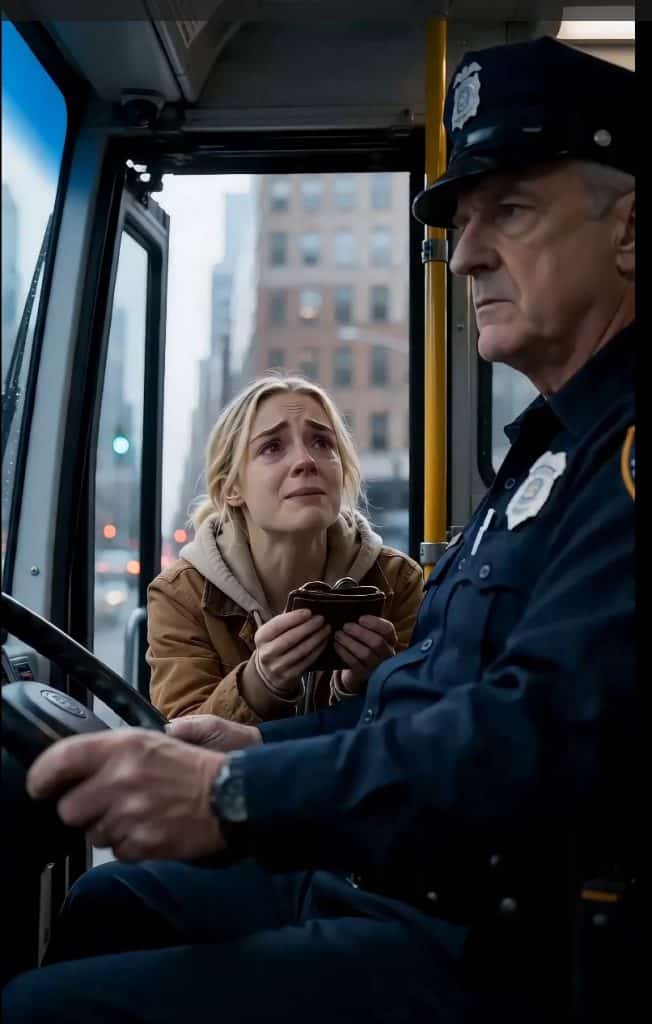
He sat high above her in a dark blue uniform, one hand resting near the steering wheel, his gray hair trimmed neatly, his face unmoved by the panic breaking across hers.
“Sir,” Maya said, breathless from running. “Please. I’m short by seventy cents. My mom is in surgery. They just called me. I have to get to St. Catherine’s.”
The driver looked at her hand, then at her face.
“No ticket, no ride.”
The words hit harder than they should have.
Maya blinked, stunned.
Around her, commuters shifted impatiently. Someone sighed. Someone else stepped around her toward the line. The city bus terminal kept moving as if her world had not just split open on the pavement.
She clutched her phone. The screen still showed the missed call from the hospital.
Her mother had collapsed at work that morning. A neighbor drove her to the emergency room. The nurse on the phone had said words Maya could barely remember now: internal bleeding, urgent surgery, family should come quickly.
Maya had left her campus job without clocking out.
She had run six blocks.
She had counted every coin in her jacket pocket while praying it would be enough.
It wasn’t.
“Please,” she said again, voice cracking. “I’m not lying. I’ll pay next time. I’ll give you my name, my student ID, anything.”
The driver’s mouth tightened.
“Everybody has a story.”
Maya froze.
Her eyes filled before she could stop them. One tear slid down her cheek, hot against the cold wind cutting through the bus terminal. She looked past the driver into the half-full bus, at people who could hear everything and still chose their windows, their phones, their silence.
“My mom might die,” she whispered.
The driver looked away.
That was the moment Maya felt something inside her give way.
Not hope exactly.
Something smaller and more fragile.
Then a cane tapped the pavement behind her.
Once.
Twice.
A hand, thin and spotted with age, reached past her shoulder holding folded bills.
“Use mine,” a gentle voice said. “I’ll walk.”
Maya turned.
An old man stood behind her in a weathered brown jacket and flat cap, leaning heavily on a wooden cane. His face was lined with age, his eyes tired but kind. His wallet hung open in his other hand, nearly empty.
Maya stared at the money.
“I can’t take that,” she said. “Then how will you go?”
The old man smiled faintly.
“Slowly.”
She almost laughed. Instead, she cried harder.
He pressed the bills into her hand.
“Go see your mom.”
The bus driver watched from above, expression guarded now, as if kindness had embarrassed him more than cruelty ever could.
Maya closed her fingers around the money.
“Thank you,” she whispered. “What’s your name?”
The old man shook his head.
“Names can wait. Mothers can’t.”
The bus doors hissed wider.
Maya climbed aboard with the fare in her trembling hand.
She looked back once before the doors closed.
The old man lifted his cane in a small, quiet goodbye.
And Maya had no idea that one act of mercy would become the debt that shaped the rest of her life.
Act II
Her mother survived.
Barely.
Maya reached St. Catherine’s with her hair windblown, her face wet, and the old man’s kindness still folded into her palm like a miracle. A nurse met her in the surgical waiting room and asked if she was family.
Maya could only nod.
The hours that followed blurred into fluorescent lights, vending-machine coffee, and prayers whispered into her sleeves. She sat alone beneath a wall clock that seemed to move only when she looked away.
At 11:42 p.m., a surgeon came out.
Her mother was alive.
Maya broke down so suddenly the surgeon had to steady her by the elbow.
For three days, she barely left the hospital. She slept in a plastic chair, studied anatomy flashcards in the cafeteria, and helped her mother sip water from a straw when the nurses allowed it.
On the fourth day, her mother woke fully enough to ask what happened.
Maya told her everything.
The call. The coins. The driver. The old man.
Her mother, Elise Bennett, listened with tears in her eyes.
“You find him,” she said weakly. “When I’m better, you find that man.”
Maya tried.
She went back to the terminal the next week and asked the dispatcher if they knew an elderly man in a flat cap who used a cane. The dispatcher gave her a tired look and said hundreds of elderly men used that terminal.
She asked vendors.
She asked drivers.
She waited at the same stop for three afternoons with a paper cup of coffee she hoped to hand him.
He never appeared.
But he did not leave her life.
Not really.
He became a voice.
Whenever Maya wanted to quit nursing prerequisites because tuition was too high, she heard him: Go see your mom.
Whenever she worked double shifts cleaning exam rooms and came home too tired to study, she remembered his cane, his wallet, and the way he gave without making her beg twice.
Whenever someone told her medical school was impossible for a girl with debt, a sick mother, and no connections, she remembered the bus driver too.
Everybody has a story.
That sentence burned.
For years, Maya thought of it as cruelty. Later, she understood it as a warning. The world was full of people whose pain had become background noise to others. The poor. The frightened. The late. The underinsured. The ones who arrived at counters with shaking hands and explanations no one wanted to hear.
Maya decided she would never become the person behind the glass who stopped listening.
She studied until her eyes ached.
She took out loans that terrified her.
She sat through lectures in shoes with cracked soles and kept a photo of her mother taped inside her notebook.
Elise recovered slowly, then fully enough to return to work part-time. She packed Maya lunches in old grocery bags, left encouraging notes on napkins, and once taped seventy cents to Maya’s mirror with the words: Never forget the difference it made.
Maya never did.
Years passed.
The girl in the brown utility jacket became a medical student. Then a resident. Then, after sleepless nights, missed birthdays, and more coffee than any human should survive, Dr. Maya Bennett.
She chose emergency medicine first, because emergencies did not wait politely for people to be ready. Later, she specialized in internal medicine and patient advocacy, drawn to the fragile space where illness met paperwork.
At St. Catherine’s, she became known for asking the question other doctors sometimes skipped.
“How did you get here?”
Not just medically.
Actually.
Did they have a ride? Food? Insurance? Someone at home? Money for prescriptions? A phone that worked?
Some colleagues teased her gently.
“Maya, you’re treating the whole life, not just the patient.”
She always answered the same way.
“That’s usually where the illness lives.”
By her early thirties, Maya helped create a hospital assistance program for patients who fell through the cracks. Transportation vouchers. Emergency medication funds. Social work referrals. Temporary lodging for families who arrived from far away.
The official name was the Bennett Access Fund.
But privately, in her own notes, Maya called it something else.
The Fare.
Her mother knew why.
No one else did.
Then, on a bright Tuesday morning nearly eleven years after the bus terminal, Maya walked through the polished lobby of St. Catherine’s in blue scrubs and a white coat, a stethoscope around her neck, three pens clipped neatly in her pocket.
She was reviewing lab results on her tablet when she heard the sound.
Not a cane this time.
Crutches.
Slow.
Uneven.
Hard against the polished floor.
Maya looked up.
An old man stood at the reception desk, thinner than memory, frailer, his flat cap held in one trembling hand. His face had changed. More wrinkles. Sharper cheekbones. A tiredness that seemed to sit deep in his bones.
But Maya knew him.
The years fell away in one breath.
The coins. The bus. The cold driver. The folded bills.
Her hand tightened around the tablet.
The old man who had once given her his fare was standing in her hospital.
And this time, he was the one being told no.
Act III
“I’m sorry, Mr. Hale,” the receptionist said gently. “Your coverage isn’t showing active.”
Maya stopped walking.
The old man shifted on his crutches. A small folder of paperwork shook in his hand.
“It was active last month,” he said.
His voice was softer now, worn thin by age and pain, but Maya recognized the warmth underneath it. The same voice that had told her mothers could not wait.
The receptionist looked pained.
“I understand, but without confirmation, we can’t schedule the procedure today unless you can provide a deposit.”
“How much?”
The receptionist hesitated.
Even before she said the number, the old man’s face told Maya he did not have it.
He nodded slowly, gathering his papers with dignity so careful it hurt to watch.
“All right,” he said. “Thank you for your time.”
He turned awkwardly on his crutches.
Maya moved before thinking.
“Sir?”
The old man looked up.
His eyes met hers.
For a moment, there was no recognition.
Why would there be? He had helped a crying girl at a bus stop over a decade earlier. To him, it may have been one brief act in a long life. To Maya, it had become a foundation stone.
She stepped closer.
“Arthur Hale?”
His brows lifted slightly.
“Yes?”
Maya’s throat tightened.
“You probably don’t remember me.”
He gave a faint, apologetic smile.
“I’m sorry. I meet a lot of people badly.”
Maya almost laughed at that. Almost.
She looked at his crutches, the worn cuffs of his jacket, the folder held carefully against his chest.
Then she said, “You once gave me your bus fare.”
Arthur went still.
Maya watched memory move slowly across his face.
A terminal. A crying young woman. A driver who would not bend. A mother in surgery.
His eyes widened.
“Oh,” he whispered. “Your mother.”
“She lived.”
His face changed then.
The worry he had carried for eleven years without even knowing her name softened into relief.
“She did?”
Maya nodded.
“She’s alive because I got there in time. Because of you.”
Arthur looked down, embarrassed.
“I only gave you a few dollars.”
“No,” Maya said. “You gave me the chance to say goodbye if I had to. And hello when she woke up.”
His lips trembled.
The receptionist looked between them, realizing something larger than paperwork was unfolding.
Maya turned to her.
“Please page Social Services and tell Dr. Lin I’m taking over Mr. Hale’s case coordination.”
Arthur straightened as much as his body allowed.
“Doctor?”
Maya smiled through tears.
“Yes.”
He stared at her white coat.
Then at the stethoscope.
Then back at her face.
“Well,” he said softly, “would you look at that.”
The simple pride in his voice nearly undid her.
Maya guided him toward a seating area near the windows, walking slowly to match his pace. She did not rush him. She remembered how he had stood with his cane and offered to walk.
Now every step looked costly.
“What brings you in today?” she asked.
Arthur tried to wave it off.
“Old-man problem.”
“Old men are allowed to need help.”
He sighed.
“Leg pain. Circulation issues. They said if it gets worse, I could lose more mobility.”
Maya’s professional mind clicked into place, but her heart stayed painfully human.
“How long have you been putting this off?”
Arthur looked out the window.
“A while.”
“Because of insurance?”
“Because of money. Insurance is just the fancy word for it.”
Maya sat across from him.
“Do you have family nearby?”
His hand tightened around the folder.
“No.”
The answer was too short.
She waited.
Arthur looked at her, then away.
“My wife passed eight years ago. My son before that. I manage.”
Maya heard the quiet pride in the last two words.
She also heard the loneliness.
“You shouldn’t have had to walk that day,” she said.
Arthur frowned gently.
“What day?”
“The bus stop.”
He smiled faintly.
“I made it eventually.”
“To where?”
The smile faded.
For the first time, he looked ashamed.
“Job interview.”
Maya’s breath caught.
Arthur shrugged, trying to make it small.
“I was late. Didn’t get it.”
The lobby noise seemed to dim.
Maya stared at him.
The fare he gave her had cost him more than a ride.
It may have cost him work, stability, a path out of whatever hardship he had been standing in that day.
“You never said,” she whispered.
“You were trying to reach your mother.”
“That mattered too.”
He looked at her then, eyes kind but firm.
“No, doctor. That mattered more.”
Maya closed her eyes briefly.
For eleven years, she had carried gratitude.
Now gratitude became responsibility.
Not guilt.
Something stronger.
A chance to answer kindness with action.
She opened her eyes.
“Mr. Hale,” she said, standing, “you’re not leaving this hospital without care.”
Arthur looked alarmed.
“I don’t want charity.”
Maya shook her head.
“Good. Because this is not charity.”
He frowned.
“What is it?”
Maya smiled, and this time her voice did not shake.
“It’s your fare coming back.”
Act IV
Hospitals are full of quiet reversals.
A man who commanded boardrooms becomes frightened by a lab result. A child too small to understand illness becomes the bravest person in a room. A stranger who once stood behind you in line becomes the doctor reading your chart.
Arthur Hale’s reversal moved through St. Catherine’s without spectacle.
Maya did not break rules. She did not wave her hand and make the system disappear like magic. Real systems were heavier than that. They required forms, approvals, calls, signatures, and people willing to push instead of shrug.
So she pushed.
She called Social Services personally. She contacted the Bennett Access Fund administrator. She found a vascular specialist with an opening that afternoon. She asked the billing office to review charity care eligibility and emergency support options. She made sure Arthur had lunch, not from a vending machine, but from the staff cafeteria.
When he protested, she placed the tray in front of him and said, “Doctors can be very annoying.”
Arthur gave her a weak smile.
“I’m learning that.”
By midafternoon, the test results were clear enough to worry everyone.
Arthur needed intervention soon. Not someday. Not when paperwork behaved. Soon.
Maya stood outside the exam room with Dr. Lin, scanning the imaging results.
“He’s been compensating too long,” Dr. Lin said. “This should have been treated months ago.”
Maya looked through the glass at Arthur sitting on the exam table, cap folded in his lap, crutches leaning against the wall.
“He couldn’t afford months ago.”
Dr. Lin sighed.
“I know.”
That was the part Maya hated most.
Everyone knew.
Patients delayed care because of money. They rationed medication. Missed appointments. Ignored pain until it became an emergency. Arrived ashamed, as if poverty were a personal failure instead of a barrier placed in front of them.
Everybody has a story.
Maya thought of the bus driver again.
She wondered if he ever remembered the crying girl he refused. Probably not. Cruelty often forgets itself.
Kindness remembers.
Arthur’s procedure was scheduled for the next morning.
Maya went back to his room to tell him.
He listened quietly, then asked, “How much trouble are you getting into for this?”
“None.”
“That sounds like something people say right before trouble.”
She smiled.
“The hospital has programs for this. Most people just don’t know how to reach them.”
Arthur looked down at his hands.
“I don’t like needing them.”
“I know.”
“I worked my whole life.”
“I believe you.”
“I paid taxes. Raised a family. Took care of my wife. Then one day there was less money, less body, less everything. People look at you like you planned it badly.”
Maya pulled a chair closer.
“My mother used to say life can empty your pockets without asking permission.”
Arthur nodded slowly.
“She sounds wise.”
“She is.”
“Still with you?”
Maya smiled.
“Still telling me what to do.”
That made him laugh, a soft sound that lifted some of the heaviness in the room.
Then his face changed.
“I thought about you sometimes,” he said.
Maya went still.
“At the bus stop?”
Arthur nodded.
“I wondered if you made it.”
“I did.”
“I wondered if your mother made it.”
“She did.”
“I wondered if giving you that money mattered.”
Maya felt tears burn behind her eyes.
“It mattered more than you could possibly know.”
Arthur swallowed.
“My wife used to say you never know which small thing heaven is watching.”
Maya looked at the man in front of her, frail but dignified, poor but not small, kind without ever asking to be remembered.
“What was her name?” she asked.
“Rose.”
The name fit him somehow.
Soft and enduring.
Maya glanced at the folded cap in his lap.
“Would you like someone called before the procedure? A neighbor? Friend?”
Arthur shook his head.
“No need.”
That answer settled too heavily.
Maya stood.
“I’ll be here.”
“You don’t have to do that.”
“I know.”
Arthur looked at her for a long moment.
Then he said, “Your mother raised you well.”
Maya’s voice softened.
“So did a stranger at a bus stop.”
Arthur turned his face away.
But not before she saw his eyes fill.
Act V
The procedure went well.
Arthur woke to morning light and the steady beep of monitors, confused for a moment by the warm blanket over his chest and the absence of the sharp pain that had followed him for months.
Maya was there, sitting beside the bed with a paper cup of coffee.
“You’re a very stubborn patient,” she said.
Arthur blinked.
“That official?”
“Extremely.”
He smiled faintly.
Outside the room, hospital life moved on. Nurses changed shifts. Families waited. Doctors hurried through corridors carrying the next emergency, the next decision, the next life tilting toward hope or grief.
Inside, time slowed.
Arthur looked toward the window.
“I dreamed I missed the bus.”
Maya’s smile faded.
“You didn’t.”
“No?”
“No. You were exactly where you needed to be.”
A week later, Arthur was discharged with follow-up appointments, transportation arranged, medication assistance approved, and a social worker who refused to let him disappear back into silence.
Maya walked him to the lobby herself.
He moved with a walker now, steadier than before, his flat cap back on his head. The same lobby where he had nearly turned away without care now seemed brighter, almost forgiving.
Near the front doors, Elise Bennett waited.
Arthur did not recognize her, of course.
Maya’s mother was older now, silver threaded through her blonde hair, but she stood straight, healthy, alive. She held a small envelope in both hands.
Maya’s throat tightened as she introduced them.
“Mr. Hale, this is my mother.”
Arthur stared.
Elise stepped forward and took his hands.
For a moment, neither spoke.
Then Elise said, “Thank you for giving my daughter time.”
Arthur’s face crumpled.
He shook his head, overwhelmed.
“I just gave her bus fare.”
Elise smiled through tears.
“No. You gave me my child at my bedside when I opened my eyes.”
The lobby blurred around Maya.
Arthur pressed one hand over his mouth.
Elise handed him the envelope.
Inside was a small card and seventy cents taped carefully to the paper.
Arthur looked at it, confused.
Maya laughed softly.
“My mother kept that on my mirror for years.”
Elise nodded.
“To remind her that sometimes the amount is small, but the mercy is not.”
Arthur held the card as if it were something breakable.
“I don’t know what to say.”
Maya stepped closer.
“You don’t have to say anything.”
But Arthur did.
He looked at Maya in her white coat, at Elise standing alive beside her, at the hospital doors opening and closing for strangers carrying fear in their hands.
Then he whispered, “I’m glad I walked.”
The words broke all three of them.
Months later, St. Catherine’s expanded the Bennett Access Fund.
The new program provided emergency transportation, fare cards, ride-share vouchers, and same-day patient advocacy for people trying to reach hospitals, shelters, and family members in crisis. Maya insisted on one small detail in the launch materials.
No one would be turned away from asking.
Not for looking poor.
Not for sounding desperate.
Not for having a story.
The staff nicknamed the program Arthur’s Fare.
He pretended to be embarrassed when Maya told him.
Secretly, he kept the brochure folded in his jacket pocket.
As he recovered, Arthur began volunteering in the hospital lobby twice a week. Not at a desk. He did not want a title. He simply sat near the entrance with his walker beside him, helping lost visitors find elevators, showing anxious families where to check in, and telling people who looked ashamed to ask for help that there was no shame in needing a hand.
Some days, he brought roses from a discount flower stand and gave them to patients leaving alone.
“Rose would like this,” he told Maya.
She believed him.
One winter afternoon, a young man ran into the lobby with panic all over his face, phone clutched in his hand, breath coming hard.
“My brother was brought here,” he said to no one in particular. “I don’t know where to go.”
The receptionist was helping another family. The nurses were busy. The young man looked seconds from breaking.
Arthur stood slowly.
Not fast. Not easily.
But he stood.
“This way,” he said, reaching for his walker. “We’ll find him.”
Maya watched from across the lobby.
For a moment, she saw the bus terminal again. The open door. The rejected coins. The old man stepping forward when everyone else looked away.
Only now the setting was different.
The girl had become a doctor.
The old man had become a patient, then a volunteer, then proof that kindness does not end where it is first given.
It travels.
It changes hands.
It waits years if it has to.
That evening, after her shift, Maya walked Arthur to the hospital exit. Snow dusted the sidewalk outside. The city lights reflected softly on the glass doors.
A hospital shuttle pulled up to the curb.
Arthur glanced at it, then at Maya.
“Think they’ll let me ride?”
Maya smiled.
“I know the doctor.”
He chuckled.
Before boarding, he paused.
“You ever find that driver?”
Maya shook her head.
“No.”
“Good,” Arthur said.
That surprised her.
He looked at the shuttle doors, then back at her.
“Some people teach us by helping. Some teach us by showing us exactly who not to become.”
Maya thought about that.
Then she nodded.
Arthur stepped onto the shuttle, turned, and lifted one hand in the same small goodbye he had given her years before.
This time, Maya was not running toward a hospital in terror.
Her mother was safe. Her patient was cared for. Her work was waiting. And somewhere inside her pocket, she carried the card with seventy cents taped to it, worn now at the edges but still intact.
A few coins.
A rejected fare.
A stranger with a cane.
That was all it had taken to change the direction of her life.
The bus driver had said everybody had a story as if stories were excuses.
Arthur Hale had understood the truth.
Everybody has a story.
And sometimes, the smallest act of kindness is the only reason that story gets to continue.