Act I
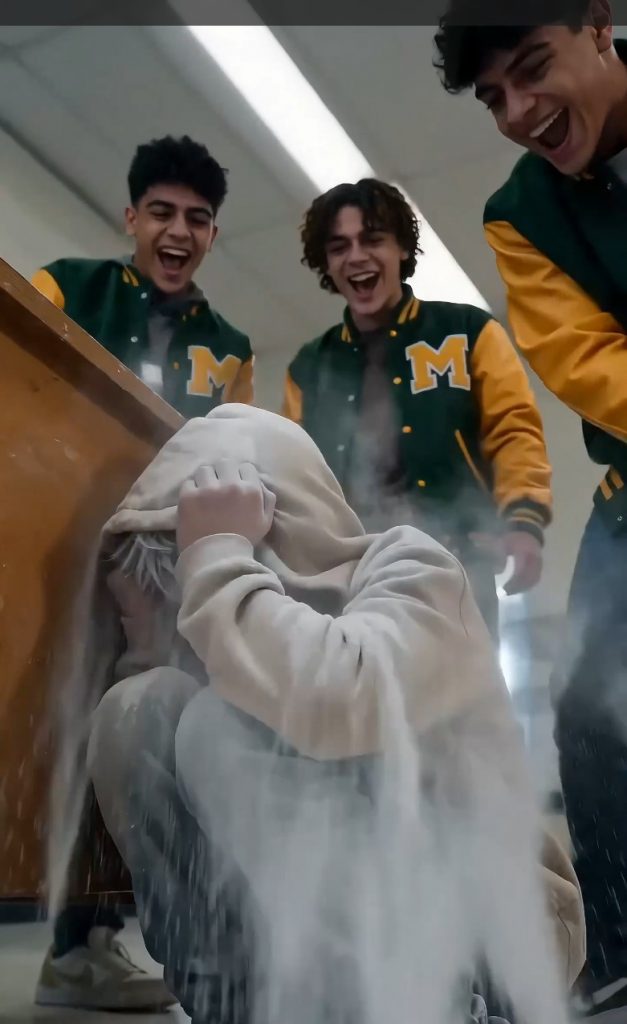
The chalk dust made Ethan Mercer look like a ghost.
It clung to his hair, his eyelashes, the folds of his beige hoodie. It floated beneath the fluorescent lights in the empty classroom, turning the air white and bitter while three older boys in green-and-yellow varsity jackets stood over him, laughing like they had won something.
Ethan coughed into his sleeve.
He was curled on the hard floor beside a student desk, knees pulled tight, one arm over his head. His backpack had slid halfway under a chair. His sneakers scraped the tile as he tried to move away without standing.
The tallest bully raised another chalk eraser.
“Look at the snowman,” he said.
The other two laughed.
The eraser came down against Ethan’s shoulder with a dull thump, bursting another cloud of chalk into the air. Ethan cried out and turned his face toward the floor.
“Please stop,” he rasped.
Nobody listened.
The boys wore the same varsity jackets, green with yellow sleeves, the letter M stitched across the chest. They were freshmen, but they already walked through Mason Ridge Middle like they owned every hallway. Their names were Bryce, Nolan, and Trent. Teachers called them energetic. Coaches called them leaders.
Ethan knew better.
Leaders did not lock classroom doors after lunch.
Leaders did not dump chalk trays over a smaller boy’s head.
Leaders did not laugh when he could not breathe.
Bryce clapped twice, loud and slow.
“Come on, Mercer. Say it.”
Ethan squeezed his eyes shut.
“Say what?” Nolan mocked. “Say thank you for the makeover.”
Ethan coughed harder. Tears cut clean paths through the white dust on his cheeks.
Then the laughter changed.
Not stopped.
Changed.
One of the boys turned his head toward the classroom door.
Heavy footsteps sounded in the hallway.
Slow.
Measured.
Too heavy for a teacher.
The door slammed open.
All three bullies froze.
From Ethan’s place on the floor, he saw only boots at first.
Military boots.
Then camouflage pants. A uniform jacket. A large hand holding a heavy green duffel bag.
The man stepped into the classroom without a word.
The duffel dropped beside his boots with a deep thud that seemed to shake every desk in the room.
Ethan lifted his chalk-covered face.
Through the dust and tears, he saw the patch on the man’s sleeve.
Then he saw the name.
MERCER.
His breath caught.
“Dad?”
The man in the doorway did not answer right away.
He looked at the chalk on his son’s face.
Then at the three boys in varsity jackets.
And the silence that followed was more frightening than any shout could have been.
Act II
Ethan had practiced the reunion in his head for weeks.
His father was supposed to come home on Friday.
There would be a banner in the cafeteria, maybe. His mother said the school wanted to do something nice because Staff Sergeant Daniel Mercer had been away for eleven months, and everyone loved a good military homecoming video.
Ethan hated that idea.
He did not want cameras.
He did not want applause from kids who ignored him every day.
He wanted his dad to walk through the front door of their apartment, smell like airport coffee and cold air, and say, “You got taller, soldier,” even if Ethan had only grown half an inch.
But Daniel Mercer came home early.
He landed that morning, caught a ride from a fellow soldier, and asked to be dropped at Mason Ridge before anyone told Ethan. He carried one duffel bag and one small gift wrapped in brown paper: a model airplane kit they had promised to build together when he came back.
At the front office, the secretary told him Ethan was in social studies.
Daniel smiled for the first time in twenty hours of travel.
Then he heard coughing down the hall.
A boy’s coughing.
Sharp, panicked, struggling.
Daniel moved before the secretary finished signing him in.
He had spent years learning the difference between noise and distress. Some sounds passed through a person. Others hooked into the spine.
This one hooked.
The classroom door was not supposed to be closed during lunch.
It was.
Daniel saw shadows move through the narrow window. Saw a flash of green-and-yellow varsity sleeves. Saw a smaller shape on the floor.
Then he opened the door.
Everything after that rearranged him.
Ethan was twelve, small for his age, too careful with adults and too quiet at school. Daniel had noticed the changes over video calls from overseas. The way Ethan stopped talking when asked about friends. The way he wore hoodies even when the weather warmed. The way his smile vanished whenever the topic of Mason Ridge came up.
His wife, Lila, had told him there were problems.
“Boys being boys,” the assistant principal said after she reported it the first time.
“We’ll keep an eye out,” the counselor said after the second.
“No evidence of targeted harassment,” the email said after the third.
Daniel saved that email.
He saved all of them.
Not because he expected to use them.
Because a soldier learns to keep records when people in authority choose soft language over hard truth.
Now his son was on the floor, covered in chalk dust, trying to breathe while three boys stared at Daniel as if he had interrupted a game.
Bryce recovered first.
He tried to stand taller.
“We were just playing.”
Daniel looked at him.
The boy’s mouth closed.
Ethan coughed again.
That sound cut through the room.
Daniel moved to his son, lowered himself beside him, and spoke in a voice softer than the bullies deserved to hear.
“Ethan. Look at me.”
Ethan tried.
His eyes were red from dust and crying.
Daniel took a clean T-shirt from the side pocket of his duffel and gently wiped chalk from his son’s face.
“Can you breathe?”
Ethan nodded, then coughed.
Daniel turned his head toward the doorway.
“Office. Nurse. Now.”
The secretary, pale and frozen just outside the room, snapped into motion.
Daniel helped Ethan sit up carefully.
Only then did he stand.
And when he did, the three varsity boys took one step back.
Act III
The principal arrived with the school nurse less than two minutes later.
Principal Howard entered fast, tie swinging, face arranged into professional concern. He took in the scene: chalk dust on the floor, erasers scattered near Ethan, three athletes against the desks, one soldier standing between them and the boy on the tile.
“Staff Sergeant Mercer,” he said, recognizing the uniform too late. “Welcome home.”
Daniel did not return the greeting.
“My son needs the nurse.”
“Of course.”
The nurse knelt beside Ethan, checked his breathing, and guided him toward the hall with careful hands. Ethan hesitated and looked back.
Daniel’s face softened.
“I’m right behind you.”
Ethan nodded.
But Daniel did not leave the room.
Not yet.
Principal Howard glanced at the bullies.
“What happened here?”
Bryce answered quickly.
“Ethan tripped.”
Nolan nodded.
“Yeah. He knocked the erasers down.”
Trent stared at the floor.
Daniel looked at him.
Trent was the youngest of the three, not innocent, but less practiced. His eyes kept flicking toward a phone sticking halfway out of Bryce’s jacket pocket.
Daniel noticed.
So did Principal Howard, but he pretended not to.
That told Daniel something.
“Phones,” Daniel said.
Bryce frowned. “What?”
Daniel turned to the principal.
“Ask for the phones.”
Principal Howard stiffened.
“We have procedures for student property.”
“My son is covered in chalk dust on your classroom floor after being locked in here with three older students. Start the procedure.”
The room went still.
Bryce scoffed, but the sound was thin now.
“You can’t make us give you anything.”
Daniel looked at the principal.
“No. I can’t.”
The weight of the words shifted toward Howard.
The principal swallowed.
“Bryce. Hand me your phone.”
Bryce’s confidence cracked.
“My dad said you need a warrant.”
Principal Howard’s expression changed at the mention of Bryce’s father.
Daniel caught that too.
Bryce Maddox was the son of Coach Maddox, the football coach whose team had won district two years in a row. His photo was in the hallway trophy case. His name was on banners. His boys could do wrong, apparently, only in ways the school did not want to document.
The secretary appeared in the doorway.
“Mr. Howard,” she said quietly, “Mrs. Mercer is on her way. And Officer Daniels is in the building for the safety assembly.”
Principal Howard closed his eyes briefly.
The day was getting away from him.
Good, Daniel thought.
Because that was what happened when hidden things finally met daylight.
Officer Daniels arrived moments later. He listened without interrupting while Daniel explained what he had seen. Then he turned to the boys.
“Phones on the desk.”
Bryce opened his mouth.
Officer Daniels held his gaze.
“Now.”
One by one, the phones came out.
The first video was on Nolan’s.
It started before Daniel opened the door.
Ethan on the floor.
Bryce holding the eraser.
Laughter.
“Look at the snowman.”
Ethan coughing.
“Please stop.”
The room listened to the recording in silence.
By the time it ended, Principal Howard looked older.
Daniel looked at the boys.
“You filmed him begging.”
Nobody answered.
Then Trent broke.
“He didn’t do anything,” he whispered.
Bryce snapped, “Shut up.”
Trent shook his head, tears suddenly in his eyes.
“He didn’t. Bryce said Ethan thought he was special because his dad was a hero. He said we should make him look like a coward.”
Daniel’s face did not change.
That made it worse.
Because now the room understood the cruelty had not been random.
It had been aimed at the one thing Ethan still held onto when school became unbearable.
His father coming home.
Act IV
Lila Mercer arrived running.
She found Ethan in the nurse’s office with a blanket around his shoulders and chalk still clinging to his hair. The moment he saw her, his face crumpled.
“I’m sorry,” he whispered.
Lila stopped.
Then she crossed the room and wrapped both arms around him.
“For what?”
“I couldn’t stop them.”
Her eyes filled, but her voice stayed steady.
“Oh, baby. You were never supposed to stop them alone.”
Daniel stood in the doorway watching them, his hand still curled around the brown paper-wrapped model airplane kit in his duffel. He had imagined giving it to Ethan with laughter.
Now it felt like an object from a different life.
Officer Daniels interviewed the boys separately. The nurse documented Ethan’s condition. The counselor, who had once written that Ethan needed to “build resilience,” stood outside the office with one hand over her mouth and no idea where to put her shame.
Coach Maddox arrived before the district representative.
He came in angry.
Not worried.
Angry.
“My son says some soldier threatened him.”
Daniel turned slowly.
The hallway quieted around them.
“I didn’t threaten your son.”
Coach Maddox looked past him toward the office. “Where is Bryce?”
“With the school resource officer.”
“For roughhousing? This is ridiculous.”
Daniel took one step closer, not enough to intimidate, only enough to be clearly heard.
“Your son and two other students locked my child in a classroom, covered him in chalk dust, mocked him while he struggled to breathe, and recorded it.”
Coach Maddox’s mouth tightened.
“Kids make mistakes.”
Lila stepped out of the nurse’s office.
Her face was pale, but her eyes were steel.
“A mistake is spilling milk. This was cruelty.”
The coach glanced at her.
Then at Daniel’s uniform.
Then at the growing cluster of teachers, staff, and students in the hallway.
His voice dropped.
“You people are blowing this up because of optics.”
Daniel almost smiled.
Not because anything was funny.
Because men like Coach Maddox always reached for power when truth cornered them.
“Optics,” Daniel said, “are what kept this quiet.”
Principal Howard flinched.
Lila opened her purse and removed a folder.
Daniel recognized it.
Every email. Every report. Every reply. Every sentence that minimized Ethan’s fear.
She handed it to Officer Daniels.
“I’ve been trying to get help since September.”
The officer took the folder.
Coach Maddox looked at Principal Howard.
“You knew about this?”
Howard did not answer.
That answer was enough.
By the end of the day, the three boys were suspended pending a formal hearing. Coach Maddox was placed on administrative leave after it became clear he had contacted staff in the past to “handle things quietly” when complaints involved athletes.
Principal Howard stood in front of Daniel and Lila near the empty classroom.
“I am sorry,” he said.
Daniel looked through the doorway at the chalk still smeared across the floor.
“Don’t apologize in here.”
Howard blinked.
Daniel nodded toward the nurse’s office.
“Apologize to him.”
So he did.
Not well.
Not perfectly.
But he stood in front of Ethan, lowered his voice, and admitted what adults rarely admit to children.
“We failed you.”
Ethan stared at him for a long time.
Then he asked the only question that mattered.
“Will it happen again?”
No one answered too quickly.
Daniel respected that.
Finally, Officer Daniels said, “Not if we do our jobs.”
Ethan looked at his father.
Daniel sat beside him.
“And not if we make them.”
Act V
The video changed Mason Ridge before the school board did.
Someone had already shared it among students before the phones were collected. By evening, parents had seen enough to demand answers. The district tried to call it an “isolated incident,” but Lila’s folder proved otherwise.
There were dates.
Names.
Warnings.
A pattern of small cruelties ignored until they became a room full of chalk dust and laughter.
At the disciplinary hearing, Ethan did not attend in person.
Daniel and Lila gave him the choice, and he chose to write a statement instead. His handwriting slanted downward near the end, but every word was his.
I don’t want them to say they were just joking. I heard them laughing when I couldn’t breathe. I want teachers to believe kids before it gets this bad.
Lila read it aloud.
Daniel sat beside her in uniform, not because he wanted attention, but because Ethan asked him to wear it.
“I want them to know who they made fun of,” Ethan had said.
Daniel answered carefully.
“They made fun of you, son.”
Ethan looked down.
Daniel lifted his chin gently.
“And you are more than my uniform.”
The boys received consequences that did not disappear after a week. Suspensions. Required counseling. Removal from athletics for the season. Restorative meetings only if Ethan later agreed, not because the school wanted a neat ending.
Coach Maddox resigned.
Principal Howard remained only long enough to implement the district’s corrective plan, then transferred out. The counselor who had written about resilience apologized to Ethan in a letter, but Lila kept it until Ethan decided whether he wanted to read it.
He did, eventually.
Then he placed it in a drawer and did not talk about it for three days.
Healing was not a hallway speech.
It was messy.
Ethan had nightmares about the classroom door. He coughed whenever chalk dust rose from a board. He stopped wearing the beige hoodie and left it folded in the corner of his closet until Daniel asked what he wanted to do with it.
“Throw it away,” Ethan said.
Daniel nodded.
Then Ethan changed his mind.
“No. Wash it.”
Lila washed it twice.
The stains faded, but did not vanish completely.
Ethan kept it anyway.
Not to wear at first.
Just to prove the hoodie had not belonged to them.
Two months later, Mason Ridge held a veterans assembly. Daniel was invited to speak, but he refused the original plan with flags, applause, and heroic music.
Instead, he stood in the gym in plain clothes.
No uniform.
No medals.
Only a microphone and a room full of students who were quieter than usual.
“My son told me some people here thought courage was never being scared,” Daniel said.
He found Ethan in the crowd.
Ethan sat beside Lila, shoulders tense but head up.
Daniel continued.
“That’s wrong. Courage is telling the truth when you think no one wants to hear it. Courage is asking for help after people make you feel ashamed. Courage is standing beside someone who is being hurt, even if your friends are laughing.”
The gym was silent.
Then Daniel said, “And adults need courage too. The courage to stop calling cruelty a joke just because handling it properly is inconvenient.”
No one clapped immediately.
That was good.
They were thinking.
Afterward, a sixth grader approached Ethan near the hallway.
“I saw the video,” the boy said awkwardly.
Ethan stiffened.
The boy looked embarrassed.
“I’m sorry nobody helped faster.”
Ethan did not know what to say.
So he nodded.
The boy pointed toward the science wing.
“Some eighth graders keep messing with this kid named Omar after lunch. I told Mr. Lewis.”
Ethan looked at him.
“Did he do anything?”
“Yeah. He came right away.”
That mattered.
More than the apology.
More than the assembly.
More than the punishment.
It meant the school had begun to move before someone hit the floor.
Spring came slowly.
Ethan joined the robotics club. Daniel helped him finish the model airplane, though they argued over the wings and had to glue one piece twice. Lila framed Ethan’s student safety statement, but he made her keep it at home, not school.
One Friday in May, Ethan wore the beige hoodie again.
Clean.
Faded.
His choice.
He walked past the classroom where it happened and stopped outside the door. Daniel was beside him because Ethan had asked him to come for career day, this time with no surprise entrance, no duffel dropping, no dramatic rescue.
Just a father signing in properly at the front office.
Ethan looked through the small window.
The room had been cleaned. The chalk erasers were gone, replaced by dust-free boards. The desks were arranged in neat rows. Sunlight touched the floor where he had once curled under laughter.
“You okay?” Daniel asked.
Ethan thought about it.
“No.”
Daniel nodded.
Ethan looked up.
“But I’m not scared to walk past it.”
Daniel put a hand on his shoulder.
“That counts.”
They walked on.
At the end of the hall, a display case held student projects, art, and a new sign written in bold blue letters:
Jokes don’t need victims.
Ethan stopped and read it twice.
Then he smiled a little.
Not because everything was fixed.
Because something had changed.
The day his father dropped the duffel bag in the classroom became the story everyone remembered, but Ethan remembered a different sound more clearly.
Not the door slam.
Not the bag hitting the floor.
Not even the bullies going silent.
He remembered his father’s voice in the nurse’s office, low and steady, saying, “You were not supposed to stop them alone.”
For weeks, Ethan repeated that sentence to himself.
Walking into school.
Opening his locker.
Passing the boys who no longer wore their varsity jackets with the same pride.
You were not supposed to stop them alone.
And eventually, the words grew wider than him.
No one was.