Act I
The first thing Olivia Crane did when she recognized Marcus Vale was laugh.
Not a surprised laugh.
Not the soft laugh people give when an old memory walks into a room unexpectedly.
A cruel one.
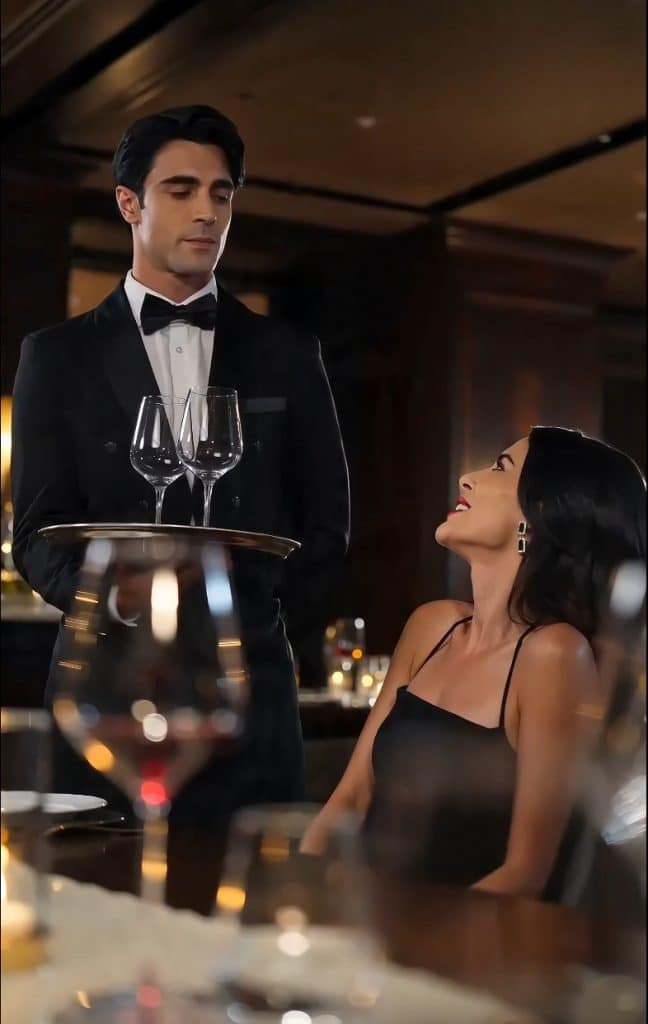
She sat beneath the warm golden lights of Bellavue, the most exclusive restaurant in the city, with one elbow resting beside a crystal wine glass and her red lipstick curved into a smile that had once made Marcus forget how badly she could hurt him.
Marcus stood beside her table holding a tray.
Dark jacket.
White shirt.
Black bow tie.
Apron tied neatly at his waist.
To the other diners, he looked like a waiter trained in silence and polished service.
To Olivia, he looked like revenge arriving in uniform.
“Oh, poor Marcus,” she said, tilting her chin up at him. “You work as a waiter?”
The man seated across from her smirked. The woman beside him lowered her menu to watch. Nearby, a few guests turned their heads just enough to pretend they were not listening.
Marcus did not flinch.
He held the tray steady.
“Just for tonight,” he said.
Olivia laughed louder.
The sound cut through the soft piano music and the clinking of glassware.
“Of course,” she said. “Just for tonight. That’s what people say when they don’t want to admit life didn’t go as planned.”
Marcus looked at her for a moment.
Same wavy brown hair.
Same statement earrings.
Same talent for making a room feel like a courtroom where she had already chosen the verdict.
Three years ago, she had looked at him in a much cheaper restaurant and told him he would never be enough.
Now she thought she had proof.
Before Marcus could speak, an older man in a gray suit approached the table. His black tie was perfectly centered, his silver hair combed back, his expression urgent but controlled.
He leaned toward Marcus.
“Sir,” he said respectfully, “the investors are waiting.”
Olivia’s laughter stopped.
Marcus handed him the tray without looking away from her.
The older man took it like accepting an order from someone far above him.
Marcus removed the dark serving jacket first.
Then the apron.
Beneath it, his white shirt was crisp, expensive, tailored to him exactly. His trousers were polished black, his watch simple but unmistakably costly.
The entire table went still.
Marcus folded the apron once and placed it over the tray.
Then he looked at Olivia.
“Come with me,” he said calmly. “I have a surprise for you.”
Olivia’s face went pale.
Because for the first time that evening, she realized the man she had mocked was not serving the room.
He owned the silence inside it.
Act II
Olivia Crane had met Marcus before anyone knew his name.
Back then, he was just the scholarship boy from a working-class neighborhood who wore the same blazer to every university event because it was the only one he owned. He studied economics during the day, worked nights in hotel kitchens, and carried a notebook full of business plans no one took seriously.
Olivia came from a different world.
Her father owned Crane Hospitality Group, a chain of luxury lounges and boutique hotels that looked successful from the outside because wealth was good at lighting itself correctly. She knew which fork belonged to which course, which names mattered at charity galas, and how to smile at someone while deciding whether they were useful.
Marcus, at first, amused her.
He did not beg for attention. He did not flatter her family. He asked questions professors could not answer without pausing. He listened more than he spoke, and when he did speak, people leaned in despite themselves.
That irritated Olivia.
Then it fascinated her.
For a year, they were almost inseparable.
She brought him to rooftop parties where her friends asked what his father did and Marcus answered honestly.
“He drives buses.”
They laughed.
Marcus did not.
Olivia told him later he should learn to soften the truth.
“My father works harder than half the men in that room,” he said.
She rolled her eyes and called him dramatic.
But she stayed.
Until the night he told her about Bellavue.
Not the restaurant as it existed now. Back then, Bellavue was an abandoned dining hall under an old hotel, all cracked tile, water stains, and broken chandeliers. Marcus had found the lease listing by accident and spent months sketching plans for what it could become.
A restaurant with dignity but no cruelty.
Luxury without humiliation.
A place where a guest could spend a fortune and still feel human, and where staff would be treated like professionals, not scenery.
Olivia laughed when he showed her the projections.
“You’re serious?”
“I am.”
“With what money?”
“I’ll raise it.”
“From who? Your bus driver father?”
That was the first time Marcus saw the full shape of her contempt.
Not playful.
Not accidental.
Rooted.
He closed the notebook slowly.
Olivia sighed as if he had disappointed her by being hurt.
“You’re smart, Marcus. But intelligence doesn’t erase where you come from.”
He looked at her.
“And love doesn’t survive when one person keeps measuring the other.”
She left him two weeks later.
Publicly.
At her father’s winter charity dinner.
Someone asked where Marcus was, and Olivia smiled over champagne.
“Hopefully somewhere learning practical skills. Ambition is charming until it becomes embarrassing.”
The table laughed.
Marcus heard about it from someone else.
He did not call her.
He did not write.
He simply disappeared.
Olivia assumed he had failed quietly.
That was how people like her made peace with people they underestimated.
But Marcus had not failed.
He had gone back to the abandoned dining hall, stood beneath the broken chandelier, and decided humiliation was a poor foundation for grief but excellent fuel for work.
Act III
Bellavue took three years to build.
The first investor said no before Marcus finished the pitch.
The second said the market was too crowded.
The third asked if he would consider selling the concept to someone with “a more credible face.”
Marcus thanked him and walked out.
He worked double shifts. Sold his car. Slept four hours a night. Hired former restaurant staff who had been dismissed by luxury establishments for being “too old,” “too direct,” “not polished enough,” or simply unwilling to be insulted by wealthy customers with a smile.
His first chef, Amara Bell, had been blacklisted after refusing to cover for a hotel owner who served unsafe food at a private event.
His floor manager, Mr. Albright, had spent thirty years in fine dining and knew every expression a guest used before cruelty arrived.
His bartender, Theo, could remember a hundred drink orders and every staff member’s birthday.
Together, they built Bellavue into something the city had not expected.
It was elegant, yes.
Dark wood.
Soft lighting.
White plates.
Hand-polished glassware.
But the service felt different.
No employee bowed their dignity away. No guest was allowed to mistreat staff because of the price of their meal. Marcus personally wrote that rule into training.
Hospitality is not submission.
Within eighteen months, Bellavue had a waiting list.
Within two years, investors wanted expansion.
Within three, Crane Hospitality Group wanted in.
That was the funny part.
Olivia’s father had overextended his company. Behind the polished launches and glossy campaigns, Crane Hospitality was drowning. Bad leases. Quiet lawsuits. Debt hidden under renovations. Olivia had returned from Europe to help secure a partnership that could save the family name.
The partnership she needed was with the Vale Group.
Marcus’s company.
She did not know that.
At least, not yet.
Marcus had arranged the dinner for a reason.
He had not planned the waiter uniform as a trick at first. Bellavue held a tradition once a quarter: executives worked a service shift to remember the truth of the business. They carried trays, polished glasses, cleared tables, listened to staff, and learned what customers revealed when they thought power was not standing beside them.
Marcus loved those nights.
People told waiters everything.
They revealed impatience, entitlement, kindness, insecurity, tenderness. They became honest in ways they never were in boardrooms.
When Mr. Albright informed him Olivia Crane had arrived early for the investor dinner and requested “the best table where important people could see her,” Marcus knew exactly what the evening would become.
He could have avoided her.
He did not.
Some wounds do not need revenge.
They need confirmation that they have healed.
So Marcus picked up the tray.
Walked to her table.
And allowed Olivia to show him, in front of everyone, that she had not changed at all.
Now she stood from her chair slowly, eyes moving from Marcus’s crisp shirt to Mr. Albright’s respectful posture.
“The investors,” she said faintly. “You mean your investors?”
Marcus gave a small smile.
“Our investors, if the meeting goes well.”
Her lips parted.
The man across from her leaned forward.
“Olivia, do you know him?”
Marcus answered before she could.
“We were students together.”
Olivia’s face tightened.
“That was a long time ago.”
“Yes,” Marcus said. “And apparently not long enough.”
Mr. Albright stepped aside and gestured toward the private dining room.
The doors were already open.
Inside, six investors sat waiting around a long table beneath a chandelier Olivia had probably admired when she entered.
At the head of that table was an empty chair.
Marcus’s chair.
Act IV
The private dining room had no music.
Only the low murmur of people who understood money well enough not to speak loudly around it.
Olivia entered behind Marcus with the posture of someone trying to rebuild herself while walking. Her smile returned, but now it was thinner, strained at the edges. She smoothed one hand over her black dress and lifted her chin.
She was still Olivia Crane.
She still had a name.
She still knew rooms like this.
Or she thought she did.
Marcus took his seat at the head of the table.
The investors stood.
All of them.
Olivia froze.
Mr. Albright closed the doors behind her.
A woman in a cream suit smiled at Marcus. “Congratulations on the London approval.”
“Thank you, Nadia.”
A bald man near the window lifted a folder. “The Singapore group is ready to match funding if you confirm tonight.”
Marcus nodded.
“We’ll discuss it after Ms. Crane presents.”
Olivia looked at him sharply.
Presents.
Not joins.
Not negotiates.
Presents.
The power had shifted from social to structural, and she felt it immediately.
She sat at the far end of the table, where a folder bearing the Crane Hospitality logo waited beside a glass of untouched water.
Marcus folded his hands.
“Whenever you’re ready.”
Olivia’s first words were polished.
She spoke of brand alignment, luxury markets, inherited trust, legacy clientele, urban expansion, and cross-property experience. She showed slides of hotel lounges, rooftop bars, and projected revenue streams.
Her voice steadied as she went on.
For a few minutes, she almost recovered.
Then Nadia asked one question.
“Why is Crane Hospitality seeking outside rescue capital if your public filings suggest stability?”
Olivia blinked.
“We prefer the term strategic partnership.”
Marcus leaned back slightly.
“That was not the question.”
She looked at him.
A flash of anger broke through the fear.
“Our internal structure is not relevant to the creative proposal.”
“It is relevant to valuation.”
The bald investor opened a second folder.
“We received revised debt disclosures this afternoon.”
Olivia’s face changed.
“My father authorized those?”
Marcus said nothing.
That was answer enough.
Her father had authorized everything because he no longer trusted Olivia’s version of the company’s health. He had come to Marcus privately weeks earlier, desperate, embarrassed, and far more honest than his daughter had been.
He had also told Marcus something else.
Olivia had pushed to reject the original Bellavue acquisition years ago, back when Marcus was seeking early funding. Her note in the rejection file had been brief.
Founder lacks social credibility.
Marcus had kept a copy.
Not for revenge.
For memory.
Now he opened the folder in front of him and slid one page across the table.
Olivia looked down.
She recognized her own words.
Her face went still.
Marcus’s voice remained calm.
“I built this restaurant after your family declined to fund it because, according to your review, I lacked social credibility.”
The investors were silent.
Olivia swallowed.
“Marcus—”
“You mocked me in my own dining room tonight because you thought I was a waiter.”
Her eyes glistened, but whether from shame or fear, he could not tell.
“I didn’t know.”
“That is not an excuse. It is the problem.”
For the first time, Olivia had no clever answer.
Marcus looked around the table.
“Crane Hospitality has assets worth saving. Staff worth protecting. Properties with history. But I will not invest in a company led by someone who mistakes service for inferiority.”
Olivia’s jaw tightened.
“What are you saying?”
Marcus closed the folder.
“I’m saying the Vale Group will proceed only under restructuring. Your father remains as transitional advisor. Independent operations review begins Monday. Staff wage disputes are settled first. And you step down from executive authority.”
Olivia stared at him.
“You can’t be serious.”
Marcus looked at her with the same steady eyes she had once laughed at across a cheaper table.
“Just for tonight,” he said softly.
The words landed like a mirror.
Act V
Olivia did not cry in the private dining room.
She was too proud for that.
She signed nothing that night. Her attorneys would negotiate. Her father would call. The board would panic, then accept reality because debt has a way of making pride expensive.
But something in Olivia broke before she left Bellavue.
Not loudly.
Not dramatically.
It broke when she passed through the main dining room and saw Marcus stop beside a young server who had dropped a fork near Table 8.
The server looked terrified.
Marcus simply bent, picked up the fork, and said something that made the young man breathe again.
No anger.
No humiliation.
No performance.
Olivia watched from near the entrance, coat over her arm.
For years, she had believed status was proven by how far above service a person could stand.
Marcus had built an empire by respecting it.
That was what she had not understood.
The next morning, every business paper in the city reported that Vale Group had entered final talks to rescue Crane Hospitality through a restructuring deal. The articles called Marcus visionary. Disciplined. Self-made. The new face of humane luxury.
None of them mentioned the waiter’s apron.
Marcus made sure of that.
He did not need the world to see Olivia humiliated.
He only needed her to see clearly.
The restructuring happened in phases.
Crane properties were audited. Toxic managers removed. Unpaid staff claims settled. Vendor debts renegotiated. A training program created at Bellavue was implemented across every hotel restaurant and lounge.
The first rule was printed in every staff room.
Hospitality is not submission.
Mr. Albright cried the day he saw it framed.
He denied it, of course.
Marcus did not embarrass him by arguing.
Olivia vanished from public events for six months. Society pages speculated. Former friends whispered. People who had laughed at her table that night slowly adjusted their loyalty, as wealthy circles often do when power changes jackets.
Then one afternoon, Marcus found her waiting in the empty dining room before service.
No red lipstick.
No statement earrings.
No audience.
Just Olivia in a plain black coat, standing beside the table where she had first mocked him.
Mr. Albright approached Marcus quietly.
“She asked to speak with you. I told her you were busy.”
Marcus looked at her.
“I am.”
“Shall I ask her to leave?”
Marcus thought about it.
“No. Give us five minutes.”
Olivia turned when he approached.
For once, she did not smile first.
“I owe you an apology,” she said.
Marcus stopped across from her.
“Yes.”
The honesty of his answer seemed to steady her.
“I was cruel.”
“Yes.”
“I thought being born into rooms like this meant I understood them.”
Marcus said nothing.
Olivia looked toward the bar, where staff were polishing glasses before dinner service.
“I didn’t understand anything.”
“That will be useful if you let it be.”
Her eyes lifted.
“Do you hate me?”
Marcus considered lying because it would be kinder.
Then he decided kindness did not require dishonesty.
“No.”
She looked surprised.
“I did for a while,” he said. “Then I got busy.”
A laugh escaped her, small and wounded.
“I deserved that.”
“You deserved honesty. That was honesty.”
She nodded slowly.
“My father wants me to start at the bottom if I return to the company.”
Marcus looked at her.
“The bottom?”
“Guest services rotation. Front desk. Housekeeping shadow. Restaurant floor.”
“Good.”
Her face flushed.
“You really think so?”
“I think anyone who wants authority over service should first learn what it costs.”
Olivia looked at the place where he had stood with the tray.
“Will people laugh?”
“Probably.”
She absorbed that.
Then she nodded.
“Then I suppose I’ll learn whether I can survive what I used to give.”
Marcus did not comfort her.
Some lessons should not be softened too quickly.
But when she turned to leave, he said her name.
She stopped.
“The work is not shameful,” he said. “Only the way you looked at it.”
Olivia’s eyes filled then.
This time, Marcus believed the tears.
Years passed.
Bellavue became the first restaurant in the Vale Hospitality Group, then the heart of it. Marcus opened locations in London, Singapore, and Chicago, but he kept the original dining room almost unchanged. Same dark wood. Same piano. Same warm lights on polished glass.
And once a quarter, he still worked the floor.
Not as a stunt.
Not as a disguise.
As a promise.
Sometimes guests recognized him and became nervous. Sometimes they did not and revealed themselves. Marcus treated both types exactly the same.
With precision.
With dignity.
With memory.
One night, a new server asked him why he still carried trays when he could be upstairs with investors.
Marcus looked across the room toward Table 12, where a young couple was celebrating an anniversary over one shared dessert, dressed carefully in clothes that were not expensive but clearly chosen with pride.
“Because rooms like this can make people forget who matters,” he said.
The server frowned.
“Who does matter?”
Marcus smiled.
“Everyone who enters. Everyone who works. Everyone who is seen.”
Near the host stand, Mr. Albright watched him with quiet approval.
The piano played softly.
Glassware chimed.
And somewhere in the polished rhythm of the dining room, Marcus remembered Olivia’s laugh from years ago, sharp and careless, the sound of someone mistaking a uniform for failure.
It no longer hurt.
Not because she had apologized.
Not because he had won.
But because he had built something her contempt could not understand.
A place where no one’s worth was measured by whether they stood beside the table or sat at it.
That night, when the investors called him “sir,” Olivia thought she had discovered Marcus had risen above service.
She was wrong.
Marcus had done something far more powerful.
He had risen without looking down.