Act I
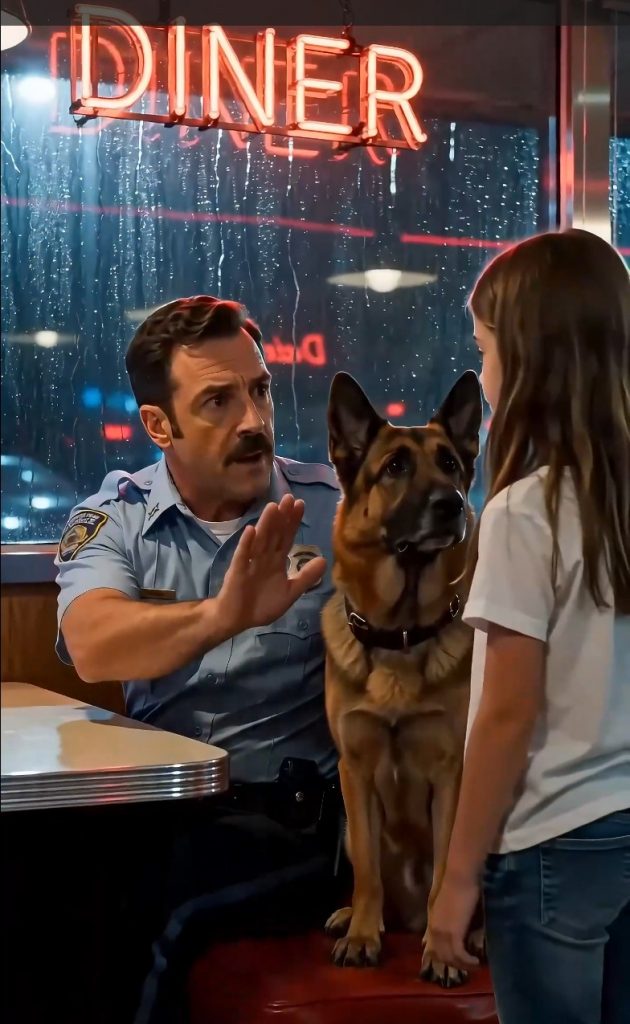
The officer told the girl to stay away before she even reached the booth.
“Stay back, kid,” he said, raising one hand. “He can bite.”
Rain streaked the diner windows behind him, turning the red neon DINER sign into a trembling glow across the white tabletop. The place smelled like coffee, fried onions, and wet coats. A few night-shift regulars sat in red leather booths, talking softly while the storm tapped at the glass.
The German Shepherd sat beside the officer, still as a statue.
His black collar rested against thick fur. His ears were up. His eyes followed the little girl as she stepped closer.
She could not have been more than eight.
Long brown hair. White T-shirt. Blue jeans damp at the cuffs from the rain outside. She looked too calm for a child approaching a police dog, too certain as she stopped beside the booth and stared at him like she had found something she had lost.
Officer Hank Dorsey leaned forward, mustache stiff over a tight mouth.
“I said stay away.”
The girl did not look at him.
“My dad had one like this,” she said softly.
Then she lifted her hand and touched the dog’s head.
Hank’s whole body tensed.
The dog did not growl.
Did not snap.
Did not even pull away.
He leaned into her palm.
Hank stared.
For two years, that dog had trusted almost no one. He tolerated Hank. Obeyed commands. Slept beside the booth during late-night meals. But strangers, especially sudden hands, made him stiffen and retreat.
Not this time.
The girl stroked the side of his face with the familiarity of someone remembering a song.
Hank swallowed.
“What did you say?” he asked. “He’s Tommy.”
The girl tilted her head.
“No,” she said.
The diner seemed to quiet around them.
The dog’s ears lifted higher.
The girl looked straight into the shepherd’s eyes and spoke one name with gentle certainty.
“It’s Rusty.”
The dog barked.
Not a warning.
Not fear.
Joy.
He surged upright in the booth, paws shifting, tail thumping against the seat, sharp excited barks filling the diner as he pressed his head toward the girl’s chest.
A fork clattered somewhere behind them.
Hank’s face drained of color.
The girl wrapped both arms around the dog’s neck and whispered, “I knew it.”
Hank stared at them, breath caught in his throat.
“No,” he whispered.
The dog barked again at the name he should not have known.
Hank’s hand trembled against the table.
“Impossible.”
Act II
Hank Dorsey had found the dog on a road nobody used anymore.
It was the old county access road beyond Blackwater Creek, where pine branches scraped the patrol car doors and the mud kept secrets better than people did. Two years earlier, during a storm much like this one, Hank had been called out because someone reported barking near the washed-out bridge.
He expected a stray.
He found a German Shepherd standing in the rain beside a torn piece of blue tarp, refusing to leave a ditch.
The dog had no collar.
No tags.
No handler.
Just mud on his legs, fear in his eyes, and a loyalty so fierce he nearly collapsed rather than step away from whatever he had been guarding.
Hank searched the ditch with a flashlight until dawn.
He found nothing but scraps of fabric, a broken watch, and a badge number scratched into an old leather strap half-buried in mud.
The number belonged to Deputy Aaron Wells.
Everyone in the county knew that name.
Aaron Wells had disappeared six months earlier.
The official story said he ran.
Stole evidence money. Abandoned his wife and daughter. Left his patrol car near the creek and vanished before Internal Affairs could arrest him.
Hank never believed it.
But Hank had been a young patrol officer then, too new to challenge the chief, too scared to ask why Aaron’s case file disappeared from the system after midnight, too ashamed to admit he had watched a good man’s name get dragged through dirt because everyone in authority told him to look away.
Aaron’s wife, Marissa, left town soon after.
People said grief made her unstable.
People said Aaron betrayed her.
People said a lot of things once the man was not there to defend himself.
Hank remembered their little girl.
Lucy.
She had been six then, always sitting in the front row at police charity events, swinging her legs while Aaron’s shepherd rested under her chair.
The dog’s name was Rusty.
Hank knew that because Lucy used to feed him fries when her mother was not looking.
But Rusty had supposedly vanished the same night Aaron did.
So when Hank found the shepherd by Blackwater Creek, the truth should have been obvious.
Instead, Chief Wallace stood in the rain, looked at the dog, and said, “That is not Wells’s K9.”
Hank pointed to the leather strap.
Wallace took it from his hand.
“Storm debris.”
“Chief—”
“Listen to me carefully,” Wallace said. “Aaron Wells was dirty. That dog is a stray. You want to protect a dead traitor, or you want a career?”
Hank hated himself for remembering how long he stayed silent.
He took the dog home.
Called him Tommy because Wallace insisted any official record use a different name.
Tommy became his dog.
At least, that was the lie.
Hank fed him, trained him, sat with him through nightmares when the dog whimpered in his sleep. But sometimes, when rain hit the windows hard enough, the shepherd would sit up and stare toward the door like he expected someone else to walk in.
Someone he loved first.
Now that someone’s daughter stood in Rosie’s Diner with both arms around him.
And she had called him by the name Hank had been ordered to bury.
Act III
“What’s your name?” Hank asked.
The girl did not let go of the dog.
“Lucy.”
Hank closed his eyes.
The diner lights seemed to hum louder.
Lucy Wells.
Older now. Taller. Her hair longer than he remembered. But there was no mistaking Aaron’s eyes in her face, that steady brown gaze that made lies uncomfortable.
Hank looked toward the counter.
Rosie, the diner owner, stood frozen with a coffee pot in one hand.
“Hank?” she asked quietly.
He did not answer.
Lucy pulled back from the dog and studied the officer.
“You know him.”
Hank’s throat tightened.
“I know a dog that looked like him.”
“No,” Lucy said. “You know Rusty.”
The dog gave a small whine at his name.
Hank looked at the booth table, at his untouched coffee, at the reflection of red neon trembling in the rain.
“Who brought you here?” he asked.
“My mom works nights now,” Lucy said. “I walked from the motel.”
Hank’s head snapped up.
“You walked here in this weather?”
“I saw you through the window.”
“Me?”
“No.” She touched the dog’s head. “Him.”
Hank felt something inside him twist.
Lucy reached into her jeans pocket and pulled out a folded photograph, soft at the creases from being handled too many times. She placed it on the table.
The photo showed Aaron Wells in uniform, kneeling beside a German Shepherd with one arm around a little girl who was missing both front teeth.
Lucy tapped the dog in the picture.
“Rusty has a white patch here.”
She pointed to the real dog’s chest.
The same white mark was there, hidden beneath the collar.
“And this.” Lucy gently lifted one of the dog’s ears. “He has a nick from when he got stuck under Grandma’s porch chasing a raccoon.”
Hank could not speak.
Lucy looked up at him.
“My mom said Rusty died with my dad. But Rusty didn’t die.”
The dog pressed his body against her knees.
Lucy’s voice became smaller.
“So maybe my dad didn’t run away either.”
The words hit Hank harder than a confession.
He had spent two years telling himself he had protected the dog. That keeping him alive was enough. That one young patrol officer could not fight a chief, a department, and a closed case with nothing but suspicion and shame.
But Lucy’s hand was on Rusty’s head now.
And she had done what no adult in town had dared to do.
She had looked at the lie and refused to call it truth.
Hank stood so fast the booth creaked.
Rosie set down the coffee pot.
“What are you doing?”
Hank picked up the photograph.
“The thing I should’ve done two years ago.”
Lucy’s eyes widened.
“You know where my dad is?”
Hank looked toward the rain-dark road beyond the window.
“No,” he said. “But I know where the lie started.”
Act IV
They did not go to the police station.
Not at first.
Hank no longer trusted the building with the flag out front and the locked file room in back. Too many people still worked there who had smiled through Aaron Wells’s ruin.
Instead, he called Mara Ellison.
Mara had been a dispatcher when Aaron disappeared. She had quit six months later and opened a private security office downtown. People said she left because of stress. Hank knew better.
She left because she had heard the radio call that vanished.
Mara arrived at the diner twenty minutes later, soaked from the rain, silver hair plastered to her cheeks, laptop bag over one shoulder. She stopped when she saw Lucy with the dog.
“Oh,” she whispered.
Lucy looked at her.
“You knew my dad?”
Mara’s face broke.
“Yes, sweetheart.”
Hank explained quickly.
The name. The reaction. The photograph. The dog’s identifying marks.
Mara sat in the booth across from Lucy and opened her bag with shaking hands.
“I kept something,” she said.
Hank stared at her.
“You kept what?”
“The dispatch recording.”
His breath stopped.
Mara looked at him, guilt and fear battling across her face.
“I was scared.”
“So was I,” Hank said.
That was not forgiveness.
Not yet.
But it was truth.
Mara opened the laptop and played the file.
Static filled the diner.
Then Aaron Wells’s voice emerged, strained but clear.
“Unit 12 to dispatch. I have evidence Chief Wallace falsified the Calder files. Repeat, Wallace is involved. I’m taking it to state police.”
Lucy stopped breathing.
The recording crackled.
Aaron spoke again.
“If anything happens to me, tell Marissa I didn’t run.”
Then another voice cut across the radio.
Chief Wallace.
“Aaron, stand down. Bring that evidence to me.”
More static.
A dog barking.
Then Aaron, lower now.
“Rusty, stay.”
Lucy covered her mouth.
The recording ended in a burst of rain and interference.
No one moved.
The old lie had finally made a sound.
Hank stared at the laptop.
“Why didn’t you turn this in?”
Mara’s eyes filled.
“I tried. Wallace said the file was corrupted. Then my tires were slashed. Then someone followed me home. I had my grandson in the house, Hank.”
Hank looked away.
He wanted to judge her.
He had no right.
Lucy’s voice was quiet.
“My mom needs to hear that.”
Hank nodded.
“She will.”
But first, they needed protection.
Chief Wallace had retired the previous year, but men like him rarely stopped reaching into rooms where their secrets lived. Hank called the state police from Rosie’s landline, not his department radio. He asked for Sergeant Paul Brenner by name, a man who had once told him, “If you ever decide to stop being afraid, call me.”
Then Hank looked at Lucy.
“I need to take you to your mom.”
Lucy shook her head.
“Not without Rusty.”
Rusty, hearing his name, pressed closer.
Hank looked at the dog he had renamed out of fear.
Then he reached down and unclipped the black leather collar.
Under it, hidden by fur, was a faint ring where another collar had once rested for years.
“You’re right,” Hank said.
His voice cracked.
“He’s Rusty.”
Act V
Marissa Wells cried before the recording reached the second sentence.
She sat on the edge of a motel bed in a faded blue sweater, one hand over her mouth, the other gripping Lucy’s so tightly their knuckles turned white. Rusty lay across Lucy’s feet, refusing to move from her side.
Aaron’s voice filled the small room.
If anything happens to me, tell Marissa I didn’t run.
Marissa folded forward like those words had struck the last support beam inside her.
For two years, she had carried shame that did not belong to her.
She had taken Lucy out of school after parents whispered. Sold their house when Aaron’s pension was frozen. Moved from one cheap room to another while the town treated her like the wife of a coward or a criminal.
All that time, the truth had been waiting in a file.
And in a dog.
State police reopened the case before dawn.
By noon, former Chief Wallace was questioned. By the next week, investigators uncovered missing evidence logs, falsified reports, and bank deposits tied to cases Aaron had been investigating before he disappeared.
The creek was searched again.
This time properly.
They did not find Aaron.
Not then.
But they found the waterproof evidence tube he had hidden beneath rocks near the old bridge, the one Rusty had refused to leave during the storm two years earlier. Inside were documents, photographs, and a flash drive wrapped in plastic.
Enough to prove Aaron had been framed.
Enough to prove he had been trying to expose corruption when he vanished.
Enough to clear his name.
That mattered.
It did not bring him home.
But it gave Lucy something she had been denied for too long: a father she could be proud of without people lowering their voices.
The town changed slowly after that.
Apologies arrived late and awkward.
Some came in letters. Some came in casseroles. Some came from people who had repeated the old story because it was easier than questioning the men who told it.
Marissa accepted very few.
Lucy accepted none.
Not at first.
Hank did not ask for forgiveness.
He visited the motel once with the old leather collar he had kept in a drawer without admitting why. Rusty’s original collar. Faded. Cracked. His name still pressed into the metal tag.
He placed it on the table in front of Marissa.
“I should have brought him to you,” he said.
Marissa stared at the collar.
“Yes,” she said.
Hank nodded.
There was no defense.
Lucy stood in the corner with Rusty leaning against her leg.
“You were scared?” she asked.
Hank looked at her.
“Yes.”
She thought about that.
“My dad was probably scared too.”
Hank swallowed hard.
“I think he was.”
“But he still tried.”
Hank could barely answer.
“Yes.”
Lucy looked down at Rusty.
“Then you have to try now.”
That was the closest thing to mercy she gave him.
So Hank tried.
He testified. He handed over every old report, every memory, every contradiction he had once buried under obedience. He resigned from the local department before they could ask him to stay quiet again and joined the state investigation as a cooperating witness.
Mara testified too.
So did Rosie, who told reporters that a little girl solved what grown people were too frightened to touch.
The diner became famous for a while.
People came to sit in the red booth where Lucy had spoken Rusty’s name. Rosie hated the attention but kept the booth clean, polished, and empty every year on the anniversary of Aaron’s disappearance.
“For family,” she said.
Six months after the case reopened, a hiker found an old emergency shelter deep beyond Blackwater Creek. Inside were signs someone had lived there briefly long ago. A scrap of Aaron’s jacket. A carved mark in the wooden wall.
M + L.
Marissa and Lucy.
No one knew if Aaron survived after leaving it.
The search continued.
But the story had changed.
Aaron Wells was no longer a man who ran.
He was a deputy who tried to come home with the truth and was stopped by men afraid of what he knew.
On a rainy night one year later, Lucy returned to Rosie’s Diner with her mother.
Rusty was with them, wearing his original collar.
Hank was already there, sitting at the counter this time, not the booth. His mustache had more gray in it. His uniform was gone. He looked older without authority on his shoulders, but also lighter.
Lucy approached him.
Rusty trotted ahead and placed his head on Hank’s knee.
Hank’s face softened.
“Hey, partner.”
Lucy slid into the seat beside him.
“His name is Rusty,” she said.
Hank smiled sadly.
“I know.”
Outside, rain slid down the windows. The red neon sign glowed across the tabletops just as it had the night everything began to unravel.
Marissa sat in the booth with Aaron’s old photograph in front of her.
She was not crying this time.
That felt like progress.
Rosie brought cocoa for Lucy, coffee for Hank, and a plate of fries for the table. She placed one fry near Rusty’s nose.
“Don’t tell the health inspector,” she said.
Rusty ate it instantly.
Lucy laughed.
The sound startled Hank because it was the first time he had heard her laugh without sadness tucked inside it.
He looked at the dog.
Then at the girl.
Then at the rain.
For two years, he had believed silence was safer.
But silence had not protected Aaron. It had not protected Marissa. It had not protected Lucy. It had only protected the lie.
A child had ended that silence with one word.
Rusty.
A name spoken in a diner booth.
A name a dog remembered.
A name that dragged the past out of the rain and into the light.
And Hank Dorsey knew he would spend the rest of his life answering for the years he called that dog Tommy.
Not because a name could change the truth.
But because the truth had been waiting under that name all along.